
Peter Crow
  • Home
  • About
  • Musings
  • Research
  • Contact

Skin in the game: A boardroom perspective

10/12/2018

0 Comments

 
Ten days ago, I was in Vienna to attend the Global Peter Drucker Forum, as an observer and participant. However, at the last minute—actually, three days before the Forum—the organisers asked me to 'jump in' to cover for a panelist who was a withdrawal. The session, which was recorded, was entitled "Managing like you have skin in the game". I was asked to provide a boardroom perspective. My comments start at 41m 35s:
0 Comments

The wildcard in family-controlled firms: undue influence

23/7/2018

 
Picture
The limited liability company is a great construct; an efficient vehicle for commerce, through which to pursue an overall aim (purpose) and to distribute wealth (however defined) over an extended period. What's more, mixed levels of ownership are possible; greater economies of scale are attainable (beyond what a sole trader or entrepreneur could typically achieve); and, importantly for absentee shareholders, liability is limited to the extent of the capital invested. 
Though they offer many benefits, the limited liability company is not without flaws—it is a social construction after all, and a complex dynamic one at that. The motivations, priorities and interests of various interested parties (shareholders, directors, managers and staff, amongst others) are often different. Contexts change, and egos can get in the way as well. Left unbridled, differences can fester, morale can suffer and, in more extreme cases, the company can be torn apart. Wynyard Group and Carillion are two recent example but there are many others. Family firms are not immune to such challenges. In fact, when the wildcard of family dynamics is added to the mix, family firms are actually more, not less, susceptible. Though not always visible, the spectre of undue influence often lurks as a contributing factor, as the following discussion reveals:
Failure to differentiate the roles of 'shareholder' and 'director': Let's start with some definitions. A shareholder is a person or entity that owns shares in a company. Ownership of shares affords certain rights, such as, selecting directors, receiving dividends and participating in major decisions. But those rights do not extend to running the business. That is the responsibility of managers, a delegation via the directors. In family firms, the roles of shareholder, director and manager can become blurred, especially when an influential family member holds multiple roles.​
The most common expression of undue influence that I've seen over the years relates to decision-making at the board table: a director with a significant shareholding 'expects' to influence significant decisions in their favour because they own a large parcel of shares. The important distinction that is lost (sometimes it is 'conveniently' neglected) in such situations is that the board meeting is not a proxy for a shareholder meeting. Shareholders and directors vote differently. Shareholder voting is conducted on a 'one vote per share' basis, whereas each director has a single vote at the board table. Regardless of whether directors hold shares or not, every director has an equal say.
If situations like this arise, they need to be nipped in the bud. If they are not, board meetings become a farce; the other directors puppets. This is far from acceptable, especially when the duty of acting in the best interests of the company (not any particular shareholder) is factored in. In most cases that I have observed, attempts to exert such [undue] influence tends to stem from ignorance and a desire to do what they think is fair, not malice. Usually, a quiet discussion with the director concerned is often all that is needed to resolve the matter. Another family member or an outsider (an independent director if there is one, or some other trusted advisor) are useful candidates for this task.
Treating the company as little more than a personal bank account:​ If I had a dollar for each time I've seen this in family firms... Recently, while observing a board meeting as part of an advisory engagement, a director asked, "Why are we always so short of cash when we are supposedly highly profitable?". The discussion that followed was both enlightening and disturbing—and, sadly, it was not the first time that I'd heard it play out. One director with banking access had been buying personal items with company funds and, from time to time, had been taking 'petty cash' for personal use. He saw nothing wrong with this because "it's my firm anyway".
If a director or shareholder uses company funds to acquire personal items, or uses the company bank account as if it were their own, they are acting in their own interests (whatever those may be). Their actions may put the viability of the company at risk as well. Neither of these motivations is permissible in law. Any shareholder wanting money from the company needs to ask the company, not just take it (that's theft!). Valid payment options include shareholder salaries (payment for effort/services rendered), dividends (a share of the profits), donations (but these may be taxable) and director's fees. ​The company may also agree to lend money to the shareholder. Regardless of the motivation or the payment option, a written policy which outlines the rules and conditions pertaining to payments to shareholders can help mitigate misunderstandings.
Employment of family members and related matters: ​Another expression of undue influence is the situation in which a family member 'pulls rank' to secure employment for themselves or another family member. While any family member may nominate anyone else (including other family members), to foist a particular person onto a manager is completely unreasonable. If managers are to be held accountable for performance, they  need to be free to make reasonable employment decisions themselves, in accordance with employment policy. In family firms, it is a good idea to add a section entitled 'Employment of family members' in the policy, to set out the rules the be applied whenever a family member is being considered for a role. 
While none of these examples of undue influence is unique to family firms, they are usually more visible (and often more destructive) in family firms. Once discovered, they need to be resolved. If not, family relationships can become strained, even to the point of breaking down. Actions that families might consider taking to prevent or at least mitigate the types of problems summarised here include:
  • ​A set of written policies, that specify various operating boundaries. Employment of family members and payments to family members are two areas in which policies can be especially beneficial.
  • A shareholder's agreement, which specifies how family members will interact with the company in matters relating to the company including acquiring and disposing of shares, employment, major decisions, dividends and voting rights, amongst others.
  • A functional board of directors (and associated governance framework), to set strategy, approve policy and oversee the operation of the firm (in accordance with the approved strategy and policy).
  • A communications framework, which outlines both the frequency and form of communications between the company and shareholders (and other stakeholders including non-shareholding family members).
Boards wanting to explore matters mentioned here should get in touch directly to arrange a private briefing.
This article is the second of three on the topic, 'Governance in family-controlled companies'. The first explored some items that are currently front-of-mind for many directors and shareholders of family-controlled firms. The third article, which will present recommendations to improve board effectiveness, will follow in late 2018.

The board of directors: a family business perspective

25/6/2018

 
Picture
From entering the business lexicon less than quarter of a century ago, 'corporate governance' has come a long way. Prior to 2000, the term was rarely mentioned in business discussions much less amongst the general public. Boards and directors directed the affairs of the firm, and that was it. Now the term is ubiquitous. Its usage has changed over time as well: from describing the functioning of the board of directors, the term is now used to describe all manner of corporate activity, much of which bears little if any semblance to the board or governance at all.
The proclivity to use the terms 'governance' and 'corporate governance' has trickled down from big business to now infect family-controlled firms. Well-intentioned but inappropriate usage—notably advisers (typically, but only accounting firms) making assertions such as "You need governance"—has had unintended consequences. When attention is diverted away from running and overseeing the business to "implement governance" (whatever that means or entails) without justification, costs have a tendency to go up not down, and a whole new set of problems including confusion, consternation and strained relationships often follow.
Over the last two decades, I've had the privilege of working with the directors and shareholders of hundreds of family-controlled firms, ranging from 'mom and pop' operations to much larger (multi-hundred million dollar) enterprises. Awareness of (and interest in) governance has become palpable, more so if a director has just read an article or heard a talk from an expert purporting a 'best practice' governance solution. Yet directors know that a single answer rarely works everywhere. Context is crucial in business; every situation is, to a greater or lesser extent, unique. As a consequence, the universal application of a formulaic 'best practice' solution does not make much sense. Recognition of this gives rise to many questions, especially from the shareholders and directors of family-controlled firms. Here is a selection of the more frequently asked ones:
  • Do we actually need a board?  If the business is a company, yes. But remember that a board is, straightforwardly, a term used to describe the directors collectively.
  • Do we need governance? This question often masks another question: whether the 'practices' of governance are always required. The answer to both is 'it depends'. If all of the directors are also managers and shareholders, and all of the shareholding is held by serving directors (as is generally the case in small firms), then the practice of meeting regularly as a board to set strategy and policy, hold management to account and provide an account to shareholders is redundant. However, once a modicum of separation between shareholding, directors and managers starts to emerge (i.e., some shareholders are no longer directors, or vice versa; or some directors do not work in the business), then its makes sense to embrace board meetings and associated reporting. Another trigger for establishing normative governance practices is the appointment of an independent director.
  • We've been told to appoint at least one independent director, because that is best practice. Is it? Not necessarily. Independence has long been held out as a proxy for better decision-making. For example, most stock markets specify a minimum number of independent directors if the company is to be listed. Yet no categorical link between independence and decision quality, much less better firm performance has been found. However, that is not to say that shareholders should avoid appointing an independent director. If the board lacks some important expertise or needs an extra perspective, an external appointment can be incredibly helpful to the quality of board deliberations and decisions.
  • Our accountant has offered to be a director. Should we take up the offer? Probably not, because to do so introduces an inherent conflict of interest. The accountant (or, accounting firm) is a servant of management, charged with providing specialist financial and reporting expertise. If he/she also sits on the board, then they are, in effect, monitoring themselves, 'marking their own work'', so to speak. Boards that lack financial acumen (for example) should seek such expertise from an external director; there are plenty of highly-skilled people with the requisite technical and governance expertise available. 
  • We are not sure that our 'independent' director is acting in our best interests. What options do we have? First, every director has a duty to act in the best interests of the company, not the shareholder or any other party. If a director, regardless of whether they hold shares or not, demonstrates biases for a particular stakeholder or appears to lack independent judgement, the matter should be raised with them. If the behaviour continues, consider releasing them. 
  • How often should the board meet? There is no hard and fast rule, other than the legal requirement for the board to meet at least once per year. Practically speaking however, the recommended frequency is "as often as is needed to fulfil duties". The boards of family-controlled businesses domiciled in the UK, New Zealand and Australia tend to meet once per month or once every two months, whereas the boards of US-based firms typically meet quarterly. 
  • We've been told to create an advisory board. Is this a good idea?​ No. 
These questions are typical of those that have been front-of-mind for the directors and shareholders of the family-controlled firms that I've interacted with in recent months. Curiously, questions about social interaction, boardroom behaviour and family dynamics (the human dimensions) are asked far less often. This, despite the board being a collective of directors—people—who are required to work together in the best interests of the firm. Boards that resolve these so-called 'soft' questions tend to be more effective. But more on that next time.
This article is the first of three on the topic of 'Governance in family-controlled companies'. The second, which explores undue influence and the impact of family dynamic is available here. A final instalment, which will make suggestions to improve board effectiveness, will follow in late 2018. Boards wanting to discuss matters raised in these articles should get in touch directly to arrange a private briefing.

Helping entrepreneurs understand the role of the board

10/1/2017

0 Comments

 
Entrepreneurs—that group of individuals who put their resources and, often, their reputation on the line, in pursuit of a big dream—are interesting people. Some are brash and larger than life; others are quieter and more considered. Despite variations in style and personality, one common thread that binds entrepreneurs is the importance of leveraging (often limited) resources to best advantage to maximise the chance of seeing their dream realised. One important and oft-overlooked resource is the board of directors. Some of the questions I've heard entrepreneurs ask include:
  • What is a board, what is corporate governance and why even have a board?
  • What role can the board of directors play in the success of entrepreneurial businesses?
  • Don't boards just get in the way most of the time?
  • What viable models exist, to ensure the board adds value?
  • How should the board–manager relationship be managed?
  • How can I leverage the board's knowledge without them 'getting in the way'?
I will be in Brisbane Australia on Tue 7 February 2017 to help entrepreneurs and directors of entrepreneurial businesses explore these questions. The Brisbane branch of Entrepreneurs' Organisation, a global network of more than 10,000 business owners in 42 countries, has invited me to deliver a talk and to host a workshop for members. The title of the two sessions are as follows:
  • The board as a value-creating engine (talk over breakfast)
  • Boards, corporate governance and so on—what does it all mean, and who cares? (morning workshop)
If you would like to know more, follow the link, or get in touch with the team at EO Brisbane Events.
0 Comments

On corporate governance: The importance of a common understanding

24/12/2016

2 Comments

 
Corporate governance—the concept and the practice—has been the subject of much debate over the past two or three decades, especially as researchers, shareholders and the public have sought to make sense of the extent and meaning of the term and the appropriate role of the board.
A cacophony of ideas and understandings have now pervaded our academies and directors' institutes (including that the scope of corporate governance extends well beyond the boardroom to include the whole of the organisation). As a concequence, the appropriate role of the board is not clear. Is it one of oversight and control, or is the pursuit of performance more important? The answer to this question is dependent on one other: What exactly is corporate governance? Many directors have become confused about these questions and, as a result, the appropriate role and contribution of the board.
Thankfully, a straightforward answer is at hand.
The term 'corporate governance' was coined just 56 years ago by Richard Eells, an academic. He used the term to describe "the structure and functioning of the corporate polity" (the board of directors). Sir Adrian Cadbury added that corporate governance is "the means by which companies are directed and controlled". In other words, corporate governance is an overarching term to encapsulate what boards (should) do as corporate goals are pursued. Corporate governance frameworks (such as those proposed by Tricker and Garratt) provide the underlying detail: they describe how the board should steer and guide the company it is responsible for governing. 
Directors expecting to make effective contributions in 2017 and beyond would be well-advised to consider this what–how distinction very carefully: a common (and agreed) understanding is crucial if the board is to work harmoniously and decision-making is to be effective.
2 Comments

How can boards exert influence from the boardroom?

18/11/2016

 
A burning question for many directors is encapsulated in the title of this muse. In recent years, the business media has published many stories about boards; questionable board practices; assertive CEOs that 'take over': and, missteps and failures that seem to emanate from the boardroom. Some of these stories are justified, whereas others lack substance. Alongside, the academic community has investigated the question, although typically from the perspective of a desk-based researcher using public data or, at best, interview comments. Reliable knowledge about the board's role in influencing business performance has remained elusive. Sadly, unsubstantiated claims have filled the void.
I have spent several years investigating the question of board influence beyond the boardroom as well, to discover whether boards are simply disempowered groups that meet to rubber stamp decisions, or whether influence (especially over firm performance) is possible. The quest has included longitudinal observations of board meetings; interviews with chairmen, directors and chief executives; and, the analysis of very large piles (mountains, seemingly!) of board papers, minutes, reports and observation notes. Useful insights have been gleaned from informal discussions with directors have provided useful insights as well.
While no definitive answers to the burning question have emerged (in any predictable sense anyway), a pattern is clearly apparent:
  • Influence is possible. The board's active and sustained involvement in an agreed set of strategic management tasks (especially strategy formulation, strategic decision-making and verifying strategic outcomes are being achieved) is crucial if the board's interventions are to have any effect on the achievement of desired business performance goals. Director capability, board activity and boardroom behaviours matter. Specifically, the harmonious expression of five underlying behaviours are necessary if the board is to have any impact.
  • However, outcomes are not guaranteed. The board does not operate the company directly (that task is normally assigned to the chief executive), and many other factors both within and outside the company (most of which are outside the board's direct control) can affect actual performance. 
Findings have been written up in my doctoral thesis. These findings are summarised in two published papers, with similar sounding titles.
  • How boards influence business performance: Developing an explanation. This paper was published in Leadership and Organization Development Journal (Volume 37, Issue 8), an academic journal.
  • Board influence from and beyond the boardroom: A provisional explanation. This paper was warmly received (it received the best paper award) at the European Institute of Advanced Management Studies' 13th Annual Workshop on Corporate Governance in Milan in late October 2016.
Copies of the papers are available here. If you want to know more, please get in touch. I'd be glad to discuss the findings (especially the implications and guidance for practice) with any board or group intent on realising and sustaining high levels of company performance.

Who (should have) the most say on the boards of family businesses?

31/10/2016

 
I arrived back in New Zealand this morning from six productive days in London (client and new business meetings) and three days in Milan (EIASM conference: day one and day two summaries). My first morning back is typically consumed attending to any non-urgent mail (envelopes and packages, not email) that may have arrived. Today was no different. Then the phone rang. The person on the other end, a director named Simon (not his real name) wanted some advice. He was struggling to settle a dispute that had been simmering in a family business boardroom for a couple of months. Tempers were starting to become frayed.
The board in question comprised six directors, three of whom were also shareholders (one was the managing director). The other three (including Simon) were independent directors. The dispute arose when one of the non-executive directors (who held approximately 28 per cent of the company's shares) disagreed with the other directors on a strategically important issue. After some discussion, Simon revealed that the director expected to influence the decision "commensurate with my shareholding". The other directors were not sure how to proceed. Thankfully, they sought external guidance before things got out of hand.
This vignette is not uncommon in family-owned businesses (regardless of size, sector or complexity). It occurs when when non-executive directors want to exert 'power' and the board as a whole is not adequately informed about its duties and responsibilities. Unchecked it has the potential to cause significant damage. Fortunately, and notwithstanding the social tensions, the issue is far from insoluble. 
​While debate (including vigorous debate) is to be encouraged in the boardroom (the research literature has associated vigorous debate with higher quality decision-making), directors need to understand that no one director necessarily has any more (or less) power than any other. When it comes to decision-making, all have an equal 'say'—one vote—because the board being a collective of peers required to make decisions together.
​Problems can occur if non-executive directors attempt to wield 'power' through their shareholding, even though shareholding has no relevance in the boardroom at all. Non-executive directors can (sometimes conveniently) lose sight of this, especially when an issue of importance to them is being debated or they hold strongly-held views on an issue. In the heat of the moment, they can confuse their director and shareholder decision rights (one vote per director v. one vote per share, respectively). Director decision rights apply when the board is in session (during board meetings). In contrast, shareholder decision rights apply in shareholder meetings only (e.g., the annual general meeting). Directors need to both comprehend this distinction and act accordingly, if the board is to be a place of productive decision-making.
If you'd like to know more, about decision-making in the boardroom or any other aspect of good board practice, please let me know. I'd be delighted to serve you.

Building board capability: Extra UK/Europe visit scheduled

5/9/2016

0 Comments

 
Subject to two pending confirmations, the schedule for my upcoming visit to London (14–20 September) is full. During this short visit, I will be participating in the Organizations with Purpose conference (16–17 September) at London Business School (in conjunction with the Blueprint Trust); attending a non-executive director forum; meeting (separately) with ICSA and ICGN executives; discussing my involvement in a significant event in 2017; fulfilling requests for confidential meetings; advising several clients; and, delivering a presentation. While the visit will be fleeting (and busy!), I am hopeful of realising a long-time ambition: to climb the dome of St. Paul's Cathedral on Sunday 18th, my day off. 
The high level of interest in my work has been both humbling and gratifying. Thank you for your support!
Looking ahead, I'll be returning to the UK and Europe is in October (19–28th), culminating with the 13th EIASM Corporate Governance workshop in Milan (I will be presenting a paper there). If you would like to learn more about my governance research (especially implications for practice); have a confidential discussion about a sensitive topic; or, discuss the possibility of me addressing your board or a public event, please get in touch. Recent experience suggests that the diary is likely to fill up quickly, so it would be wise to act promptly.
0 Comments

Governance evolution and trends: Brisbane, May 2016

17/7/2016

0 Comments

 
Recently, I had the privilege of addressing several groups of directors and executives in Brisbane, Australia on the topic of emerging governance trends. Over 200 directors of family and privately-held companies attended breakfast and dinner events hosted by TCB Solutions, Hanrick Curran and AMPLiFi Governance. The talks and the panel discussion that followed provided a candid ​summary of some of the challenges boards face and offered suggestions to guide boards intent on achieving high performance and good returns to shareholders.
The dinner event was recorded. Clips of my talk (in two parts) and the panel discussion (in three parts) that followed are now available:
If you have a question or a comment arising from these clips, or want to discuss the possibility of me speaking at an event or sharing ideas directly with your board, please get in touch. I'd be delighted to hear from you.
0 Comments

Teamwork, to enhance the learning experience

24/6/2016

0 Comments

 
The sharing of knowledge with clients and conference attendees is an activity that I find very fulfilling, mainly because it is a two-way activity. Be it facilitating a professional development course, speaking at a conference or dinner event, or facilitating a private learning workshop, the opportunity to both share knowledge with and learn from attendees is one to be taken seriously.
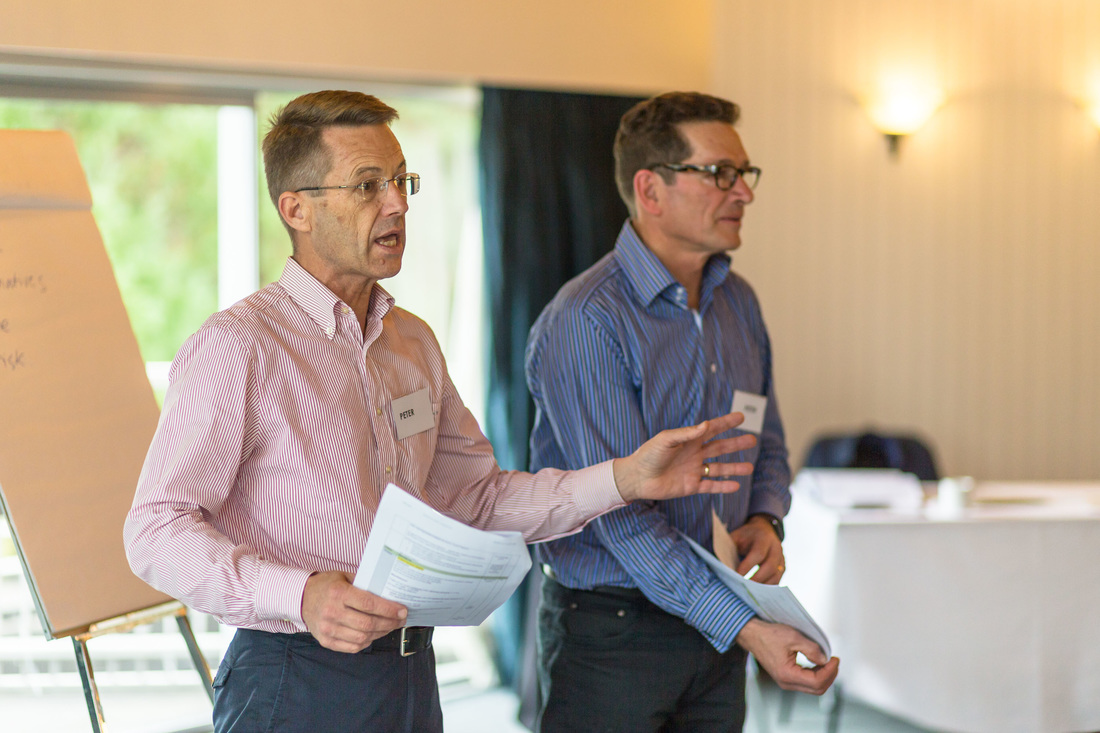
On several occasions recently, I have had the privilege of seeing this operate at yet another level: a team-based delivery model whereby two presenters work together to share insights, answer to questions and learn from the assembled group. The positive response from attendees to a team-based model was a sight to behold. The levels of engagement; esprit de corps; and, quality of learning amongst the assembled group (not to mention the banter between the presenters) really lifted the learning experience. The following examples provide windows into two of my recent experiences, and then the learnings to emerge follow.
Rural Governance Development Programme
Earlier this year, Peter Allen of Business Torque Systems invited me to join a team to refine the five-day Governance Development Programme (a popular course previously run by DairyNZ for dairy businesses) to suit all of rural businesses. In updating the course, a decision was made to use a team-based delivery model, with two presenters working together with attendees. The hope was that this would provide better coverage of the material, as well as enabling attendees (directors, shareholders and chief executives of rural businesses) to a hear different perspectives as the course progressed. And so we jumped in...
Picture
We resolved to work from the front of the room together, sharing the speaking and listening roles...

Picture
We stepped aside, to check in and make adjustments... This ​picture, taken on the third day (of five—the course days are spread over a ten-month period so delegates can apply their learning in practice and bring questions and experiences back to the next session), captured us discussing a couple of 'in-flight' adjustments while participants worked on an exercise to improve their strategic decision-making skills in a boardroom setting.
Health sector board member development workshop
The second example relates to the delivery of a professional development session for the board members and executives of three primary health organisations (PHOs). They wanted a refresher on board effectiveness and strategy in the boardroom—topics dear to me. The organiser was keen on a two-person delivery model as well, which created another opportunity to explore and experience the effectiveness of the team-based model.
I organised to work with a trusted colleague, Murray. We know each other well and share a commitment to excellence but have slightly different styles. After introductions and scene-setting, we asked the group to tell us what they wanted to get from the session and to mention specific areas of interest. Then it fell on me to lead the first session (board effectiveness) with Murray chipping in regularly to help answer questions and share examples from his experience. The roles were reversed for the second (strategy) session later in the afternoon. Finally, we jointly ran an free-flowing plenary session to check all of the areas of interest had been addressed and answer any remaining questions.
Learnings
Feedback from the attendees (informal plus evaluation sheets) from both the rural course and the health sector learning session indicated that the double-teaming model works. Attendees said they got more from the session than they thought they might have gained had there been one presenter. They could listen to and tell stories to connect ideas with practice; ask similar questions and get a different (!) responses; and, they said they benefitted from tapping into a broader pool of knowledge and experience than what would otherwise have been possible.
One board member went as far as saying that the session was "the best learning session ever organised by <PHO-name omitted>", gratifying feedback indeed. The levels of trust and interaction in the room in both the rural course and the health sector session were also noticeably high. (Whether this is a reflection of what is being modelled from the front of the room or it is simply an expression of the delegates' innate character and desire to learn is open for debate!)
Where to from here? Though not without its challenges (working so closely together requires considerable planning and trust, for example), the early experiences have been positive. There is also a 'cost' of putting two people in the room. However, the benefits in terms of enhanced learning outcomes tip the balance in favour of the team-based model—especially for advanced topics and multi-day courses. The learning theorists are probably all across this, so I'll need to play catch-up.
If you have any experiences to share—positive or negative—I'd be keen to hear from you. Please respond by posting a reply or send me an email.
0 Comments
<<Previous
Forward>>

    Search

    Musings

    Thoughts on corporate governance, strategy and boardcraft; our place in the world; and other topics that catch my attention.

    View my profile on LinkedIn

    Categories

    All
    Accountability
    Artificial Intelligence
    Change
    Conferences
    Corporate Governance
    Decision Making
    Director Development
    Diversity
    Effectiveness
    Entrepreneur
    Ethics
    Family Business
    Governance
    Guest Post
    Language
    Leadership
    Management
    Monday Muse
    Performance
    Phd
    Readings
    Research
    Research Update
    Societal Wellbeing
    Speaking Engagements
    Strategy
    Sustainability
    Teaching
    Time Management
    Tough Questions
    Value Creation

    Archives

    December 2025
    November 2025
    October 2025
    September 2025
    August 2025
    July 2025
    June 2025
    May 2025
    April 2025
    March 2025
    February 2025
    January 2025
    December 2024
    November 2024
    October 2024
    September 2024
    August 2024
    July 2024
    May 2024
    April 2024
    March 2024
    February 2024
    January 2024
    December 2023
    November 2023
    October 2023
    September 2023
    August 2023
    July 2023
    June 2023
    May 2023
    April 2023
    March 2023
    February 2023
    January 2023
    December 2022
    November 2022
    October 2022
    September 2022
    August 2022
    July 2022
    June 2022
    May 2022
    April 2022
    March 2022
    February 2022
    December 2021
    November 2021
    July 2021
    June 2021
    March 2021
    February 2021
    September 2020
    August 2020
    July 2020
    June 2020
    May 2020
    April 2020
    March 2020
    November 2019
    October 2019
    July 2019
    June 2019
    May 2019
    April 2019
    February 2019
    January 2019
    December 2018
    November 2018
    October 2018
    August 2018
    July 2018
    June 2018
    April 2018
    March 2018
    February 2018
    January 2018
    December 2017
    November 2017
    October 2017
    September 2017
    August 2017
    July 2017
    June 2017
    May 2017
    April 2017
    March 2017
    February 2017
    January 2017
    December 2016
    November 2016
    October 2016
    September 2016
    August 2016
    July 2016
    June 2016
    May 2016
    April 2016
    March 2016
    February 2016
    January 2016
    December 2015
    November 2015
    October 2015
    September 2015
    August 2015
    July 2015
    June 2015
    May 2015
    April 2015
    March 2015
    February 2015
    January 2015
    December 2014
    November 2014
    October 2014
    September 2014
    August 2014
    July 2014
    June 2014
    May 2014
    April 2014
    March 2014
    February 2014
    January 2014
    December 2013
    November 2013
    October 2013
    September 2013
    August 2013
    July 2013
    June 2013
    May 2013
    April 2013
    March 2013
    February 2013
    January 2013
    December 2012
    November 2012
    October 2012
    September 2012
    August 2012
    July 2012
    June 2012
    May 2012
    April 2012
    March 2012

Dr. ​Peter Crow, CMInstD
© Copyright 2001-2026 | Terms of use & privacy
Photo from Colby Stopa
  • Home
  • About
  • Musings
  • Research
  • Contact