• Published on

    On boardrooms, digital mongrels and company performance

    Mike O'Donnell is a business manager, company director, family man and self-confessed techno-geek who writes a weekly column for the Dominion Post. Mike's comments can be provocative, cynical, irreverent and highly insightful—sometimes in the same column. Almost always though, his comments are entertaining and relevant. His latest contribution, which recounts a speech he delivered at the recent Institute of Directors annual conference, fits in the inspired and relevant category. Here's a piece from the column:
    I see the role of directors as being threefold. First, to select and appoint the right CEO for the company. Second, to provide meaningful governance on issues like solvency, risk, remuneration and health and safety. Third, to help set a strategic direction that will deliver growth and help monitor its implementation.
    In three points, Mike summed up the role of the board really well. However, I would alter the sequence, because the third point needs to come first. Without purpose and strategy, there is not much for the CEO to do, or the board to govern.
  • Published on

    Actions and consequences should go together

    Another entry was added to the rather sad chronicle of Ross Asset Management yesterday. David Ross, the founder, has been struck off by the New Zealand Institute of Chartered Accountants. It is pleasing that the Institute's rules have such provisions. Membership of a professional body should be obligatory for all practitioners, to provide consumers of the services rendered with confidence. However, it should not be a right. It should be reserved for those that satisfy specified entry criteria (through formal assessment)—and continue to do so. Membership and responsibility go together, including a commitment to on-going professional development and the upholding of professional standards, amongst others.

    The Institute of Directors in New Zealand (IoDNZ) is partway through a process of professionalisation, to bring governance into line with other professions. The chartered director proposal includes a tiered membership structure and a commitment by members to the maintenance of standards and on-going professional development. This is timely, as some directors have been in the news in recent months, for all the wrong reasons. Members will vote on the proposal at the upcoming AGM. 

    The IoDNZ proposal seems to be sound, except the accountability component is somewhat weak. Actions and consequences should go together. The IoDNZ constitution includes provisions to strike off members who act fraudulently or bring the Institute into disrepute. However, if the IoDNZ is seriously committed to upholding governance standards, then a mechanism is required whereby members are held accountable for their ongoing compliance with the proposal. If a member fails to demonstrate a commitment to on-going professional development for example, then a downward adjustment of membership level may be appropriate. I hope members see fit to consider the inclusion of such an accountability amendment before the proposal is adopted.
  • Published on

    Crowdsourcing my doctoral research: can you help?

    My doctoral research, to discover how boards can influence company performance outcomes, is continuing a pace. Currently, I have one more board meeting to observe, after which the twelve month cycle of boardroom observations will be complete. This major milestone signals a change in emphasis, towards data analysis, the testing of ideas and the drawing of conclusions—oh, and writing the thesis document! Although it'll be tight, I hope to complete the thesis and submit it for examination by Christmas.

    The purpose of this post is to request some feedback please, to help me make sense of some emerging ideas. I'm mulling over a new conceptualisation of governance, one that challenges the widely-held view that governance and management should be kept separate. As alluded to in the paper I presented at ICMLG recently, the concept has the board fully engaged in the development of strategy.

    The question that I would like some feedback on is: What underlying powers, behaviours and concepts do you think are necessary for such a conceptualisation of governance to work well? Five are mentioned in the paper, but you may have some other suggestions based on your experience. If you would like to share your ideas (supported with examples if you can), please contact me!
  • Published on

    The contribution of boards to company performance

    A blog article, with the catchy title How to double your company's profit: begin by refreshing your board of directors, appeared in Huffington Post today. The article is helpful because it highlights the importance of having a diverse board. Here's a snippet: 
    Imagine instead a board comprised of 10.7 people (the average board size) where directors of a variety of ages bring the relevant expertise and leadership experience that is needed, and have grown up in various regions of the world, in a variety of socio-economic conditions. Such a group, some with academic credentials or particular subject mastery, others having built and led innovative ventures, climbed the ranks of multinational corporations throughout the world, having life experiences in emerging markets, and playing and working with the latest technologies from the time they could crawl, can truly envision what's possible and also know what questions to ask management.

    With such boards of directors, multinational corporations will finally unleash their greatest potential, attaining exponential profits while achieving peace and prosperity.

    Korngold makes some great points—she is amongst an increasing number of people to suggest that better governance leads to better performance. Diversity in the boardroom is a good thing. However, a couple of her assumptions deserve comment:
    • Korngold suggests that diversity in the boardroom is causal to increased company performance. Sorry, but we don't know that. Diversity of thought and experience within a group has been associated with the making of better decisions (because a wider range of options and ideas are explored). However, placing a diverse group of experienced and effective directors together to govern a company does not necessarily lead to high performance. There are many other internal and external factors, some of which are well outside the control of the company, let alone the board.
    • Korngold asserts that increased performance occurs when board members "truly envision what's possible and also know what questions to ask management". These are important attributes of effective boards, however there is much more to it. In addition to being fully engaged in the process of governance (implied in Korngold's comments), boards need to be forward facing and actively involved in the development of strategy. Even then, increased performance may not follow.

    Governance is complex, socially-dynamic and every board is unique in some way. Things that work in one instance may or may not have the same effect elsewhere. Notwithstanding these comments, I enjoy reading Korngold's articles. They add much richness to the discourse.
  • Published on

    Understand your business better: SWOT 2.0

    Image description
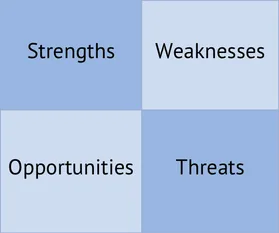
    Do you use the SWOT tool in your organisation as a precursor to the strategy development process? SWOT (Strengths, Weaknesses, Opportunities and Threats) is a useful tool, but it has fallen out of favour in recent years, as organisations have struggled to deal with the 'laundry lists' generated during SWOT sessions. Also, other tools have become popular. 

    Many people have told me that SWOT is old (it is) and irrelevant (let's discuss this), and that newer tools do a better job. I agree, to a point. The trouble with most SWOT analyses is that they only go half-way. Identifying those internal and external things that are helpful or harmful to your organisation's success is useful if and only if something is done about them. The lists generated from SWOT sessions can be long, and complementary items often appear on each side of the ledger. Creating and resourcing effective action plans from such lists is simply too hard in most cases.

    One modification that I have used for a couple of years now is to add a 'so what?' question to the analysis after the lists are assembled. For each strength, weakness, opportunity and threat, think about the impact or consequence of that item on the organisation—by asking 'So what?'. If the impact or consequence is high or significant, create an action to maximise (strength or opportunity) or minimise/mitigate (weakness or threat) it. If the impact or consequence is low or insignificant, simply put it to one side for now. This simple addition (let's call it SWOT 2.0) helps teams prioritise those things things that actually matter. It has transformed the usefulness of the tool (and the quality of the strategy) in every case that I am aware of.

    One last word though: don't be lulled into thinking that SWOT, SWOT 2.0, PESTEL or any other tool is a panacea. They are just tools. They need to be used correctly, for the purpose for which they were designed. Often, it is wise to use a couple of tools, to ensure you get a well-rounded picture to base your strategy development work on. 
  • Published on

    Purpose before strategy

    One of the big temptations in the strategy development process is to jump into 'answer' mode too early. Jumping quickly to conclusions is a real and understandable temptation. We live in a high-paced world and we want answers. We want plans to achieve our goals—the sooner the better. 

    Many companies start the strategic planning process by jumping to the determination of goal (what do we want to achieve?) before leaping head-long into the question of how the goal will be achieved (what is our strategy? or what is our plan?). Sometimes, this process is informed by an environmental scan. Generally, the strategies that emerge from such processes are ill-conceived and readily defeated. I've lost count of the number so-called strategic plans that follow this pattern.

    The crucial element that is often missing from the strategy development process is purpose: an answer to the 'why' question. Spending time with shareholders (or, their representatives at least), with customers and possibly with a wider group of stakeholders, to work out why the organisation exists is time well spent. A drug company needs to know it exists to defeat cancer (for example) long before any strategies to develop medications or build grand marketing plans are considered. People get onboard with causes not things. Imagine how different things might have been if Martin Luther King had uttered "I have a plan" in 1963.

    'Why' needs to come before 'what', in business and in research. Owners, boards and trustees of not-for-profit agencies need to own the 'why' question and doggedly pursue a response. To ignore this maxim is to simply do stuff without due reason or cause—and that's hardly conducive to the building of a sustainable business or to conducting effective research.