• Published on

    On the sources (and a possible remedy) of so-called "governance failure"

    The much-storied scandals at FIFA, HSBC and Toshiba have highlighted a plethora of weaknesses in the way large companies are led and run. Fingers have been pointed and blame apportioned. Management has copped a fair bit of flak, but the board has not been immune either. While the media has had a field day, finger pointing and broad statements provide little comfort to those in pursuit of long-term performance. Remedies are required.
    Reputability has studied a number of failures recently(*), in pursuit of remedies. The analysis identified nine prominent categories of weakness, the first six of which were influential in the majority of failures:
    • Board skill and NED control
    • Board risk blindness
    • Defective information to or from board
    • Leadership on ethos and culture
    • Risk from incentives
    • Risk from complexity
    • Risk glass ceiling
    • Charismatic leader
    • Poor crisis management
    When these factors are considered holistically, the stark implication is that failure appears to be associated with board weakness in at least three areas (engagement, strategy and risk). If boards are to make effective contributions, these weaknesses need to be resolved. And therein lies a challenge: a return to first principles, and a different conception of corporate governance is likely to be necessary. Will boards embrace such a change in pursuit of better business performance? Let's hope so.
    (*) The full Reputability Report, entitled Deconstructing failure—Insights for boards, is available here.
  • Published on

    The Toshiba case: Is it time to re-think our understanding of corporate governance?

    These seemingly innocuous statements are telling: Fix the compliance and the problem will be fixed. Yet history (Olympus, HSBC, FIFA, amongst many others) shows otherwise. Neither the 'monitor and comply' conception of corporate governance, nor the 'advise and monitor' variant espoused by many corporate governance codes and directors' institutes have achieved the desired outcomes. Yet, many boards dogmatically pursue such conceptions. 
    The problem seems to be more fundamental. The contemporary conception of corporate governance seems to be flawed. Consider these statements, which highlight the problem:
    How many more failures will it take to realise that additional layers of regulation and compliance-oriented boards that operate as policemen don't actually add value? How many more failures will it take to acknowledge that a new understanding of corporate governance and appropriate board practice might be appropriate? Emerging research seems to suggest that when boards adopt a strategic orientation, and corporate governance is re-conceived as a value-creating mechanism, increased performance is not only possible—it is potentially sustainable. Please get in touch if you'd like to know more.
    The now very public overstatement of profits at Toshiba (approximately US$1.22bn over six years) has led to the downfall of the chief executive, Mr Hisao Tanaka (below), and seven other senior managers, all of whom were also board directors. The share price has taken a 25 per cent hit and the company's reputation is in tatters. What a mess. At least there is a modicum of accountability and remorse, something sadly lacking in many other cases including HSBC and Lombard Finance
    Thankfully, people have begun thinking about what needs to change. So far, the response has followed a predictable course: The possibility of appointing independent directors to replace the disgraced directors has been mooted. Will this structural response be enough to fix the problem? Maybe, but I'm not convinced. Compliance responses rarely lead to sustainable change. (The compelling case is Sarbanes–Oxley: created post-Enron, it did little to prevent the GFC.) 
  • Published on

    On diversity: How many is too many, and does it matter?

    Calls in support of appointing women as corporate directors have proliferated in recent years: the stated view being that the presence of women around the board table can improve decision quality and, potentially, business performance. Some legislatures have supported these calls by implementing quota systems. Many (but certainly not all) boards now count at least one female amongst their number.
    Anecdotal commentaries suggest that the level of attendance, engagement and discussion quality improves after a woman is appointed to a board. This is good, but another question lurks around the corner: If one capable women makes an impact and two more so, is an all-female board better still—or can we have too much of a good thing? Might an all-female board be as problematic as a board comprised only of men?
    I've seen some great all-male boards, some great all-female boards and, sadly, some rather ineffective diverse boards in action. That a diverse range of options are explored, independence of thought is displayed and that directors make considered decisions seem to be more important considerations than the physical composition of the board. Thankfully, the rhetoric is starting to mature along these lines. Hopefully director selection processes will soon follow, such that the qualities possessed by directors and the way they work together in the boardroom are the main considerations. Then, the gender (or any other diversity attribute) of directors should matter no more. Might this offer a viable path forward?
  • Published on

    Speaking & advisory tour to UK & Eire—programme is filling fast

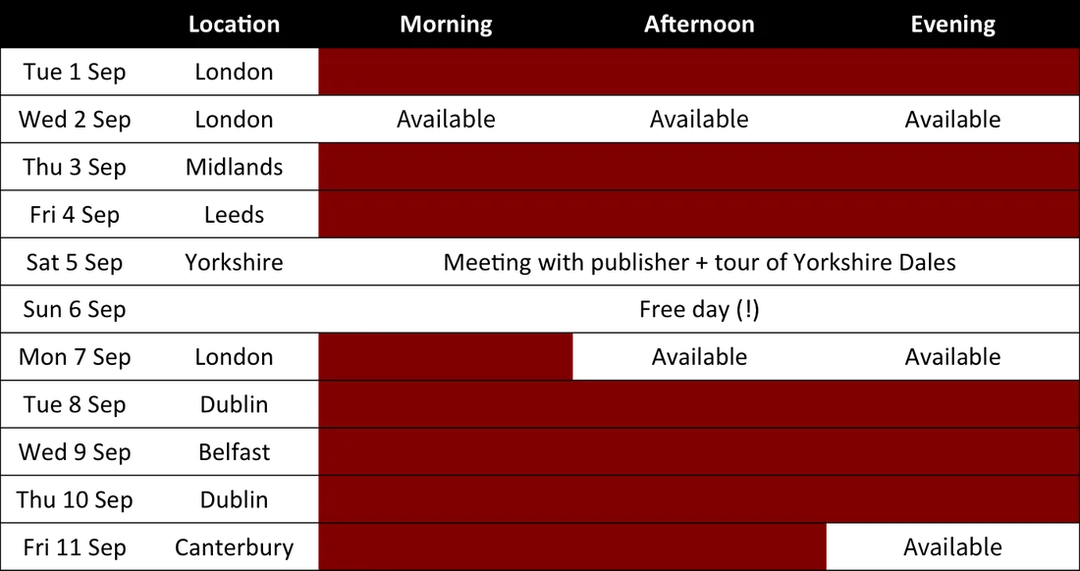
    Wow, that was quick! Six days ago, plans for my Spring speaking and advisory tour to the UK and Ireland were 'starting to come together'. Now the eleven-day tour—to discuss corporate governance, value creation and board practice topics—is nearly full subscribed. Thank you! Three masterclasses, four 'general' speaking engagements, a masters-level lecture and several private meetings are confirmed on the programme. (Details of the 'public' events will be published by the event sponsors in due course.) In addition, two parties have requested planning meetings to discuss future advisory or speaking engagements, to occur in early 2016. If you think you might want to book me but want to talk about it first, that's entirely fine. Just let me know.
    As of today, just one full day (2 Sep) and one part-day (7 Sep) remain available to be booked. I'll be in London on both days as you can see. If you are based in London (or the home counties) and you want to book a meeting or speaking engagement, please get in touch soon--before it's too late!

    Picture
  • Published on

    Success attributed to board: Lessons for all

    How valuable is a board of directors to the performance of the business it governs? Does it influence business performance; or does it act as a policeman, "simply" monitoring the chief executive; and, do we even know? Many have attempted to answer this question. More often than not, the responses have been based on statistical analyses of secondary data (surveys, questionnaires, public data). Descriptions of what actually occurs in the boardroom typically remain hidden. Insights from direct observations of boards in action or from first-hand interviews are rare, so it pays to take note when they become available—as occurred when Nigel Bamford, chief executive of fireplace manufacturer Escea went on record this week. His comments, reported here, provide some interesting insights for boards to consider:
    The Bamford interview provides a much-needed glimpse into the boardroom of a successful company. However, and thankfully, the Escea experience is not unique. The insights are consistent with emerging research about what boards need to do if they are to exert influence on business performance. Consequently, important questions for your own board to consider include:
    • The Escea board meets monthly, for two hours per meeting. Despite this small amount of time spent together, the board manages to monitor past performance and look ahead. This suggests that the chairman has a disciplined approach to meeting protocol, and that the board has at least one eye on the future success of the business.
    • The board is comprised of directors with "a whole range of different perspectives and different disciplines". Decision quality appears to have benefited as a consequence.
    • That the board is comprised of three company founders and two external directors suggests that technical independence (as promoted in many corporate governance codes) is not necessary for board effectiveness including effective decision-making.
    • The emphasis in Bamford's comments is on debate and diversity of thought. Gender and other forms of observable diversity were not mentioned.
    • The Chief Executive expects the board to 'add value' by challenging proposals and driving the decision-making process.
    • A one-size-fits-all approach to board practice and corporate governance is not appropriate.
    • While the Escea board looks ahead, strategy was not explicitly mentioned. Whether the board works with management on the development of strategy, or critiques strategic options and proposals presented by management is unclear.
    Bamford's final comment is perhaps the most telling. "In time, a board is useful for all businesses of reasonable scale and ambition." Two important lessons emerge from it:
    • Formalised boards and board practices are helpful once ambitious (growth oriented) businesses have achieved reasonable scale, and if attention is focussed on the future.
    • Formalised board structures and practices are not always necessary (beyond statutory requirements), especially very small businesses where the same person or group of people both own the company shares and manage the business. Meet your statutory requirements but don't burden the business with unnecessary corporate governance and board practices. They are not required.
    • How might the insights discussed here help your board lift its performance in pursuit of business success and value creation?
    • Might a discussion at your next board meeting, to consider the appropriateness of your current board practices be useful? 
  • Published on

    Big ideas and goals are insufficient, strategy needs to a purpose

    The seemingly innocuous statement, that business success is predicated on creating an effective strategy to achieve a goal, seems to have a fairly broad following amongst company leaders and directors. However, the reality (of what is needed to achieve business success) is somewhat different, as Ken Favaro points out hereFavaro's commentary is helpful, but only to a point. His suggestion that a 'big idea' is necessary to success is not particularly reassuring. What of all the other successful companies out there? How did they succeed if they didn't have a singular 'big idea', or even several 'medium ideas' for that matter? There's got to be something else that drives success.
    The consistent theme that I've observed amongst companies that have enjoyed long-term success is that they have had a clear sense of why they exist—a purpose. This is because people get behind causes, not things. Sinek's 'golden circles' thesis is the best annunciation of this that I have seen.
    Boards and management teams grappling with strategy and the future of their business should watch Sinek and use his ideas to re-think their business. Those that do so have told me it's the best 18 minutes they have invested for a long time, far better than any search for a 'big idea'.