• Published on

    Thank you for your interest in my work!

    I'm writing to express gratitude for your interest in my upcoming talk at the British Academy of Management conference. That my research to explain how boards can influence the achievement of company performance outcomes has stimulated such interest, even before it is completed, has amazed me. Thank you. 

    My paper will be on presented on Thu 11 September. A copy will be posted here afterwards. If you are planning to attend the conference and would like to meet between sessions, over lunch or in the evening, please contact me via Twitter or email. Also, I'll post summaries and reflections on this blog throughout the BAM conference, to give those that cannot attend an insight into what was discussed. 

    To those people that have asked questions about my research: I will send a private reply. To those that have asked about meetings and speaking engagements in London and elsewhere: my schedule is now full (sorry!). However, I will be back in the UK and Europe in November. If you'd like to meet me then, please contact me to make an arrangement.
  • Published on

    Learning to enjoy the eye of the storm

    In seven days time, I expect to be at least 35,000ft above the north-west reaches of the UK, nearing the end of a journey from Auckland, New Zealand to London, England. The reason for my trip? I'm booked to speak at the British Academy of Management conference in Belfast. While in the UK, I'll also attend some meetings, and take a few days off with my wife who is travelling with me. The trip involves 40,000km of air travel; 24 hours of timezone change; and, a season change (from late winter to late summer and back).

    On the surface, it'll be a demanding trip. However, the trip may actually be a blessing in disguise: a time of relative calm sandwiched between two even busier periods. Here's what I've been up to in recent weeks:
    • Commenced a formal board evaluation (18-member board with many challenges and tensions)
    • Written a manuscript for a highly regarded journal (now being peer-reviewed)
    • Written an article for an online magazine
    • Delivered a couple of professional development courses
    • Facilitated three strategy development workshops
    • Reviewed the Company Directors Course material for the Institute of Directors 
    • Attended two board meetings
    • Added about 7500 words to my doctoral thesis

    A new list of actions to be completed before Christmas awaits my attention when I get home:
    • Complete the data analysis and thesis write-up (my stated goal is to submit the doctoral thesis for examination before Christmas)
    • Present the board evaluation report (the 18-member board)
    • Deliver three professional development courses
    • Attend a professional development course
    • Facilitate three strategy development workshops
    • Attend four board meetings

    Measured against these lists, the seemingly hectic trip, to fulfil a speaking engagement and attend meetings on the other side of the planet, might not be so demanding after all. In fact, the trip may be analogous to the eye of storm. My point? The here-and-now can seem pretty hectic. Long-distance travel can be pretty demanding. However, if one steps back and looks at the big picture, periods of relative calm become visible amongst the busyness. Seek them out and enjoy them, for the next period of busyness lies in wait. 
  • Published on

    "Big firms fail to match growth of economy"

    Bryan Gaynor shone the light on a very important problem today—that many large firms in New Zealand simply are not growing in line with the growth of the economy. In other words, they are going backwards. Gaynor's analysis is insightful: to lose ground when the flow is good suggests that something is amiss. This raises several important follow-on questions: 
    • What have the boards of these firms been doing over the last few years?
    • Why have the boards not held the Chief Executive accountable for performance?
    • Who is actually in control and who is driving strategy? (It's unlikely to be the board, from what I can see.)
    • What changes are required to get these firms, and the economic contribution they make, back on track?

    While the issues before each firm will be unique, there are some constants:
    • The board is responsible for business performance.
    • The board needs to ensure that an appropriate corporate strategy is in place
    • The budget is not the strategy, it is a measure of progress.
    • The basis of performance should be achievement of strategy, not achievement of budgets.

    Hopefully, the boards of these firms will take stock, ask some quite tough questions, and make appropriate adjustments to get back on track. High company performance has many positive flow-on benefits beyond shareholder wealth, and these need to be realised if at all possible.
  • Published on

    I learnt a new phrase today: 'governance sects'

    The English language is constantly evolving, as we find new ways of describing things and expressing ourselves. Sometimes, words and phrases are helpful abbreviations of a new social phenomena ('selfie'). Other words and phrases convey a reasonably strong value judgement, like the one I learnt today:
    Picture
    The use of 'sect' to describe those that promote new ideas about boards and corporate governance, or suggest derivations or deviations from existing ideas, raises the stakes. According to my dictionary a sect is "a group of people with somewhat different religious beliefs (typically regarded as heretical) from those of a larger group to which they belong".

    Why some people find it necessary to promote aspects of the bigger picture as being the picture is beyond me. If the purpose of a board is to optimise company performance in accordance with the shareholder's wishes, and corporate governance is the mechanism through which the board seeks to achieve this, is this not where our effort should lie?
  • Published on

    What is it with IT governance? 

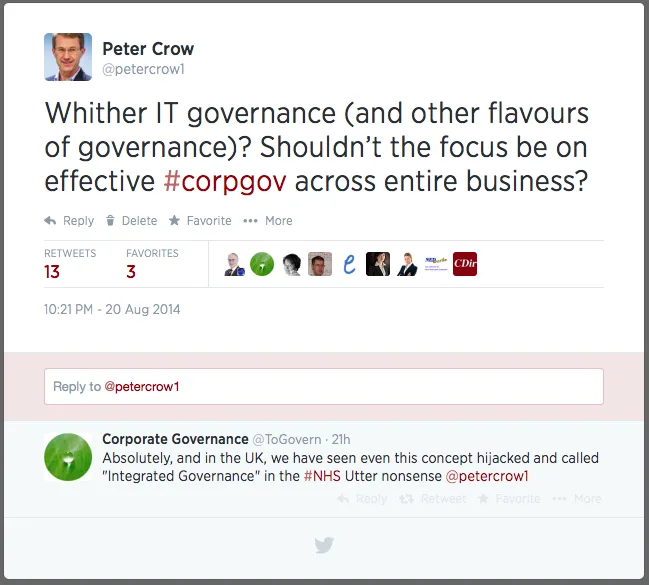
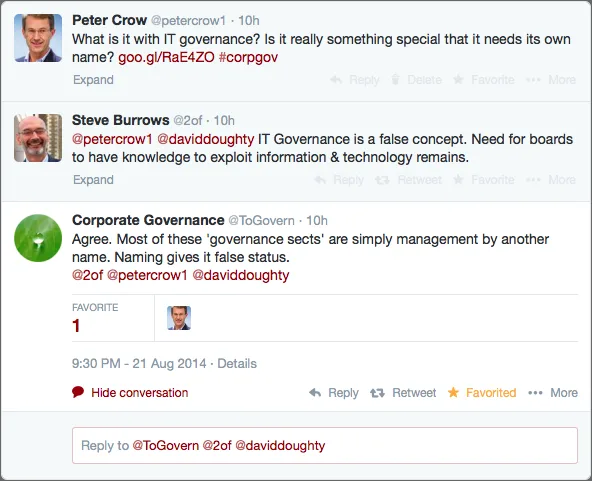
    I got a bit frustrated yesterday. Three messages arrived from people promoting IT governance—heavily. The problem wasn't so much the topic per se, but rather the brow-beating that accompanied it. According to the messages, companies need IT governance, and it is important for CIOs to be appointed to boards. Really? The board's responsibility is to think about the company as a whole—to set strategy; to make decisions; and, to monitor strategy implementation to ensure goals are achieved. I couldn't find a credible explanation as to why IT governance was crucial, so decided to ask the question:
    Picture
    To my surprise, the question was retweeted to tens of thousands of others. Several influential people replied privately to say they were puzzled. @ToGovern replied publicly, as you can see. As I've thought about it some more, I've found myself wondering why people find it necessary to grab concepts, re-name them and re-apply them, often inappropriately. For example:
    • Why isn't the process of managing the implementation of a major technology system called 'project management' any more? Surely the board would be more interested if the Project Manager provided a straightforward report to each board meeting, to enable it to monitor and verify the implementation of its earlier decision to approve the project investment?
    • If technology looms large within a strategic priority, or has the prospect of becoming a disruptive influence on the company's business model, why wouldn't a board co-opt a specialist advisor (or several, if the topic is sufficiently complex) for a period, to help it work through the issues and reach an informed decision?

    The board's interest in the first example is verification, and strategic decision–making in the second—both of which are important parts of the corporate governance remit. The information feeds to inform these matters are just that, information feeds. If IT professionals want boards to understand what they do; what they want to do; and, what the emerging trends are, they need to think and speak like boards do. Proposals need to be in the context of approved strategy. Project and management reports both need to demonstrate progress towards agreed corporate goals. Market reports needs to demonstrate relevance to, or impact on, the corporate strategy. If managers write their board reports and provide information in this way, and advisors provide sound advice, directors should have no problem asking appropriate questions in order to understand the issues. If this happens, technology-related topics can be handled by boards in the same way as any other major agenda item, can't they? 
  • Published on

    We all get stale. How do you freshen up?

    One of the big challenges of tackling a major project relates to vitality. When we set out to tackle something new, be it a hobby, a job, a long walk, a marriage or something other 'project'; we generally start with much hope and anticipation. However, over time, we can get a little stale, as the rigours and routines of the daily grind take precedence in our mind over the goal that we set out to achieve. Sound familiar?

    Regular readers will know that I've been working on a major research project in early 2012. The good news is that the end is now in sight. However, there is still much to do and the risk of getting stale is never far away. One of the techniques that I have used to keep fresh is to change the focus temporarily—by helping others solve gnarly real-world problems. Today for example, I had the privilege of working with a group of directors and a manager—helping them wrestle with their business, to try to get some clarity around core purpose and strategic priorities. The Chair's closing comment, "the morning was incredibly worthwhile", suggested that progress had been made. Next week, I have an independent review of another board to do. That board has some interesting challenges around focus; role; and, interaction with the Chief Executive.

    Small 'side' projects keep me mentally fresh. They get me out of the office and away from the routine of the research. Sitting with real people, and helping them wrestle with real problems, is so invigorating. Crucially, when I return to the research, I feel sharper and seem to work more effectively. How do you freshen up?