• Published on

    Effective boardroom practices: Dispatches from Singapore

    ​Nearly fifty chairmen, directors and company secretaries from around South-east Asia, the Middle East and Northern Africa gathered at the Ritz–Carlton Millenia Hotel in Singapore this week for The Boardroom Agenda conference. Delegates received presentations, shared stories and debated issues over two days (23–24 November), under the Chatham House rule. I had the honour of contributing to the discussion on the second day. Here are some of the takeouts:
    • Neal Cross, Managing Director and Chief Innovation Officer at DBS Bank provided a stirring keynote presentation to kick off the day. Disarmingly frank in delivery, his topic Fostering innovation in the boardroom was both challenging and well-received. Cross asserted that banks simply must innovate, and radically so, lest their market collapses around them as fintechs and large technology companies (read: Google, Amazon, Apple, others) eat the bank's lunch. He then outlined the DBS approach to innovation, which includes a three-day 'hackathon', whereby teams of staff are set up to create new product ideas. The resultant ideas are pitched to the board, and funding is provided to commercialise the best ones—entrepreneurship in action.
    • Raoul Chiesa, Board Member on the Italian Association of Critical Infrastructures delivered a wake-up call to delegates. Speaking straight off a flight from Europe, Chiesa, an expert of information security matters, summarised the history of hacking and the crucial need for boards to take information security seriously—all with some powerful (and quite alarming) case studies and real-world examples. Delegates were amazed at the scale of the problem and the material risk to commerce that 'the bad guys' present. The cyberthreat is widespread and poorly understood, especially in boardrooms. The message was clear: boards need to get up to speed, by receiving presentations and updates from experts; asking probing questions; taking a strategic view of risk; and, empowering the CEO to act.
    • The pre-lunch session took the form of a panel discussion and dialogue with delegates. I joined Ralph Ward at the front of the room. A wide range of topics were explored including the merit of codes of conduct; diversity in the boardroom;  the conundrum of balancing conformance and performance; confidentiality; conflict management; the conduct of effective board evaluations; and, the difference between so-called independent directors and independence of thinking. Delegates seemed to appreciate the candid responses from panelists, including recognition that no one-answer-fits-all; best practice often isn't; and that the work of the board can be messy.
    • After lunch, delegates attended one of two streams. I chaired the Board Insiders one. Dr Lim Lan Yuan, a Singapore-based business and law scholar and company director spoke first. He managed to squeeze forty years of experience into a thirty-minute talk. It was a sight to behold. Delegates were enthralled with his summary of how boards should work; how they actually work (or don't); the importance of a clear division of responsibility between board work and management activity; the importance of the board undertanding the business of the business, strategy and market trends; boardroom dynamics; and, anecdotes of associates that messed up (badly) and went to jail. That Dr Lim was able to move seamlessly between theoretical concepts, practical recommendations and real-life stories as he spoke helped the delegates gain considerable value from the talk. The only person who struggled with his commentary was me: Dr Lim covered off several of the points that I was going to discuss in the following slot. Consequently, a few on-the-fly adjustments were needed to extend the discussion to related areas of interest (see pic below). That the delegates heard similar stories and recommendations from two different speakers with different cultural and business backgrounds was hopefully encouraging—and supportive of the notion that 'good practice' is good practice almost anywhere.
    • The final session of the day was a 'deep dive', whereby delegates gathered around one of two tables to consider a table-question and to share experiences. One table was asked to identify factors that contribute to both good and bad dynamics in a boardroom, and the other was asked to discuss how a board should function in the event of a major crisis. The groups had 30 minutes or so to wrestle with the assigned question and then report back. The insights shared were great, and the good-natured banter demonstrated that the delegates had built a good rapport with each other. Thank you to Dr Lim and Curtis Chin who moderated the table discussions. You made my job of session chair very straightforward.
    • The conference was organised by marcusevans. Their people did a great job, both in the weeks leading up to the conference and at the venue itself. If you get the chance to work with them, take it.
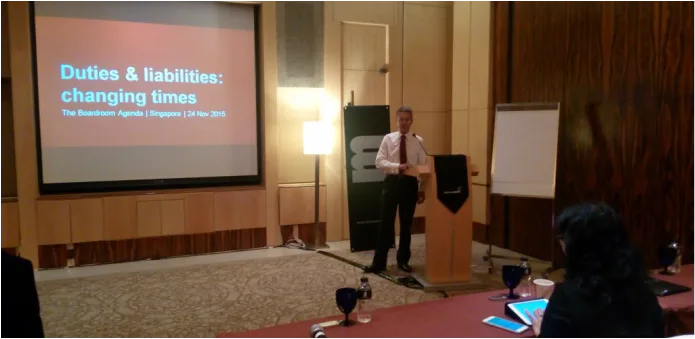
    Picture
    ​I've come away from the conference with the impression that the quality of corporate governance and board practice in Asian and Middle Eastern economies is rapidly improving. Overall, the hunger to improve board effectiveness was plain to see, as was the desire to learn from those with experience gained elsewhere (if the many conversations, requests to return and business cards in my satchel are any indication). However, care must be taken to ensure that models and frameworks in use in the Anglosphere are not blindly implemented in this region. Such colonialism is unwarranted and patronising, and it may be culturally demeaning as well.
  • Published on

    The boardroom agenda: Raising the bar on board effectiveness

    I will be in Singapore early next week (23–25 November) for the "The Boardroom Agenda" conference at the Ritz-Carlton Millenia. The attendance list includes senior chairmen, directors, company secretaries and chief executives from across Asia and the Middle East.
     The main aim of the conference is to 'raise the bar' on board performance and take the board's effectiveness to greater heights. In addition to five plenary presentations, two parallel streams (Board Insiders and Council, and Board Guardians) of cases studies, mini think-tanks and deep dive sessions are scheduled. The third day is dedicated to an optional masterclass workshop.
    My main contributions will be on Day Two. I will be a panelist (The Board Governance Dialogue); delivering a presentation (Responding to the re-emergence of director's duties and liabilities); and, chairing the Board Insiders and Council stream. ​For more information:
    ​Summaries of important insights will be posted here.
    Finally, if you are in Singapore on Mon 23 or Tue 24 and wish to meet privately to discuss other matters of interest, I am available to do so over dinner. Please get in touch if you want to take advantage of this.
  • Published on

    Governing Apple is nothing like governing a fledgling company

    Image description
    What is it with corporate governance? Thirty years ago, the term hardly rated a mention in business magazines—let alone general conversation. Now, corporate governance is seen by many (tacitly at least) as a panacea for all manner of corporate ills and director recalcitrance. The pursuit of best practice models (the one-size-fits-all approach) has become commonplace, even though the operating context of and challenges faced by small and medium companies are fundamentally different from those of publicly listed corporations. 
    Mak Yuen Teen, an associate professor of the NUS Business School and corporate governance expert thinks the one-size-fits-all approach is myopic and has just gone on record on the matter. Furthermore, many commentators, regulators and serving directors seem to have lost sight of Sir Adrian Cadbury's commentary, that corporate governance is primarily about the performance of the business. My experience, in research and as a serving director bears this out.
  • Published on

    Insights for boards, from a learned gentleman one Friday afternoon

    ​I was party to a fascinating conversation on Friday evening, with a gentleman—in the full sense of the word—in the lobby of a comfortable hotel in Lisbon, Portugal. The gentleman, a learned business professor, advanced in years but razor sharp of mind, was asked to comment on the Portuguese political situation, particularly as it related to the recent election and the selection of a new Prime Minister.
    ​After a considered pause of some twenty seconds or more, and the repeated stroking of his furrowed brow, he responded. Speaking in somewhat broken but ultimately capable English, the professor said "Aah, the situation is interesting, very interesting. We have many challenges; Portugal needs strong leadership."
    The professor went on to describe several challenges and difficulties, including that the highest polling party lacks the numbers to nominate their leader as Prime Minister and govern by majority. A complicating factor is that the President of Portugal will soon complete his term. The situation is unstable. If it cannot be resolved quickly, a coalition of minor parties including an extreme leftist party may try to usurp power and turn away from the gains made in recent years. The professor suggested that the main casualities will be the economy and the wellbeing of the people. The small audience of four leaned in as the professor spoke, enthralled by the palpable intensity of the situation.
    ​The parallels and lessons for companies, and boards in particular, are stark. 
    ​Boards that are not united in purpose cannot hope to lead the company they are charged with overseeing effectvely. Similarly, chief executives without a clear mandate to lead risk stasis. Those that run agendae in variance to agreed priorities or strategies put the future prosperity (and, potentially, the viability) of the business at risk. 
    ​In society, democracy has it benefits, but only to a point. When a group of people—be it the electorate, a group of executive managers or a board of directors—can't agree, the organisation can't hope to compete effectively or make progress towards value creation goals. As with the Portuguese election result, such situations in business are not sustainable. Strong leadership is required, from the top, to break the deadlock.
    ​As we parted ways, the professor graciously invited me to return to Portugal, both to spend more time with him and to share insights with business leaders. If the quality of our brief exchange is any indication of what might be possible in a wider context, I look forward to that day, and very much so. Thank you professor.
  • Published on

    ECMLG'15: On cyber defence and leadership

    ​The second day of the 11th European Conference on Management, Leadership and Governance opened with an outstanding keynote delivered by Lt. Col. Paulo Nunes of the Portugese Military Academy. Nunes is the Programme Leader of a NATO-sponsored multinational cyber defence education and training (MN CD E+T) project (click for more details).
    The digital and physical worlds are, increasingly, being integrated—to the extent that some would suggest the existence of a blurred reality. 'Cyber' is a red-hot topic in both the business and military worlds, to the extent that it has become the frontline of various attempts to achieve both legal and illegal political, military and economic objectives. Nunes reported that the biggest weakness in the system is people, the human firewall.
    The MN CD E+T project has been commissioned to design and implement an integrated approach to increasing awareness and providing training at the nation, NATO, EU and business levels to prepare, detect and respond the various weaknesses and threats. This includes work to determine expected behaviours and desired operational outcomes, and then to develop and deliver appropriate learning systems. Seventeen nations are currently involved in the programme, with more enrolments expected in the coming months.
    If implemented well, the programme offers considerable benefits to businesses of all sizes and types. Boards and directors would be well advised to receive briefings and allocate time to think critically through the issues and implications.
  • Published on

    ECMLG'15: Performance evaluation systems for corporate directors

    Demands on boards to ensure desired company performance outcomes are achieved have led to increased scrutiny of directors and director effectiveness in recent years. Performance evaluation systems (PES) have emerged as a tool of choice to assess director performance. However, the influence of such systems on business performance is largely unknown.
    ​Marie-Josée Roy reported the findings of a recent Canadian study that examined PES closely, in an attempt to bridge the knowledge gap. Roy's survey-based study of 89 large Canadian companies identified three distinct types of PES (exemplar, formal, minimalist—definitions of which were provided in her supporting paper). The typology was based on descriptions provided by survey respondents. Her analysis revealed some interesting correlations, including that boards with an exemplar PES were more likely to be involved in important board roles of strategy and monitoring, and were more likely to be effective in these roles.
    While ​Roy's study was helpful in that it provided empirical evidence on board performance evaluation systems, it did not resolve the crucial question of how, in actuality, an effective PES might work. Survey respondents can (and often do) provide answers of convenience. Sadly, knowledge of whether any PES in use is actually useful (or not) for improving director and board performance remains largely unanswered. Other approaches to research, including longitundinal observations of boards in action and (probably) pyschological assessments are likely to be required if tangible progress is to be made. Even then, another even more vexing question—of whether improved board effectiveness leads to improved company performance—lies in wait.