• Published on

    Checking the big picture: Are we still on track?

    Picture
    The prospect of looking back on the year past at this juncture seems a little odd, even presumptuous, given five weeks remain in 2023. And yet, with the onset of the holiday season (Christmas, Hanukkah, Diwali, as relevant in your cultural setting), I have noticed minds are starting to turn; casual comments in my hearing indicate some people are starting to reflect on the year soon-to-be-gone; others upon what the future might hold.
    As someone called on to think broadly about organisational challenges and opportunities, and to share insights that might be helpful to helping boards govern with impact or realise organisational potential, I too, take time to ponder. To think about what has passed, what lies ahead, and how one can help is not only smart, it is vital—if one is to learn, make adjustments to stay on track and achieve goals and, over time, become a better person.
    Turn now to the person you see in the mirror. What did you set out to achieve in 2023? Did you set specific goals? If so, have you checked progress? Are you still on track? ​Have you taken into account changes in the environment around you and made adjustments, or have you pressed on in spite of changing circumstances? As a leader, you owe it to yourself—and all those you interact with—to check progress periodically and make adjustments if you have veered off track or lost sight of the goal.
    For the record, my goal for 2023 was audacious; to ensure every director and board I had the privilege of serving, globally, derived some benefit from the interaction. The goal was audacious because 'every' set a high bar; essentially, it left no room for slippage! Thankfully, feedback to date suggests I'm doing OK. Hopefully, the feedback still to come is consistent with that received through the year. If it is, I'll wrap up the year contented; tired but contented.

  • Published on

    Taking time to read and to think, to re-charge

    Picture
    Twice this week, I have been asked about my reading and thinking habits. One enquirer wanted to know much time I spend reading and pondering insights garnered from various authors; the other whether I schedule [slow] thinking time. 
    Although neither asked explicitly, both enquirers seemed to assume that quiet time and the notion of reading widely are important to me. And, indeed they are. But, why?
    The practice of reading serves, I think, two inherent objectives: to maintain currency with trends and developments, and to become a better person. The objective is not to become a technical expert capable of regurgitating data and ideas (ChatGPT can do that), but a more holistic thinker—one who discerns problems and opportunities, considers them from different perspectives, asks appropriate questions and draws relevant conclusions. More succinctly, someone who leads a reflective life.
    May I propose something? To philosophise is to breathe. In my experience, and that of others who I have been fortunate to interact with, the ideas that emerge from the practice of philosophising provide a solid foundation for that which follows. And yet many business leaders and board directors claim to be too busy to take time to ponder (think about) possibilities that might lie below the surface or around the corner. Quite why such a (seemingly) bedrock activity is neglected is a curiosity to me; high quality thinking is an antecedent of effective leadership and governance, n'cest ce-pas?
    When people I interact with, especially friends and clients, say they see a better me (someone who is on top of his game, is nice to be around and who offers relevant and considered advice), such observations tend to coincide with a period of reading literature (or other so-called 'brainy' books) and thinking deeply about the questions posed by the authors. While comments like this are gratifying, they serve a higher purpose: to remind me to make time, regardless of what else is going on around me.
    (And, in case you are wondering, my answers to the enquirers were, "About 12–15 hours each week" and, "Yes.")
  • Published on

    A journey, in thought and deed

    Picture
    When I was a boy, milk was free (I was raised on a dairy farm), but you could buy it in a glass bottle with a silver foil top (pasteurised but not homogenised) for four cents a pint at the general store. Television (once we got one, in 1969, to see the Apollo 11 moonshot) was a grainy, black-and-white experience, with a single channel available. You got to watch whatever the broadcaster chose to deliver across the airwaves.
    Now, milk costs several dollars a litre, but it comes in many different styles (blue, light blue, skim, lo-fat, full-cream, calcium fortified, lo-lactose and UHT—as well as products called milk that contain no milk at all, such as oat milk and almond milk, in a wide variety of packaging options). Television has changed too: from a take it or leave linear broadcast experience via rabbit-ear antennae, to a plethora of video-on-demand (streaming) options via the internet. 
    These are but two of thousands of examples that illustrate the onwards match of technology. Oh how life has changed, even in my lifetime.
    The onward march has also affected the way we communicate, not only personally with family and friends, but also with clients, suppliers and the general public as well. The notion of using a fountain pen to handwrite a letter, or making a toll call, seems quaint now—but some of us still value these moments. The emergence of social media has extended our reach in ways not thought possible twenty years ago. Sharing business cards, once commonplace, is now rare. If people want to contact me or learn about me, they tend check my LinkedIn profile (notice the assumption, that I have one), even before mentioning Google or asking about a website or blog. 
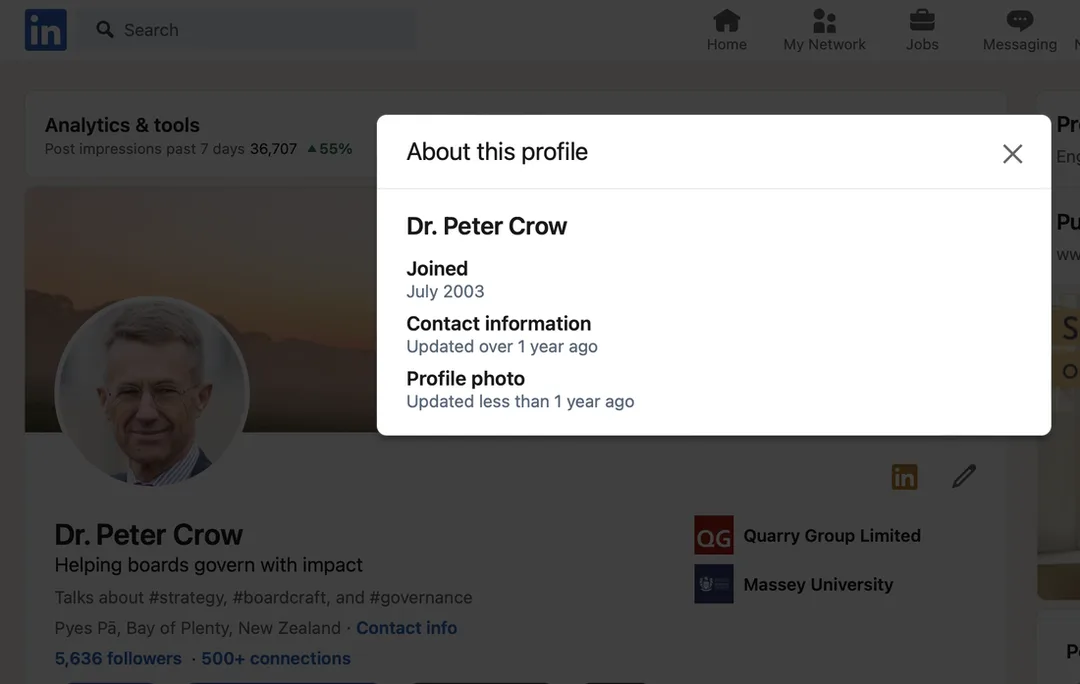
    And that brings me to the point of this muse, which is to share one aspect of a conversation with an esteemed company director, in the hope it might encourage others committed to serving the director community. Yesterday, I was asked about the role of social media in my business life, what channels I use and how long had I been using these. The first two questions were readily answered; the third took a little longer—because I needed to find the menu option!
    • Social media: LinkedIn is the only social platform I use. It complements my website and blog, as a forum to comment on topical issues, share articles written by other people and, candidly, reach boards and directors who make use of Linkedin as a trusted source of information. Previously, I used Twitter, but that did not last long for the platform was, I thought, little more than a soapbox for people to shout at each other. When I checked my LinkedIn profile, I was surprised to see I had first used the platform in July 2003, over twenty years ago and just three months after the platform was officially launched by Reid Hoffman!
    • Website: petercrow.com was first launched in November 2001, the month after I left paid employment and founded QuarryGroup, the global board advisory practice. Musings, the blog, came later, in March 2012. The websites were (and remain) online brochures, whereas the blog was created as a place to share my thoughts and test ideas while working on my doctorate. Since 2016, Musings has become a forum for a wider range of board and governance topics. Today, approaching 750 entries later, Musings is read widely, by a global audience.
    Thank you for permitting me to share my experience. I hope anyone considering using social media or a blog as a channel might be encouraged—not only to do so, but to stick at it over the longer term. My journey to date has been fulfilling; I have met thousands of people from many walks of life and, I hope, they have valued the interaction as much as I have.