• Published on

    Observations from interactions with 520 directors

    Picture
    Today marks the beginning of a lull following a busy programme of international and domestic commitments since early February. Over a 110-day period, I have spent time in Australia (four times), England (twice), the US (twice), Germany (twice), Ireland, Sweden and Lithuania—and at home in New Zealand; interacting with over 520 directors, chairs and chief executives from 19 countries. Formal and informal discussions at conferences, seminars, masterclass sessions, education workshops, dinners, advisory engagements and board meetings were instructive to understanding what's currently top-of-mind for boards around the world. The following notes are a brief summation of my observations. I hope you find them useful.
    Diversity and inclusion: These topics continue to dominate governance discussions in many countries. But, and noticeably, the discourse has matured somewhat over the last six months. The frequency with which the rather blunt (and often politically-motivated) instruments of gender and quota is mentioned is starting to subside, as directors and nomination committees start to realise the importance of diverse perspectives and options to inform strategic thinking and strategising. Long may this continue, as board effectiveness is dependent on what boards do, not what they look like.
    Big data and AI: What a hot topic! Globally, boards are being encouraged by, inter alia, futurists, academics and consultants to get on board (if you'll excuse the pun) with the promise that developments in this area will change the face of decision-making and improve corporate governance. Some assert that these developments will obviate the need for board of directors in just a few years. The directors I spoke with agree that these tools can help managers make sense of complex data to produce information, even knowledge. But these same directors have significant reservations when it comes to strategic decision-making. Automated systems are poor substitutes for humans when it comes to making sense of (even recognising) contextual nuances, non-verbal cues and other subtleties. Unless and until this changes, the likelihood that boards will continue to be comprised of real people engaged in meaningful discussion remains high.
    Corporate governance codes: The number of corporate governance codes introduced in markets has been steadily rising over the last decade. Most western nations, and a growing number of Asian and developing nations, have implemented codes to supplement statutory arrangements. Many directors and institutions around the world continue to look to proclamations that the UK is the vanguard when it comes to corporate governance thinking and related guidance: the recently-updated UK corporate governance and stewardship codes are held up as evidence of good practice. While the quality of board work in the UK has improved over the last decade, a strong compliance focus continues the pervade director thinking—across the business community in the UK and beyond. The reason is stark: codes are little more than rulebooks. Further, rules don't drive performance, they define boundaries. The more time boards spend either complying with the rules or finding ways to get around them, the less time is left for what actually matters, company performance. In many discussions over the past few months, I've pointed people to the ground-breaking work of contributors such as Bob Tricker, Sir Adrian Cadbury and Bob Garratt. These doyens provided much-needed impetus to help boards understand their responsibility for company performance. The emergent opportunity for regulators and directors' institutions is to consider alternative responses to ineptitude and malfeasance: instead of creating more rules all the time, why not hold boards to account to the existing statutes, most of which seem to be eminently suitable?
    Best practice: Many individual directors (and boards collectively) are starting to move beyond 'best practice' as an aspirational goal. Further, directors and boards are demanding to hear educators and thinkers who are also practicing directors, not trainers delivering off-the-shelf courses. Context is everything. The evidence? When a director asks to explore the difference between theory and practice you know something in his prior experience has missed the mark. Practising directors know that the board is a complex and socially-dynamic entity, and that the operational environment is far from static. Directors' institutes, consulting firms and trainers need to stake stock and move beyond definitive 'best practice' claims, lest they be left behind and become monuments to irrelevance. Enough said.
    Governance remains a fashionable topic: ​If I had a dollar every time I've heard 'governance' promoted as a career in recent months, or the term used in discussions (including, sadly, often inappropriately), I would be really well off. But the act of invoking a term during a discussion is no panacea to whatever situation is being discussed. More capable directors are needed to contribute to the effective governance of enterprises, of that I am sure. But the established pattern of selecting directors from a pool of seemingly successful executives—as if a reward—is folly. The findings from a growing number of failure studies from around the world attest to this. The role of a director is quite different from that of a manager or executive. Managers and executives have hierarchical authority and decisions are made by individuals. In contrast, directors lead by influence and decisions are always collective. The challenge for those aspiring to receive a board appointment is to set their managerial mindset aside, to enable a more strategic mindset and commitment to the tenet of collective responsibility to emerge. 

    Picture
    Standing back from these interactions, the board landscape seems troubled. But I remain hopeful. Progress is being made (albeit more slowly than many would wish) and a pattern is slowly emerging. Increasing numbers of directors are acknowledging that the board's primary role is to ensure performance goals are achieved, and that the appropriate motivation for effective boardroom contributions is service, not self. 
    The challenge is to press on. If the number of requests from those wanting to understand what capabilities are needed in directors, what boards need to do before and during board meetings, and desirable behavioural characteristics is any indication, boards are getting more serious about making a difference—and that points to a brighter future. If a tipping point can be reached, arguments centred on board structure and composition that have dominated the discourse can be consigned to their rightful place: history. I look forward to that day.

  • Published on

    Understanding 'independence'

    Picture
    For years, independence has been held up as a desirable—even necessary—attribute of boards; the moot being that independent directors are a prerequisite if boards are to consider information objectively and make high quality decisions. In practice, the listing rules of most stock exchanges state that at least two directors must satisfy independence criteria, and many directors' institutes promote independence as a desirable attribute.
    But does the presence of independent directors actually lead to improved business performance? Notable investor, Warren Buffett, has his doubts.
    Buffett took the opportunity at the annual meeting of Berkshire Hathaway, an investment firm, to question the merit of appointing independent directors. He said that many independent directors cow-tow to the chief executive, an assertion that is tantamount to suggesting that the balance of 'power' and 'control' lies with the chief executive not the board. If this is correct, directors are not acting in the best interests of the company (as the law requires). Thus, independence becomes meaningless. 
    Buffett's solution is to recommend that directors need to have skin in the game. But if they do, what is their motivation likely be? Will the holding of shares lead to directors becoming more effective?
    Long-standing research(*) suggests that, as with other static attributes of boards (board size and the board's  'diversity' quotient are topical examples), structural (or, technical) independence per se provides little if any guarantee that board decisions will be of high quality, much less assurance that the board will be effective or that high performance will be sustained. Much storied cases, such as, HSBC (USA), Mainzeal (New Zealand), Carillion (UK) and CBA (Australia), amongst many others, make the point plain. 
    If the board's role in value creation is not dependent on structural attributes (in any predictable sense), should independence be set aside? Not completely. Independence can be helpful, if directors think critically and  exercise both a strategic mindset and wisdom, as they seek to make sense of incomplete data in a dynamic environment. But even this proposal is limited: independence of thought (also called ‘diversity of thought’) is hardly a silver bullet. Better to pursue cognitive diversity, to ensure a range of different approaches to tackling problems. Context is crucial too: shareholders and boards must be careful not to fall into the trap of thinking about corporate governance or board effectiveness in deterministic or formulaic terms. 
    If boards are to have any chance of exerting influence from the boardroom, directors need to embrace an holistic understanding of how best to work together as they assess information, make decisions and verify whether the desired outcomes of prior decisions are achieved or not. For this, the actions of boards (function) trumps what they look like (form). Emerging research suggests that board effectiveness has three dimensions, namely, the capability of directors (technical expertise, sector knowledge, wisdom, maturity);  what the board does when it meets (determine purpose, strategy and policy, monitor and supervise management, provide an account to shareholders and other stakeholders); and how directors behave (individually and collectively). 
    (*) see Larcker & Tayan (2011) Corporate governance matters, for example. 
  • Published on

    On boards, wicked problems and social media

    Picture
    Over the last twenty years, I have spent countless hours serving on and advising boards, and thinking about governance and the characteristics of effective boards. To have been invited to work with boards around the world as they have sought to realise the full potential of the enterprises they govern has been a real privilege. ​But with such privilege comes responsibility—the importance of standing back from time-to-time to take stock and reflect on learnings cannot be overstated, which is exactly what I have been doing over the last few days. 
    Two things in particular stand out just now. First, boards are increasingly aware that ultimate responsibility for enterprise performance lies with the board itself (not the CEO); and second, social media is starting to get in the way of effective learning.
    That awareness is trending upwards is great news. But the supplementary question of how high performance is achieved and sustained remains problematic. The market is awash with best practice recommendations and supposedly definitive guidance ("five ways to...."), many of which have been implemented diligently. But alas, company failures continue to be blots on the landscape. 
    Directors want reliable guidance, but many directors struggle to sort the wheat from the chaff. They say that the plethora of often discordant information is more a hindrance than it is helpful. Privately, some admit that they have become confused about the purpose of the board, what corporate governance is and how it should be practiced. ​Others have suggested that the question itself (of the board's role in achieving high enterprise performance) is 'wicked', meaning it is easy to describe, but really difficult if not impossible to solve due to incomplete or contradictory information and a highly contextual setting—a moving target camouflaged in a landscape that is far from static.
    The other thing that has become relatively clear in recent times is the role and impact of social media: it seems to be getting in the way of meaningful debate on big questions and wicked problems. Yes, news feeds and the 'like' button can be additive, but self-proclaimed experts offering opinions disguised as 'solutions' generally add little except noise and clutter. If progress is to be made, more reliable guidance is needed to help boards focus on what actually matters—enterprise performance. For this, researchers need to go to the source (the boardroom), to discover, analyse and report what really happens when the board is in session, including what boards do; how decisions are made; and how power is wielded and influence is exerted. Interviews, surveys and the quantitive analysis of large datasets all have their place, but the direct (and ideally, long-term) observation of boards in action is the gold standard. Researchers, advisors and directors need to continue to pursue meaningful dialogue—not sound bites—both with each other and at conferences and other interactive forums (workshops and masterclasses, for example) to explore situations, discover what works (and what doesn't) and, crucially, understand the contextual limitations and nuances of various options. A commitment to read widely and critically is also important.
    Press on we must; the question of how boards influence enterprise performance is far too important to ignore. Tough problems need time and space for critical thought and analysis. Thus my decisions to step away from Twitter and to change my use of LinkedIn—to create more space for critical thinking and analysis. My hope is that what emerges will be of some use to helping boards address something that has remained constant: responsibility for enterprise performance starts—and ends—with the board.
    My current thinking on board effectiveness is available here. If you are interested, please read the articles with a critical eye and let me know what you think.
  • Published on

    Is 'good' governance to be desired?

    Picture
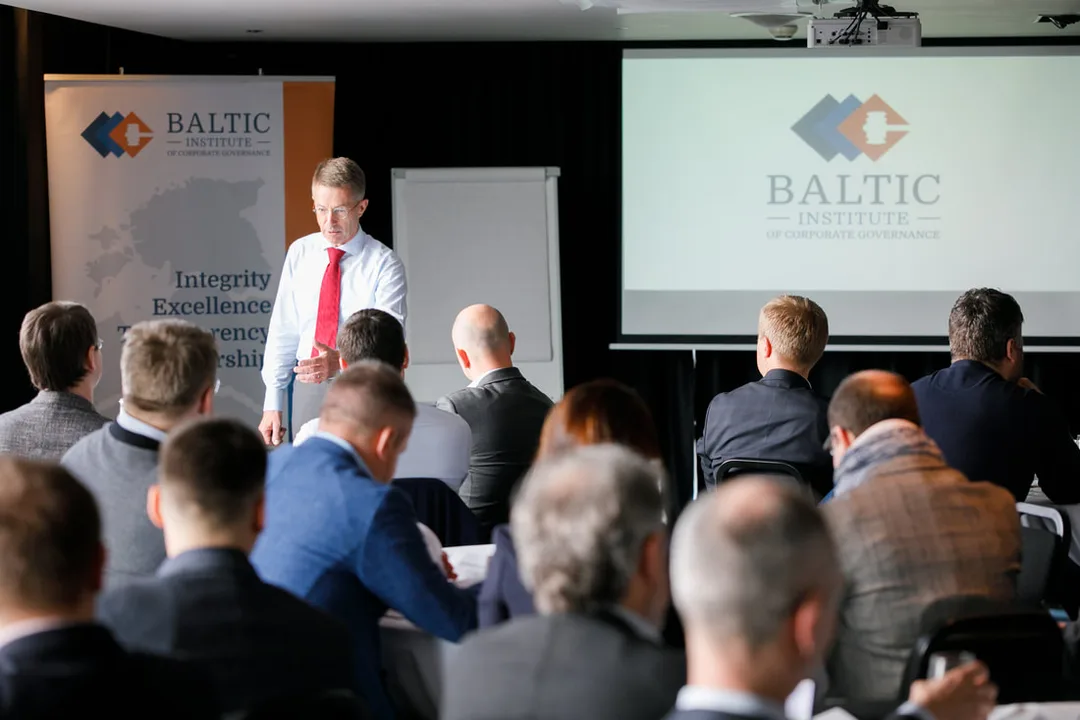
    I'm in London for the weekend, an interlude between inter alia commitments hosted by the Institute of Public Administration (a masterclass for board chairs, in Dublin); Lagercrantz Associates (a workshop, in Stockholm); and the Baltic Institute of Corporate Governance (a masterclass and the BICG conference keynote, in Vilnius). 
    To work with people across cultures, countries and contexts is a great privilege. Discussions reveal differences in perspective and approach. Yet, some things are consistent, transcending borders and cultures. One example is 'good governance'. Directors everywhere want to know how to achieve good governance.
    This is a tough request. The problem is that 'good' is a moral qualifier, implying someone or something is morally excellent, virtuous or even righteous. But that is not all it means. A quick check in any dictionary reveals at least 39 other definitions! Which one does a person have in mind they ask for help to achieve 'good governance' or 'good corporate governance'? And what about other directors around the table. Do they have the same understanding or not?
    It's little wonder that directors have become confused about the role and purpose of the board.
    Pragmatically, corporate governance is the means by which companies are directed and controlled (Cadbury, 1992), that is, it describes the work of the board. The objective is to produce an agreed level of performance (however measured). 'Effectiveness' is a more appropriate qualifier than goodness. If something is effective it is adequate to accomplish a purpose; producing an intended result. 
    Returning to the question of how to achieve good governance. After reminding the enquirer that so-called best practices offer little guarantee of success (which one is best anyway), I usually steer the discussion away from goodness towards effectiveness (performance), and suggest that Bob Garratt's Learning Board matrix, and the Strategic Governance Framework are useful starting points for a lively discussion at the board table.
    Once directors acknowledge that high company performance is the appropriate goal, and that success is a function of effectiveness more so than goodness, they start to ask more relevant questions, such as, "What actually matters?" and, "How do I as a director and we as a board become more effective?"
  • Published on

    The important role of company secretary: Changing times?

    The company secretary, a role defined in law in most jurisdictions, is an important actor in company boardrooms; a servant of the board with a mandate to ensure the smooth running of the board and its activities. Specific tasks include supporting the chair and chief executive in assembling board documentation; ensuring effective communications between key actors and external parties; recording and publishing minutes of meetings; and providing process support to the board as and when needed. Such a role seems clear.
    But in recent times, company secretaries have assumed greater roles including speaking at meetings; exerting influence over decision-making processes, even to the point of presenting papers; and speaking for the board in the market square. This has been encouraged by associations representing company secretaries with the term 'governance professional'. Times are changing, for sure, but are these developments sound? Most of the contributions listed here come dangerously close to the secretary acting, or being seen to act, as a director. 
    But the company secretary is not a director.
    Rightly understood, the role of board secretary should—indeed must—remain one of servant to the board, not part of the board. If governance is a profession (a debatable point, given almost anyone can be a director and professional standards are not enforced), then it is directors not secretaries who are the rightful claimants of the title 'governance professional'. Some other questions boards may wish to consider are:
    • ​The company secretary's modus operandi needs to founded on service, discretion and trust, not power. Is this reasonable, or do you disagree? 
    • How does your board secretary actually operate? How should they?​​
  • Published on

    Governance: An act of leadership or service, or both?

    Picture
    I have just returned home from a busy but most invigorating week on the East Coast of the United States. The purpose of the trip was two-fold. First, to invest in myself by attending a course; and second, to participate in a series of meetings and discussions to explore matters relating to boards, board effectiveness and how high performance might be achieved.
    The following paragraphs summarise some of my learnings. If you want to know more, please get in touch.
    • The Boards that lead programme at Wharton Business School attracted 49 serving and aspirational directors from ten countries. Professors Michael Useem and Ram Charan and their colleague Dennis Carey led the course incredibly well; a highly interactive exploration of when boards should lead, when they should follow and when, simply, they should get out of the way. The insights and commentaries from both the course leaders and several highly-esteemed company chairs, activists and academics during 'fireside chats' provided great assurance that it is possible to make a difference. A notable theme was that directors cannot afford to be aloof in their role. If [strategic] decisions are to be informed and value is to be created, directors need to ensure they understand the business of the business well—and that takes time. 
    • Many boards in the United States are still caught in the 'compliance' trap—the protection of personal and professional reputation continues to be a more pressing priority for many directors (than the achievement of performance goals). As a consequence, boards are not paying sufficient attention to the strategic future of the companies they govern. While compliance matters are by no means discretionary, boards need to get more courageous with their time allocation, and also demand better reporting, to ensure compliance matters do not dominate the agenda. 
    • Several directors lamented—some at length—that the promotion of ESG in recent years has been counter-productive. Rather than focussing boards on performance dimensions beyond money (the intention), boards have in practice become more concerned about adherence to prescribed 'best practice' frameworks. The directors I spoke with said that 'G' (governance) element in particular is problematic—adding little in terms of focussing boards on the creation of value over the longer-term. The alternative that sits more comfortably with directors I spoke with is SEE (social, environmental, economic).
    • The value of purpose reared its head in several discussions—director awareness of the need for clarity in relation to why the companies they govern exist is increasing. However, more needs to be done, to ensure a collective understanding is achieved. Time spent explicitly sharing thoughts and assumptions, with the intention of reaching agreement on a single, stated purpose is crucial: A North Star for decision-making.
    • The diversity discourse continues to evolve. Thankfully, a growing cohort of directors are realising that physical attributes of boards (number of directors, ethnic or racial heritage, or gender diversity, for example) provide little assurance of board performance let alone company performance. A more sophisticated understanding is crucial. My colleague, James Lockhart, has been vocal on this point for some time.
    • I was asked on several occasions to explain the Strategic Governance Framework, a key finding to emerge from my doctoral research completed in 2016. Both individual directors and boards were fascinated to learn that a framework for better board effectiveness (one informed by actual board observations) is now available for consideration and deployment. This was most gratifying. Boards interested in exploring this framework further should contact me directly for a private discussion.
    • Capping off the week, I spent 36 hours in Washington DC, taking in the sights and sounds of the National Mall, and visiting a couple of two of the Smithsonian Institution's fine museums. Returning to the hotel, the last eighteen words of Lincoln's address at Gettysburg rang in my ears. If companies are to prosper in the future, boards need to embrace a strong sense of purpose and service—to the company and legitimate stakeholders. Anything less is not only selfish, it is unsustainable.
    • Finally, and more personally: to the many unnamed folk I met through the week, thank you for your generosity. If the high level of interest throughout the week is any indication, the likelihood of me spending more time in the United States, to wrestle with both the opportunities and challenges of rethinking board effectiveness, and concentrate on company performance more so than compliance tasks (although such tasks cannot be neglected), is high.
    If you would like to discuss any aspect of this summary, challenge my observations, or explore implications for your board, please get in touch, I'd be delighted to hear from you..