• Published on

    On complexity, pathways and outcomes

    Picture
    I have had the good fortune of time in South Africa this week, as a guest of GovernEx, a board advisory practice. To have been invited to interact with hundreds of directors, executives, academics and political leaders, to listen, learn, and offer insights has been invigorating.
    South Africa is a dynamic society. In the 31 years since nation-building was restarted (May 1994) much has changed. Black South Africans comprise over eighty per cent of the population; they now dominate the middle class. Efforts to build an inclusive society, whereby circa 63 million people can participate, have produced much fruit. But some cracks are visible: extremes (of wealth and poverty, in particular) remain; guidance introduced to enable and empower has become prescriptive over time; corruption is apparent in some quarters; and, in some cases, the pursuit of inclusion has delivered little more than a power shift, from whites to blacks. The situation is complex, of course, and hope springs eternal. But hope is hardly a strategy.
    South Africa’s political leaders have recognised the situation, and they are responding. The President, Cyril Ramaphosa, together with an entourage of business, community and sporting leaders, met with the President of the United States a few days ago. The G20 summit will be held in South Africa in late 2025. Business leaders have told me of their desire to move beyond various codes and constructs that have devolved to now impose more cost than benefit in many cases. Their question is telling: “Tick-box exercises for what benefit?”
    My sense is that great courage will be needed, if business leaders are to step beyond the pathways and structures that served the nation well in the early years but now seem to have become hindrances to further progress. Those I have spoken with this week are not without courage—and they have been excited to explore alternate pathways to secure better outcomes, amongst these the Strategic Governance Framework. The challenge now is one of deciding: whether and how to act.
  • Published on

    Better truth or health?

    Picture
    The truth, they say, is a good thing, for it will set you free. This seems reasonable, even self-evident to many. But what is truth? Is it a thing (a fact) or a process? Is it deterministic or does it emerge? Is it absolute or relative? And, in a social context, is truth even possible or desirable?
    The pursuit of truth conjures the notion of a deterministic 'answer' to a question or problem, without worrying too much about (or even considering) the context within which the truth claim exists. Consider darkness. Does being unable to read a book on the patio at twilight mean it is dark? How might this expression of darkness compare with the darkness inside a sealed cavity into which light cannot penetrate? And what of degrees of truth? If just one instance is discovered to be false, does that mean the entire truth claim needs to be set aside? Complicating matters, something may be 'true' but unpalatable, such as, genocide or rotten eggs. 
    Now, consider health. What does it mean to be healthy? For some, maintaining a balanced diet and sleep pattern is sufficient. For others, health involves strenuous exercise and physical fitness. Yet others pursue mental health, a sound mind and great relationships. Is the threshold one of having food, shelter and security; or is a higher order of fulfilment necessary to be healthy? 
    And, how might health and truth relate to each other? Is truth a necessary condition for personal health, or are there situations in which truth might need to be secondary to health? Are truth and health even related? And what of truth and health in an organisational setting? Are the comparisons similar or different? Who decides and what factors should be considered in the decision process? 
    In the past two years, I have come face-to-face these types of questions on many occasions:
    • Observing a demanding board chair pressing hard to get her way, because, in her words, "I am right." (trading off a healthy discussion and decision process to secure her version of the truth, even to the extent of flouting directors' duties)
    • A family member receiving chemotherapy and surgical intervention following a cancer diagnosis. (accepting truth—cancer—but taking a tough option in pursuit of health)
    • A chief executive adhering to a strict interpretation of  employment law during a restructuring process, but in so doing delaying the process and exposing the company to viability risks.
    Selecting between two tough options is never easy. The 'least bad' option doesn't sit well in many cases. But as in life, decisions in organisations need to be made, more so in boardrooms. If boards are to provide effective steerage and guidance in pursuit of an agreed outcome, they need to roll their sleeves up, understand the options and make a decision. But with what reference point to the fore? Should boards prioritise being 'right' (legalistic, truth), or should they select options more likely to lead to sustainable outcomes (organisational health)?  ​If  boards are to govern with impact, the high road is, in most cases, the better option.
  • Published on

    On boardroom decision-making: How does your board measure up?

    Picture
    Boards are under pressure. Every time news of another corporate failure hits the news waves, attention is focussed on the board. Such attention is justified; ultimate responsibility for company performance lies with the board after all. That five out of six directors do not have a comprehensive understanding of the business of the business they are charged with governing suggests that boards deserve the scrutiny they get.
    Regulators have responded by instituting a raft of regulations—and directors' institutions and others have promulgated codes and ‘soft’ guidance too—in the hope of improving board practice. Activists have not been idle either, voting against those perceived to be ill-equipped to contribute well. To date, actions taken have had the opposite effect in many cases. The rising tide of regulations and codes, and activism, has seen many boards adopt a siege mentality. What is more, many boards struggle with the seemingly straightforward task of making smart decisions to ensure future business success. 
    Research published by Henley Business School nearly a decade ago showed fewer than one in three boards have sufficient cognition, cohesion, commitment and knowledge to reach a conclusion, much less make a smart decision. ​If the level of understanding of the business amongst directors is low, and the quality of the board's decision-making is weak, it is little wonder aspersions are being cast and board effectiveness is being questioned. Reputations are on the line, and rightly so. 
    Boards are by no means powerless, of course. My global research reveals a common pattern amongst the most effective boards: they are aspirational, and they ask great questions to inform their decision-making. Five questions, in particular, stand out:
    • What are we trying to achieve?
    • Are we doing what we planned?
    • How does this fit proposal with our agreed strategy?
    • What are the expected benefits and how will they be achieved?
    • Have we made good decisions today?
    If boards are to have any hope of governing with impact, directors need to understand the operating context (market and competitors), emerging trends and disruptions (situational awareness), and the business of the business. They also need probe and verify (that is, ask good questions and cross-check), to determine whether the decision under consideration is not only meritorious, but well-aligned with, and contributory to, the agreed corporate purpose and strategy. Anything less is a dereliction of duty, n’est-ce pas?
    How does you board measure up?
  • Published on

    Taking notice, for context matters

    Picture
    I like exploring: old towns and villages, and the countryside; enjoying the landscape, clambering along trails and even into river beds to look more closely at flora and fauna. The pictures that form in my mind’s eye provide important context to understand the scene, and what may have gone before. Take the above image for example, a photograph I took a few weeks ago, having stepped off the path while walking towards a disused railway. This seemingly innocuous scene is of a fast flowing river, in a gorge. But more than that, it is just along from an abandoned gold mining settlement and an extraction plant (who knew?), and it has a name: the Ohinemuri River, this section is in the Karangahake Gorge.
    If the picture is studied more closely, details not apparent at first glance can be seen: plants in bloom, logs dumped from an earlier flood event, and an adjacent highway. Some details seem inconsequential, like the red blooming plant, others are far more significant (the river obviously floods from time to time, the gorge ‘hosts’ a major highway).
    Clearly, the act of looking ‘into’ the picture, not simply at it, reveals much. 
    And so it is with board work: to look beyond what is written in board papers, to consider what is not written, the wider context within which the company operates, and still-weak signals that may portend trends and potential disrupters is crucial, if the board is to secure a more complete understanding and, ultimately, make more informed decisions. While some boards behave as if such things do not matter, effective boards know better. They are alert to both macro trends and issues (this recent report, from INSEAD, offers helpful insight), and more immediate matters such as sales figures, staff engagement and customer satisfaction trends.
    When was the last time you scanned the horizon to understand the wider context within which the company you serve operates, and how long has it been since the board thought deeply about the future, and the various risks and opportunities that might effect the company and its prospects?
  • Published on

    Exploring boards and board work, thrice more

    Picture
    One of the most satisfying aspects of my work involves sharing insights gained from 'live' experiences, in the hope they might be of some value to others. Whether it be facilitating a boardroom discussion, advising a chair, delivering a keynote, leading a capability building workshop, or chatting with a colleague, the call to share my knowledge and experience is strong. So, when Mark Banicevich, Founder of Governance Bitescontacted me for a chat, I was agreeable, more so as we had previously explored various aspects of board work (the recordings are available: herehere and here). The topics Mark wanted to explore included boards in crisis situations; ethical dilemmas in governance; and, governance in developing nations. A date was agreed, and the 'record' button was pressed.
    Now, all three of the fireside chats have been published. You can watch them here ⬇️. If you have any questions having watched them, or want to check something out, please feel free to contact me directly.
    Boards in crisis situations:
    Ethical dilemmas in governance:
    ​Governance in developing nations:
  • Published on

    Decisions-making, amidst complexity

    Picture
    That life is complex and unpredictable is a truism. And, though the frequency and impact may vary, change is a constant, it seems. If one is to thrive (succeed, realise goals) in such an environment, adaption is critical having detected something has changed. To ignore or pay lip-service to change is folly, and to guess how to respond is about as reliable as gambling.
    The same principle applies in organisational and boardroom settings. As in life, some of what is seen, heard or read is reliable, but much is not—to the extent that descriptors such as misinformation and  disinformation have become commonplace, even hackneyed. Consequently, those charged with providing effective steerage and guidance need to be alert, to ensure decisions about how to proceed are underpinned by accurate data from reliable sources, and insights from conversations and analysis.
    Two techniques I have found useful when considering decisions with strategic implications:
    • Take stock: Rarely does anyone have everything needed to make an informed decision off the bat. Acknowledge the existence of gaps. Ask probing questions to try to understand what is going on and bridge the gaps. Test everything (on the assumption that what seems at first to be the case may not be). Hold options lightly. Invoke an advocatus dialboli mindset, to explicitly draw out alternative perspectives. Listen carefully. Draw on prior experience too, for the likelihood of historical experiences being relevant is high.
    • Take time: Rarely does a so-called strategic decision need to be made immediately, despite first appearances and temptations in modern society to be seen to be agility, and to embrace pace and an urgency mindset. Clarify and agree when the decision needs to be made. Agree the pathway to the decision, and what intermediate decisions can be made to de-risk the strategic decision.
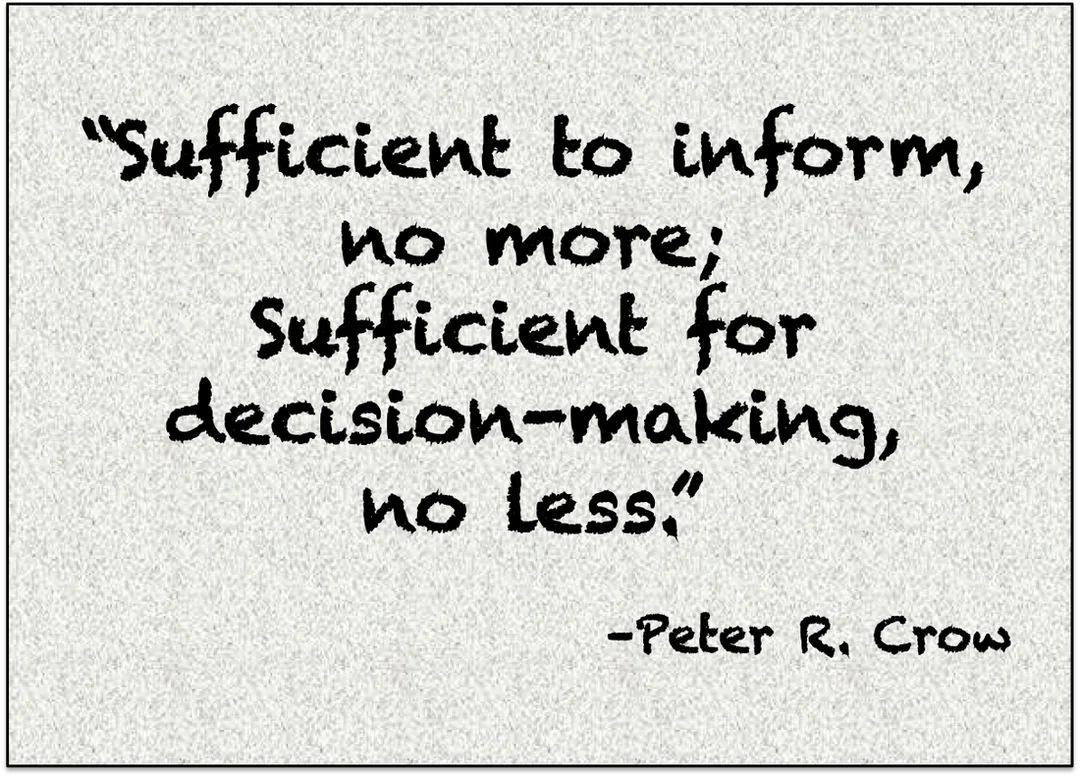
    If boards are to make sound decisions, directors need to breathe—to create space and time to consider options well. Boards should also agree on the decision criteria, process and timing at the outset; guard against being drawn into irrelevancies along the way; and, employ a strategic mindset throughout. How does your board measure up in this regard?