• Published on

    What is going on with New Zealand's largest company?

    Picture
    After several years of paying high milk prices to its farmer-suppliers, Fonterra has hit hard times. International demand for milk products has slumped. On the supply side, prices paid to farmer-suppliers have tumbled. Some have said the problem is primarily related to changing demand especially in China, whereas others have suggested that Fonterra is complicit having stimulated supply to 'feed' its massive processing plants. To make matters worse, Fonterra has started losing farmer-suppliers to its competitors and it seems to be exercising "considerable discretion" with payment terms as well. 
    The latest commentary, an interview on Paul Henry's breakfast show today, lay out some of the challenges in plain English. Click here to watch the video clip. (disclosure:  James Lockhart is my doctoral supervisor, but had no prior knowledge of this interview.)
    The situation, which has been brewing for a several years, is messy to say the least. Other companies including Tatua and Open Country Dairy seem to coping much better. This begs several questions including whether the Fonterra board and management are actually in control; whether the corporate strategy is sound or not; and, whether the company has the financial and managerial resources to respond effectively. While I'm nowhere near close enough answer these questions, the old saying "where there's smoke there's fire" seems to apply.
  • Published on

    Does good governance require a fresh approach?

    I've been pondering this question for quite a few years now, since reading a seemingly endless stream of articles about the global financial crisis of 2007–2009 published in the popular press and academic literature. Curiously, many authors identified the board as a source of failure (of corporate governance), yet few if any have offered positive contributions to put corporate governance back on the tracks. This apparent void was one of the motivations of my doctoral research quest. 
    However, from time to time, articles do stand out, because the authors speak out. Their comments may not be popular, but take a stand they do. Recently, the ICSA recognised one such author, Ruth Keating, who openly asked the question in a recent essay competition. Two sentences towards the end of her well structured and very readable essay say it all:
    “Corporate governance can do better, and with significant investment, capital and jobs on the line, it must. Good governance requires a new approach, because governance has become a formality to be satisfied rather than something which can be hugely valuable."
    My hope is that, by openly asking the question (as Ms Keating has) others might join the debate. One outcome could be a new understanding of corporate governance and a genuine commitment by the board to add value. Who knows where this might lead, perhaps even to a new normal, whereby boards expect to exert influence from and beyond the boardroom. If that is achieved, a new dawn might not be too far away.
  • Published on

    Directors: Are you alert and active, or snoozing at the wheel?

    Picture
    The recent collapse of one of Stonewood Homes' franchisors has placed the conduct of directors squarely in the spotlight once again. The company collapsed owing about $15 million. This article makes the issues plain, and it serves as a warning for other directors. 
    The Companies Act 1993 specifies the duties of directors, including that they must act in the best interests of the company and not allow the company to trade recklessly. That a company collapsed owing such large debt suggests that the company may have been trading near, at or beyond its means for some time. Whether the directors of the collapsed company were negligent or not will be determined in due course, I'm sure.
    The role of a director carries much responsibility. If you are a director, you must know and understand your duties and responsibilities under the Act, and whether you are discharging them correctly. If you have any doubt, discuss the matter at your next board meeting and seek independent advice from a competent lawyer. Don't forget to ask about related legislation—you may have responsibilities under other pieces of legislation and you may not realise it. An independent governance review, to review the operation of the board as a whole might also be in order, to assess the board's performance especially in relation to value creation. Another consideration is professional development, to ensure all directors are adequately trained and knowledgeable.
  • Published on

    Can strategy and execution be usefully distinguished?

    Image description
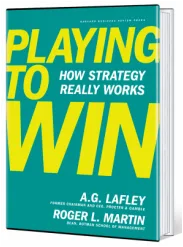
    Roger L Martin, a respected professor at Rotman School of Management and co-author of Playing to Win, has put the cat amongst the pigeons, with this commentary, itself a response to this widely circulated article. The authors of the original article reported findings from a study, which showed that only eight per cent of leaders are good at both strategy and execution. Martin contends that most leaders who are very effective at either strategy formulation are also very effective at execution. Quite a different view. Two different perspectives. Who is correct?
    As with any report involving statistics, context is crucial. If you consider all leaders (as Leinwand, Mainardi and Kleiner did), only eight per cent are "very effective" at both formulating strategy and executing strategy. However, if you only consider only those that are "very effective at strategy", fully two-thirds are also good at execution (Martin's point). Thus, both authors are 'correct'. But which commentary is more helpful to leaders and those intent on achieving business success?
    The shocking statistic is that just sixteen per cent of leaders are "very effective" at strategy formulation or execution or both. Turbulent times demand outstanding leadership, both to determine strategy and to ensure it is executed with excellence. Poor, neutral and even "effective" contributions have little chance of moving companies toward their goals if they are competing against "very effective" leaders. Consequently, 84 per cent of leaders will be found wanting (notice the Pareto Principle?). Rather than debate statistics, it may be more useful to move the discussion to discovering how to move more leaders into the "very effective" sector.
    Another perhaps more important question—for boards of directors in particular—centres on Martin's assertion that strategy and execution are the same thing. Can the two tasks can be distinguished? 
    Strategy formulation and execution are two of the four pillars of strategic management (development, approval, implementation and monitoring). My research suggests that business success is dependent on two things: having a clear sense of purpose and an effective strategy, and great execution. The former is an important task that boards and managers should work on together and the latter is the domain of management (only) once strategic decisions are made by the board. However, some flexibility is required because things change. Decisions and adjustments are required from time to time. If companies are to react and respond quickly, strong leadership is crucial to avoid mayhem. So where does that leave Martin's assertion, that formulation and execution cannot be usefully distinguished? What is your experience?
  • Published on

    On the DNA of high performing businesses

    Picture
    What makes a successful business successful? Can success be pursued, or are great outcomes largely a matter of luck? Success, it seems, is dependent on companies doing a rather small number of things consistently well. Jim Collins (Good to great), Colin Campbell-Hunt (World famous in New Zealand) and others have studied this question and produced some great insights.
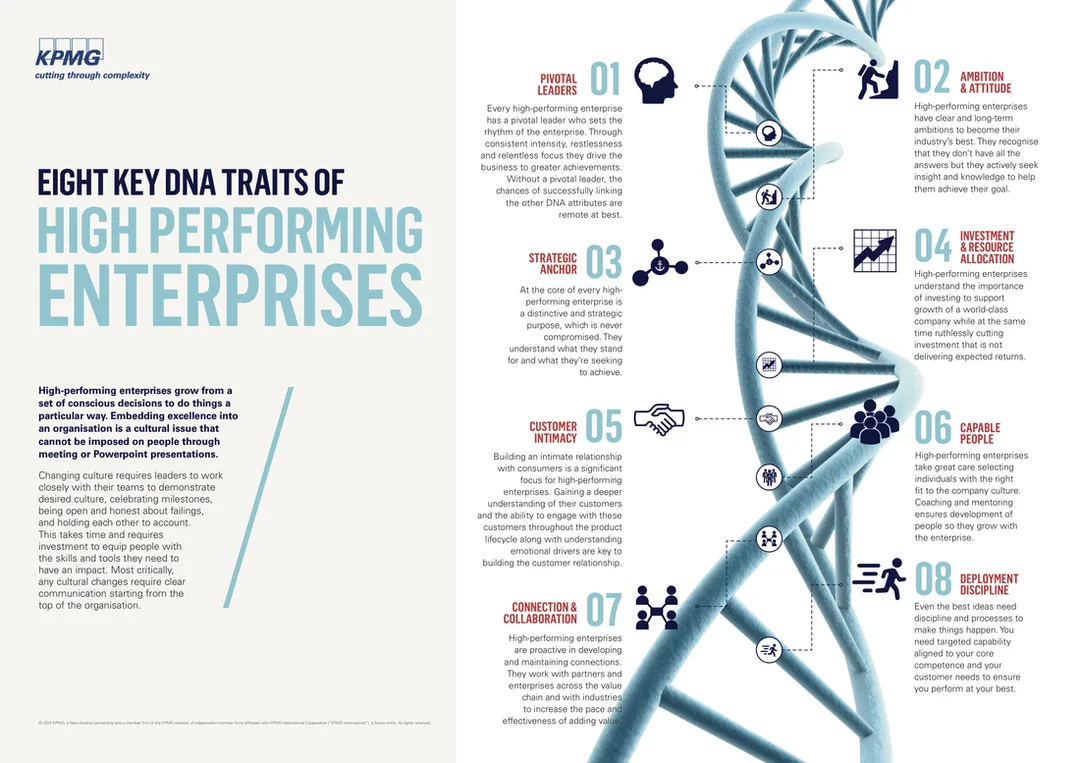
    Recently, business advisory firm KPMG, added their view. The KPMG study revealed eight 'DNA traits' of high-performing enterprises, as follows (click image on right for a larger version):
    • Pivotal leadership
    • Attitude
    • Strategic anchor
    • Investment and resource allocation
    • Customer intimacy
    • Capable people
    • Connection and collaboration
    • Deployment discipline
    Picture
    This guidance is as applicable to smaller companies with big dreams as it is to more mature companies wanting to defend against competitors or push on to the next level. Did you notice that a having great product or a killer app—often lauded as being 'the crucial difference'—does not rate a mention? This point has interesting implications for strategic management, and strategy development in particular. While good products and services are important, leadership, people (customers and team), smart decisions and a sense of purpose are far more significant moderators of business success.
    If you'd like to discuss the implications of these observations for your board or your corporate strategy, please get in touch. I'd be more than happy to be a sounding board.
  • Published on

    On democracy, morals and business performance

    Image description
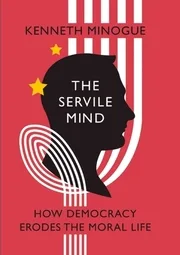
    As 2015 gives way to 2016, many people will be reflecting on the past and looking to the future; thinking about what was and what might have been. I'm no different. One of the books I've been reading while pondering the past and the future this week is The Servile Mind by Kenneth Minogue. A friend recommended it—he wondered whether the commentary might be applicable to directors and boards. My response, having read half of the book so far, is an unreserved 'yes'! Here's the note on the flyleaf:
    One of the grim comedies of the twentieth century was that miserable victims of communist regimes would climb walls, sim rivers, dodge bullets, and find other desperate ways to achieve liberty  the West at the same time that progressive intellectuals would sentimentally proclaim that these very regimes were the wave of the future. A similar tragicomedy is playing out in our century: as the victims of despotism and backwardness from Third World nations pour into Western States, academic and intellectuals present Western life as a nightmare of inequality and oppression.
    In The Servile Mind: How Democracy Erodes the Moral Life,​ Kenneth Minogue explores the intelligentsia's love affair with social perfection and reveals how that idealistic dream is destroying exactly what has made the inventive Western world irresistible to the peoples of foreign lands. The Servile Mind looks at how Western morality has evolved into mere "politico-moral" posturing about admired ethical causes—from solving world poverty and creating peace to curing climate change. Today, merely making the correct noises and parading one's essential decency by having the correct opinions has become a substitute for individual moral responsibility.
    Instead, Minogue argues, we ask that our governments carry the burden of soling our social—and especially moral—problems for us. The sad and frightening irony is that the more we allow the state to determine our moral order and inner convictions, the more we need to be told how to behave and what to think.
    Humbly, I commend this book to all directors who want to govern well and make a difference in 2016.