• Published on

    On strategy: "A palette of plans"

    Image description
    Every now and then, a great article crosses my desk—one that seems to lift itself off the page, as if to command attention. This is one such article. Writing in The Economist, Schumpter comments on an idea promoted by Boston Consulting Group: that dexterity is increasingly important in today's fast-paced world. The assertion is that modern companies need to be adept at skipping nimbly between strategies or types of strategies (or to commit to multiple strategies simultaneously). Five types of strategy are identified, as follows:
    • Classical: find a niche and develop a plan to achieve dominance
    • Adaptive: try many things and back those that work
    • Visionary: the 'blue-ocean' approach of creating a new market based on a compelling idea
    • Shaping: partnering with others to achieve both scale and reach
    • Renewal: whole reshaping of the business (often to defend against pending failure)
    The article makes plan the challenge moving between strategies, especially with management reputations and careers on the line. One option to resolve this challenge might be for boards to focus directly on leadership and strategy because the task of developing strategy has become so important to business success. A return to the historical conception of strategy--strategos, the art of command—is appropriate. (Many business academics and boards of directors consider strategy to be an important task of the chief executive.) If boards become more strategic, by contributing expertise and challenging strategic options, then 'ownership' of both strategy and the outcomes that flow is likely to move to where it actually belongs--in the boardroom.
  • Published on

    Martin Wolf at ICGN'15: "Let a hundred flowers bloom"

    Martin Wolf CBE, Associate Editor and Chief Economics Commentator at the Financial Times, delivered a rousing keynote talk to wrap up the final day of the ICGN annual conference. After observing that the limited liability, joint-owned corporation had been the cause and consequence of almost all economic activity over the last two hundred years, Wolf posed and commented on four questions. He qualified his comments by saying that he expected they might raise some profound questions. Indeed, some of Wolf's comments were controversial—the evidence being the questions asked by some members of the audience after he finished speaking.
    What is a limited liability corporation? They are a semi-permanent entity designed to outlast small-medium enterprises (because founders retire—the corner store conundrum) and markets, and they are a construct for the consolidation of relational and implicit contracts. Their genius is the importation of older hierarchical forms (to get things done) into the market system. With scale comes efficiency, endurance and effectiveness (but not always!).
    What is their purpose? The apparent purpose of the LLC is to generate economic value. However, this is insufficient. Wolf asserted that LLCs should also pursue a wider remit, by seeking to 'add value' in social terms (through the provision of payments for services rendered—wages and salaries—for example).
    What is their operational goal? The oft-quoted goal, of maximising shareholder returns, is far too simplistic, according to Wolf. It is selfish and can only lead to failure elsewhere in society. Rather, the operational goal of LLCs needs to include ethical constraints to protect all participants and in so doing ensure the good of society (at no point did Wolf pursue or even imply any form of Marxist agenda).
    Who should control them? Economically, shareholders bear residual risks following corporate activity and, therefore, shareholders should possess control rights. Wolf challenged this commonly-held view as folly because shareholders are unable to exert full control over the affairs of the corporation. Managers may manipulate the affairs of the company, sometimes to the detriment of shareholders and other stakeholders. Short-term incentives, implemented to motivate managers towards the maximisation of shareholder returns, rarely position the company for longer-term success.
    Wolf concluded by saying that LLCs are a wonderful construct. However, he went on to say that the two associated doctrines (of shareholder control and value maximisation) are unhelpful because they are too short-sighted. He told the shareholders in the room that "it is in your interest not to control the corporation completely". Other parties—large bondholders, for example—also bear residual risks. Why would they not have decision rights?
    Wolf's comments were demonstrably controversial (amongst some of the audience at least). However, the poor reputation of big business amongst the general populace suggest Wolf's comments might be closer to the 'truth' than what many in the audience might care to admit. 
    Wolf closed with this demanding challenge: A better approach might be "to let a hundred flowers bloom", so that the best [control] model might rise up and be applied for a given situation—the beneficiary being society at large.
  • Published on

    ICGN'15: The demands on boards in the future

    The second panel discussion of the third (and last) day of the ICGN conference looked to the future. The topic brought together many of the discrete threads from earlier conversations. Here are some of the takeaways:
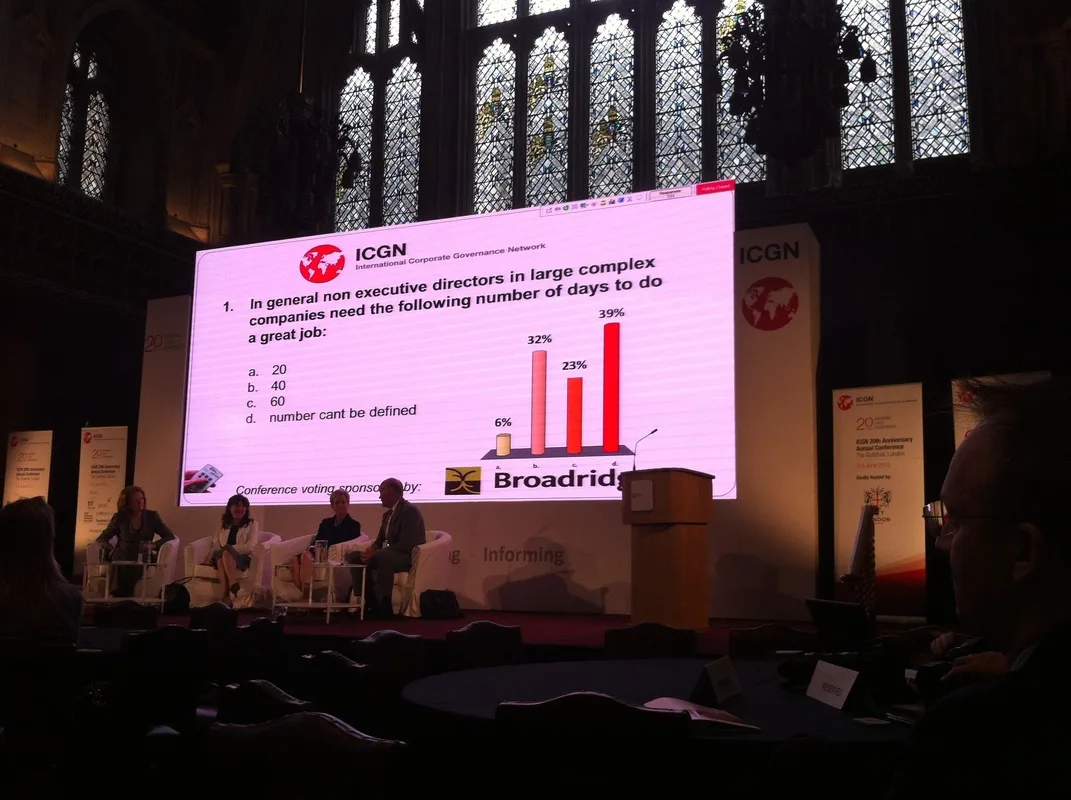
    • Directors' expectations of themselves are climbing. About 30 hours per board per month is now considered to be average. The trend towards much higher levels of involvement and accountability is well established.
    • There appears to be a significant difference between the amount of time that the directors spend working on the boards of publicly-listed companies and private-held firms. PLC boards tend to be 'low touch' with a monitoring and compliance emphasis, whereas PHF boards tend to be 'high tough' and the focus is on strategy and business performance. 
    Picture
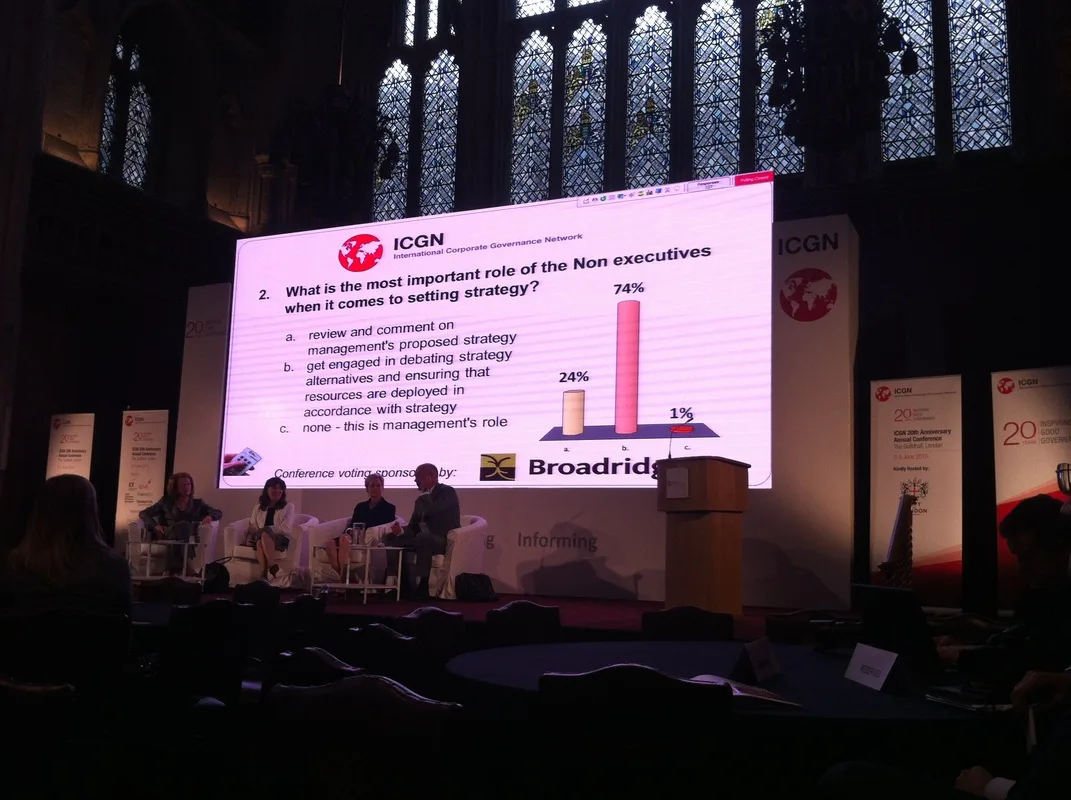
    • Boards need to get far more involved with the consideration of strategic options than most do now (cf. my research, which suggests that an active involvement in strategy development is crucial).
    • Most shareholders and institutional investors 'know' that boards need to be involved in strategy development (per the survey result below), yet precious few boards actually take the task of strategy development and strategy management as seriously as the survey suggests is required.
    Picture
    • Directors need to be fully informed on all material matters. Suggested channels included formal due diligence; asking probing questions of rhe chair executive during board meetings; eliciting information from multiple sources; asking for information to be presented in a particular format.
    • Boards need to be high-trust environments, whereby directors are free to debate the issues (heatedly sometimes) in the pursuit of an agreed company purpose and strategy.
    • One panel member took the position that expecting that 'board involvement in 'strategy' might be expecting too much from directors (even though directors have a duty of care to make enquiries and become adequately informed.
    These takeaways demonstrate that boards are starting to thinking about future business performance. However, there is much work to do, both by boards to determine an appropriate division of labour between the board and management, and by shareholders to express their wishes more clearly than perhaps now is the case.
  • Published on

    ICGN'15: On sustainable market reform—what needs to be done?

    Day 3 of the ICGN annual conference opened with a lively panel discussion on the subject of sustainability reform. From the title of the session, I thought the conversation would explore ways and means of reforming the capital market in the fight against short-termismthe goal being longer-term corporate value and sustainable economic growth. However, the conversation was actually about the ESG (environmental, sustainability, governance) agenda.
    The starting point for the conversation what that shareholders need to change their mindset, away from short-termism and quarterly results, towards the long term prospects of the company, for the good of the economy and the well-being of society. Regulation was identified as being important (and probably necessary) if the desired behaviour change was to occur. However, there was little appetite for a new regulatory regime to expedite change. Rather, the panel thought professionalism was a far better vehicle—on the basis that professionalism well implemented should reduce the need for prescriptive regulation.
    Notwithstanding this, a reasonably significant shift in behaviour is likely to be required (amongst shareholders and the board) if companies are to respond positively to the sustainability expectations of customers, suppliers and the general public. Institutional investors probably need to step up and become part of the conversation, both to move their focus beyond the ninety day cycle and to pressure management into embracing sustainable business practices. 
    The panel was asked how this move towards professionalism could be effected. One popular and readily implementable option was to use the AGM as a forum to raise questions. If institutional investors were to speak publicly (at the AGM) on matters of climate change, sustainable business practices and responsible business practice (for example), and do so in a firm but fair manner, then others (including the press and smaller investors) would notice. In so doing, astute directors and managers would respond by adjusting various priorities.
    Much of the conversation was focussed on structural responses to identified problems. However, the ante was raised somewhat towards the end of the session, when an audience question shifted the conversation. Panel members were asked for their thoughts on how to drive desirable (sustainability) behaviours in the boardroom. After some um-ing and ah-ing, the following three items were proposed:
    • Think in terms of the purpose of the business
    • Demarginalise ESG: Make it prominent on the agenda
    • Respect SME suppliers—they are not equipping to fund the working capital of larger companies!
    This seemingly 'thin' response exposed another problem: that investors may not think about what goes on in the boardroom as much as some might think or hope. This probably needs to change.
    Standing back a little, the session explored a different question from the one I expected to be tackled. However, the discussion was very helpful because it demonstrated that change is possible if the right sort of pressure and catalyst is brought to bear. The power of the AGM as a suitable forum to raise questions and exert pressure on the board and management of companies should not be underestimated for example.
  • Published on

    ICGN'15: A timely call to action

    Image description
    Robert AG (Bob) Monks is a experienced shareholder activist and pioneer in corporate governance. The tall octogenarian has spent a lifetime influencing boards and board performance, especially in corporate America. Monks was invited to deliver the keynote address the ICGN conference.
    Monks, a gifted orator, spoke from the heart, and he had the gathered delegates enthralled as he did so. Reviving memories of the wartime leader Winston Churchill, Monks reminded delegates that, while they had come far, they were not at the end (ie. 'arrived') nor were they at the beginning of the end. They were, he said, "at the end of the beginning". He went on to suggest:
    • Boards and shareholders (particularly institutional investors) had barely started on the journey of convincing management that an engaged shareholder more likely to be helpful than a hindrance. I suspect this was a wake-up call for many, particularly those that think they 'do' corporate governance well and that shareholders should be kept at arms' length.
    • Too many chief executives and executive teams had autocratic control of the levers of power. They were feathering their own nest and allocating resources in favour of short-term outcomes—and boards were allowing chief executives to get away with such behaviours. Thus, chief executive accountability is largely a myth.
    • Much of what actually happens in boardrooms is not corporate governance or even an approximation of corporate governance. Rather it is a shadow play, orchestrated to give he appearance of the board doing the things that it should be doing. The statement that corporate governance is a high-profile smokescreen was as telling as it was damning. 
    Monks continued by offering several recommendations to the audience (comprised largely of institutional investor representatives but also other participants in the corporate governance community including academics and advisors). He said that shareholders need to be genuinely engaged (by specifying what they want from their investment); that integrated reporting is crucial (to provide clarity around actual business performance); and, that all publicly-listed companies need to have real (identifiable) owners (to satisfy the engagement challenge.
    Monks received a standing ovation from some of the delegates, such was the power of his oratory and the high esteem in which he is held. One surprise: neither value creation or strategy was mentioned. I wonder what Monks thinks about these activities and the board's role therein. Rather than guess, I'm going to ask him. Congratulations to the conference organisers for securing Bob Monks' contribution to the debate.
  • Published on

    ICGN'15: Inside the boardroom black box

    For many of us, the boardroom is an opaque structure, whereby those on the outside can only but guess what might (or might not) happen on the inside. And that's the way many directors like it: strong norms of privacy and claims of confidentiality are held up as defences against such things as professionalism and accountability. While many boards try to do their job well, some directors are victims of hubris, arrogance, laziness and, in some more extreme cases, a perception of being above or beyond the law (the slippery slope that often leads to fraudulent activity). It's little wonder that the level of distrust (of directors) is at an all-time high.
    The second plenary of the second day of the ICGN conference tackled the topic of what does (well, should) happen in boardrooms. The panel prized open the corner of the blackbox.Here's some of the takeouts from the discussion:
    • Directors, you need to think about who you represent (Clue: the constituency that put you there is not the correct answer).
    • Many boards focus on risk (at the expense of future performance, value creation and shareholder wishes) far too much.
    • All boards have a culture, but not all board cultures are aligned with corporate culture.
    • Groupthink is an ever-present problem for boards. Diversity can help.
    • The highest standards of integrity and probity are crucial, and especially so for the chairman. If either of these are compromised or perceived by others to be compromised, then the director concerned needs to leave the board, immediately.
    • High levels of trust between directors and with the chief executive are crucial, to provide a suitable foundation for vigorous debate to occur.
    • Boards need reliable / accurate / unfiltered information to make informed decisions. That which is received via the chief executive is, often, biassed in some way. The panel thought board–staff conversation was to be encouraged (within an agreed framework or protocol) as a means of eliciting a more complete picture.
    • "What happens in the boardroom stays in the boardroom".
    My experience, both as a serving director and as a silent observer is that the characteristics listed above are probably necessary to board effectiveness. However, they are by no means sufficient  nor do they necessarily guarantee business performance outcomes will be achieved.
    I was surprised that little attention was paid by the panel to time splits (compliance / monitoring / forming future strategy) or to the importance of strategy as a board agenda item. This would have been useful guidance for serving directors. However, it is probably a touchy subject. Most directors 'know' how much time they perhaps should spend on strategy (and they'll 25–40 per cent if asked), whereas most boards actually spend far less time on this activity (typically five per cent). Perhaps this discrepancy is a source of embarrassment to directors and, therefore, it does not get discussed. Notwithstanding this, this discussion as probably the most useful of the conference to date—because it was about boards and what boards [should] do (ie. corporate governance).