• Published on

    Reflections: International Corporate Governance Network conference

    The twentieth annual conference should be recorded in the annals of the International Corporate Governance Network as being a successful conference. From small beginnings twenty years ago, when 49 hardy souls met, the ICGN annual conference has grown ten-fold. Nearly 500 delegates assembled (from close to 50 countries) at the Guildhall in London to listen, share and, importantly, to exchange experiences.
    • While all of the speakers and panel members were of a high calibre, Alderman Alan YarrowBob Monks and Martin Wolf stood out. Drawing on their vast experience, each of these gentlemen offered perspectives and insight that many of the younger delegates are unlikely to have considered previously.
    • The unspoken conception of corporate governance that seems to pervade the conference (as something that helps investors get what they want) surprised me. My understanding of corporate governance concerns the way boards of directors work, both in oversight of management and in pursuit of desired outcomes. This surprise may simply have been one of perspective—many of the delegates and speakers are members of the investor community, whereas much of my experience is from within the boardroom.
    • Another surprise was the disparity between who I thought might attend this conference and who actually did. The delegate list was dominated by institutional investor and industry body representatives, advisors and lawyers with some academics to boot. However, there were precious few serving company directors in attendance. Serving directors are a (the?) crucial cog in the corporate governance ecosystem. Perhaps the organisers might wish to consider how to redress this imbalance at future conferences.
    • The matters of trust (between directors on a board, and between shareholders and the board) and reputation were visible throughout the conference, and rightly so. That big business suffers a troublesome reputation amongst the general populace was noted publicly and it was discussed further over the tea-cups—although whether any remedial actions are forthcoming remains to be seen.
    • The conference was well-organised and well-run, and the venue was, simply, stunning.
    • The organisation (which prefers to think of itself as a network actually, it's less hierarchical) appears to be in good health. Kerrie Waring is a capable leader. She and her team clearly have the best interests of the organisation, and its goal of lifting the standard of corporate governance, at heart.
    • More personally, I met some amazing people (including some that, to this point, had been but names or acronyms on social media exchanges) and had some very helpful discussions. My intention was to watch and to take it in. That others saw it fit to invite me to join their discussions was humbling indeed.
    Was the conference worthwhile? If the quality of the insight, discussions and relationships are any indication, the answer must be 'yes'! Consequently, the 21st edition is already marked my diary.
  • Published on

    ICGN'15: On sustainable market reform—what needs to be done?

    Day 3 of the ICGN annual conference opened with a lively panel discussion on the subject of sustainability reform. From the title of the session, I thought the conversation would explore ways and means of reforming the capital market in the fight against short-termismthe goal being longer-term corporate value and sustainable economic growth. However, the conversation was actually about the ESG (environmental, sustainability, governance) agenda.
    The starting point for the conversation what that shareholders need to change their mindset, away from short-termism and quarterly results, towards the long term prospects of the company, for the good of the economy and the well-being of society. Regulation was identified as being important (and probably necessary) if the desired behaviour change was to occur. However, there was little appetite for a new regulatory regime to expedite change. Rather, the panel thought professionalism was a far better vehicle—on the basis that professionalism well implemented should reduce the need for prescriptive regulation.
    Notwithstanding this, a reasonably significant shift in behaviour is likely to be required (amongst shareholders and the board) if companies are to respond positively to the sustainability expectations of customers, suppliers and the general public. Institutional investors probably need to step up and become part of the conversation, both to move their focus beyond the ninety day cycle and to pressure management into embracing sustainable business practices. 
    The panel was asked how this move towards professionalism could be effected. One popular and readily implementable option was to use the AGM as a forum to raise questions. If institutional investors were to speak publicly (at the AGM) on matters of climate change, sustainable business practices and responsible business practice (for example), and do so in a firm but fair manner, then others (including the press and smaller investors) would notice. In so doing, astute directors and managers would respond by adjusting various priorities.
    Much of the conversation was focussed on structural responses to identified problems. However, the ante was raised somewhat towards the end of the session, when an audience question shifted the conversation. Panel members were asked for their thoughts on how to drive desirable (sustainability) behaviours in the boardroom. After some um-ing and ah-ing, the following three items were proposed:
    • Think in terms of the purpose of the business
    • Demarginalise ESG: Make it prominent on the agenda
    • Respect SME suppliers—they are not equipping to fund the working capital of larger companies!
    This seemingly 'thin' response exposed another problem: that investors may not think about what goes on in the boardroom as much as some might think or hope. This probably needs to change.
    Standing back a little, the session explored a different question from the one I expected to be tackled. However, the discussion was very helpful because it demonstrated that change is possible if the right sort of pressure and catalyst is brought to bear. The power of the AGM as a suitable forum to raise questions and exert pressure on the board and management of companies should not be underestimated for example.
  • Published on

    ICGN'15: The demands on boards in the future

    The second panel discussion of the third (and last) day of the ICGN conference looked to the future. The topic brought together many of the discrete threads from earlier conversations. Here are some of the takeaways:
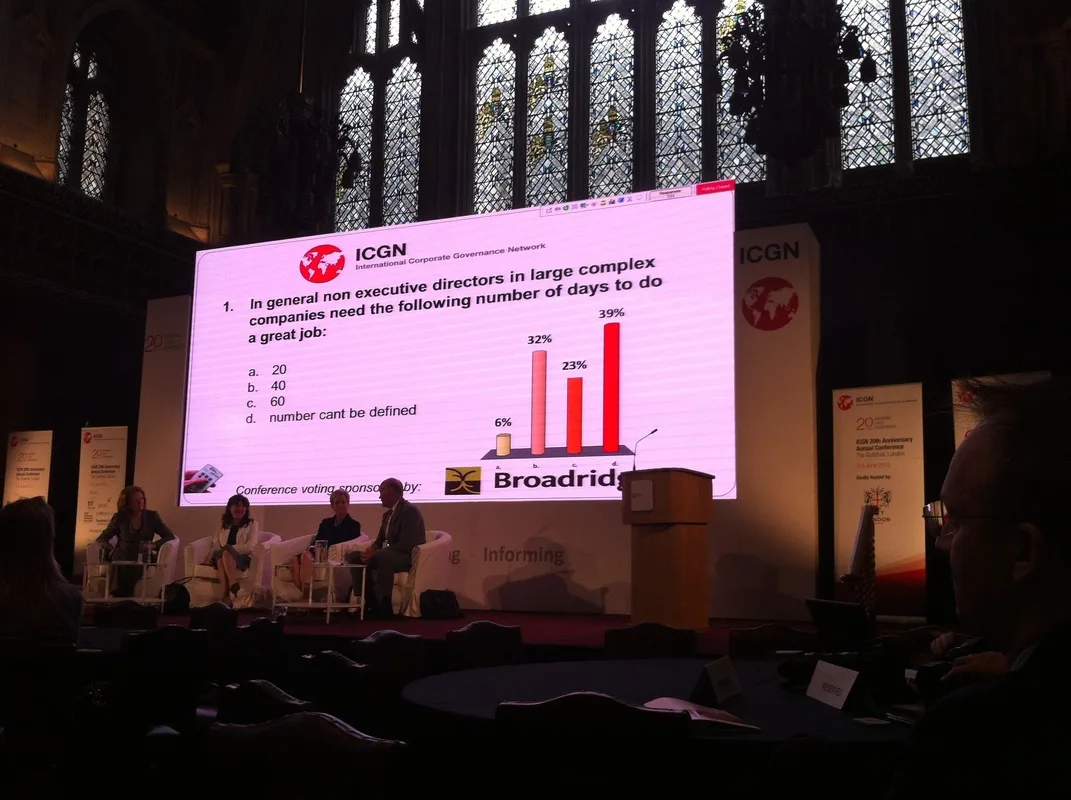
    • Directors' expectations of themselves are climbing. About 30 hours per board per month is now considered to be average. The trend towards much higher levels of involvement and accountability is well established.
    • There appears to be a significant difference between the amount of time that the directors spend working on the boards of publicly-listed companies and private-held firms. PLC boards tend to be 'low touch' with a monitoring and compliance emphasis, whereas PHF boards tend to be 'high tough' and the focus is on strategy and business performance. 
    Picture
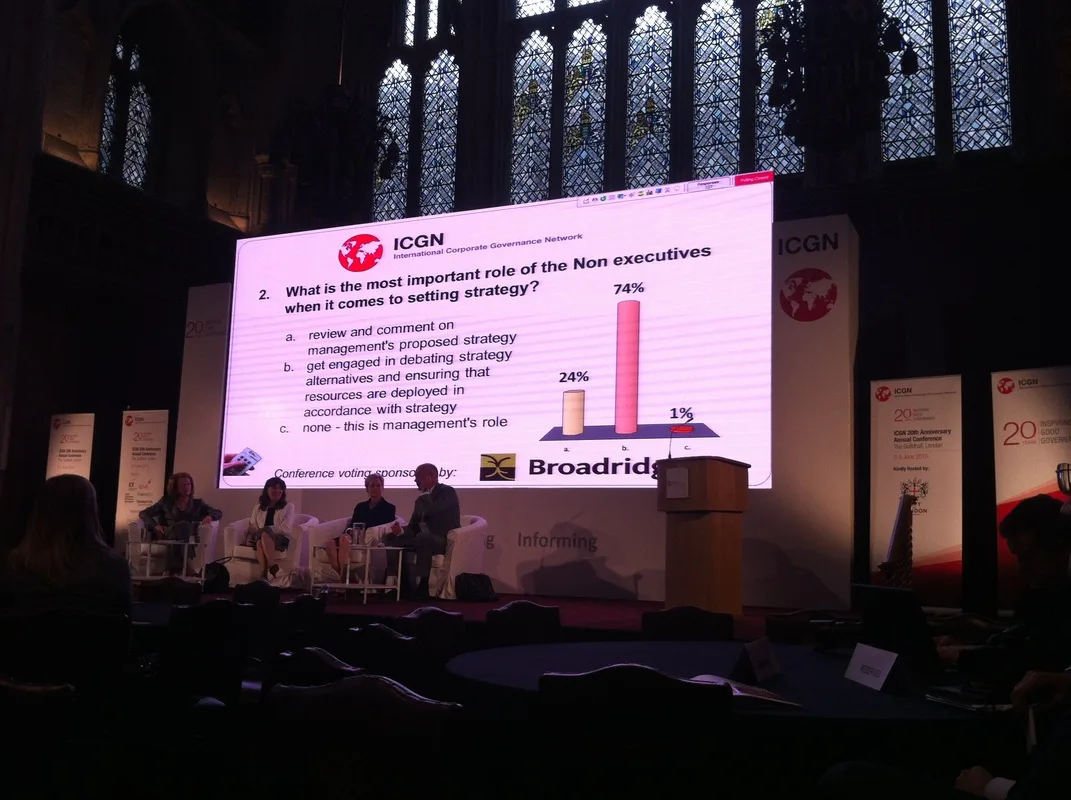
    • Boards need to get far more involved with the consideration of strategic options than most do now (cf. my research, which suggests that an active involvement in strategy development is crucial).
    • Most shareholders and institutional investors 'know' that boards need to be involved in strategy development (per the survey result below), yet precious few boards actually take the task of strategy development and strategy management as seriously as the survey suggests is required.
    Picture
    • Directors need to be fully informed on all material matters. Suggested channels included formal due diligence; asking probing questions of rhe chair executive during board meetings; eliciting information from multiple sources; asking for information to be presented in a particular format.
    • Boards need to be high-trust environments, whereby directors are free to debate the issues (heatedly sometimes) in the pursuit of an agreed company purpose and strategy.
    • One panel member took the position that expecting that 'board involvement in 'strategy' might be expecting too much from directors (even though directors have a duty of care to make enquiries and become adequately informed.
    These takeaways demonstrate that boards are starting to thinking about future business performance. However, there is much work to do, both by boards to determine an appropriate division of labour between the board and management, and by shareholders to express their wishes more clearly than perhaps now is the case.
  • Published on

    ICGN'15: Inside the boardroom black box

    For many of us, the boardroom is an opaque structure, whereby those on the outside can only but guess what might (or might not) happen on the inside. And that's the way many directors like it: strong norms of privacy and claims of confidentiality are held up as defences against such things as professionalism and accountability. While many boards try to do their job well, some directors are victims of hubris, arrogance, laziness and, in some more extreme cases, a perception of being above or beyond the law (the slippery slope that often leads to fraudulent activity). It's little wonder that the level of distrust (of directors) is at an all-time high.
    The second plenary of the second day of the ICGN conference tackled the topic of what does (well, should) happen in boardrooms. The panel prized open the corner of the blackbox.Here's some of the takeouts from the discussion:
    • Directors, you need to think about who you represent (Clue: the constituency that put you there is not the correct answer).
    • Many boards focus on risk (at the expense of future performance, value creation and shareholder wishes) far too much.
    • All boards have a culture, but not all board cultures are aligned with corporate culture.
    • Groupthink is an ever-present problem for boards. Diversity can help.
    • The highest standards of integrity and probity are crucial, and especially so for the chairman. If either of these are compromised or perceived by others to be compromised, then the director concerned needs to leave the board, immediately.
    • High levels of trust between directors and with the chief executive are crucial, to provide a suitable foundation for vigorous debate to occur.
    • Boards need reliable / accurate / unfiltered information to make informed decisions. That which is received via the chief executive is, often, biassed in some way. The panel thought board–staff conversation was to be encouraged (within an agreed framework or protocol) as a means of eliciting a more complete picture.
    • "What happens in the boardroom stays in the boardroom".
    My experience, both as a serving director and as a silent observer is that the characteristics listed above are probably necessary to board effectiveness. However, they are by no means sufficient  nor do they necessarily guarantee business performance outcomes will be achieved.
    I was surprised that little attention was paid by the panel to time splits (compliance / monitoring / forming future strategy) or to the importance of strategy as a board agenda item. This would have been useful guidance for serving directors. However, it is probably a touchy subject. Most directors 'know' how much time they perhaps should spend on strategy (and they'll 25–40 per cent if asked), whereas most boards actually spend far less time on this activity (typically five per cent). Perhaps this discrepancy is a source of embarrassment to directors and, therefore, it does not get discussed. Notwithstanding this, this discussion as probably the most useful of the conference to date—because it was about boards and what boards [should] do (ie. corporate governance).
  • Published on

    ICGN'15: On global governance reform

    Sophie L'Helias, Senior Fellow, Governance at Governance Board chaired a very interesting panel discussion. The panel was asked to discuss whether corporate governance had progressed or regressed over the last twenty years (since ICGN was formed). The opening observation was that much had changed, yet much remained the same:
    • Investors hold more power now than they did twenty years ago. Shareholders—institutional investors in particular—now know they can exert influence and many are starting to take this role quite seriously.
    • While activism brings its own challenges (including battles during proxy season), the notion of trying to hold a company and its board accountable for company performance is something institutional investors and smaller shareholders are increasingly aware of.
    • Transparency, accountability, fairness and responsibility are four key principles that feature more often now than in the past. However, the application of such principles is by no means universal.
    • The conceptualisation of corporate governance remains, in the main, one of a policy framework within which shareholders seek to exert influence over performance and outcomes. [note: In this regard, the investor community seems to be some distance behind the research that suggests corporate governance is far more than a structure or a process or a policy framework.]
    • Calls for 'responsible investing' and responsible use of the three capitals—financial (money), human (people) and natural (environmental)—are much more prevalent than ever before.
    This first panel session of the conference provided an interesting opening play, upon which later discussants could build (or otherwise!). The main takeaway for me was that shareholders and boards need to 'grow up'. Looking over the fence at each other (and, in some cases, simply ignoring each other) is not a healthy context for either productive ownership or effective control. Boards were created to bridge between owners and managers, yet many boards seem to be far more interested in pursuing their own interests and priorities (than acting in the best interests of the company or the shareholders). While we appear to have come far, we still have much to learn.
  • Published on

    ICGN'15: integrated reporting update

    The 20th ICGN conference is underway. While the annual meeting and official welcome signalled the start of the conference, ICGN committee meetings and lunchtime panel discussions were scheduled, to fit everything into the thee-day window. Claudia Kruse chaired a very interesting lunchtime panel discussion on integrated reporting. The IIRC's Corporate Reporting Dialogue (CRD) was launched twelve months ago, and it was the panel's purpose to discuss the progress made and to solicit feedback from the gathered members.
    ICGN has bee an active proponent of 'tidying up' reporting. The aim of integrated reporting is to provide a representative view of how the company is actually performing. After a brief summary provided by the panel, the time was turned over to attendees, to ask questions and discussion:
    • The panel acknowledged the perennial chestnut, of who wants IR was briefly mentioned. Panel members indicated a dichotomy exists whereby some think IR is an investor-led initiative, and others think it is (or should be) management-led. While the question was not opened fully, I found the possibility that any group other than the shareholders or the board might initiate anything. Yet boards hardly rated a mention during the entire conversation. This, despite the board being a proxy representative of shareholders!
    • I found it interesting that 'value creation' was offered as a key driver for integrated reporting, and that "proper reporting leads to better corporate governance". Really?
    While I am a strident fan of transparency and straightforward reporting, I couldn't help but think that the approach the IIRC and ICGN is following has missed the boat somewhat. Integrated reporting has been conceptualised as being management-led activity, and that "proper reporting leads to better corporate governance. Yet the elephant in the room (if I can mix metaphors) is that integrated reported has been conceptualised by the ICGN team as being a management activity. The board was mentioned rarely during the entire panel discussion, even though the board is supposed to be accountable for company performance. Another challenge for the ICGN working group is that the focus is almost entirely on publicly-listed companies. I asked the question and, for my troubles, may have 'volunteered' to working out if and how integrated reporting might apply in a privately-held company context. 
    Notwithstanding these challenges, the fact the ICGN is asking the question and looking for ways to bridge between the different reporting requirements of different jurisdictions is good, really good. I look forward to future updates and, possibly, to contributing the the 'privately-held' part of the discussion.