
• Published on

    Curiosity, COVID19 and the cat

    Picture
    The global crisis brought about by COVID19 has precipitated a range of reactions and emotional responses. These have included fear (of catching the virus, becoming very sick or even losing life); frustration (that civil liberties have been withdrawn); anger (the prospect of high levels of state control after the immediate crisis has passed); praise (the selfless actions of first responders and healthcare professionals); disappointment (of not being able to spend time with loved ones); beatification (of some political leaders); confusion (about the conflicting official guidance); and more besides. Inherent biases are also on display, as people turn to social media to express themselves (or react to what others have written). Some have supported the government's actions and public health responses; others have been highly critical, even vitriolic.
    It's perfectly natural for people to react to what they read and hear about the situation and the uncertainty foisted upon them—and to be curious about the motivations of leaders and what the future might hold. 
    In times of great crisis (when chaos tends to reign), the most important priority for a leader (board of directors, executive team, community leaders or the government) is to re-establish a sense of stability and order, noting the fine line between providing leadership and imposing one's will.
    Effective leaders tend to roll their sleeves up, identify options, openly encourage alternative perspectives, make decisions based on best-available data and assumptions thought valid at the time of the decision, and explain why decisions have been taken. But as the situation develops—and it will, both naturally and in response to various interventions—progress and data need to be reviewed. Effective leaders display an openness to reverse or amend earlier decisions promptly if new data do not conform to a priori assumptions. Transparency and accountability are both crucial to maintain the confidence and support of stakeholders.
    But effective leaders also look beyond the immediate crisis. They ask questions to discover what the future might hold, and whether the crisis presents an opportunity to do things differently. But they don't pursue change for change sake. Over the past two or three weeks, a bevy of visions of what a post-COVID19 world could or should look like have been published by think-tank groups; futurists; independent consultants; journalists; social media commentators; self-styled experts; company leaders and other pundits. Amongst those shared to date, 'digital transformation'; 'locking in new ways of working'; 'a post-office world'; 'the end of globalisation'; 'balanced capitalism'; 'a more inclusive society' and other similar phrases have featured prominently. Some of the proposals I have seen are coherent and merit further investigation; others are little more than bias-laden and thinly-veiled attempts to influence public opinion in favour the author's favoured ideology. Hopefully, political leaders have been considering options to rebuild the economy and social fabric too, but these are yet to be revealed.
    With so many options (and many more to come, no doubt), business, political and community leaders face a daunting challenge: of threshing the wheat from the chaff, and making strategically-important decisions in the best interests of others, not self. To decide where and how to move next, in the midst of great ambiguity and uncertainty, is not for the faint-hearted. Wisdom and maturity are invaluable capabilities in this context.
    Many tools and frameworks are now available to help leaders make sense of a multiplicity of options, and to respond well given the prevailing context. The Cynefin Framework is worthy of consideration. (Hat-tip to a Netherlands-based colleague who reminded me of it recently.)
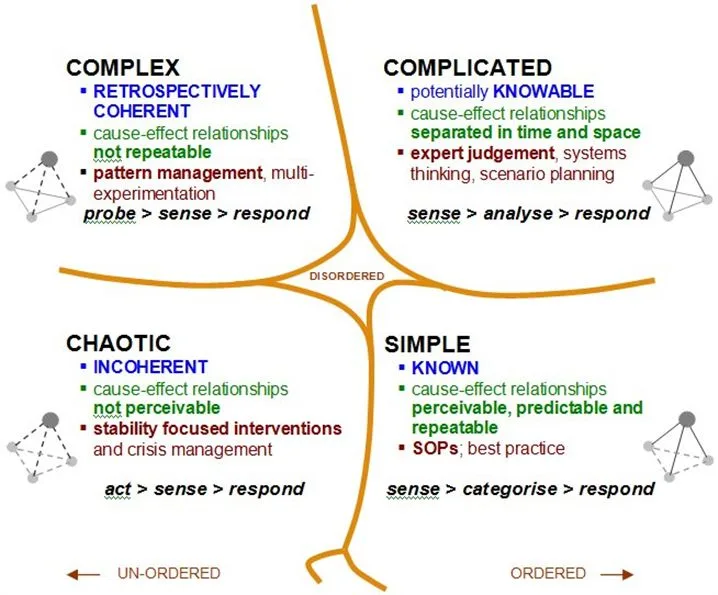
    Picture
    Regardless of which approach or framework you use, high-level sense-making and systems thinking expertise is vital. Heterodox ​perspectives are to be encouraged too. Without these, leaders run the risk of becoming introspective, leaning in on natural biases or, worse, preferred ideologies. Also, great care must be exercised to ensure intended visions are made plain, strategies are coherent and decisions are evidence-based. If such care is not taken, those concerned by what they deem to be inappropriate experimentation or investigation might bite back. ​Curiosity killed the cat, after all.
    The COVID19-induced crisis presents leaders (politicians, boards of directors, community leaders) with a golden opportunity to take stock and, having thought carefully, make decisions in the best interests of the constituency, company, community they serve. Effective decision-making in chaotic situations is far from straightforward, but our future prosperity depends on it.

  • Published on

    Boards and crises: seeing the bigger picture

    Picture
    The unexpected outbreak and spread of Covid-19 has had a seismic effect on the lives and well being of people, around the world. Politicians and government officials have activated crisis response plans (some more quickly and effectively than others) and business leaders have reached for their continuity plans. Amongst the turbulence, little if anything is clear—except that SARS-CoV-2 has our attention.
    Horizons have shortened, and most if not all resources have been diverted to deal with the situation. This is reasonable, but it also exposes the company to a significant risk. Business leaders (especially boards) need to keep one eye on the future, because the crisis will eventually pass. When it does, companies need to be ready to 'go' in the post-crisis environment, lest they be outgunned by others. 
    The most pressing questions for boards as they look to the future relate to the wider operating context, the answers of which inform strategic choices.
    • What has changed, and what might things look like after the crisis has passed?
    • How does this effect our ability to compete; and our ability to win?
    • What adjustments (both strategic and operational) are needed to ensure the company is positioned to thrive in the future?
    As boards work through these and other related questions, careful judgement (wisdom and maturity) is needed, to both balance competing interests (resourcing the crisis versus strategising the future) and to avoid traps that have the potential to stymie the company's recovery. Here are three pitfalls that can entrap boards:
    • Short horizon and great detail: While horizons are, naturally, shortened during times of crisis, boards need to begin looking further into the future early. But, when they do, they need to resist the temptation to dive into the detail (many directors associate detail with higher quality decisions and the mitigation of risk). This is a trap. A strong focus on perfection and detail diverts one's gaze away from the big picture, the wider context within which the company operates. Emerging but still weak signals and new risks will be missed. Left unchecked, the resultant strategies and decisions will be little more than long lists of activities. Roger L. Martin's words speak volumes: "True strategy is about placing bets and making hard choices. The objective is not to eliminate risk but to increase the odds of success". If in doubt, play long—but refine often.
    • An over-optimistic outlook: Strong leaders like solving problems, but they are also prone to thinking they are better or more capable than they are. We see it in politicians, project leaders and business executives: humans have an innate tendency to overestimate their abilities, especially to predict future outcomes. Boards are no exception. One way of mitigating this is to ensure someone acts as an advocatus diaboli  (devil's advocate), to challenge the thinking at each step along the way. Another is to explicitly seek expert advice from independent sources. An external facilitator with a strong personality (to manage egos!) can also be very valuable.
    • Confusion over the board–management nexus: This trap is more common than most care to admit. Usage of the term governance over the last 15–20 years has become so widespread (in appropriate and inappropriate contexts), that is has become a panacea for all manner of corporate activity and ills. With it, the board–management nexus has become clouded, with the two parties unsure of who is doing what. If the board and management are to work well together, with the company's best interests to the fore, a well-defined of division of labour is required, to allocate to tasks explicitly to the board, to management, or to both.
    The temptations to look just ahead; embrace detail; mitigate all risks; confuse strategy and tactics; conflate the roles of governance and management; and be highly optimistic are very real—more than many would care to admit. But they are by no means insurmountable. 
    Boards intent on ensuring the company is well-positioned to emerge from a crisis intact know that high quality steerage and guidance is vital: a clear sense of purpose (reason for being), a coherent and appropriately resourced strategy that is relevant to the circumstances, a dedicated team and effective oversight. They also know that this principle holds regardless of the company's size, sector or span of operations.
    A much brighter future awaits those companies that do not lose sight of the bigger picture as they work through the mire towards solid ground.
  • Published on

    Every stick has two ends

    Picture
    To suggest that the COVID-19 pandemic is the news story of the year is, as they say, a bit of an understatement. And it is easy to understand why. The personal, community and economic impact has been dramatic. Many thousands of people have died; untold millions have lost their jobs or soon will; community life has been put on hold; and economic activity has, largely, ground to a halt.
    As of today (14 April), nearly 2,000,000 people are known to have been infected by the SARS-CoV-2 virus. The actual number is unknown, but it will be far greater, without doubt. About 120,000 deaths have been linked to the virus as well—although most were due to co-morbidities. Only a small portion of the reported fatalities were directly due to COVID-19 (data from Italy suggests 12 per cent).
    Understandably, most of the reportage has concentrated on the headline numbers, decisions by politicians, and the public health response. But personal stories have featured too. As you would expect, partisan biases are also on display: Trump has been slammed and Ardern lauded
    Despite the seemingly strong alignment apparent across the reportage, the picture being painted is far from complete (the situation is still developing, after all), and it may not be accurate either. ​Underlying data may be misunderstood, misinterpreted or missing. Yet decisions need to be made, and decisions have consequences, just as sticks have two ends.
    The challenge for politicians is no different from that boards of directors face all the time. The best and most effective boards are those who seek counsel from a diverse range of perspectives (including competing options) before they make a decision.
    This article, positioned prominently on the front page of the Dominion Post today, highlights the emerging situation in New Zealand and the challenge for political decision-makers. It is well worth reading, as much for the language used as the story itself. The first sentence in the print edition read, "A group of public health experts has broken ranks on the Government's lockdown strategy ...". (The online edition was subsequently edited, at 8.28am, to read, "A group of public health experts has challenged the Government's public health strategy ..."​.) The cited experts argue that, with the border secure, various restrictions in place can (should) be relaxed, to enable people to return to a level of normalcy. This view is at odds with the advice the government seems to be relying on, but it remains valid as an option nonetheless and, therefore, merits consideration. 
    Whether the government decides to balance the best interests of the economy and society, or to hold tightly to the current course, should become clear soon. Regardless, its decisions will have consequences, just as every stick has two ends. Politicians, as boards of directors, ignore this truism at their peril.
  • Published on

    Sunlight, and the insolvency line

    Picture
    The global onset of the COVID-19 virus has precipitated a wide range of reactions in the community, from ambivalence to anxiety. Many governments have stepped in to support their citizens. Some have imposed community-wide lockdowns and social distancing protocols in an effort to break the spread of the contagion; others have implemented rigorous testing and quarantine regimes to identify and isolate those affected.
    Business leaders have been considering their options too. Working from home has become a 'thing', as has the use of video conferencing and other online tools. Amongst the many responses, one in particular caught my eye this week: proposals by the directors' institutes of several countries—notably AustraliaNew Zealand and Britain, and Germany and others as well—to temporarily suspend director liability in the case of insolvency.
    Superficially, this sounds like a reasonable idea. When a force majeure event strikes, the impact on sales, working capital and jobs may be very significant. The effect may be immediate, especially if the company is prevented from trading due to a lockdown. If the affected company cannot restructure its cost base, draw on financial reserves or secure finance quickly, business continuity will be at risk. Insolvency may follow, and all jobs will be lost. Thus goes the argument. But on the flip side (there always is one), the suspension of director liability and allowance to trade whilst insolvent may open the door for abuse, despite the honourable intention of keeping the economy functioning. 
    Insolvency has always been a red line for boards and companies. This proposal makes it porous, by absolving directors of responsibility for trading while insolvent. Some questions worth considering as lawmakers assess the proposal:
    • What is an acceptable level of insolvency, both in financial terms and time?
    • How will the suspension of liability provisions be monitored and policed?
    • How will any suspected abuses be detected and dealt with?
    • How will the judiciary distinguish between a crisis-induced insolvency, and one resulting from recklessness?
    • When the COVID-19 scare has run its course and a level of normalcy is reached again, will the proposed provision be removed, promptly and in full? Or will a further period of grace be allowed?
    ​While a force majeure event can catch even the most well-run companies out, those with strong balance sheets and highly-engaged boards are better placed to respond well. They probably do not need the protection of the proposed provision, because they are more likely to have a robust risk assessment and mitigation framework in place, and strategic risks will have been assessed at most board meetings. But those companies being run close to the wire, or with inadequately engaged boards or weaker systems, may be caught flat footed. And if they are, what then? Should directors be protected, or be held to account? 
    Lawmakers need to tackle these types of questions, and resolve ambiguities thoroughly. If they don't, expect scurrilous directors to exploit the inevitable loopholes—to defend against other, board-induced, problems such as ineptitude, incompetence, negligence or malfeasance, for example. 
    Enquiry is appropriate, regardless of the catalyst, because sunlight, as they say, is a great disinfectant.
  • Published on

    Governing well, in the face of a crisis

    Picture
    Information (and mis-information) about the spread of COVID-19 around the world is clogging our airwaves, inboxes and social media feeds as quickly as the virus itself is spreading. But amongst it all, there are some things we can hold as self-evident. Many people are suffering, some are dying. New phrases are entering the lexicon, such as, social distancing (should be physical distancing, I think) and self isolation. Governments are responding with a variety of controls to limit movement. Borders have been closed, and lockdowns are being imposed in some areas. Airlines have reduced capacity, grounding fleets. Many businesses, especially SMEs, are in turmoil. People are on edge—lives have been put on hold.
    While COVID-19 has spooked many people, not to mention the stock markets and wider economy, life must go on—and it will, albeit with some adjustments, of course.
    The challenge for those who direct the affairs of companies—boards—is one of governing well in the face of what is, patently, a very different environment from that which existed even two weeks ago.
    Businesses face continuity and safety risks every day. Routinely, staff and managers spot, assess, prioritise and respond to operational risks every day; that is their job. But when risks have strategic implications (i.e., an occurrence is likely to have a major effect on strategy execution, future business success or even company viability), the board must become involved. COVID-19 is one such risk. The board needs to understand the potential short- and longer-term impact (using information from credible sources and tools such as scenario planning, for example), consider various options and make informed decisions.
    Some practical questions that the board may wish to consider include:
    • Has management made changes to the work environment (including remote working options, physical barriers, closing sites, etc.) to ensure the safety of all staff, customers, suppliers and any visitors?
    • What additional financial resources need to be released to support continued business operations, and how will they be provided?
    • What is the likely impact on short- and longer-term income, and do any adjustments need to be made to reduce operating expenses (including, potentially, suspending or releasing staff) to maintain viability?
    • What capital projects can be deferred to release funds to support working capital demands?
    • ​Should the board itself use on-line meeting or video conferencing tools instead of meeting in person?
    • Should the board meet more frequently, rolling its sleeves up in support of management and for more timely decision-making?
    One final point. COVID-19 is no longer a strategic risk. It is upon us. Boards everywhere need to deal with it as well as they can, given the most reliable information available, with the best interests of the company to the fore. That means providing close support to management; more so if big decisions are needed, such as releasing staff or partial closures. However, and most importantly, boards should not panic. Neither should the board react to suggestions being advanced by some that an event such as the COVID-19 outbreak should be seen as a catalyst to redefine corporate governance. Corporate governance remains corporate governance—the means by which the company is directed and controlled. What might be appropriate though is a review, to consider how the board practices corporate governance. But that should wait until the current crisis in in hand. Fix the problem first, then learn from it.
  • Published on

    Hiding in plain sight

    A kerfuffle has broken out on the East Coast of the US, between Lucian Bebchuk, an esteemed professor at Harvard University, and Martin Lipton, partner at New York law firm Wachell, Lipton, Rosen & Katz. Specifically, Lipton has mounted a strong attack on an article published by Bebchuk (a critical examination of 'stakeholder governance'). That Lipton has objected should not be surprising. After all, he is a lawyer with vested interests and he has a long record of promoting stakeholder governance.
    This is what Bebchuk asserted:
    Stakeholderism, we demonstrate, would not benefit stakeholders as its supporters claim. To examine the expected consequences of stakeholderism, we analyze the incentives of corporate leaders, empirically investigate whether they have in the past used their discretion to protect stakeholders, and examine whether recent commitments to adopt stakeholderism can be expected to bring about a meaningful change. Our analysis concludes that acceptance of stakeholderism should not be expected to make stakeholders better off. 

    Furthermore, we show that embracing stakeholderism could well impose substantial costs on shareholders, stakeholders, and society at large. Stakeholderism would increase the insulation of corporate leaders from shareholders, reduce their accountability, and hurt economic performance. In addition, by raising illusory hopes that corporate leaders would on their own provide substantial protection to stakeholders, stakeholderism would impede or delay reforms that could bring meaningful protection to stakeholders. Stakeholderism would therefore be contrary to the interests of the stakeholders it purports to serve and should be opposed by those who take stakeholder interests seriously.

    Lipton's counter to these assertions was strident:
    We reject Professor Bebchuk's economic, empirical and conceptual arguments. They are ill-conceived and ignore real-world challenges companies and directors face today.

    As we have discussed, new laws—such as federal legislation of the type proposed by Elizabeth Warren—are likely to sweep far too broadly and risk substantial destruction of corporate value. They are also unnecessary if companies and investors embrace stakeholder capitalism as contemplated by The New Paradigm and as adumbrated by the actions Professor Bebchuk condemns.

    We recommend that companies and boards monitor and review their stakeholder and ESG profiles as a matter of increasing priority, and engage regularly with their major investors on these issues.
    This debate exposes something awkward—that when partisans announce their views people react, especially if they denounce other perspectives. This tactic may well pique interest and sell column inches, but it rarely results in viable outcomes that can be sustained over time. 
    My own research, and experience both as an advisor and serving company director, suggests that either-or argumentation, a characteristic of determinism, is deeply flawed. To pursue profit as an exclusive goal inevitably results in selfishness and inequity. Similarly, the pursuit of priorities espoused by ESG proponents introduces a another, and not insignificant, risk—of exposing the companies and the economy more generally to an 'Icarus moment'. 
    Larry Fink, Chairman and CEO of Blackrock, summed things up well in his January 2019 letter:
    Profits are in no way inconsistent with purpose—in fact, profits and purpose are inextricably linked. Profits are essential if a company is to effectively serve all of its stakeholders over time—not only shareholders, but also employees, customers, and communities. Similarly, when a company truly understands andexpresses its purpose, it functions with the focus and strategic discipline that drive long-term profitability. Purpose unifies management, employees, and communities. It drives ethical behaviour and creates an essential check on actions that go against the best interests of stakeholders.
    Fink's position highlights that a balanced perspective is probably 'best'. But how might it be achieved? The pathway may be hiding in plain sight. If the board is to fulfil its duty to ensure value is created over time, it needs to look well beyond selfish interests and motivations. This means considering the wider context within which the company operates, creating a viable strategydetermining appropriate 'performance' measures and only then governing accordingly. 
    Bebchuk was brave to call out the messianic assertions of the stakeholder capitalism camp. Perhaps Lipton might take stock, and meet with Bebchuk—the purpose being to explore the nuances of each other's views, in search of a more balanced understanding of the purpose of companies and role of the board.