• Published on

    A journey, in thought and deed

    Picture
    When I was a boy, milk was free (I was raised on a dairy farm), but you could buy it in a glass bottle with a silver foil top (pasteurised but not homogenised) for four cents a pint at the general store. Television (once we got one, in 1969, to see the Apollo 11 moonshot) was a grainy, black-and-white experience, with a single channel available. You got to watch whatever the broadcaster chose to deliver across the airwaves.
    Now, milk costs several dollars a litre, but it comes in many different styles (blue, light blue, skim, lo-fat, full-cream, calcium fortified, lo-lactose and UHT—as well as products called milk that contain no milk at all, such as oat milk and almond milk, in a wide variety of packaging options). Television has changed too: from a take it or leave linear broadcast experience via rabbit-ear antennae, to a plethora of video-on-demand (streaming) options via the internet. 
    These are but two of thousands of examples that illustrate the onwards match of technology. Oh how life has changed, even in my lifetime.
    The onward march has also affected the way we communicate, not only personally with family and friends, but also with clients, suppliers and the general public as well. The notion of using a fountain pen to handwrite a letter, or making a toll call, seems quaint now—but some of us still value these moments. The emergence of social media has extended our reach in ways not thought possible twenty years ago. Sharing business cards, once commonplace, is now rare. If people want to contact me or learn about me, they tend check my LinkedIn profile (notice the assumption, that I have one), even before mentioning Google or asking about a website or blog. 
    And that brings me to the point of this muse, which is to share one aspect of a conversation with an esteemed company director, in the hope it might encourage others committed to serving the director community. Yesterday, I was asked about the role of social media in my business life, what channels I use and how long had I been using these. The first two questions were readily answered; the third took a little longer—because I needed to find the menu option!
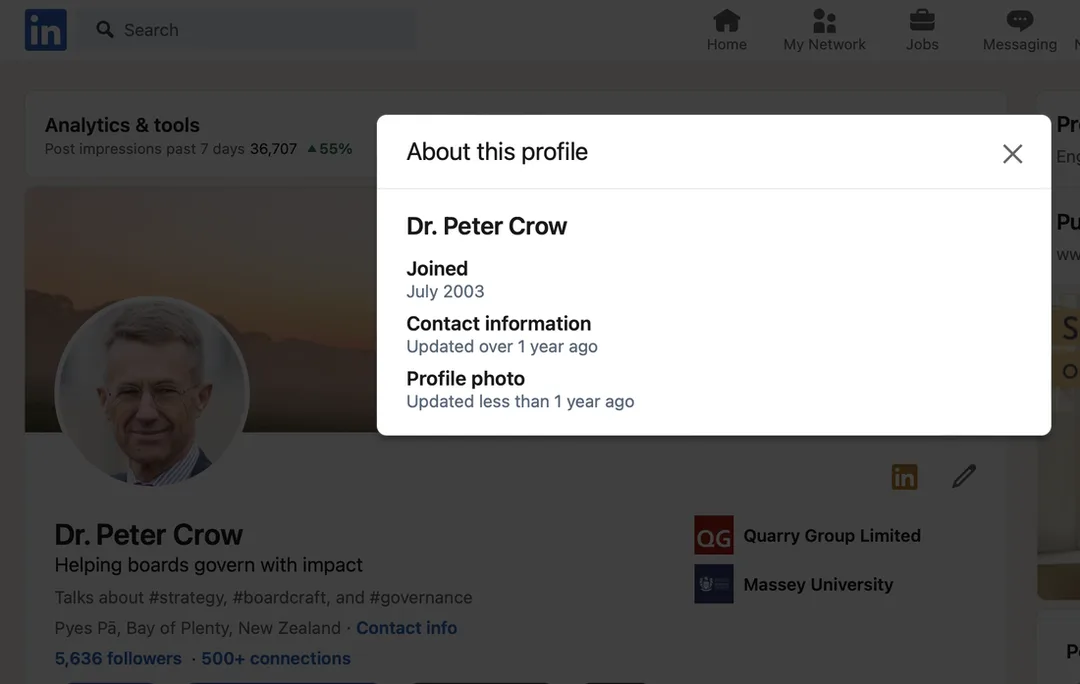
    • Social media: LinkedIn is the only social platform I use. It complements my website and blog, as a forum to comment on topical issues, share articles written by other people and, candidly, reach boards and directors who make use of Linkedin as a trusted source of information. Previously, I used Twitter, but that did not last long for the platform was, I thought, little more than a soapbox for people to shout at each other. When I checked my LinkedIn profile, I was surprised to see I had first used the platform in July 2003, over twenty years ago and just three months after the platform was officially launched by Reid Hoffman!
    • Website: petercrow.com was first launched in November 2001, the month after I left paid employment and founded QuarryGroup, the global board advisory practice. Musings, the blog, came later, in March 2012. The websites were (and remain) online brochures, whereas the blog was created as a place to share my thoughts and test ideas while working on my doctorate. Since 2016, Musings has become a forum for a wider range of board and governance topics. Today, approaching 750 entries later, Musings is read widely, by a global audience.
    Thank you for permitting me to share my experience. I hope anyone considering using social media or a blog as a channel might be encouraged—not only to do so, but to stick at it over the longer term. My journey to date has been fulfilling; I have met thousands of people from many walks of life and, I hope, they have valued the interaction as much as I have.

  • Published on

    Boards and ... mathematics?

    Picture
    Diversity of thought has been widely promoted in recent times, as a mechanism to supposedly increase decision quality in boardrooms. Superficially, the idea of thinking differently is a positive evolutionary development from earlier efforts (think: women on boards) to break what is often described as the Old Boys' Club. That the discourse and intent has begun to move beyond appointing directors on the basis of physical attributes is helpful. And yet, the idea of 'diversity of thought' has long troubled me. 
    How does anyone know what I am thinking, or anyone else in the boardroom for that matter? And what is diversity in this context anyway—me having different thoughts, or several of us thinking differently? Crucially, what of any link to the board's work and purpose, which is to provide steerage and guidance to achieve a strategic goal? 
    Researchers have published correlations based on specific datasets, but the general case (a reliable linkage between demographic diversity and organisational performance) remains elusive. The somewhat amorphous 'diversity of thought' is similarly afflicted. Recently, cognitive diversity (that is, different ways of processing information and approaching problems) has been suggested as a more reliable mechanism to achieve higher quality decisions and, by implication, outcomes. This sounds positive, but reliable explanations are yet to emerge. 
    Why is this so hard? Could the paucity of reliable explanations (of the relationship between board work and company performance) be due to researchers, directors' institutions and others trying to explain board work and develop 'best practice' models looking in the wrong place or using inappropriate tools? What if hypothetico-deductive techniques (in search of a deterministic best practice approach to some aspect of board work) are laid to one side and methods more common in social science used (critical realism or contingency theory, for example)? Should researchers embrace the idea that boards are social organisms, and that governance is a mechanism activated by the board?
    For the record, I employed critical realism, long-term observational techniques and contingency theory when researching boards a decade ago, as part of my doctoral research. The study was ground-breaking for it revealed new insights about board work including an explanatory framework. If you want to learn more about this study, check my thesis (academic-speak) or this article (plain-speak).
    In the past few weeks, I have picked up the question again (thanks to a wandering mind on long haul flights!), and have begun to wonder if fractals and chaos theory might offer a viable pathway to developing a theory of board work. Whether this might be a fruitful search or a blind alley remains unclear. Regardless, my mission is to help boards govern with impact, so the least I can do is dig further. And dig I shall.
    One request: If you know about fractals, or know of anyone who possess such expertise—especially in relation to social phenomena—could we schedule a call please? I'm starting from a pretty low base!
  • Published on

    Better board work: what does 'good' look like?

    Picture
    And there you have it: before many of us realised, the solar equinox has passed once more—that moment when the sun passes the celestial equator and winter (or, for those in the global south, summer) beckons.
    The equinox also signals the recommencement of on-the-ground contributions in the Northern Hemisphere. To wit, I shall be in the United Kingdom and Switzerland soon—from 2nd through 13th October, in fact. My programme sees me in London, Leeds, Cambridge, Zurich and St. Gallen, for a variety of contributions:
    • ​meetings with boards, directors and colleagues;
    • a private luncheon with a doyen of corporate governance;
    • two conferences (EIASM 20th anniversary workshop on corporate governance, in St. Gallen; and, the IBEM thought leadership conference, in London);
    • delivery of two keynotes and a guest lecture; and,
    • some quiet time writing.
    I am looking forward to hearing the heartbeat of company directors, advisors and others, to understand recent developments and emerging trends, and to discern changes since I visited earlier this year.
    I have intentionally held space available for a few informal meetings. So, if you want to meet up while I am in your neighbourhood—be it to discuss the work and impact of boards, corporate governance, or some other topic of interest—do get in touch. I would be delighted to hear from you.
  • Published on

    On writing well:

    Picture
    One of the great challenges for board directors and executive leaders concerns written expression. How might one cast vision, report progress clearly, make a request unambiguously, or argue a point convincingly if the key messages are not clearly stated? Directors and executives owe a duty to their colleagues in this matter, for written reports are the primary vehicle for sharing ideas, proposals and data before each board meeting. 
    To suggest the quality of the report (especially, the clarity of the message within) may be the difference between success and failure (that is, acceptance or rejection) is, probably, a truism. ​So, if we are to be convincing in our argumentation, we need to write well. But how?
    The first thing to acknowledge is that writing is a craft. And, as with any other craft, proficiency is something that emerges over time, as principles are learnt and applied in practice. Look to others who write well, and glean from them. Seek feedback from your readers too, and make adjustments. 
    I have long relied on the guidance of William Zinsser (1922–2015), especially that offered in On writing well​. Another great source is the Blue Book of Grammar and Punctuation, which provides specific instructions. How do you ensure board reports and business proposals are well written, and what tools and approaches do you use?
  • Published on

    Do you have a question about governing with impact, or driving organisational performance?

    Picture
    One of the great joys of being an independent advisor is the opportunity to spend time with people from a wide range of backgrounds; business and social experiences; walks of life; and, in my case, countries and cultures. The depth and breadth of humanity never ceases to amaze me. Paradoxically, a common thread runs amongst the diversity: people intent on improving organisational effectiveness and making a difference spend lots of time asking questions, lots of questions.
    When a question is asked from the floor after a keynote talk, during an advisory engagement or professional development workshop, or as part of a confidential discussion or informal chat, something mysterious happens: Both parties learn! This should come as no surprise, for no one has all the answers—although some people behave as if they do.
    Recently, I posed several questions board directors may wish to consider. ​The response to that musing has been overwhelming, so I thought an open invitation might be in order.
    ​If you have a question about any aspect of corporate governance, strategic management, board craft or the challenge of governing with impact—either personally or on behalf of a board you serve on—please ask and I will gladly respond. Use the comment link here or, if you prefer, send an email. Let's learn together!
  • Published on

    The questions we ask matter, do they not?

    Picture
    The role of company director has become quite visible over the past couple of decades. From hardly rating a mention in the popular press or polite society fifty years ago, public awareness of boards and directors has blossomed in recent times. Questionable practices and failures of various kinds have seen boards become a source of board fascination and disdain—targets of criticism in the eyes of the business media, political class, regulators and, increasingly, the wider public. Activists, institutional investors, proxy advisors, and other stakeholders and supernumeraries have sought to exert influence and press various claims too, on both company priorities and board decision making (think: ESG, disclosures, DEI, climate change, net zero, and more besides).
    While some boards have responded well to changing circumstances, others have battened down the hatches. Defensiveness can be an important response at times, but it is not a sustainable tactic given the mandate to govern (provide appropriate steerage and guidance to achieve a specified goal).
    If directors are to steer and guide effectively, they need to consider information, ask questions to check progress and elicit missing information and, having debated various options, make decisions. This is crucial, for the questions directors ask may be the difference between effectiveness and ineffectiveness in role. The following list provides a useful starting point for boards intent on governing with impact:
    • Why does the company exist (purpose)?
    • Are we doing the right things, to achieve agreed purpose?
    • Are intentions, decisions and instructions being actioned as planned?
    • Are expected benefits [from a prior strategic decision] being realised?
    • How are we monitoring and assessing signals, disruptions, and trends?
    • Are we attuned to stakeholder expectations and preferences?
    • How will shareholders and legitimate stakeholders be kept up to date?
    • What of non-business matters, such as, funding family activities, or social or environmental concerns?
    • Is enough time being allocated to scenario planning and strategising?
    • Is resource allocation aligned with desire outcomes?
    Do you agree or disagree—I welcome your thoughts on this! Also, what other questions have you found useful?