• Published on

    On 'corporate governance': Is our understanding flawed?

    ​One of the enduring questions of my career as a board advisor and company director is this:
    • When and how did our predeliction for the term 'corporate governance' emerge?
    ​My father was a company director, of a large processor in the dairy sector for fifteen years. He hadn't heard of the term until six months before he retired in 2001, when a young director who had recently joined the board started using the term. To that point, my father thought that directors governed and provided direction, and he was not alone.

    Picture
    A search back in time reveals that Eells (a researcher) was the first to use the term—in 1960—to describe the functioning of the polity (the board). Then, silence reigned until 1977 when the term appeared in HBR and subsequently in 1980 in academic journals. Yet since 2000, when the term entered the public's consciousness (perhaps as a result of media reports of hubris, incompetence, moral failures and fraud amongst directors), usage has exploded.
    ​Today, the term's usage has become so commonplace and distorted that a correction is needed.
    ​Corporate governance--the act of steering, guiding and piloting—describes what boards [should] do when in session. It does not describe and is not a proxy for the board itself, nor any other party or activity outside the boardroom. Regulators (to set rules), proxy advisers (lobbyists on behalf of shareholders and other interests), and shareholder meetings (communications) are all important, but none is corporate governance.
    Rob Campbell, your call to address this misunderstanding is both timely and most welcome. Directors institutes, business schools and consultants should take note, lest the expectations of the market, regulators and shareholders—not to mention directors themselves—wander further away from their original purpose, which is to pursue business performance in the best interests of the company and on behalf of shareholders.

  • Published on

    Strategy without purpose is, actually, just a collection of activities

    Image description
    Do you know why your company exists, it's raison d'etre? Can you provide a clear and succinct response to the question, or does the question leave you somewhat flummoxed? When I ask the question of others (it's usually the first thing I ask when leading a strategy development workshop), the most common response is a description of what the company does. But this does not answer the question! 
    Most people (especially your staff, customers and suppliers) don't care what your company does, they want to know why. You need to be able to tell the story. This article, published by Harvard Business Review sums it up nicely. Here are some questions for your board to consider:
    • Does your company have a single, clearly-stated purpose?
    • Is the purpose consistent with the wishes of shareholders?
    • Is your company's strategy demonstrably linked to achieving the agreed purpose?
    • Has the purpose been communicated throughout the company?
    • Do people (the board, management, staff) buy in to it?
     Directors need to get their collective heads around these questions. It's a matter of leadership, and of accountability. Let me know if you need any assistance with this, I'd be delighted to help.
  • Published on

    Effective boardroom practices: Dispatches from Singapore

    ​Nearly fifty chairmen, directors and company secretaries from around South-east Asia, the Middle East and Northern Africa gathered at the Ritz–Carlton Millenia Hotel in Singapore this week for The Boardroom Agenda conference. Delegates received presentations, shared stories and debated issues over two days (23–24 November), under the Chatham House rule. I had the honour of contributing to the discussion on the second day. Here are some of the takeouts:
    • Neal Cross, Managing Director and Chief Innovation Officer at DBS Bank provided a stirring keynote presentation to kick off the day. Disarmingly frank in delivery, his topic Fostering innovation in the boardroom was both challenging and well-received. Cross asserted that banks simply must innovate, and radically so, lest their market collapses around them as fintechs and large technology companies (read: Google, Amazon, Apple, others) eat the bank's lunch. He then outlined the DBS approach to innovation, which includes a three-day 'hackathon', whereby teams of staff are set up to create new product ideas. The resultant ideas are pitched to the board, and funding is provided to commercialise the best ones—entrepreneurship in action.
    • Raoul Chiesa, Board Member on the Italian Association of Critical Infrastructures delivered a wake-up call to delegates. Speaking straight off a flight from Europe, Chiesa, an expert of information security matters, summarised the history of hacking and the crucial need for boards to take information security seriously—all with some powerful (and quite alarming) case studies and real-world examples. Delegates were amazed at the scale of the problem and the material risk to commerce that 'the bad guys' present. The cyberthreat is widespread and poorly understood, especially in boardrooms. The message was clear: boards need to get up to speed, by receiving presentations and updates from experts; asking probing questions; taking a strategic view of risk; and, empowering the CEO to act.
    • The pre-lunch session took the form of a panel discussion and dialogue with delegates. I joined Ralph Ward at the front of the room. A wide range of topics were explored including the merit of codes of conduct; diversity in the boardroom;  the conundrum of balancing conformance and performance; confidentiality; conflict management; the conduct of effective board evaluations; and, the difference between so-called independent directors and independence of thinking. Delegates seemed to appreciate the candid responses from panelists, including recognition that no one-answer-fits-all; best practice often isn't; and that the work of the board can be messy.
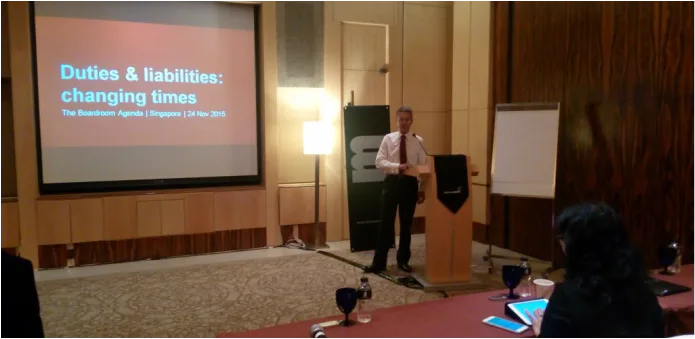
    • After lunch, delegates attended one of two streams. I chaired the Board Insiders one. Dr Lim Lan Yuan, a Singapore-based business and law scholar and company director spoke first. He managed to squeeze forty years of experience into a thirty-minute talk. It was a sight to behold. Delegates were enthralled with his summary of how boards should work; how they actually work (or don't); the importance of a clear division of responsibility between board work and management activity; the importance of the board undertanding the business of the business, strategy and market trends; boardroom dynamics; and, anecdotes of associates that messed up (badly) and went to jail. That Dr Lim was able to move seamlessly between theoretical concepts, practical recommendations and real-life stories as he spoke helped the delegates gain considerable value from the talk. The only person who struggled with his commentary was me: Dr Lim covered off several of the points that I was going to discuss in the following slot. Consequently, a few on-the-fly adjustments were needed to extend the discussion to related areas of interest (see pic below). That the delegates heard similar stories and recommendations from two different speakers with different cultural and business backgrounds was hopefully encouraging—and supportive of the notion that 'good practice' is good practice almost anywhere.
    • The final session of the day was a 'deep dive', whereby delegates gathered around one of two tables to consider a table-question and to share experiences. One table was asked to identify factors that contribute to both good and bad dynamics in a boardroom, and the other was asked to discuss how a board should function in the event of a major crisis. The groups had 30 minutes or so to wrestle with the assigned question and then report back. The insights shared were great, and the good-natured banter demonstrated that the delegates had built a good rapport with each other. Thank you to Dr Lim and Curtis Chin who moderated the table discussions. You made my job of session chair very straightforward.
    • The conference was organised by marcusevans. Their people did a great job, both in the weeks leading up to the conference and at the venue itself. If you get the chance to work with them, take it.
    Picture
    ​I've come away from the conference with the impression that the quality of corporate governance and board practice in Asian and Middle Eastern economies is rapidly improving. Overall, the hunger to improve board effectiveness was plain to see, as was the desire to learn from those with experience gained elsewhere (if the many conversations, requests to return and business cards in my satchel are any indication). However, care must be taken to ensure that models and frameworks in use in the Anglosphere are not blindly implemented in this region. Such colonialism is unwarranted and patronising, and it may be culturally demeaning as well.
  • Published on

    Governing Apple is nothing like governing a fledgling company

    Image description
    What is it with corporate governance? Thirty years ago, the term hardly rated a mention in business magazines—let alone general conversation. Now, corporate governance is seen by many (tacitly at least) as a panacea for all manner of corporate ills and director recalcitrance. The pursuit of best practice models (the one-size-fits-all approach) has become commonplace, even though the operating context of and challenges faced by small and medium companies are fundamentally different from those of publicly listed corporations. 
    Mak Yuen Teen, an associate professor of the NUS Business School and corporate governance expert thinks the one-size-fits-all approach is myopic and has just gone on record on the matter. Furthermore, many commentators, regulators and serving directors seem to have lost sight of Sir Adrian Cadbury's commentary, that corporate governance is primarily about the performance of the business. My experience, in research and as a serving director bears this out.
  • Published on

    The board chair's dilemma: what would you do?

    Each month, Julie Garland McLellan, non-executive director and board consultant, invites several people to respond to a tricky board or governance situation. This month (Oct'15 issue), she crafted a challenging relationship dilemma with an ethical twist, and I was asked to provide a response. Thanks for inviting me to contribute Julie. The dilemma and my response are replicated here:
    The dilemma:
    ​Ximena chairs a government utility business that operates large primary industrial processes and is also involved in construction of new assets. Safety is a key issue and the board have zero appetite for any physical harm to staff, contractors or innocent bystanders. As board Chair Ximena also chairs the remuneration committee and has recently incorporated some nominations work into the charter and activities to better support the government with their desire to involve boards in director succession planning.

    The HR Director recently asked Ximena for a meeting at which she told Ximena that staff were concerned by the CEO’s activities outside of work. Specifically the CEO is involved in White Collar Boxing and the HR director feels this is not appropriate given the culture of the workplace and the visible support the organisation, and many other government companies, has given to anti-domestic violence campaigns. The HR Director also checked the terms of the company’s key man insurance policy and discovered that this would be voided for injuries or death resulting from action sports activities that include boxing. The HR Director has asked that Ximena talk to the CEO about ceasing his involvement with the sport.
    Ximena is concerned but cautious. She knows that the CEO, who was brought in from commercial industry, and the HR Director, a long serving public sector employee, have often differed in their opinions and that, whilst both are professional, there is scant respect and less regard between them. But she has to admit that a boxing CEO might not sit well with the ‘A Fight is Never Right’ campaign the company has just sponsored.
    Is this the CEO’s private business or an issue for the company and its board: What should Ximena do?
    Peter's response:
    ​Broadly, Ximena has four options:
    1. To ignore the HR Director’s appeal, by pushing back. However, this may see the issue ‘leaked’ to the public domain, especially given the HRD’s lack of respect towards to the CEO. If this were to occur, the board may be faced with a bigger problem - a damage control action. This option also provides tacit endorsement of the CEO’s actions.
    2. A private conversation will enable Ximena to hear the CEO’s perspective, ask questions and make suggestions. The CEO may not see the matter as a problem! Contingent on the quality of the working relationship, the chairman should be able explore options, present the wider perspective and reach an agreement over how best to proceed.
    3. To ask the CEO to meet with a board committee does two things. It signals to the CEO that the board is treating the matter seriously, in pursuit of a workable solution. However, it also sets a precedent whereby staff can approach the board directly. Staff need to take their concerns to the CEO first.
    4. To launch a full (presumably formal) investigation. This is probably an over-reaction.

    The most tenable option is probably the private conversation. While legal private activities are not and should not be the concern of the company, activities that may be considered to be incompatible with the company’s purposes, values or culture, or may call the company’s reputation into question or bring it into disrepute need to be curbed - particularly as the CEO is a highly visible role. Through their actions, they set the cultural tone of the organisation.
    Notwithstanding which option is eventually selected, the tension between the CEO and the HRD is a problem that needs to be resolved. The scant respect and regard is a harbinger of low trust, empathy and teamwork; thus rendering the working relationship difficult, at best. Whether the two parties are able to work together productively in the future is probably moot, especially as the HRD went around the CEO to the chairman directly. The HR Director probably needs to consider her tenure with the business.
    If you want to understand more about these options, or if you think you might need assistance with a challenging board situation, please get in touch.
  • Published on

    New VW CEO wants a new strategy. Why?

    An interesting development hit the press today: Matthias Mueller, the incoming chief executive of Volkswagen AG, reportedly wants to embrace a new strategy for the beleaguered group. That an incoming chief executive wants to put his mark on the business is not particularly newsworthy, it is commonplace.
    The interesting piece is the board's response. Will it entertain a new strategy, or will it assert its authority as the top-most decision-making authority? The challenge for the VW board is to decide whether the existing strategy is satisfactory and well-implemented (notwithstanding the scandal relating to the US market emission standards), or whether the company's strategy is flawed.
    Given the strong financial performance over recent years, the more likely of the two options is that the strategy is OK. If this is correct, the board's decision becomes a straightforward assessment of power. Who is in control, the board or the chief executive?