• Published on

    On boardroom decision-making: How does your board measure up?

    Picture
    Boards are under pressure. Every time news of another corporate failure hits the news waves, attention is focussed on the board. Such attention is justified; ultimate responsibility for company performance lies with the board after all. That five out of six directors do not have a comprehensive understanding of the business of the business they are charged with governing suggests that boards deserve the scrutiny they get.
    Regulators have responded by instituting a raft of regulations—and directors' institutions and others have promulgated codes and ‘soft’ guidance too—in the hope of improving board practice. Activists have not been idle either, voting against those perceived to be ill-equipped to contribute well. To date, actions taken have had the opposite effect in many cases. The rising tide of regulations and codes, and activism, has seen many boards adopt a siege mentality. What is more, many boards struggle with the seemingly straightforward task of making smart decisions to ensure future business success. 
    Research published by Henley Business School nearly a decade ago showed fewer than one in three boards have sufficient cognition, cohesion, commitment and knowledge to reach a conclusion, much less make a smart decision. ​If the level of understanding of the business amongst directors is low, and the quality of the board's decision-making is weak, it is little wonder aspersions are being cast and board effectiveness is being questioned. Reputations are on the line, and rightly so. 
    Boards are by no means powerless, of course. My global research reveals a common pattern amongst the most effective boards: they are aspirational, and they ask great questions to inform their decision-making. Five questions, in particular, stand out:
    • What are we trying to achieve?
    • Are we doing what we planned?
    • How does this fit proposal with our agreed strategy?
    • What are the expected benefits and how will they be achieved?
    • Have we made good decisions today?
    If boards are to have any hope of governing with impact, directors need to understand the operating context (market and competitors), emerging trends and disruptions (situational awareness), and the business of the business. They also need probe and verify (that is, ask good questions and cross-check), to determine whether the decision under consideration is not only meritorious, but well-aligned with, and contributory to, the agreed corporate purpose and strategy. Anything less is a dereliction of duty, n’est-ce pas?
    How does you board measure up?

  • Published on

    The map is not the terrain

    Picture
    Since time immemorial, man has sought to explore: natural curiosity has led to many discoveries, of previously unknown lands, flora and fauna, and more besides. Innovations and inventions too; discoveries enabling further exploration, and on it goes. Through the arc of history, exploration and discovery has been based upon empirical techniques—going and having a look.
    About six decades ago, Jane Goodall put this approach to work as part of her research to learn more about chimpanzees. Her assessment was, straightforwardly, that if reliable understandings of how chimpanzees socialise were to be achieved, they needed to be watched, directly, over an extended period, as difficult as that might be. The extended period is necessary because behaviours change when a new actor arrives. Thus, Goodall’s study could not begin in earnest until the chimps became more familiar with her and reverted to behavioural patterns thought natural. When behaviours reverted, as Goodall thought they might, several new discoveries not previously known were made.
    The approach Goodall used, and her discoveries, demonstrated the high value of longitudinal ethnographic techniques when studying social groups and their behaviours. And yet, while this has been understood for decades, centuries even, its application to my field—boards—is rare. Instead, since the dawn of board research, the dominant paradigm has been to collect data about directors, the composition of the board and other data, from outside the boardroom, typically from public databases, interviews and surveys. Such approaches have been deemed acceptable because researchers have found it very difficult to enter the boardroom. Given the only place the board and its work actually exists is in the boardroom, and that the board is a social group, surely the gold standard must be to conduct long-term studies of boards in session (through direct and non-participatory observation), as Goodall studied chimpanzees?
    This issue, of using appropriate techniques that explore the subject of interest, not a proxy, was made plain by an ex-military colleague recently; his pertinent remark was, simply, “The map is not the terrain.” What seems to be the case (on the map) may not be the case (in reality). The underlying message was confronting: if you want to really understand, go there, gain first-hand knowledge. And so it is with board research. If we really want to understand how boards work, and how boards actually make decisions and influence performance, not how directors say they do when they are interviewed, watch them over an extended period. Then, possibly, you might be able discern what happens; how directors act and interact; and, even, spot associations between a strategic decision and some subsequent change in organisational performance. The findings will be contingent, of course, because the group is social, the situation complex, and external influences are many and varied.
    To date, fewer than a dozen longitudinal observation studies, of boards going about their work, have been published. And, somewhat awkwardly, the reported findings present a different perspective from that commonly asserted by others informed by research conducted away from the boardroom: The capability of directors (what they bring), the activity of the board (what it does), and behaviour (how directors act and interact), appears to be far more important than the structure or composition of the board.
    Now, as I wait to board a flight, for yet another international trip to work with boards, my colleague’s comment is ringing in my ear. And with it, a question, “What guidance will you rely on, given the importance of governing with impact?”

  • Published on

    Boardroom effectiveness: Managing difference

    Picture
    In recent times, diversity, equity and inclusion (often, DEI) has become topical in many spheres of business, social, organisational and political life, and boardrooms are no exception. The moot is that increased in-group diversity directly enhances organisational (project, team) performance. While this remains unproven, expectations are running high, and there are no signs they are abating.
    With this development, tensions have become apparent: between those people and groups who argue that demographic diversity is material to better outcomes, and those who do not; those who assert that boards should be representative of the shareholders or communities they serve, and those who prefer the best governors in the room, regardless of representation, to ensure the best decisions are made. 
    These tensions, and the underlying complexities extant both within an organisation and in the wider marketplace, are real. Boards ignore them (or discount or run roughshod over them) at their peril. Difference needs to be acknowledged and harnessed, to draw out multiple perspectives. But directors need to be sufficiently mature and wise to also align their efforts, to ensure great decisions are made having taken various contextual factors into account. This is hard, not only because directors need to find common ground where little may exist, but also because cultural differences tend to run deep and they may be difficult to navigate.
    Seemingly straightforward matters are almost guaranteed to become difficult if cultural norms are ignored or brushed over. Consider these cultural scenarios, all of which I have experienced over the past twelve months:
    • Starting the meeting 60 minutes after the advertised time. This was a misread on my part: the hosts started at the advertised time, but not with the business meeting as I expected. There was a formal welcome and a light meal (culturally normal for the board, but not advised to me). Around 60 minutes the after we first assembled, the chair called the directors and visitors together, and the 'formal meeting' got underway.
    • A female board member seemingly ignored. In the West this would be uncommon; indeed it would be offensive for some. But it happened during a board observation in a highly patriarchal community setting. While the group seemed to be accommodating, the woman was present in body only; cultural norms prevented her from speaking or otherwise contributing in any meaningful way.
    • An entire group I was working with went silent on me. The group had been animated and engaged until they were asked a question that put them on the spot. Rather than engaging with the question, or expressing their discomfort at being asked, they simply sat and waited, and waited. After a minute or so, I asked for help. The group 'leader' said that, culturally, they preferred not to debate sensitive matters 'in public' (that is, with outsiders, such as me).
    When working across cultures, seek first to understand. Breathe. Invest time and effort to learn how others think; what drives them; how they feel; how their mind works; how decisions are made; and whatever else seems relevant. And, what is more:
    • Prepare ahead of time.
    • Read widely.
    • Ask for guidance.
    • Learn how to ask questions in a culturally safe manner.
    • Listen carefully, especially to what is not spoken.
    • Break bread together (gather socially, over a meal).
    • Travel together (to remote meetings).
    • Spend time in each other's company.
    The group leader (board chair) has an incredibly important role in this, to draw everyone into the conversation; acknowledge difference, but harness it for the common good.
    Finally, a note: The techniques listed here are simply suggestions. But, in my experience, they can be incredibly powerful catalysts upon which relationships can develop and trust can be built. Ultimately, if boards are to have any hope of governing with impact, a sound understanding of 'who' is in the room, and 'how' they think, act and contribute is necessary. Invest time and effort, it'll pay off.
  • Published on

    Ten days in the UK & Europe: A snapshot

    Picture
    I have just arrived back in New Zealand, from ten days in the UK and Europe. My meetings with directors, advisors, academics, students and directors’ institutions had two primary objectives: to listen and to share. The listening aspect was to gain firsthand knowledge of issues and opportunities; the sharing aspect to provide updates on the craft of board work and my experiences as a practicing director.
     Learnings (a few immediate observations, in no particular order):
    • Directors say they are finding it hard to distinguish between signal  and noise—that which is material to monitoring and verifying performance and progress, and that which is, essentially, argumentation from stakeholders asserting preferences with only tenuous associations with sustainable performance.
    • ESG remains 'hot', although everyone I asked said the marketplace was fracturing. Acolytes are becoming more assertive, especially in their expectations that companies prioritise net zero, climatic change response, and equity above all else. Others are less convinced, as they are yet to see any increase in company performance or alpha. The gap between the groups is growing too—adherents have started using the 'anti-ESG' moniker, in an effort to claim the high ground. Detractors have not been silent either, saying the discourse needs to move away from what they describe as ideological fervour to pragmatism and common sense. 
    • Increasingly, directors are questioning whether quarterly board meetings (common in Europe) is actually a good idea. The directors I spoke with said they find it really difficult to keep up with compliance matters, much less contribute well to strategic items. The power balance leans reasonably strongly in favour of the CEO too.
    • Calls for optionality to be removed are becoming more commonplace. (Optionality meaning all directors of companies of substance should be required to be professionally qualified, in the same way as doctors and lawyers need to achieve and maintain a relevant professional accreditation.)
    • Geopolitical turbulence is front of mind (greater in Eastern Europe than Western Europe). The situation is exacerbated by economic headwinds and energy security concerns (think: gas and electricity supplies) despite Europe emerging from a mild winter. The UK and France (in particular) are also struggling with high inflation, strikes and, in France, a proposal to raise the age of retirement. Given the uncertainties, many leadership teams have shortened their strategic horizons and some have become quite defensive.
    • The Credit Suisse bailout by UBS unfolded before my eyes—I was in Zürich the day after the failure. Like many other failures, this one came as little surprise to insiders; the company has endured scandals and criticism for some years. (My early assessment: the board appears to have been asleep at the wheel.)
    • Directors continue to struggle with what corporate governance is and how it should be practiced. Sadly, the confusion observed during this trip is as widespread as in the past. Directors' institutions have a critical role to play, to clearly and straightforwardly assert what corporate governance is and, critically, what it is not. 
    Amongst it all, there were some gems:
    • Several directors spoke passionately about their work, and how efforts to engage more actively, with an underlying sense of purpose, is starting to make a difference.
    • Researchers are moving focus, from quantitative studies using public data, to trying to get inside boardrooms to observe boards in action (ie: the practice of governance).
    • Advisors to General Counsels, CEOs and SME founders have recognised a different conversation is needed to appeal to boards and directors. I was pleased to offer a few insights and suggestions.
    • I had the delight of delivering a guest lecture to forty or more researchers and students at Leeds Beckett University. The Q&A was fascinating—a candid exchange with people passionate about helping boards govern well.
    Several followup visits are now being planned, to advise, assess, educate and speak on topical board and organisational performance matters. If you want to discuss a matter of interest, or check my availability to assist, contact me for a confidential, obligation-free discussion.
    The headline picture, showing a derelict property in Soho, London, is analogous to the state of governance in many places in Europe: structurally sound but outwardly messy.  
  • Published on

    The blame game

    Picture
    News of a new variant of the coronavirus emerged this week. B.1.1.529 (now Omicron, a moniker assigned by the World Health Organization) was first isolated by scientists in South Africa. Already, it has been detected in several neighbouring countries and in the United Kingdom, Belgium, Czechia, Hong Kong, Germany, Australia and Israel. Governments are reportedly “scrambling to protect their citizens from a potential outbreak". These responses are supposedly to protect but also, undoubtedly, to buy time.
    Given the experiences since the coronavirus disease was first detected and subsequently declared to be a global pandemic, the reactions to the latest variant are hardly surprising. News agencies and social media commentators have been up to their usual antics; newsfeeds are abuzz. Fear is a powerful catalyst, of course. But reliable guidance to indicate whether Omicron is more or less contagious, and more or less virulent, is yet to emerge. For example, the two cases in Australia are asymptomatic and both people are fully vaccinated. A calm response is needed.
    Another interesting aspect of the current situation is the response to those who first alerted the world to what they had discovered. When virologists in South Africa openly shared the results of their advanced gene sequencing tests, others (especially in so-called advanced economies) were quick to point the finger. They accused several countries in southern Africa of being the source of the outbreak, and ostracised them by banning travel—even from countries with no recorded cases—demonstrating the blame game is alive and well.
    Effective leaders (boards) do not get caught up in the blame game. They take another path:
    • They think strategically and dynamically;
    • they seek multiple perspectives, and consider a wide range of options and possibilities;
    • they are proactive, formulating plans ahead of time to ensure they and those around them can respond well to various scenarios that might emerge, including scenarios that are difficult or even impossible to predict;
    • they document plans, response options and desired outcomes into risk management frameworks; and,
    • they communicate openly with others.
    Then, having prepared and decided upon a course of action, effective boards remain engaged. They keep their eyes open, scanning for weak signals that might portend danger. If danger strikes, they engage immediately and fully—supporting the executive response but remaining calm at all times.
    Is your board well-equipped to lead in an event that threatens the company’s prosperity or viability? And what is the likelihood it will oversee an appropriate response? Will it work calmly with the executives as a conjoint team to assess the situation and activate an appropriate response, or will it remain aloof and descend into finger pointing (perhaps because directors are more interested in protecting their personal reputation)? If there is any chance of the latter, consideration should be given to replacing the board with directors who are prepared to take their duties more seriously.
  • Published on

    Living in interesting times

    Picture
    I arrived in London yesterday, ahead of what promises to be an interesting week. Formal commitments include delivery of the CBiS seminar in Coventry; planning for a future board research initiative; and a miscellany of meetings in which corporate governance, effective board practice and this recent article will be discussed. Two recent events, Carillion's fall from grace, and the now-public machinations at the Institute of Directors (which have resulted in the resignations of the chairman, Lady Barbara Judge, and deputy, Ken Olisa), are likely to invigorate discussions. Already, I've been asked to comment publicly on the Institute's troubles.
    The problems at the Institute of Directors in particular are troubling. They strike at the heart of what many say is wrong with boards and corporate governance; the Institute becoming a laughing stock in some quarters. The Institute's effectiveness as a professional body is contingent on it being the epitome of good board practice. The IoD chief executive, Stephen Martin, said on Friday that the resignations are a victory for good governance. They are not. Rather, they are an indictment of poor governance.
    Sadly, the Carillion and Institute of Directors cases are not unique. They are but two of many examples of poor practice that reinforce perceptions that boards are not effective. The ancient Chinese saying (more correctly, curse) seems especially applicable just now. 
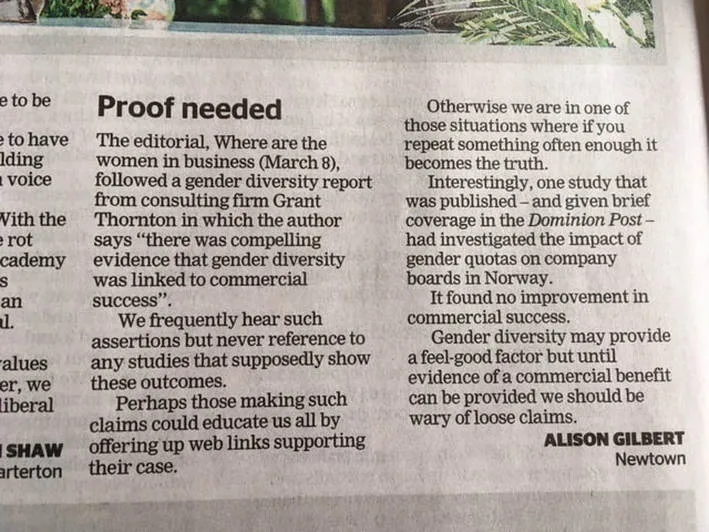
    If trust and confidence is to be restored, the power games, hubris and ineptitude apparent in some boardrooms need to be rectified. Flawed understandings of what corporate governance is and how it should be practiced also need to be corrected, especially the misguided belief that any particular board structure or composition is a reliable predictor of firm performance (the following letter highlights the conventional wisdom problem).
    Picture

    Source: Letters to the Editor, Dominion Post, 10 March 2018

    The scene is set for some fascinating discussions this week. I'll let you know how I get on.