• Published on

    Effective boardroom practices: Dispatches from Singapore

    ​Nearly fifty chairmen, directors and company secretaries from around South-east Asia, the Middle East and Northern Africa gathered at the Ritz–Carlton Millenia Hotel in Singapore this week for The Boardroom Agenda conference. Delegates received presentations, shared stories and debated issues over two days (23–24 November), under the Chatham House rule. I had the honour of contributing to the discussion on the second day. Here are some of the takeouts:
    • Neal Cross, Managing Director and Chief Innovation Officer at DBS Bank provided a stirring keynote presentation to kick off the day. Disarmingly frank in delivery, his topic Fostering innovation in the boardroom was both challenging and well-received. Cross asserted that banks simply must innovate, and radically so, lest their market collapses around them as fintechs and large technology companies (read: Google, Amazon, Apple, others) eat the bank's lunch. He then outlined the DBS approach to innovation, which includes a three-day 'hackathon', whereby teams of staff are set up to create new product ideas. The resultant ideas are pitched to the board, and funding is provided to commercialise the best ones—entrepreneurship in action.
    • Raoul Chiesa, Board Member on the Italian Association of Critical Infrastructures delivered a wake-up call to delegates. Speaking straight off a flight from Europe, Chiesa, an expert of information security matters, summarised the history of hacking and the crucial need for boards to take information security seriously—all with some powerful (and quite alarming) case studies and real-world examples. Delegates were amazed at the scale of the problem and the material risk to commerce that 'the bad guys' present. The cyberthreat is widespread and poorly understood, especially in boardrooms. The message was clear: boards need to get up to speed, by receiving presentations and updates from experts; asking probing questions; taking a strategic view of risk; and, empowering the CEO to act.
    • The pre-lunch session took the form of a panel discussion and dialogue with delegates. I joined Ralph Ward at the front of the room. A wide range of topics were explored including the merit of codes of conduct; diversity in the boardroom;  the conundrum of balancing conformance and performance; confidentiality; conflict management; the conduct of effective board evaluations; and, the difference between so-called independent directors and independence of thinking. Delegates seemed to appreciate the candid responses from panelists, including recognition that no one-answer-fits-all; best practice often isn't; and that the work of the board can be messy.
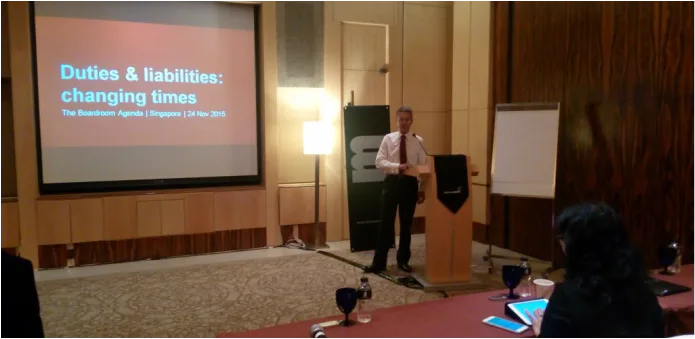
    • After lunch, delegates attended one of two streams. I chaired the Board Insiders one. Dr Lim Lan Yuan, a Singapore-based business and law scholar and company director spoke first. He managed to squeeze forty years of experience into a thirty-minute talk. It was a sight to behold. Delegates were enthralled with his summary of how boards should work; how they actually work (or don't); the importance of a clear division of responsibility between board work and management activity; the importance of the board undertanding the business of the business, strategy and market trends; boardroom dynamics; and, anecdotes of associates that messed up (badly) and went to jail. That Dr Lim was able to move seamlessly between theoretical concepts, practical recommendations and real-life stories as he spoke helped the delegates gain considerable value from the talk. The only person who struggled with his commentary was me: Dr Lim covered off several of the points that I was going to discuss in the following slot. Consequently, a few on-the-fly adjustments were needed to extend the discussion to related areas of interest (see pic below). That the delegates heard similar stories and recommendations from two different speakers with different cultural and business backgrounds was hopefully encouraging—and supportive of the notion that 'good practice' is good practice almost anywhere.
    • The final session of the day was a 'deep dive', whereby delegates gathered around one of two tables to consider a table-question and to share experiences. One table was asked to identify factors that contribute to both good and bad dynamics in a boardroom, and the other was asked to discuss how a board should function in the event of a major crisis. The groups had 30 minutes or so to wrestle with the assigned question and then report back. The insights shared were great, and the good-natured banter demonstrated that the delegates had built a good rapport with each other. Thank you to Dr Lim and Curtis Chin who moderated the table discussions. You made my job of session chair very straightforward.
    • The conference was organised by marcusevans. Their people did a great job, both in the weeks leading up to the conference and at the venue itself. If you get the chance to work with them, take it.
    Picture
    ​I've come away from the conference with the impression that the quality of corporate governance and board practice in Asian and Middle Eastern economies is rapidly improving. Overall, the hunger to improve board effectiveness was plain to see, as was the desire to learn from those with experience gained elsewhere (if the many conversations, requests to return and business cards in my satchel are any indication). However, care must be taken to ensure that models and frameworks in use in the Anglosphere are not blindly implemented in this region. Such colonialism is unwarranted and patronising, and it may be culturally demeaning as well.
  • Published on

    On diversity: How many is too many, and does it matter?

    Calls in support of appointing women as corporate directors have proliferated in recent years: the stated view being that the presence of women around the board table can improve decision quality and, potentially, business performance. Some legislatures have supported these calls by implementing quota systems. Many (but certainly not all) boards now count at least one female amongst their number.
    Anecdotal commentaries suggest that the level of attendance, engagement and discussion quality improves after a woman is appointed to a board. This is good, but another question lurks around the corner: If one capable women makes an impact and two more so, is an all-female board better still—or can we have too much of a good thing? Might an all-female board be as problematic as a board comprised only of men?
    I've seen some great all-male boards, some great all-female boards and, sadly, some rather ineffective diverse boards in action. That a diverse range of options are explored, independence of thought is displayed and that directors make considered decisions seem to be more important considerations than the physical composition of the board. Thankfully, the rhetoric is starting to mature along these lines. Hopefully director selection processes will soon follow, such that the qualities possessed by directors and the way they work together in the boardroom are the main considerations. Then, the gender (or any other diversity attribute) of directors should matter no more. Might this offer a viable path forward?
  • Published on

    Boardroom diversity: Is the rhetoric finally starting to mature?

    These topics, both arguably proxies for the on-going fight for a more equal society, have been the subjects of much research and discussion over the last decade or more. Claims and counter-claims have been asserted—sometimes quite stridently—in both the popular press and in the academic literature. While many commentators have asserted that the presence of women in boardrooms, or diversity amongst directors is causal to increased company performance (and others have jumped on the bandwagon), a small number of bold souls have questioned the analysis, recognising that any linkage is complex and likely to be contextual.
    Researchers, consultants and commentators need to build on Turner's comments. If we are to understand how boards work, and how influence is exerted, boards need to be observed in action. Sophisticated analyses, capable of exposing factors that may not be directly observable or consistently applicable, are also required. The resolution of the problem (of explaining how boards influence business performance) is more likely to be found in the subtleties of director qualities and behaviours, and the complexities of how they work together, than in any regular correlation between an observable attribute and subsequent business performance.
    Thank you Caroline Turner for recognising this, and for advancing the conversation.
    Now, Caroline Turner, a leading commentator appears to have called time on the rather simplistic assertions that have dominated the discourse (click here to read her recent article). Her response to the question of whether gender diversity is good, bad or indifferent is "It depends on which study you read". I agree. Importantly, Turner's conclusion (that "solid research by highly respected organizations, disputed by some, shows a correlation between gender diversity and results") and appeal (for more research) signals a much needed maturing of the rhetoric.
    What is it with the women on boards and diversity discourse? 
  • Published on

    REDUX: Towards a 'strategic board'

    Many commentators—academics and practitioners—agree that corporate governance is complex and difficult to get right. In the context of maximising business performance, boards must satisfy many demanding (and competing) priorities including shareholder expectations; legal and compliance requirements; the management of risk; the determination of future direction; and, the hiring (and sometimes firing) of the chief executive. Directing is a busy job, and it is one that takes time and commitment to do well. The steady stream of boardroom 'fails' in recent years (HSBC and Christchurch City Council amongst many others) and indiscretions (FIFA) suggests many boards are not doing their job as well as they need to. Why is this?
    • Are director's schedules too full to give each board the necessary time and effort?
    • Are boards defaulting to the arguably 'easier' task of performance monitoring, and disregarding strategy and future value?
    • Are directors simply not asking the right questions?
    • Is the safety of consensus thinking suppressing the debating of diverse options?
    Many aspects of boards and board practice have been studied in recent decades including structure, composition and boardroom behaviour in an effort to understand how boards work and how they might contribute to performance. Independent directors have been held up as being crucial to boards maintaining distance from the chief executive and to the effective oversight of performance. Gender (and other) diversity has been promoted heavily in many quarters. The forming of a strong team through high levels of engagement and desirable behaviours has also been explored. As yet, none of the research has exposed any conclusive results in terms of increased company performance and value creation.
    Imagine what board meetings might be like if the focus changed. They'd probably last longer. Directors would read their papers before meetings, and they would be actively engaged. There may be heated discussions. Necessarily, directors would sit on fewer boards. But perhaps, if boards were bold enough to change their focus, they might become more effective. Perhaps. Here's hoping.
    The original version of this muse, posted in December 2012, is available here.
    The prevailing theory of board–management interaction (agency theory) that underpins much of the current understanding of how boards work (or should work) appears to be flawed. It assumes that management is opportunistic and cannot be trusted and, therefore, needs to be closely monitored. Yet none of the structural provisions based on the theory (independence, incentives, various structures) have been causative to increased performance, despite considerable effort over many years.
    Rather than continue to dogmatically pursue a flawed model, we need to move on. The goal posts need to be shifted—from a focus on compliance, structure and composition to a focus on value creation. The notion of a strategic board suggests a focus on future performance and strategy; on high levels of engagement to understand the business and the market; on critical thinking and an independence of thought; and, on robust debates which explore a wide range of strategic options (diversity of thought being considered crucial to avoid consensus thinking). 
  • Published on

    IGW'15: Gender diversity on boards

    The topic of gender diversity on boards has received a lot attention in recent years. Researchers, interest groups and the media have chased various agendas. Much has been written and many claims have been made. However, compelling conclusions remain elusive. The topic received more attention during the first session of the second day of the International Governance Workshop in Barcelona.
    Three speakers presented the results of their research, conducted in the Polish and Spanish contexts. The studies explored variations on the theme of the impact of women on various financial and non-financial measures. All of the studies were quantitative analyses, conducted using publicly available data and statistical techniques. I have been critical of the use of such techniques for social research in the past. Reductivist approaches rarely provide insight beyond straightforward correlations. Sadly, I heard nothing to suggest otherwise in these talks. 
    The challenge for board research is to move beyond the 'big three' assumptions--ontological reductionism, that a single objective reality might exist, and that a constant conjunction between variables constitutes a causal explanation—are inapplicable to board research, because boards and the context within which they exist, companies, are social constructions. Rather, the more demanding route, of qualitative research that explores boards in situ is more likely to reveal explanations that shareholders and director nomination committees can rely on.
    I remain convinced that women and people from a diverse range of background affect board practice. However, simple empirical research is not the appropriate pathway to understand and explain whether this is correct is not. More subtle approaches, that consider the context and behavioural nuances of individual directors appears to be crucial.