• Published on

    Downtime is great for relocating your True North

    Busy-ness seems to be a fact of life for many people these days. Whether it is running between commitments, as a business person, as a parent or anything in between, downtime has become a precious commodity—one to be treasured and nurtured. Modern conveniences like unlimited wifi (including on some flights nowadays) mean we are never far away from activity and doing things that, in our own mind at least, add to our personal sense of worth.
    While busy-ness can be a good thing, more often than not sustained periods of busy-ness will lead to reduced effectiveness and possibly even burnout or breakdown. We get so wound up doing stuff that our world closes in around us, until we lose sight of 'why'—our True North. Loosing perspective is not good for us, or those around us.
    As a senior executive or company director with significant responsibilities, you no doubt have a busy schedule. How do you keep things in perspective to ensure that you are actually effective in your work? Do you have an anchor, a True North, and do you referencing back to it? ​​
    For me, downtime is the key to effectiveness—slowing the heart rate; getting away from people; taking time out to explore ideas (that would not normally even register on my everyday radar); and, in so doing, remind myself of what really matters, my True North. I do that by reading. Here's a selection of the books currently on my reading list. If you read as a means of maintaining your perspective, I commend them to you.

    Picture
    Picture
    Picture
    Picture
    Picture
    Picture
    PS: What you do to keep track of your True North doesn't really matter. Go for a walk, paint, read, sew, draw or whatever else takes your fancy. That you are taking time out from the busy-ness of life is what will make the difference to your effectiveness—as paradoxical as that may seem. 
  • Published on

    On the director–shareholder relationship

    It had to happen. Someone just asked one of 'those' questions. Should boards of directors communicate with shareholders? Great question Lex Suvanto! You can read his blog post here. Amongst his comments, Suvanto makes two quite startling observations: 
    Many directors are passionately against the idea of engaging directly with shareholders.
    Directors also correctly point out that the board should not say anything out of step with management anyway, so they question the value of this effort, especially given limited available time that directors can devote.
    These observations, and others in the article raise important supplementary questions about how boards conceive their role and the mindset of directors—including these:
    Ultimately, appropriate responses to these questions are straightforward if boards understand the statutory framework and directors have a clear understanding of both why boards exist and what boards (should) do (i.e., corporate governance).
    ​Directors are appointed by shareholders to ensure the effective operation of the company, in accordance with shareholder wishes (whatever they might be). If the senior-most decision-maker in the company is the board, is it not reasonable to expect the board to both understand what the shareholders want from their investment and subsequently provide an account to those that put them there? I think so. Suvanto's article contains some helpful suggestions to get started. I'm available if you want to chat further.
  • Published on

    On boards, #Brexit, bravado...and reality

    News emerged today that many FTSE 250 company boards had made no contingency plans for a possible #Brexit decision. As Alice Korngold notes in her article, this highlights serious deficiencies in relation to risk management, board process and board composition. Korngold is right to challenge boards on this exposure. But does Korngold go far enough? Most of the concerns expressed are framed in the context of a traditional understanding of boards and corporate governance: monitoring the executive and managing various risks.
    Directors carry important duties, to the company and shareholders. In addition to acting in the company's best interests, directors have an important responsibility to deliver value to shareholders (in whatever form might be agreed). This means that monitoring the executive and managing risks is insufficient. More is required. Boards also need to make important decisions to set the company on a path towards a desired future state.
    An increasing percentage of directors say they are involved in strategy (read the surveys), suggesting boards do take their responsibilities seriously. However, observations of boards in session (i.e., board meetings) suggests that a gap exists between claimed and actual behaviour. Korngold's commentary adds to those concerns. That some boards are not performing the 'basics' of monitoring performance and managing risk adequately—let alone driving future performance—is problematic. What confidence can shareholders have that boards are considering strategic options and determining an appropriate strategy to achieve the company's purpose? The bluff and bravado that has permeated the discourse needs to be replaced with an authentic commitment to drive business performance. Is this too much to ask?
    Looking to the future, if the result of the British plebiscite does little more than motivate boards to take the future performance of the company more seriously, then it will have been a worthwhile exercise. Until then, Barton and Wiseman's observations are likely to remain—sadly—resoundingly accurate.
  • Published on

    Experts, yet we have much to learn

    One of the biggest shake-ups to confront the Western World (since the collapse of communism and the fall of the Berlin Wall anyway) occurred in the United Kingdom last week. The result of a much anticipated plebiscite was a decision by the British people to leave the EU. In the weeks leading up to the referendum, the flow of information became a cacophony as politicians, scaremongers and other 'experts' promoted various positions, in an effort to influence to voting public. 
    Finally, the day arrived and the people voted. Soon, the results were published. The people had spoken. Some cheered while others mourned. Curiously, some reacted by rueing their decision, wondering whether they had voted wisely. Really? With a straightforward question to answer and a plethora of information to hand, how could anyone make the 'wrong' choice (unless they didn't vote, of course)? Is this reaction an outpouring of buyer's remorse on a national scale, or is something else going on—an indication that some did not take the decision seriously or that a dose of hubris clouded the better judgement of some voters perhaps?
    Picture
    The British plebiscite highlights a behavioural weakness that besets many people. From an early age, we spend our lives learning as much as we can, aspiring to become experts in whatever field interests us. Most of us want to excel; to realise our potential. In our haste to make decisions and get ahead, we tend to embrace new ideas and disregard 'old' ones. If we can secure an advantage, we'll take it—thank you very much. But when it comes to big decisions, we may not be as smart as we think we are. Decisions that are based on politically-motivated or emotion-filled pleas, or knee-jerk responses seldom deliver the 'best' outcome.
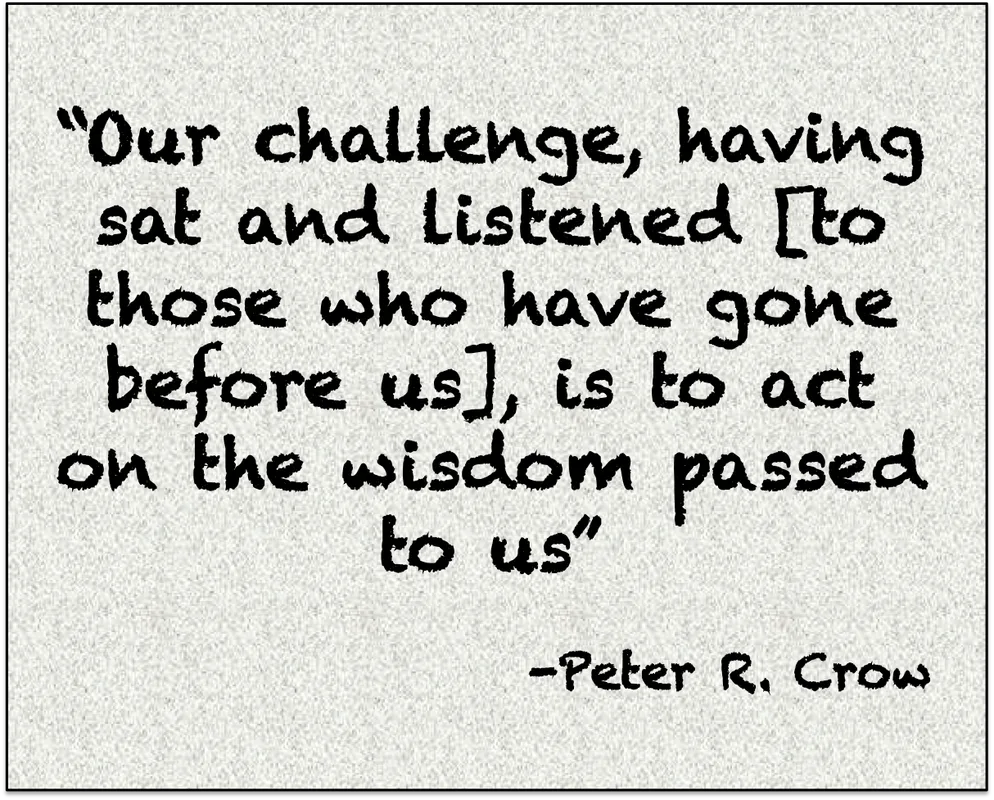
    Often, the best decisions are those made after we have paused and looked back, for guidance about how best to move forward. Whether we are cast as leaders or followers, we could do far worse than to seek out people like Bill and Augusto, sit with them and, having asked them a question, listen intently to what they have to say. Our challenge, having sat and listened, is to act on the wisdom passed to us.
  • Published on

    Teamwork, to enhance the learning experience

    The sharing of knowledge with clients and conference attendees is an activity that I find very fulfilling, mainly because it is a two-way activity. Be it facilitating a professional development course, speaking at a conference or dinner event, or facilitating a private learning workshop, the opportunity to both share knowledge with and learn from attendees is one to be taken seriously.
    On several occasions recently, I have had the privilege of seeing this operate at yet another level: a team-based delivery model whereby two presenters work together to share insights, answer to questions and learn from the assembled group. The positive response from attendees to a team-based model was a sight to behold. The levels of engagement; esprit de corps; and, quality of learning amongst the assembled group (not to mention the banter between the presenters) really lifted the learning experience. The following examples provide windows into two of my recent experiences, and then the learnings to emerge follow.
    Rural Governance Development Programme
    Earlier this year, Peter Allen of Business Torque Systems invited me to join a team to refine the five-day Governance Development Programme (a popular course previously run by DairyNZ for dairy businesses) to suit all of rural businesses. In updating the course, a decision was made to use a team-based delivery model, with two presenters working together with attendees. The hope was that this would provide better coverage of the material, as well as enabling attendees (directors, shareholders and chief executives of rural businesses) to a hear different perspectives as the course progressed. And so we jumped in...
    Picture
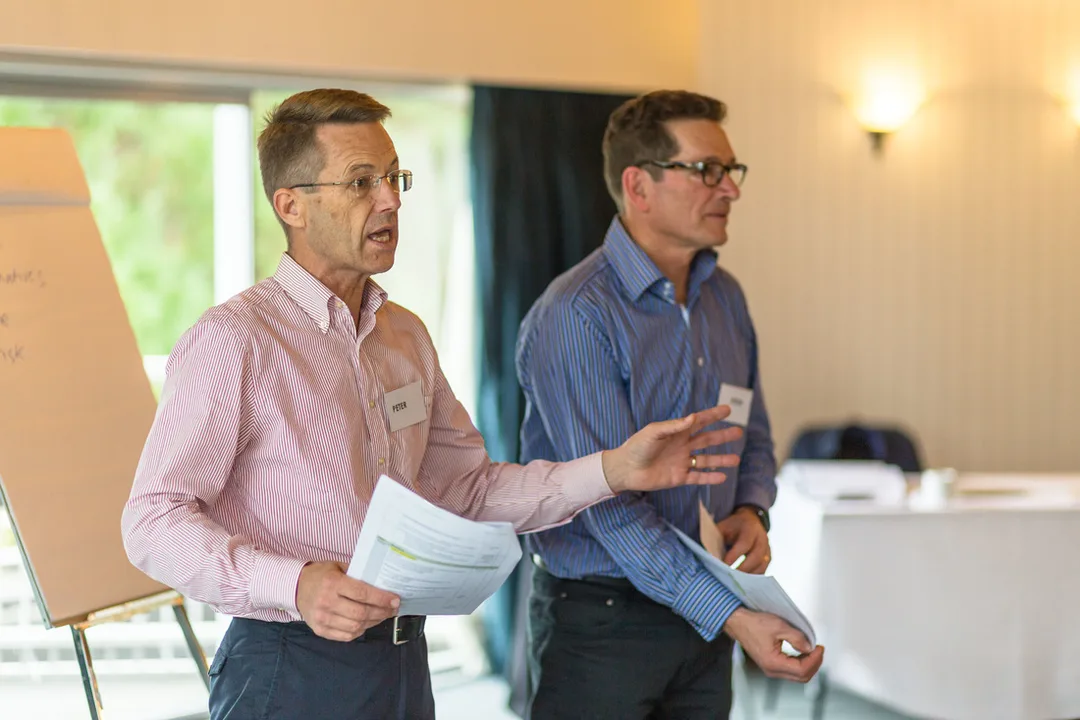
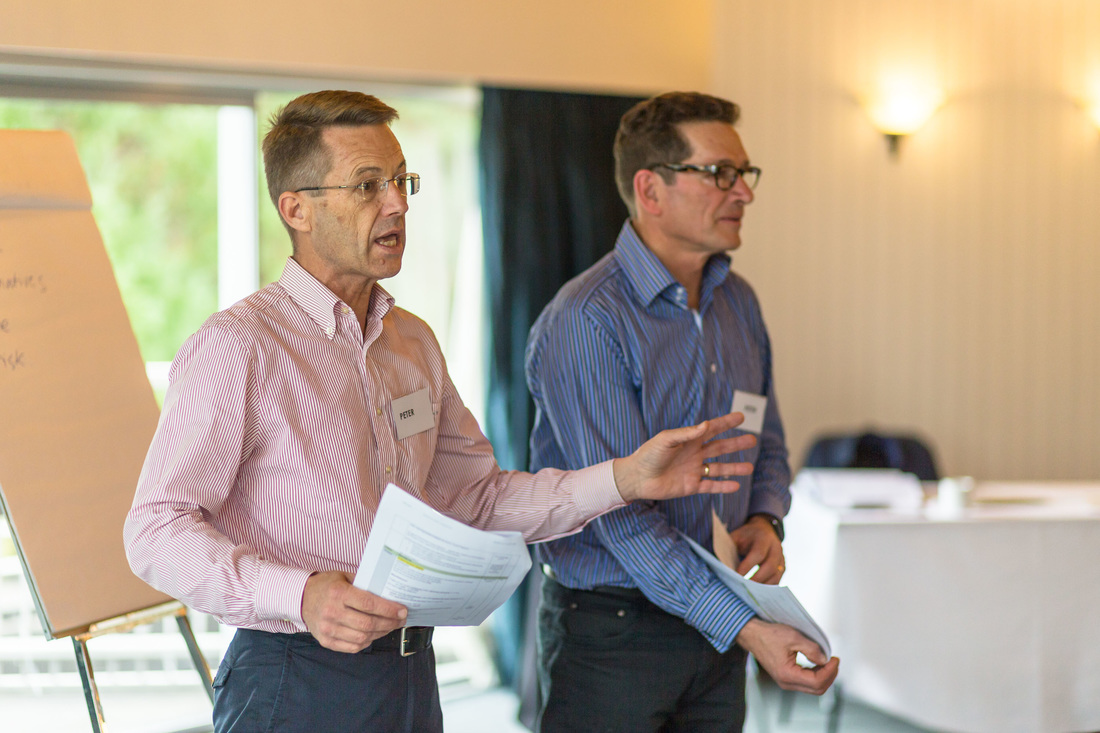
    We resolved to work from the front of the room together, sharing the speaking and listening roles...
    Picture
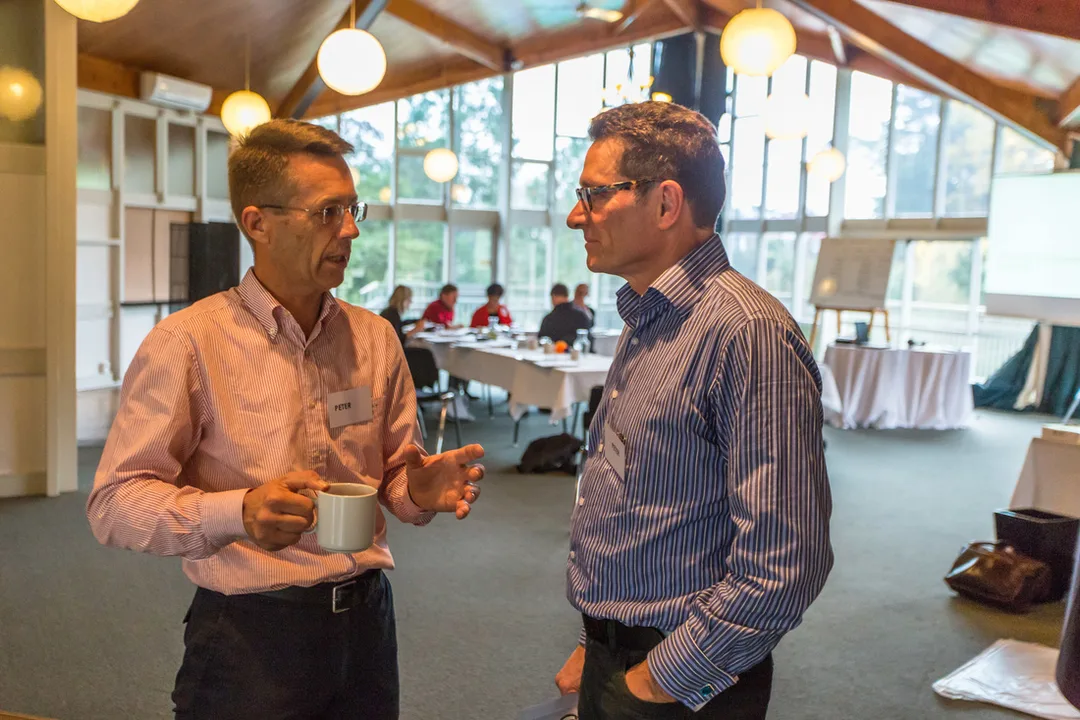
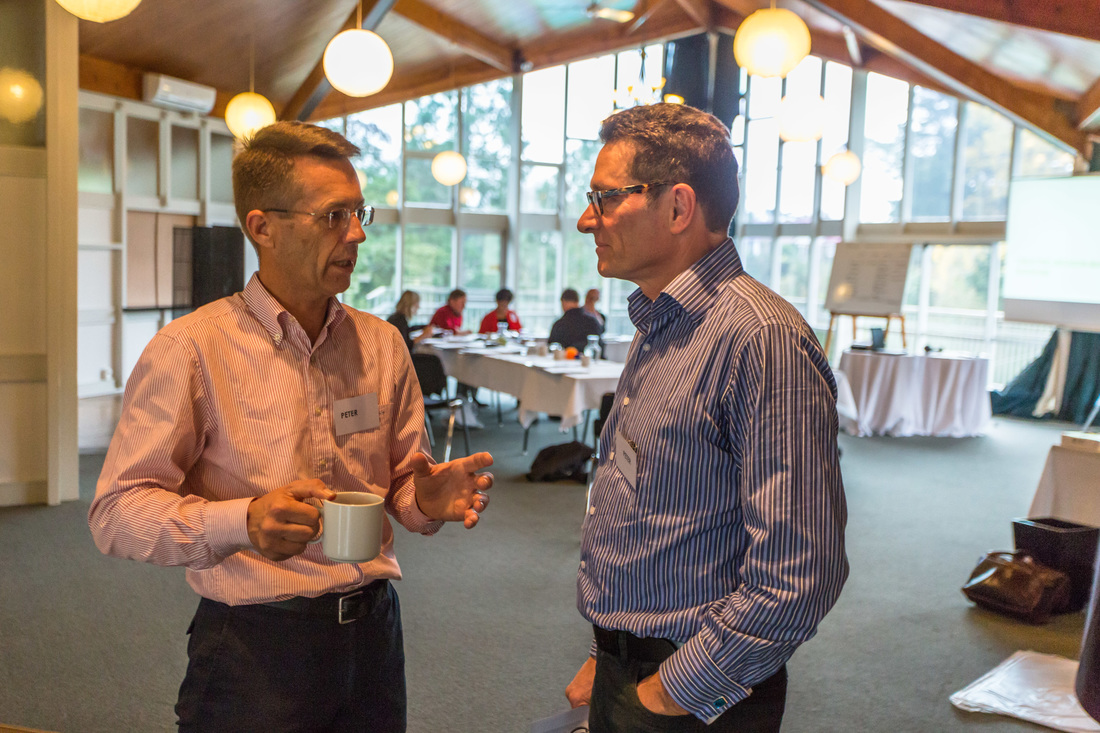
    We stepped aside, to check in and make adjustments... This ​picture, taken on the third day (of five—the course days are spread over a ten-month period so delegates can apply their learning in practice and bring questions and experiences back to the next session), captured us discussing a couple of 'in-flight' adjustments while participants worked on an exercise to improve their strategic decision-making skills in a boardroom setting.
    Health sector board member development workshop
    The second example relates to the delivery of a professional development session for the board members and executives of three primary health organisations (PHOs). They wanted a refresher on board effectiveness and strategy in the boardroom—topics dear to me. The organiser was keen on a two-person delivery model as well, which created another opportunity to explore and experience the effectiveness of the team-based model.
    I organised to work with a trusted colleague, Murray. We know each other well and share a commitment to excellence but have slightly different styles. After introductions and scene-setting, we asked the group to tell us what they wanted to get from the session and to mention specific areas of interest. Then it fell on me to lead the first session (board effectiveness) with Murray chipping in regularly to help answer questions and share examples from his experience. The roles were reversed for the second (strategy) session later in the afternoon. Finally, we jointly ran an free-flowing plenary session to check all of the areas of interest had been addressed and answer any remaining questions.
    Learnings
    Feedback from the attendees (informal plus evaluation sheets) from both the rural course and the health sector learning session indicated that the double-teaming model works. Attendees said they got more from the session than they thought they might have gained had there been one presenter. They could listen to and tell stories to connect ideas with practice; ask similar questions and get a different (!) responses; and, they said they benefitted from tapping into a broader pool of knowledge and experience than what would otherwise have been possible.
    One board member went as far as saying that the session was "the best learning session ever organised by <PHO-name omitted>", gratifying feedback indeed. The levels of trust and interaction in the room in both the rural course and the health sector session were also noticeably high. (Whether this is a reflection of what is being modelled from the front of the room or it is simply an expression of the delegates' innate character and desire to learn is open for debate!)
    Where to from here? Though not without its challenges (working so closely together requires considerable planning and trust, for example), the early experiences have been positive. There is also a 'cost' of putting two people in the room. However, the benefits in terms of enhanced learning outcomes tip the balance in favour of the team-based model—especially for advanced topics and multi-day courses. The learning theorists are probably all across this, so I'll need to play catch-up.
    If you have any experiences to share—positive or negative—I'd be keen to hear from you. Please respond by posting a reply or send me an email.
  • Published on

    On diversity in the boardroom: A brief update

    The matter of diversity in corporate boardrooms has been the topic of much debate in recent years. Some people have claimed that the die is cast: that the presence of women (or some other group) in the boardroom leads to increased business performance. Others are less convinced. I have contributed to the debate on a few occasions, both as a panelist and in print. You can read some of my comments here and here, or use the search box to find other articles on diversity.
    While the debate goes on in the trenches, some commentators have begun to stand back, to offer a more holistic perspective. Jeff Jacoby, for example, has just written this article, published in the The Boston Globe. His balanced summary highlights various aspects of the debate. Two sentences stand out:
    "The evidence that more female board members means higher corporate profits is murky at best."
    "Either way, what no study has managed to nail down is causation."
    With these comments and others in the article, Jacoby has put his finger on the core of the issue. Board effectiveness (especially any relationship between board attributes and subsequent firm performance) is a complex issue. No one structure, composition or set of behaviours fits all situations (much less all companies). 
    Looking ahead, the challenge is two-fold. First, everyone who is interested and capable of making an effective contribution in the boardroom needs to be encouraged to offer themselves as a serious director candidate. Shareholders (or their nomination committees) need to work hard to find and appoint the best candidates—regardless of any physical attribute or notional diversity variable. The ability to govern well in the team environment must be the compelling basis of assessment. Second, the rhetoric needs to continue to mature, beyond the blunt instrument of observable characteristics to focus the subtleties of what actually matters—the capabilities of directors (individually and collectively) and the quality of boardroom interaction and debate as boards consider options; make strategic decisions; and, pursue performance goals in the context of the agreed purpose of the company.