• Published on

    Healthy team dynamics trumps individual performance

    A new piece of research, about boards and performance, confirms what many people already know: the power of 'team' is more conducive to performance than individual brilliance is. You see it all the time in team sports. Whether it's the Seattle Seahawks, Sky Procycling or the All Blacks of New Zealand, the collective power of a cohesive team, working towards a single goal, is a much stronger proposition than a team of individuals, as brilliantly capable as some of the individuals may be.

    Boards of directors are no different. Celebrity directors or notables with important political, investment or other business connections are no match for a cohesive board that works as one towards an agreed goal. Given the widespread knowledge of this principle, why do so many shareholders and activist investors continue to promote candidates that play as individuals the moment they enter the boardroom?

  • Published on

    Qantas: a corporate tragedy, or a gross failure of governance?

    Image description
    What is happening at Qantas, Australia's once great national airline? While other airlines, including Air New Zealand, are performing well and generating solid returns, Qantas has fallen off its perch. Profits are down and jobs are being axed. Many commentators have published articles in the past few days about the impending demise of Qantas, including this one published in the Sydney Morning Herald. While claims of impending demise may be impetuous, a sorry pattern of neglect is apparent. The board of directors is nowhere to be seen.

    The board has the delegation to oversee the performance of the company, in accordance with the shareholder's wishes. Yet the board has not been mentioned. It has remained remarkably silent. We don't know what its been doing. Have the directors been actively working in the back room, or have they fallen asleep at the wheel? Clearly a series of mis-steps and mishaps have beset Qantas and placed it on a downward trajectory. The job of the board is to respond. It is the board's job to set strategy, appoint a CEO to implement it and make adjustments when needed. Will CEO Alan Joyce (just 42 years old when appointed) and others be sacked? Maybe. Should they be? If Alan Joyce has failed to implement the approved strategy then possibly. However, if the board has not crafted an appropriate strategy, or if it has not made adjustments in response to unexpected situations and changing market dynamics, then the board itself is culpable.

    Clearly, there are more moves to be played out yet, including the possibility of a bailout by the government (that happened to Air New Zealand—over a decade ago now). However, we need to hear from the board, to see some leadership in what is obviously a time of crisis. After all, the accountability buck stops there.
  • Published on

    Advancing governance research beyond correlations

    A couple of months ago, I was asked to consider submitting a paper to the British Academy of Management (BAM), for presentation at the annual conference (in Belfast, Northern Ireland this year). The BAM conference is attended by over 850 delegates, from academia and the working world. Once I got over the surprise of being asked to contribute to such an esteemed conference, the challenge of choosing a topic loomed large in my mind.

    The topic I have selected plays to the foundation of my current research work: that of finding a way to move beyond the limitations of the research methods that have been favoured by many governance researchers. Researchers are really good at counting and measuring things, but the process of digging deeper, to explain why something is as it is (in my case, how boards influence company performance) has proved to be much harder. The aim of the paper I have written is two-fold:
    • Challenge the foundational assumptions and normative input-output approach that has dominated the much of governance research agenda
    • Suggest an alternative approach to governance research, to enable the researchers to move beyond correlations toward the postulation of credible explanations and theories 

    The paper was submitted last night. The ideas in it are somewhat contentious, so it will be interesting to see how the paper is received, and whether it is accepted on the programme. Please contact me if you'd like a sneak-peak at the abstract now, or to be sent a copy of the paper after it is presented.
  • Published on

    My multifaceted week: the life of a governance researcher

    Please excuse my silence over the last ten days or so. I have been concentrating on several important research tasks and some family matters, and this has precluded me writing any musings. To give you an idea, here's a list of some of my activities from the last week:
    • Prepared for and observed the February meeting of the Company Alpha(*) board, to collect more research data.
    • Prepared for the next observation of the Company Beta board, to occur in a few days' time. 
    • Attended a PhD forum, a new initiative run by Massey University School of Management to bring its doctoral candidates together from the three campuses for support, encouragement and technical assistance with the process of research.
    • Reviewed feedback provided by my supervisors, of the first substantive draft of the research methodology chapter that I sent them a couple of weeks ago.
    • Continued the refinement process of the methodology chapter, ahead of reforming it into a standalone paper suitable for submission to the BAM conference.
    • Hosted guests visiting from Belgium. Our daughter's host parents from her twelve-month student exchange to Flanders are on holiday in New Zealand at present.
    • Drove our daughter and her gear to Massey University (90-100 minutes drive north of our home), to start her tertiary career. (She's enrolled in the Business Studies programme, and will be living on-campus in one of the hostels.)

    I'm hoping things will settle down a little next week, so I can finalise the BAM paper; spend some more time on data analysis; start thinking about the slidedeck for my presentation to the International Conference on Management, Leadership and Governance in Boston, Mass. on 20–21 March; and, resume normal transmission on Musings. 

    (*) Companies Alpha and Beta are the two companies who have provided me with access to observe their boards in action and collect governance data. Both are quasi-public, high-growth organisations of substance domiciled in New Zealand. Anonymity is a condition of research so all other information that may enable the companies to be identified is withheld.
  • Published on

    CEO quits: But what of the board?

    News emerged today that Peter Campbell, CEO of Brackenridge, an intellectual disability facility, has resigned after five months of investigations and media scrutiny. Tragically, three residents died at the facility last year. There have been a series of complaints relating to safety as well.

    Clearly, there have been operational problems at Brackenridge—the review concluded that management had been distant and unresponsive. Notwithstanding this, I suspect there has been a failure of governance as well. Some important questions that need to be asked are:
    • What has the board been doing in the period leading to the review and since?
    • Did the board know about the "series of complaints" that precipitated the review? If so, why did it not investigate and act? And if not, why not?
    • Why has the chair chosen to defend the CEO, when clearly something was amiss?

    Superficially, the board appears to have been quite passive, to the extent it may have failed to discharge its legal and moral duties effectively. Notwithstanding the remedial plan now in place, the performance of the board needs to be reviewed. Weaknesses need to be identified and changes made, to improve the process of governance and quality of oversight at Brackenridge. The residents and their families deserve as much.
  • Published on

    The "Learning Board": a good model

    Image description
    Over the last few months, I have re-read quite a few books and articles about models of governance, to see how my doctoral research might build on the suggestions of earlier contributors. Many years ago my father taught me that building on the work of others is smart, but only when the prior work is solid—a stable foundation being crucial to anything that follows.

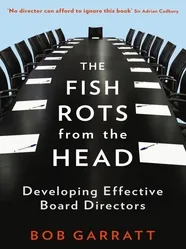
    The "Learning Board", developed and suggested by Bob Garratt nearly twenty years ago, is one of the models that has captured my attention. Garratt published his suggestions in a profoundly titled book The Fish Rots from the Head (3rd edition). Garratt highlights four key tasks of directors within the context of a board's lifecycle:
    • policy formulation and oversight
    • strategic thinking
    • supervising management
    • ensuring accountability.

    He suggests that boards need to balance four intellectual viewpoints simultaneously in order to achieve the four key tasks. When they do, overall effectiveness can be enhanced.
    • An external perspective
    • An internal perspective
    • A short-term perspective
    • A long-term perspective.

    I found this to be very helpful, because it provides a useful context for my work (an investigation of how boards can influence company performance, and the influence of strategic decision-making). Regardless of my efforts though, I commend Garratt's book to aspiring and established directors. It's easy to read, and logical in its approach to the topic.