• Published on

    Wynyard Group: What went wrong?

    Former sharemarket darling, Wynyard Group, was put into voluntary administration this week. The announcement was made via a notification to the share market and notice on the company website.
    The company was highly-valued, well-funded and governed by seemingly capable directors. Its products, software systems to assist in crime fighting, were seemingly in demand—evidenced by strong revenue growth since an IPO in 2013. Milford Asset Management, a shareholder, valued the company at nearly $120M at the time of the IPO. But Wynyard failed to make money, then or since. The result was inevitable: the company became caught in an ever-deepening hole that, in the end, was too deep to climb out from. When last traded, the notional value of the company had fallen to less than $40M. Now that the liquidator is involved, the residual share value is (close to) zero.
    What went wrong?
    Whereas some failures reported this year appear to have been grounded on hubris or fraudulent behaviour, such motivations do not appear to have been significant at Wynyard Group. The failure appears to have been more straightforward. Indicators have been visible for some time as well. Ultimately, the actions (or inaction?) of the board of directors need to be placed under scrutiny.
    The company's business model was characterised by infrequent high-value sales (read: a lumpy revenue profile). The company also employed lots of highly-capable software engineers and other technical specialists. Effective cash management is crucial in such companies. Superficially, the company appears to have been carrying too much cost, suggesting that it took on expense too far ahead of the revenue curve. The company does not appear to have had a backup plan to be activated if revenue expectations were not realised (in either the expected timeframe or manner). 
    The market seemed to know there was a problem (track the share price over the last 18–24 months), yet the situation was allowed to continue seemingly without any major corrective action being taken. The company burned through over $140 million of shareholder funds. It's little wonder that the investors became bitter.
    Why were the problems not addressed by the board much earlier? Was the board (which included several high-profile directors, three of whom resigned in May and June 2016) not in control as it should have been? Though present, were directors asleep at the wheel rather, in effect adopting a passive style of oversight—in contrast to that conceptualised by Eells, Cadbury, Garratt and others?  Was the board captured by an optimistic outlook and charismatic management? More pointedly, who was actually in control? The early indications suggest that the company was being controlled by management—ineffectively so, as is now patently clear—usurping the board's statutory role.
    What can we learn?
    That Wynyard Group has now joined (unwittingly) a rather long list of companies of interest to governance researchers and MBA classes (adding case example of what not to do) is clear. This case will also, no doubt, be played out in the business media and by 'experts' in the days to come. In the meantime and regardless of whether Wynyard is wound up or continues to trade in some form, the case provides salutary lessons for boards elsewhere:
    • First, directors should realise they have a duty to act in the best interests of the company, not the shareholders, employees, managers, suppliers or any other party. This includes not allowing the company to trade recklessly and, importantly, making tough decisions if required. If the viability of the company is at risk, the board is duty-bound to act.
    • Second, directors need to make appropriate enquiries and ask probing questions, to ensure they clearly understand the business of the business (a weak point of many directors). Active engagement and adequate knowledge are crucial foundations not only to the formulation and approval of strategy (a responsibility of the board) but also effective decision-making including strategic decisions.
    • Thirdly, to what extent is the conformance–performance dilemma in hand? Is the board spending adequate time on forward-facing performance-related matters (especially strategy), or (as is more common than many directors admit when surveyed) is most of the board's time being spent on compliance and conformance matters?
    • Other considerations include whether the directors are strategically competent, actively engaged and operating with a sense of purpose. Also, does the board possess the collective efficacy thought to be necessary to work together and exert control constructively? 
    Boards should discuss these and related matters periodically, to ensure they are appropriately focussed on (and adequately equipped to pursue) the value creation mandate. A formal, externally-facilitated board and governance assessment (providing an outside perspective) should offer useful insights as well, so long as any recommendations arising are acting on.

  • Published on

    Webinar: Influencing company performance, from the boardroom

    I'm thrilled to announce that the Madinah Institute for Leadership and Entrepreneurship (MILE) has invited me to present a webinar entitled Influencing company performance, from the boardroom. The webinar will start at 3:00pm Saudi time on Sunday 2 October—to suit American, UK/European, Middle Eastern, African and Asian company directors and board members in particular.
    For more information, click here. You'll need to register (free).
    The following topics will be discussed during the 45-minute webinar (with an open Q&A session afterwards):
    • How to resolve the challenge of exerting influence and adding value from the boardroom
    • What effective boards do and how effective directors behave
    • Practical suggestions to move the board's focus from compliance to performance
    Reserve your place today!
  • Published on

    Making an impact on performance, from the top

    One of the great challenges all business leaders face is the question of how to make an impact on the overall performance of the firm they lead. Boards are no exception. Effective boards are comprised of capable people who assess situations, make strategic decisions, and oversee management to ensure goals are achieved.
    The challenge of leading well and making an impact on business performance is very real, especially in today's environment of fluid work patterns and declining levels of employee loyalty. Boards are responsible for company performance, yet they do not run companies directly (that is the job of the chief executive). How might boards respond to ensure firm performance goals are actually achieved?
    Here are some considerations:
    • Boards need to accept that responsibility for overall business performance lies with them, not the chief executive.
    • The overall purpose of the business (i.e., its reason for being) must be both clearly defined (board responsibility) and well communicated (chief executive responsbility).
    • A carefully crafted strategy (to achieve the purpose) needs to be developed (ideally, by the board and management, together) and implemented.
    • Business systems and processes need to be optimised to expedite effective collaboration; teamwork; and, ensure the information that people need to do their job effectively is available when they need it. 
    The importance of this last consideration should not be underestimated: if employees cannot collaborate effectively because crucial information is missing or hard to access, overall performance will suffer—period. The impact on employee morale, productivity and the bottom line is likely to be very significant.
    The board needs to know how the business is performing relative to the agreed strategy, and the whether expected outcomes and associated benefits are being achieved (or not). Financial reports only tell part of the story. Employee engagement is an important though often overlooked indicator. If your board isn't sure whether employees are fully engaged, it needs ask the chief executive some probing questions; request a staff engagement survey; seek regular updates from senior managers (in addition to the chief executive); or, pursue some combination of these and other options (*). If employee engagement is low or any inconsistencies are discovered, weak information flows or ineffective collaboration within the company and/or with customers are likely to be contributing factors—a starting point for further investigation and subsequent decision-making.
    (*) Boards that lack direct expertise to actively pursue these suggestions themselves should seek independent advice from a seasoned expert, to help them understand what might be possible, establish benchmarks and inform future board decisions. A long-time colleague of mine, Michael Sampson, is one such person. He is an expert in the fields of workforce collaboration, teamwork and new approaches to work. Michael also speaks at conferences around the world and has written several books​I commend him to you.
  • Published on

    On purpose, strategy, execution: Together is best

    Last week, I had the privilege of spending an entire day with the directors and executives of a highly-regarded architectural practice. The large practice has developed a great reputation over several decades for creating 'meaningful' architecture—buildings and spaces that 'fit' the surrounding environment, and that people enjoy living and working in. The job at hand was to facilitate a strategy development workshop, working with eleven capable and motivated men and women to select a course to guide the further growth and development of the practice. In essence, the day was about looking up and looking out.
    Using the StratCross framework and summaries of PESTEL and SWOT analyses completed prior to the workshop, we got stuck in. Before we knew it, the time was 4:30pm and the intense but enjoyable workshop was over. As we packed up, several directors indicated that the workshop had been "hugely valuable", "challenging" and "galvanising", and that they were looking forward to seeing the fruits of their labour. On the way home, my thoughts wandered, reflecting on the day and why it had been so much fun. Here's a few observations that came to mind. You may find useful for your next retreat or planning session:
    • All of the attendees had a comprehensive understanding of both the business of the business and the wider environmental context within which the practice operates. They had done their homework—and demonstrably so. Also, and unlike some boards that I have worked with, everyone wanted to be in the room and to make a contribution. These two factors were foundational to creating an environment which encouraged the informed, healthy debate that seemed to flow naturally throughout the day.
    • Directors (especially) were quick to latch on to the importance of the first question, "Why does the business exist?" It was as if they knew that if strategy is built without a clear and agreed purpose, the resultant output (i.e., the strategy) would be reduced to, simply, a collection of activities. 
    • The attendees recognised that many architectural projects take several years from initial ideation to completion, and some can take more than ten years. Consequently, a long-term view is necessary. This spilled over to the discussion of how far ahead the strategy should look. The group was happy to look more than ten years out, on the basis that goals would take time to realise and the proviso that the resultant strategy was not prescriptive (it was not) and that it was reviewed regularly. 
    • During the afternoon, a couple of the attendees (one director and one manager that I noticed, there may have been more) voiced a desire to build action plans and get underway. They said liked what they saw at the high-level but were concerned that the good work could be for nought unless clear action plans were developed and a commitment to execution ensued. Others agreed this was vital.
    • Despite some of the managers operating at fine levels of detail in their day-to-day work, the group as a whole agreed that "less is actually more helpful". Why write 20 or 30 pages of detail when 3–5 pages can actually provide a more holistic understanding? This demonstrated a clear awareness that strategy is a 'big picture' activity, and that detailed action plans and operating budgets are supporting documents that are the responsibility of managers. 
    • Finally, together is best. Every the director and executive was 'present' in the room throughout the day. Also, there was no sense of 'us and them' nor any visible expression of 'power'. Rather, the attendees worked together collaboratively, functioning as a group of peers committed to achieving an outcome. Compare that with common practice, which suggests that distance and a clearly-defined separation between board and management is appropriate.
      (Note: The action of one manager who collected everyone's phone as the workshop started may have contributed to this. If nothing else, her action triggered a bit of light-hearted banter to kickstart the day!)
    So, overall it was a good day, with some observations to boot. While most attendees came away hopeful of an even brighter future for the practice, they also realised that, despite a coherent strategy (to be written up in the coming days) and a commitment to execution once approved, success is not automatic—unlike the arrows in the picture imply. A realistic way to end the day.
  • Published on

    Experts, yet we have much to learn

    One of the biggest shake-ups to confront the Western World (since the collapse of communism and the fall of the Berlin Wall anyway) occurred in the United Kingdom last week. The result of a much anticipated plebiscite was a decision by the British people to leave the EU. In the weeks leading up to the referendum, the flow of information became a cacophony as politicians, scaremongers and other 'experts' promoted various positions, in an effort to influence to voting public. 
    Finally, the day arrived and the people voted. Soon, the results were published. The people had spoken. Some cheered while others mourned. Curiously, some reacted by rueing their decision, wondering whether they had voted wisely. Really? With a straightforward question to answer and a plethora of information to hand, how could anyone make the 'wrong' choice (unless they didn't vote, of course)? Is this reaction an outpouring of buyer's remorse on a national scale, or is something else going on—an indication that some did not take the decision seriously or that a dose of hubris clouded the better judgement of some voters perhaps?
    Picture
    The British plebiscite highlights a behavioural weakness that besets many people. From an early age, we spend our lives learning as much as we can, aspiring to become experts in whatever field interests us. Most of us want to excel; to realise our potential. In our haste to make decisions and get ahead, we tend to embrace new ideas and disregard 'old' ones. If we can secure an advantage, we'll take it—thank you very much. But when it comes to big decisions, we may not be as smart as we think we are. Decisions that are based on politically-motivated or emotion-filled pleas, or knee-jerk responses seldom deliver the 'best' outcome.
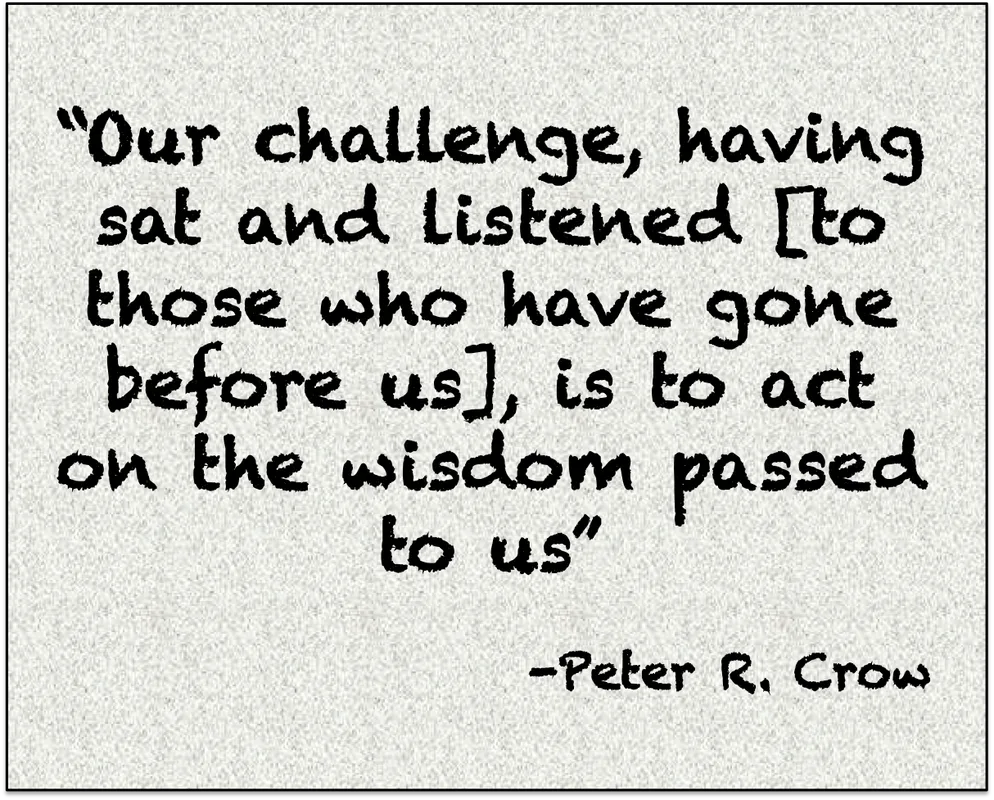
    Often, the best decisions are those made after we have paused and looked back, for guidance about how best to move forward. Whether we are cast as leaders or followers, we could do far worse than to seek out people like Bill and Augusto, sit with them and, having asked them a question, listen intently to what they have to say. Our challenge, having sat and listened, is to act on the wisdom passed to us.
  • Published on

    Moving beyond 'USP' and 'point of difference'

    A couple of weeks ago, I met with a recently appointed chief executive who wanted to test some ideas in his quest to identify the company's USP (unique sales proposition) and, therefore, its point of difference. Paul's concern was that the company was operating in a crowded and competitive marketplace without a coherent strategy, and that success was dependent on standing out. We had a fascinating conversation—the essence of which is repeated here because Paul's question seems to be topical (I have just come off a phone call with a chairman (different company) who posed a very similar question). 
    I asked Paul to describe the company and summarise the present reality. He recounted the company's past successes, current capabilities, market position and strong product line. Then he said that market share had drifted downwards in recent years. After sipping my coffee, I asked Paul why the company existed. He looked blankly at me as if I had come down in the last rain shower. "To make a healthy profit, of course".
    "Of course", I said. "I expected to hear that. But doesn't every company have that goal? How does being different serve this goal, especially when barriers to entry are so low these days that difference is only temporary, at best?
    "Apart from serving our collective egos, that you have something different (or even unique) to offer is of little consequence to most busy people. It matters even less when a competitor offers something seemingly similar for a lower price. When this happens, it's a race to the bottom—and that's dumb. Shouldn't your motivation be to make a difference and help your clients achieve their goals? With this in mind, might a better objective be to identify your company's 'point of impact'? In my experience, people choose to embrace your ideas and buy your product because they believe in you and what you represent. Imagine the response if MLK had uttered "I have a plan"—that speech would have been a footnote, gathering dust in the annals of history. But he didn't."
    The conversation moved to other matters. Then, as we finished our coffees, Paul smiled knowing that he had some work to do. I wished him well and we parted ways.
    Do you know why your company exists? The next time your board and executive gathers to review strategy and set future goals, start by asking this question. I respectfully suggest that you don't move on until a lucid answer is both determined and agreed.