• Published on

    Where should the accountability benchmark be placed?

    Corporate boards and executive managers have endured some criticism of late, as yet another wave of reports of incompetence, fraud and hubris have reached the public domain. Some directors have been lambasted for their actions, while others have avoided any direct consequences. Clearly, this raises an interesting question of consistency. Where should the accountability benchmark for acceptable director performance be placed? 

    My sense is that directors need to think very carefully about why they are appointed and what duties they must fulfil having accepted any appointment. All directors have a duty of care and a duty of loyalty—to the company or to the shareholders (depending on the jurisdiction) and not to themselves. This means that the director role is a servant role, of serving the best interests (of the company/shareholders). In fulfilling these duties, directors need to ensure they are adequately informed and well-intentioned, lest the wool is pulled over their eyes or they make decisions that are not consistent with their duties. The role of the director bears a weighty responsibility, so directors need to take their appointments seriously. Most do, but some, clearly, flout the boundaries of moral and ethical acceptability. 

    Directors need to be beyond reproach, and clear demarcations of what is acceptable—and what is not—need to be established. The challenge, of course, is holding directors to this level of performance, in the public domain and through any legal processes that may be required.
  • Published on

    Outsource the board? I don't think so.

    The contentious topic of board performance seems to be getting more and more attention in the popular press. The attention is great, because boards are responsible for company performance, in accordance with the wishes of owners, and they need to be held accountable. However, not all of the discussion is helpful. For example, this provocative article appeared in the Economist recently. While the article was well-written, the proposal it contained—to outsource the board—was irksome. I remember tweeting about it at the time.

    The board is a proxy for absentee owners, to represent their interests. Why any owner (shareholder) would allow a board to (re)outsource what is, in effect, an arrangement that is already outsourced is beyond me. If the board is not delivering the results the owners want it should be replaced, not outsourced. Thankfully, an influential commentator has provided this rejoinder to Schumpter's article, and in so doing reintroduced some much needed balance and a modicum of sensibility.

  • Published on

    BAM2014: Final programme published

    The 28th Annual British Academy of Management Conference is now less than a week away. The conference is being held in Belfast, Northern Ireland, on 9–11 September, and the final version of the BAM2014 programme is now available on the conference website. I'm down to deliver my paper on Thursday morning.

    This year, over 640 full and developmental papers will be delivered over three full days. Helpfully, the wide range of topics have been grouped into 24 tracks. In addition to the papers, keynote speakers will address the delegates each morning; and there are symposia; special interest group meetings; professional development workshops; and, a gala dinner (at the Belfast Titanic Museum, no less) to attend. Delegates will be busy!

    If you are interested in a particular track or specific paper, but cannot attend, please let me know. I will do my best to attend the presentation for you and report back. Also, if you are planning to attend the conference and would like to meet up over a coffee or snack, please contact me via Twitter or email.

    PS: As has become my practice during conferences, I will provide summaries and reflections throughout BAM2014, so please check back regularly if you are interested.
  • Published on

    "Big firms fail to match growth of economy"

    Bryan Gaynor shone the light on a very important problem today—that many large firms in New Zealand simply are not growing in line with the growth of the economy. In other words, they are going backwards. Gaynor's analysis is insightful: to lose ground when the flow is good suggests that something is amiss. This raises several important follow-on questions: 
    • What have the boards of these firms been doing over the last few years?
    • Why have the boards not held the Chief Executive accountable for performance?
    • Who is actually in control and who is driving strategy? (It's unlikely to be the board, from what I can see.)
    • What changes are required to get these firms, and the economic contribution they make, back on track?

    While the issues before each firm will be unique, there are some constants:
    • The board is responsible for business performance.
    • The board needs to ensure that an appropriate corporate strategy is in place
    • The budget is not the strategy, it is a measure of progress.
    • The basis of performance should be achievement of strategy, not achievement of budgets.

    Hopefully, the boards of these firms will take stock, ask some quite tough questions, and make appropriate adjustments to get back on track. High company performance has many positive flow-on benefits beyond shareholder wealth, and these need to be realised if at all possible.
  • Published on

    What is it with IT governance? 

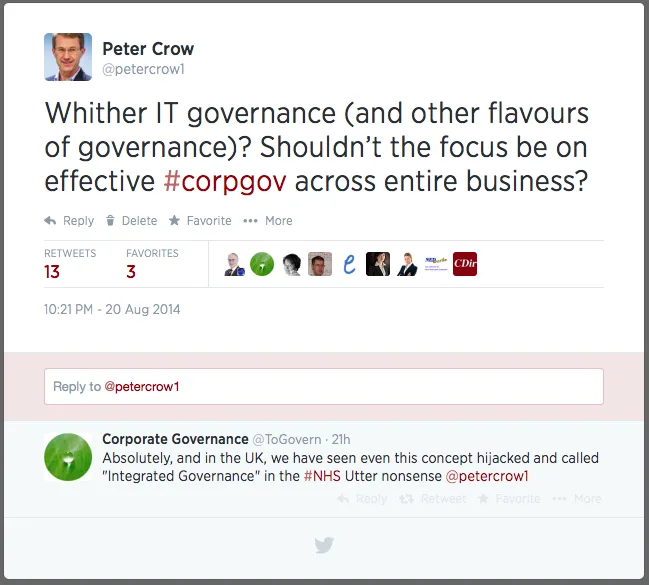
    I got a bit frustrated yesterday. Three messages arrived from people promoting IT governance—heavily. The problem wasn't so much the topic per se, but rather the brow-beating that accompanied it. According to the messages, companies need IT governance, and it is important for CIOs to be appointed to boards. Really? The board's responsibility is to think about the company as a whole—to set strategy; to make decisions; and, to monitor strategy implementation to ensure goals are achieved. I couldn't find a credible explanation as to why IT governance was crucial, so decided to ask the question:
    Picture
    To my surprise, the question was retweeted to tens of thousands of others. Several influential people replied privately to say they were puzzled. @ToGovern replied publicly, as you can see. As I've thought about it some more, I've found myself wondering why people find it necessary to grab concepts, re-name them and re-apply them, often inappropriately. For example:
    • Why isn't the process of managing the implementation of a major technology system called 'project management' any more? Surely the board would be more interested if the Project Manager provided a straightforward report to each board meeting, to enable it to monitor and verify the implementation of its earlier decision to approve the project investment?
    • If technology looms large within a strategic priority, or has the prospect of becoming a disruptive influence on the company's business model, why wouldn't a board co-opt a specialist advisor (or several, if the topic is sufficiently complex) for a period, to help it work through the issues and reach an informed decision?

    The board's interest in the first example is verification, and strategic decision–making in the second—both of which are important parts of the corporate governance remit. The information feeds to inform these matters are just that, information feeds. If IT professionals want boards to understand what they do; what they want to do; and, what the emerging trends are, they need to think and speak like boards do. Proposals need to be in the context of approved strategy. Project and management reports both need to demonstrate progress towards agreed corporate goals. Market reports needs to demonstrate relevance to, or impact on, the corporate strategy. If managers write their board reports and provide information in this way, and advisors provide sound advice, directors should have no problem asking appropriate questions in order to understand the issues. If this happens, technology-related topics can be handled by boards in the same way as any other major agenda item, can't they? 
  • Published on

    Congrats IoD—now others need to take heed

    The Institute of Directors has just played a wonderful hand, and in so doing may have started an important transition—from being perceived as being a nice club for well-to-do directors, to being a forthright influencer in the commercial world. In recent years, most professional bodies seem to have concentrated their efforts on recruitment, membership services and education. Some, including the Institute of Directors in New Zealand, have established a chartered director programme, in an effort to raise the level of professionalism across the director community. However, one important element has been missing, or at least not apparent, until now: lobbying.

    The Institute seems to have emerged from the shadows however, by taking this tough stance on executive remuneration. While the move may not win many friends amongst those who frequent the top echelons of corporate power, it signals a return to the principles of the royal charter under which the organisation was formed. It also signals intent: to hold directors accountable and, hopefully, to commence an active lobbying initiative. That standards of professionalism be raised, lawmakers be influenced and directors be held to account bodes well for shareholders seeking to wrest back control of the companies that they own. It also bodes well for the community, because high company performance is an important contributor to economic growth and societal well-being. 

    Congratulations are due to the Institute. Simon Walker and his colleagues have made a bold move. Now we need to see more of this type of behaviour—from the Institute, and from the institutes in New Zealand, USA, Australia and elsewhere.