• Published on

    What are the keys to effective leadership?

    Picture
    As a devotee of life-long learning and a student of history, I keep an eye out for ideas and examples to share with boards and directors—in the hope that some might prove useful to help boards lead more effectively, from the boardroom. Amongst the news feeds and magazines that cross my desk (actually, computer screen), this journal often contains thought provoking articles. Recently, I was looking through some older issues and stumbled across this item, which explores effective leadership. The author offers seven 'keys' to effective leadership, as follows (I've taken the liberty of attaching a comment to each—a consideration for boards and directors):
    • Provide the why: Why does your firm exist? People get behind causes, not things. Simon Sinek makes the point better than anyone else I know. Purpose first, then strategy
    • Embrace variety and listen: Cookie cutter approaches to strategy rarely work. When your board and management team goes off-site to form strategy (yes, together), are customers, suppliers and industry experts invited into the tent, to explain what's important to them and their success? In my experience both as a director and a facilitator, the value these people provide is priceless.
    • Influence: Boards do not operate companies directly, that role is delegated to the chief executive. The only way boards can get things done is through the actions of others (who need to agree to act). Effective working relationships are crucial, and everything needs to be tied back to the agreed purpose and strategy of the enterprise.
    • Read, think, write: How busy are you as a director? Companies and the markets they operate in are complex and fluid. If directors are to contribute effectively and boards are to make good decisions, they need understand the business of the business. Getting up to speed and staying there takes time. 
    • Lead education and change: It all starts at the top. Bob Garratt made this point deftly about twenty-five years ago. His book should be on every director's reading list. Another suggestion: directors need to commit to continuing professional development (ideally, through an accredited provider or local directors' institute ). 
    • Understand failure and take risk: I re-read this article when preparing to facilitate purpose and strategy development workshops, or to complete a board effectiveness assessment: "True strategy is about placing bets and making hard choices. The objective is not to eliminate risk but to increase the odds of success." Enough said.
    • Understand surprise and chaos: As much as directors and chief executives like to think they can, they cannot predict the future. If Covid-19 is to teach us anything, it is that. Companies that have endured over generations get this. Learn from them.
    Comments?

  • Published on

    Curiosity, COVID19 and the cat

    Picture
    The global crisis brought about by COVID19 has precipitated a range of reactions and emotional responses. These have included fear (of catching the virus, becoming very sick or even losing life); frustration (that civil liberties have been withdrawn); anger (the prospect of high levels of state control after the immediate crisis has passed); praise (the selfless actions of first responders and healthcare professionals); disappointment (of not being able to spend time with loved ones); beatification (of some political leaders); confusion (about the conflicting official guidance); and more besides. Inherent biases are also on display, as people turn to social media to express themselves (or react to what others have written). Some have supported the government's actions and public health responses; others have been highly critical, even vitriolic.
    It's perfectly natural for people to react to what they read and hear about the situation and the uncertainty foisted upon them—and to be curious about the motivations of leaders and what the future might hold. 
    In times of great crisis (when chaos tends to reign), the most important priority for a leader (board of directors, executive team, community leaders or the government) is to re-establish a sense of stability and order, noting the fine line between providing leadership and imposing one's will.
    Effective leaders tend to roll their sleeves up, identify options, openly encourage alternative perspectives, make decisions based on best-available data and assumptions thought valid at the time of the decision, and explain why decisions have been taken. But as the situation develops—and it will, both naturally and in response to various interventions—progress and data need to be reviewed. Effective leaders display an openness to reverse or amend earlier decisions promptly if new data do not conform to a priori assumptions. Transparency and accountability are both crucial to maintain the confidence and support of stakeholders.
    But effective leaders also look beyond the immediate crisis. They ask questions to discover what the future might hold, and whether the crisis presents an opportunity to do things differently. But they don't pursue change for change sake. Over the past two or three weeks, a bevy of visions of what a post-COVID19 world could or should look like have been published by think-tank groups; futurists; independent consultants; journalists; social media commentators; self-styled experts; company leaders and other pundits. Amongst those shared to date, 'digital transformation'; 'locking in new ways of working'; 'a post-office world'; 'the end of globalisation'; 'balanced capitalism'; 'a more inclusive society' and other similar phrases have featured prominently. Some of the proposals I have seen are coherent and merit further investigation; others are little more than bias-laden and thinly-veiled attempts to influence public opinion in favour the author's favoured ideology. Hopefully, political leaders have been considering options to rebuild the economy and social fabric too, but these are yet to be revealed.
    With so many options (and many more to come, no doubt), business, political and community leaders face a daunting challenge: of threshing the wheat from the chaff, and making strategically-important decisions in the best interests of others, not self. To decide where and how to move next, in the midst of great ambiguity and uncertainty, is not for the faint-hearted. Wisdom and maturity are invaluable capabilities in this context.
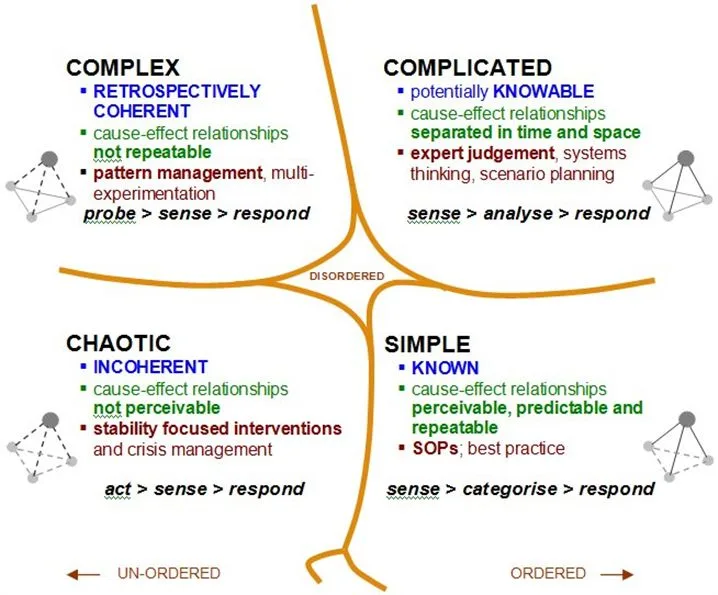
    Many tools and frameworks are now available to help leaders make sense of a multiplicity of options, and to respond well given the prevailing context. The Cynefin Framework is worthy of consideration. (Hat-tip to a Netherlands-based colleague who reminded me of it recently.)
    Picture
    Regardless of which approach or framework you use, high-level sense-making and systems thinking expertise is vital. Heterodox ​perspectives are to be encouraged too. Without these, leaders run the risk of becoming introspective, leaning in on natural biases or, worse, preferred ideologies. Also, great care must be exercised to ensure intended visions are made plain, strategies are coherent and decisions are evidence-based. If such care is not taken, those concerned by what they deem to be inappropriate experimentation or investigation might bite back. ​Curiosity killed the cat, after all.
    The COVID19-induced crisis presents leaders (politicians, boards of directors, community leaders) with a golden opportunity to take stock and, having thought carefully, make decisions in the best interests of the constituency, company, community they serve. Effective decision-making in chaotic situations is far from straightforward, but our future prosperity depends on it.
  • Published on

    Boards and crises: seeing the bigger picture

    Picture
    The unexpected outbreak and spread of Covid-19 has had a seismic effect on the lives and well being of people, around the world. Politicians and government officials have activated crisis response plans (some more quickly and effectively than others) and business leaders have reached for their continuity plans. Amongst the turbulence, little if anything is clear—except that SARS-CoV-2 has our attention.
    Horizons have shortened, and most if not all resources have been diverted to deal with the situation. This is reasonable, but it also exposes the company to a significant risk. Business leaders (especially boards) need to keep one eye on the future, because the crisis will eventually pass. When it does, companies need to be ready to 'go' in the post-crisis environment, lest they be outgunned by others. 
    The most pressing questions for boards as they look to the future relate to the wider operating context, the answers of which inform strategic choices.
    • What has changed, and what might things look like after the crisis has passed?
    • How does this effect our ability to compete; and our ability to win?
    • What adjustments (both strategic and operational) are needed to ensure the company is positioned to thrive in the future?
    As boards work through these and other related questions, careful judgement (wisdom and maturity) is needed, to both balance competing interests (resourcing the crisis versus strategising the future) and to avoid traps that have the potential to stymie the company's recovery. Here are three pitfalls that can entrap boards:
    • Short horizon and great detail: While horizons are, naturally, shortened during times of crisis, boards need to begin looking further into the future early. But, when they do, they need to resist the temptation to dive into the detail (many directors associate detail with higher quality decisions and the mitigation of risk). This is a trap. A strong focus on perfection and detail diverts one's gaze away from the big picture, the wider context within which the company operates. Emerging but still weak signals and new risks will be missed. Left unchecked, the resultant strategies and decisions will be little more than long lists of activities. Roger L. Martin's words speak volumes: "True strategy is about placing bets and making hard choices. The objective is not to eliminate risk but to increase the odds of success". If in doubt, play long—but refine often.
    • An over-optimistic outlook: Strong leaders like solving problems, but they are also prone to thinking they are better or more capable than they are. We see it in politicians, project leaders and business executives: humans have an innate tendency to overestimate their abilities, especially to predict future outcomes. Boards are no exception. One way of mitigating this is to ensure someone acts as an advocatus diaboli  (devil's advocate), to challenge the thinking at each step along the way. Another is to explicitly seek expert advice from independent sources. An external facilitator with a strong personality (to manage egos!) can also be very valuable.
    • Confusion over the board–management nexus: This trap is more common than most care to admit. Usage of the term governance over the last 15–20 years has become so widespread (in appropriate and inappropriate contexts), that is has become a panacea for all manner of corporate activity and ills. With it, the board–management nexus has become clouded, with the two parties unsure of who is doing what. If the board and management are to work well together, with the company's best interests to the fore, a well-defined of division of labour is required, to allocate to tasks explicitly to the board, to management, or to both.
    The temptations to look just ahead; embrace detail; mitigate all risks; confuse strategy and tactics; conflate the roles of governance and management; and be highly optimistic are very real—more than many would care to admit. But they are by no means insurmountable. 
    Boards intent on ensuring the company is well-positioned to emerge from a crisis intact know that high quality steerage and guidance is vital: a clear sense of purpose (reason for being), a coherent and appropriately resourced strategy that is relevant to the circumstances, a dedicated team and effective oversight. They also know that this principle holds regardless of the company's size, sector or span of operations.
    A much brighter future awaits those companies that do not lose sight of the bigger picture as they work through the mire towards solid ground.
  • Published on

    Leadership when it matters

    It has been said that a leader without any followers is, in reality, just a person going for a walk. Followers are, by definition, necessary. But the presence of followers is an incomplete measure of a leader's effectiveness. Messages of praise by acolytes and enthralled observers are rarely useful indicators either. 
    The winning of an election by a national politician, civic leader or a company director reveals little about the quality or effectiveness of their subsequent leadership. It simply shows they were more popular than their rivals on the day of the election! Consider the UK Prime Minister's victorious 'peace in our time' utterance in 1938 (which proved to be short-sighted, even deluded); the Watergate scandal (second-term presidential hubris); the Christchurch City Council's consents debacle (leadership ineptitude); and Wells Fargo's mis-selling of accounts (executive-level malfeasance). Chamberlain, Nixon, Parker and Stumpf were all thought to be leading well, but all ultimately stumbled when it mattered. 
    That leadership is a function, not a position, is axiomatic. And like magnetism and gravity, leadership cannot be seen directly; only through its effects. Indicators of leadership effect include the behaviours, decisions and actions of a leader as an overall goal is pursued.
    The past three weeks have produced innumerable examples of leadership behaviours and use of positional power to exert influence or make decisions in response of the COVID-19 outbreak. Here's a few examples:
    • Chinese authorities initially covered up the outbreak.
    • The President of the United States closed the border to travellers from the EU (and subsequently the UK and elsewhere), and claimed that the war on COVID-19 would be won by Easter.
    • The Prime Minister of New Zealand implored to people to stay at home and be kind; and, in relation to locking the country down and implementing border controls, claimed to have acted early and hard.
    • Singaporean and South Korean authorities locked down borders, and quarantined those confirmed or thought to have become infected by COVID-19.
    • The British Prime Minister asked people to go about their business, but subsequently locked down the country, and caught the virus himself.
    An amalgam of factors contribute to any leader's effectiveness. These include (but are not limited to):
    • Providing a clear and credible objective: ​Has the leader clearly articulated an overall vision or end-state to be achieved—and is it realistically achievable?
    • Being visible: ​Is the leader visible, available and on-hand?
    • Being consistent: Are the leader's actions and behaviours consistent, or are they variable depending on the immediate situation?
    • Decisiveness: Does the leader make decisions with the intention of advancing towards the stated objective, using the best-available evidence and advice, or do they dither?
    • Acting with integrity: Is the leader honest, with a strong moral compass, or do they mislead?
    • Fairness and equity: Is the leader impartial?
    Prime Minister of New Zealand, Jacinda Ardern, has been lauded for her handling of the COVID-19 outbreak. She is widely regarded as being a great and empathetic communicator, which should not be surprising given her training is in public relations and communications. The form is good, but what of the substance of her messages? Is Ms Ardern actually providing strong leadership, as many have opined? The factors listed above is one means of considering these questions:
    • The Prime Minister has been highly visible during the COVID-19 crisis. She has attended press briefings, frequently appearing at the daily press update alongside the Director-General of Health and others to deliver news and answer questions. Her empathy with the plight of many is palpable.
    • The stated objective, currently, is to eliminate COVID-19. New Zealand is the only country to have taken up this lofty goal. If it can be achieved, that would be wonderful. But don't think for a minute that it will be easy. It will require complete isolation at the border for an extended period. Is such strict isolation feasible given New Zealand is an international trading nation within a global economy? And what of the longer-term economic outlook? The credibility of the objective is dependent in no small measure on the exit path—how to restart the economy. As yet, nothing has been announced.
    • The State of Emergency and enforced lockdown that New Zealand is enduring has stopped much economic activity. While the primary, logistics, healthcare and grocery sectors are operating, most retail stores and all non-essential businesses have been closed. Outdoor sports and fitness pursuits including team sports, surfing, mountain biking and many other types of outdoor exercise have been banned. Waiting times to enter supermarkets now exceed one hour in many places. The Police have been empowered to detain people flouting the rules, and individuals have been detained. Yet amongst this, the Minister of Health has seen it fit to ride his mountain bike and go to the beach. Of themselves, these actions by the Minister are not inherently unsafe. But they do set a poor example; a high degree of arrogance from a Minister who should have known far better. That the Prime Minister did not sack the Minister of Health immediately upon learning of his actions, or accept his resignation (which was offered), raises questions about the Prime Minister's performance, especially in relation to equity, consistency and decisiveness.
    • Calls to close the border and implement strict quarantine measures were first made at the end of February. In the days that followed, a bevy of academics, researchers and some self-styled experts published predictions about the large number of people who would die to COVID-19 infections. Some suggested 10,000, others 80,000. These numbers have been repeated by the Prime Minister on several occasions, which has the effect of endorsing them. The Prime Minister also said that as many as 4000 people may become infected before the 'curve is flattened', a number that is less than the predicted number of deaths! All of this, despite the Director-General of Health, an exemplar of stability and consistency, saying that he expected the curve to flatten in 10–12 days (from the date of the lockdown) and that that the case count would rise to about 1000–1400 by then. And it has. Why the Prime Minister did not heed the advice of her top health sector official is not known. Dire predictions (and several at that) and worse-case scenarios are of little help when the likelihood of them occurring is, essentially, nil. Meanwhile, the border has remained porous, despite claims of acting early and hard, allowing infected travellers to not only return, but disperse around the country.
    The picture that emerges here is one of a communicator who is endearing, building esprit de corps. But oratory without substance is not sufficient. Leaders need to set out a credible goal, clearly; be decisive and consistent;  and insist that decisions are acted on, in full.
    ​Calls for the Prime Minister to move beyond both empathetic sound bites and measures that would not look entirely out of place in a socialist regime are gaining traction. The time to consider the future is now; to forge the pathway towards economic recovery and the restoration of civil liberties within a functional civil society, is a matter of great urgency. And that is where the extent, quality and effectiveness of the Prime Minister's leadership will be laid bare. Leadership when it matters. 
  • Published on

    Leading from the boardroom: a collective imperative

    Picture
    Leadership is topical in most spheres of human endeavour; companies are no exception. To encourage others to achieve great things is the stuff of effective leaders. The most successful are widely-lauded. But leadership can take many forms, of course. Cast your eye over the last 100 years or so and you'll discern leadership in action in different ways. The era of the titan (Rockerfeller, Carnegie and Morgan being notable examples) saw leaders exert control over companies powerfully. The emergence of the management class in the inter-war years saw the emphasis change, the efficient operation of companies came to the fore. Since the turn of the century and the entry of corporate governance into the business lexicon, leadership has taken another form: the oversight of companies from the boardroom.
    Often, perhaps typically, leadership is understood to be an individual endeavour; a person exerting influence. But leadership has a collective dimension too—the board of directors is an instructive case. While individuals (directors, trustees) contribute to board discussion and process, it is the board (not directors) that decides. Leadership in this context is, exclusively, collective.
    Collective leadership requires a different approach. Directors need to work together to reach consensus for a start. This article has some more great tips that boards may wish to consider as they seek to lead effectively:
    • Good leaders focus more on character than ability. Where does your board recruitment practice put its energy?
    • Effective leaders are open to learning from others. When did your board last undertake a professional development session, together?
    • Effective leaders are marked out by a spirit of appreciation and thankfulness. Does your executive team know that you appreciate their work and the results they achieve? What about staff, clients and other stakeholders?
    • Effective leaders are self-aware. Does your board assess this, or is hubris a problem?
    • Effective leaders choose to get on the solution side very quickly. To dwell on problem definition and compliance is to vote for stasis not progress.
    How does your board measure up? More pointedly, does your board even know the effect of its decisions? Nearly thirty years ago, the challenge of explaining board influence over company performance was famously described by Sir Adrian Cadbury, a doyen of corporate governance, as being "a most difficult of question". Thankfully, some progress has been made in recent years, as researchers have entered the boardroom to conduct long-term observational studies of boards in session, and leaders such as Charles Hewlett have shared insights from their experience. While robust explanations remain elusive, one thing is now clear: neither the structure nor composition of the board is a direct predictor of its effectiveness, let alone company performance. If boards are to contribute effectively in the future, they need think, act and behave differently.
  • Published on

    How does your board rate on the 'trust' scale?

    Picture
    Trust is one of those social building blocks that is crucial for getting things done with others. Board work by no means exempt. When directors a faced with making strategically-important decisions, they must rely on information from and interaction with their board colleagues, the chief executive and any other advisors who may have been invited to contribute. Then, after consideration and having made a decision, the board needs to follow through, by ensuring the decision is implemented well. But, and sadly, the  levels of trust both between directors and with external stakeholder groups is often lower than what is needed for effective decision-making. The following comments, originally published in 2016 by EpsenFuller (subsequently acquired by ZRG Partners), make the point deftly:
    Board directors today face a variety of challenges. Whether it is a case of corruption or the increasing threat of cybercriminals, their performance in dealing with these issues is the subject of considerable attention, explained The Huffington Post (Jan. 25, Loeb). Investors, consumers and NGOs alike are looking to boards for accountability in terms of company performance. Yet, a recent study found that public trust in boards of directors is lower than that of CEOs. A mere 44 per cent of survey participants claimed to have trust in a company's board—five per cent less than trust in CEOs. Influential constituencies are demanding that boards perform at exceptional levels while maintaining distinct independence from company executives.
    That some directors do themselves no favours (through poor behaviour, malfeasance, hubris and  failing to complete actions, for example) is self-evident. But all is not lost. High levels of performance are possible—if all of the directors commit to working together (both as a board and with management) and reach agreement on the company's core purpose; the strategy to be pursued to achieve the agreed purpose; how performance will be measured; and the values that will underpin behaviour standards, decisions, and everything the company does and stands for.
    Perhaps if more boards embraced this mindset (working together), with the company's best interests to the fore, the trust problem that generates so much tension (not to mention column inches) would gradually become a thing of the past. Is this expectation worth striving for, or do you think it is too ambitious?