• Published on

    What if a board chair was an animal?

    Picture
    “If a high-performing board chair was an animal, what animal would it be?”
    This was the opening question to panelists at a High Performing Chair conversation hosted by the Institute of Directors in Tauranga last evening. I had the privilege of serving on the panel alongside Debbie Ireland and Nathan Flowerday to offer some comments about our experiences chairing the boards of large, medium and smaller organisations. 
    The opening question set the tone for what followed, for it got those in attendance thinking, about the capabilities and attributes of an effective chair, and what distinguishes a good chair from a great one. ​The responses from the panelists were instructive; three different perspectives drawing out critical attributes common amongst highly-effective chairs:
    • Wolf: sometimes out the front, sometimes amongst, and sometimes leading from the rear.
    • Kea: naturally inquisitive, tenacious, asking questions
    • Lion: power by presence, overseeing, exercising strength when needed
    Panelists went on to respond to a wide range of questions from both the moderator and the floor, covering such matters as meeting management, chair–chief executive relations, communications, tenure, balancing priorities, handling crises, continuing development, and strategic decision-making. 
    Thanks to Brian Staunton, for your expert moderation of the panel, and the Institute, for hosting the conversation. ​I came away more well-informed than before, and hope those in attendance did too.

  • Published on

    When AI writes the news

    Picture
    Today is the last day of 2024, the day many people reflect on the year gone and ponder what might lie ahead. Everything from checking off goals set twelve months earlier, to setting goals and resolutions for the year ahead. I am amongst those who 'reflect and set' around this time of the year. Normally, the exercise involves reading back through notes and notebooks, and pondering goals. This year, I asked for help; not help from anyone who knows me really well, but from a newly-released LinkedIn feature, Coauthor. 
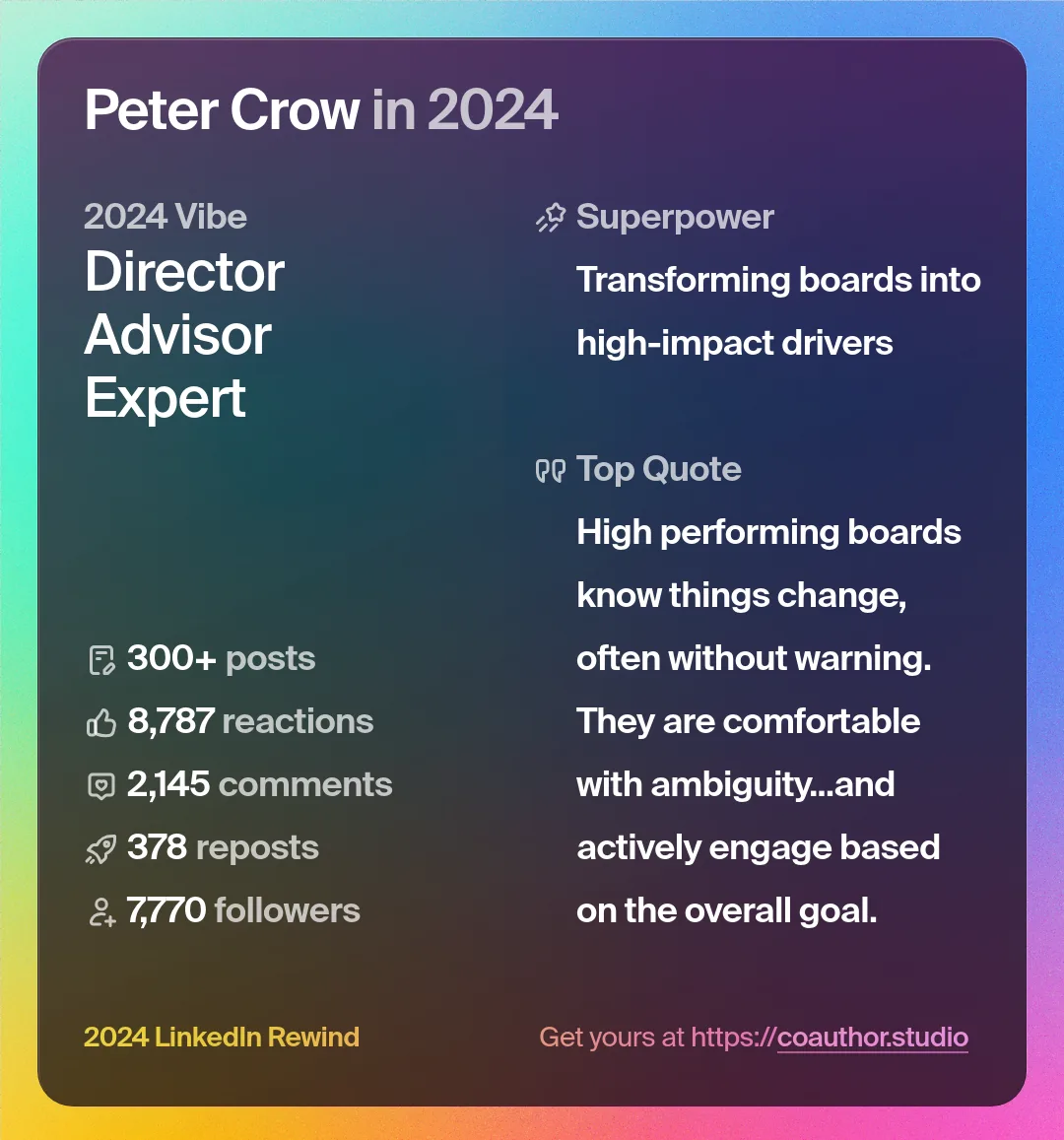
    This is what Coauthor, an AI tool, curated, in both textual and info-graphical form:

    What happens when a board advisor steps into new territories while staying true to core principles? 2024 showed me. The year brought significant evolution in how I serve boards and directors, particularly through co-founding govern&; with Jurate Stanisauskiene to help boards in the Baltics achieve sustainable outcomes. The year brought meaningful progress:
    •  Co-founded govern& to serve boards in Baltic region
    •  Joined Editorial Board of Advances in Corporate Governance Journal
    •  Completed significant governance review work for Baptist Union of New Zealand
    •  Expanded influence through international speaking engagements

    Yet the core mission remained constant: helping boards govern with impact.

    Picture
    While I may not have highlighted these specifics 'by hand', the general tenor of the summation by Coauthor is pretty good—save one word: expert. While my record implies a level expertise in several areas, I make no claim to be an expert director, expert advisor or even a governance expert. To use 'expert' in this way is, I think, self-aggrandisement. I am, straightforwardly, someone with a deep interest in the performance of organisations and the contributions of boards of directors.
    So far, so good. But what of the future? How does AI do when looking ahead? What does Coauthor have to say in relation to 2025? This:
    ​govern& will expand its impact in the Baltics while I continue advancing thought leadership in corporate governance. The focus remains helping boards see around corners and make decisions that drive sustainable outcomes.
    This is a reasonable attempt, as far as it goes. What Coauthor does not, and cannot, 'know' is what sits in the wings, much less how other as yet unknown factors might influence me in 2025. My intent to finish writing Boardcraft: The art of governing with impact is not mentioned, nor is a significant initiative to support boards in several developing nations, or speaking engagements at conferences in New York and Milan. And therein lies a critical limitation. When AI writes the news, it can but summarise the past. And, generally, speaking, it does this very well. Making statements about what might lie ahead is much more difficult; anything requiring mimicry of human traits—such as intuition, reasoning, sense-making and undeclared preferences—are beyond its capabilities.
    Boards need to bear this in mind when considering if, how and where AI might 'fit' when considering strategic options. AI can be an incredibly powerful enabler, and its application to drive efficiencies and expose new sources of competitive advantage should be explored. But, great caution is needed: as attractive as the outputs from LLM models appear to be, their predictive power beyond the next word, or ability to credibly simulate social traits, is rather more limited. 
    Regardless, thank you for your supporting 2024, and best wishes for what lies ahead in 2025.
  • Published on

    For what purpose?

    Picture
    Recently, I announced the findings of empirical research conducted over an eight year period. The aim of that research was to discover how many boards are fully aligned in relation to corporate purpose. The findings were staggering: five per cent of the participating boards—yes, one in twenty—were completely aligned in relation to corporate purpose. When asked, every director and executive had an answer, but only five boards (out of one hundred and three, to date) had one answer. How can any board do its job (make informed decisions, and provide effective steerage and guidance) if it has not first agreed on an objective (purpose) to work towards?
    Compare this situation with that of a plant. The example in the picture—echium vulgare, or, more commonly, viper's bugloss or blueweed—is as good as any. Echium vulgare, a native of Europe, is an introduced species in parts of north-eastern North America, south-eastern South America, and New Zealand. The plant is toxic to horses and cattle, but the bright blue flowers are very attractive to bees. And, despite the toxins in the plant, honey produced from the nectar is very tasty indeed!
    "So what?" you might ask. To compare a board and a plant seems a little odd. Yes, maybe, but please allow me to explain. 
    E. vulgare, like all other plants, has a single purpose, which is to grow and reproduce. All the plant's energies are dedicated to this single goal, using the resources available to it. Nothing more, and nothing less. In contrast, many companies operate without an overarching and enduring goal, as the research mentioned above shows (save to make a profit). And that begs another question: how can any organisation realise its full potential without first establishing a clearly defined and achievable goal?
    'Purpose' has become a hot topic in board, shareholder and stakeholder circles. Some have interpreted purpose to mean mission and vision: an overarching goal the company intends to achieve. Others have a different understanding—one that positions the company as a servant of society, as the question below illustrates:
    How can a company not be in the business of improving human health and making the world a better place?
    This question, posed by a US-based leadership consultant, positions purpose as a catalyst to influence or resolve an external societal or environmental situation. In effect, the underlying expectation is that the company prioritises something external and, most probably, well beyond the company's means and ability to influence, much less achieve.
    The difference between the two understandings is stark, as are the implications. Readers will, probably, gravitate towards one or other, and some may hold such strong views as to be offended by 'the other one'. And that is okay; shareholders and the board can strive to achieve whatever they want—such is their prerogative.
    What matters is that every board takes responsibility for answering the question, of why the company it is charged with governing exists. Essentially, "For what purpose?" Without this, the company will lack a North Star, and efforts to create a meaningful strategy, let alone allocate resources well and achieve high levels of performance, will be fraught. But, if purpose is clearly stated, and agreed and understood by every director and all key staff, the company will not only attain membership of a most desirable club—the Five Percent Club—the board will have established a robust foundation upon which a coherent strategy can be developed, resources allocated, decisions made, and the full potential of the company pursued. And that, I think, is a good thing.
  • Published on

    On writing well:

    Picture
    One of the great challenges for board directors and executive leaders concerns written expression. How might one cast vision, report progress clearly, make a request unambiguously, or argue a point convincingly if the key messages are not clearly stated? Directors and executives owe a duty to their colleagues in this matter, for written reports are the primary vehicle for sharing ideas, proposals and data before each board meeting. 
    To suggest the quality of the report (especially, the clarity of the message within) may be the difference between success and failure (that is, acceptance or rejection) is, probably, a truism. ​So, if we are to be convincing in our argumentation, we need to write well. But how?
    The first thing to acknowledge is that writing is a craft. And, as with any other craft, proficiency is something that emerges over time, as principles are learnt and applied in practice. Look to others who write well, and glean from them. Seek feedback from your readers too, and make adjustments. 
    I have long relied on the guidance of William Zinsser (1922–2015), especially that offered in On writing well​. Another great source is the Blue Book of Grammar and Punctuation, which provides specific instructions. How do you ensure board reports and business proposals are well written, and what tools and approaches do you use?
  • Published on

    Taking care of business

    Picture
    Today, 26th May, is my fourth and final day in the office this month. Airports, hotels, taxis, client and speaking engagements, and board meetings have been the order of the month—until today. Now, my attention is elsewhere: on other important tasks, which, if neglected, could undermine what has gone before. 
    Taking care of business on days like today means taking care of administration: creating and issuing invoices, collating receipts and claiming disbursements, checking in with a couple of director colleagues, and seeking feedback from family business meeting. And, regardless of whether one is a leader in a large organisation, a freelance consultant, small business owner, or an independent director and advisor, paperwork left to mount up exposes one to operational and, potentially, reputational damage.
    Most months, I spend one evening per week in the office, to keep on top of things. But sometimes, travel and other commitments stand in the way of this rhythm. And, when this happens, a concerted effort is needed to get back on track. Today is that day.
    How do you keep on top of administrative tasks?
  • Published on

    The craft of board work; 21 years on

    Picture
    Twenty-one years ago this week, I embarked on a journey to pursue a dream: to help directors and boards become value creators, realising the potential of the companies they govern. At the time—four weeks after the terror attack on the World Trade Centre—governance was hardly known as a word, and most boards had a strong compliance orientation. I had no idea whether the dream was realistic, much less attainable. But, at 39 years old, the calling was strong—compelling even. So, I took a deep breath and walked away from a great company and international role, armed solely with a strong belief that I might be able to add some value. I was told that stepping away from financial security and the makings of a stellar international career was crazy. But the decision had been made.
    I found that people would happily talk about their situation and what they wanted to achieve if they thought you were genuinely interested in them. That insight has provided the foundation for everything that followed—including working with thousands of directors in 45 countries across five continents, serving on boards, delivering hundreds of talks and leading many education sessions. The 2012–2016 period dedicated to complete doctoral research, to try to answer that most difficult question of how boards influence company performance provided a breakthrough that I hope, one day, will be taken up widely: the Strategic Governance Framework. To have met and spent time with doyens of corporate governance, strategy and leadership along the way—including Bob Garratt, Bob Tricker, Charles Handy, James Lockhart, Jenny Darroch, Roger L. Martin, Rita Gunther McGrath, Silke Machold, Stuart Farquhar, Andrew Kakabadse and many more besides—has been inspirational. I am indebted to everyone who has spared a few minutes to answer questions and share insights.
    Other highlights include sitting with directors in India, Eastern Europe and other places well off the beaten track, to listen; experience their thirst for insight; and receive their gratitude for what little I had to offer. 
    Without exception, everyone I've met and worked with has wanted to find ways to guide and steer the businesses they govern with greater effect. To have been asked to contribute has been a honour. 
    Thank you to every established director, board trustee, and board chair; every aspiring director; every chief executive and leadership team; every MBA student, researcher and associate; everyone who has heard me speak or read my articles (note: all my articles and blog posts remain available today); every regulator and government who sought confidential assistance; and, untold others I've never met. Thank you for considering my submissions and arguments, for believing in me, for encouraging me and for engaging me.
    Today, 21 years on from stepping out of the boat, the calling remains strong. I remain available to serve for as long as boards and directors call for assistance, and my ability to contribute allows. To that end, and with the passing of the pandemic, I am available once more to travel to meet in person to understand and speak into situations. So, if you have a question or want to discuss a problem, please get in touch. I stand ready to serve.