• Published on

    Who should be in "control"—the CEO or the Board?

    Power is an interesting dimension of human behaviour. It can (and often does) bring out the best and the worst in us, and in those around us. The question of where power could or should be held has been the topic of much debate—wars even—over the centuries.

    In the modern corporate context, the CEO generally occupies the alpha male (queen bee) position in a company, especially in jurisdictions where the CEO and Chair roles are combined. In such cases, the board is relegated to the relatively passive position of making those decisions it has to, and to monitoring performance. Many CEOs like it this way—they are happy to hold the power and privilege that go with the position.

    An increasing number of calls, in academia and practice, are starting to challenge the status quo. However, calls for the board to take responsibility and be accountable for business performance, by becoming more involved in direction setting and strategy development, may have an unintended consequence: a power struggle. Power struggles are generally negative, because they move one's attention from the overall goal (business performance) to a lesser goal (being in control).
    • How should such matters be resolved?
    • Should the CEO remain in control?
    • Should the board usurp power? 
    • Is a collegial position achievable or sustainable?

    I'd value your thoughts on these important questions!
  • Published on

    Boards: a timely call for courage

    I had the pleasure of working with 24 outstanding business leaders and company directors yesterday—delegates on the IoD Company Director's Course. The topic of the day was strategy, as it always is on the second day of the course. My task was to lead the day and provoke discussion and debate, as part of the learning experience. The entire course is run under The Chatham House Rule, so delegates can speak freely and use real-world examples without fear of sensitive information being made public. However, some of the themes and conclusions that emerged from the discussion can be mentioned:
    • Boards need to be involved in the development of strategy, in some way.
    • A standard lexicon is crucial, so that everyone knows and understands what is meant when certain words are used. (We had a lengthy discussion on the question, "What is strategy?")
    • Boards owe a duty of care to ask probing questions of management, to satisfy themselves as to what is really going on.
    • Business is complex and strategy development is not straightforward. Things change, and sometimes tough choices need to be made, often without complete information.

    As we worked through the day, it became clear that the delegates had a realistic view of how boards and business actually work, and they recognised that there is often a gap between [tidy] theory and [somewhat messy] practice. The separation of governance and management, first espoused by Berle and Means in 1932 and now accepted dogma for companies in the Anglosphere, may not be the best model, for example. The discussion reminded me of a timely call made in an article that appeared in The Conference Board Review recently:
    Unfortunately, despite the theory on how boards are supposed to work, the reality is considerably messier. Reinvigorating boards with curiosity and courage would be a very good place to start fixing what is broken.
    Hopefully, delegates are able take away something from the course to ponder and challenge their status quo and some of the accepted maxims of governance. Boards cannot afford to remain as "parsley on fish—decorative but useless" (Irving Olds, Chairman, US Steel 1940–1952). If the behaviours and comments of the CDC delegates this week are any indication, curiosity and courage may be about to re-enter our boardrooms.
  • Published on

    Understand your business better: SWOT 2.0

    Image description
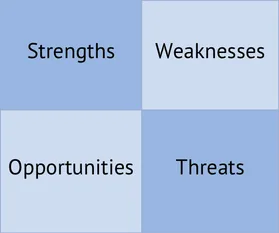
    Do you use the SWOT tool in your organisation as a precursor to the strategy development process? SWOT (Strengths, Weaknesses, Opportunities and Threats) is a useful tool, but it has fallen out of favour in recent years, as organisations have struggled to deal with the 'laundry lists' generated during SWOT sessions. Also, other tools have become popular. 

    Many people have told me that SWOT is old (it is) and irrelevant (let's discuss this), and that newer tools do a better job. I agree, to a point. The trouble with most SWOT analyses is that they only go half-way. Identifying those internal and external things that are helpful or harmful to your organisation's success is useful if and only if something is done about them. The lists generated from SWOT sessions can be long, and complementary items often appear on each side of the ledger. Creating and resourcing effective action plans from such lists is simply too hard in most cases.

    One modification that I have used for a couple of years now is to add a 'so what?' question to the analysis after the lists are assembled. For each strength, weakness, opportunity and threat, think about the impact or consequence of that item on the organisation—by asking 'So what?'. If the impact or consequence is high or significant, create an action to maximise (strength or opportunity) or minimise/mitigate (weakness or threat) it. If the impact or consequence is low or insignificant, simply put it to one side for now. This simple addition (let's call it SWOT 2.0) helps teams prioritise those things things that actually matter. It has transformed the usefulness of the tool (and the quality of the strategy) in every case that I am aware of.

    One last word though: don't be lulled into thinking that SWOT, SWOT 2.0, PESTEL or any other tool is a panacea. They are just tools. They need to be used correctly, for the purpose for which they were designed. Often, it is wise to use a couple of tools, to ensure you get a well-rounded picture to base your strategy development work on. 
  • Published on

    Boards, have you got a CEO succession plan in place ?

    I've been reading through some research papers and magazine articles today, motivated by Xero's active approach to succession in the boardroom (see previous post). I wanted to find out how the related task of CEO succession is managed by boards. My two word conclusion from today's reading: not well.

    A recent Stanford research survey provides insight. Half of the directors surveyed by the Stanford researcher said that a CEO successor was being groomed. That sounds good, but what about the other half? Over the years, I've asked a lot of directors to list the important tasks of the board. Most say that hiring the right CEO is towards the top of the list, yet the Stanford survey reveals that half don't follow through with an adequate succession plan.

    You would think that all boards would have a solid CEO succession plan, particularly as they carry overall responsibility for company performance, and strong leadership is crucial to strategy execution and company performance outcomes. I'm not sure why some boards overlook this important task. Are they too busy with other more pressing matters? Or are they too lazy? Or have they not thought about it? Perhaps shareholders can help, by asking questions at annual meetings to encourage boards to take CEO succession more seriously than many do now. I'm sure the payback to such enquiries will be palpable.
  • Published on

    On ego, knowledge and effective governance

    Do people that promote themselves heavily—by describing themselves in glowing terms; providing long introductions; and, embellishing their accomplishments—annoy you? People that behave like this are relatively easy to spot. They are often quite loud, and their large egos generally signal their presence.

    Interestingly, a recently published article has suggested an inverse relationship between ego and knowledge—which suggests that those with large egos have little to contribute. This is somewhat alarming, as many corporate disasters over the last forty years can be traced back to failures of governance, fuelled by hubris and overactive egos. Just how knowledgeable were the directors in these cases? The message in the article is relevant for everyone in the business community, particularly those directors that see themselves as being above the law and beyond any form of accountability. How long will it take, and how many more lives will be lost, before someone takes a stand?
  • Published on

    ICMLG'14: closing remarks

    Well, ICMLG is over for another year. The ACP organisation, and hosts Babson College (Phil Dover and Sam Hariharan, in particular), organised a great conference. Delegates assembled from over 20 countries from the five major continents. The theme of entrepreneurship provided a linking thread between the keynote speakers (Isenberg and Schlesinger), the paper streams and many conversations over coffee and food.

    I particularly enjoyed the provocative sessions of Isenberg and Schlesinger, and appreciated the opportunity to test some of the ideas that are emerging from my research, especially with researchers from outside the Anglosphere. That feedback will result in some adjustments to the way that my thesis is written up. To everyone who offered feedback: thank you!

    I commend this conference to all management, leadership and governance researchers, and practitioners with an interest in these and related fields. Next year, the conference venue is in the southern hemisphere, in Auckland New Zealand. The co-hosts will be AUT and Massey University. Certainly, I am looking forward returning the hospitality afforded to me in the international conferences that I've been fortunate enough to attend in the last couple of years.