• Published on

    IGW'15: Opening Keynote

    The second International Governance Workshop got underway at Toulouse Business School, Barcelona Campus on Thursday 11 June 2015. Professor Morten Huse, an esteemed corporate governance scholar from Norway, provided the opening day keynote. Huse has been studying boards for a long time—the mid 1970s—so when he speaks, people tend to listen. Here's four of the points from his talk:
    Huse's talk set the scene for a lively debate through the balance of the conference. It will be very interesting to see how this develops.
    • The dominant logic of modern boards—independence and opportunism—has not delivered any significant value to shareholders over time. Rather, it has driven short-termism, strong norms of privacy and mis-trust.
    • The conception of corporate governance as a set of rules and regulations to keep management honest needs to be replaced. Instead, boards need to think and behave in terms of becoming value-creating teams.
    • A fundamental shift is starting to occur, if you look closely: Evidence is starting to emerge to suggest that boards that lead, seek to create value and are involved in the strategic management process are more likely to make positive and meaningful contributions. However, this is not guaranteed, as boards are comprised of people and complex interactions, and external forces exert influence as well.
    • Huse suggested that a common language is required. Too often, a speaker says 'X' only to find that other directors hear 'X', 'Y' or even 'Z'. He went on to overlay a common language and important board tasks over the value creation process (the value chain, if you will).
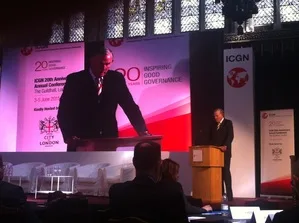
  • Published on

    International Governance Workshop: starts tomorrow

    The annual International Governance Workshop, hosted by the Toulouse Business School, starts tomorrow in Barcelona. Although only in its second year, this conference is an important gathering because it has attracted many of the world's leading corporate governance and board researchers. To be in the same room as these people, to hear them present and debate the results of emergent research is truly an honour. In contrast to the scale of the ICGN annual conference, the IGW is more intimate and more focussed. However, the programme of topics to be explored is no less significant. 
    Session summaries will be posted here, as usual, so you can keep up to date. My paper will be delivered on Thursday afternoon. 
  • Published on

    Martin Wolf at ICGN'15: "Let a hundred flowers bloom"

    Martin Wolf CBE, Associate Editor and Chief Economics Commentator at the Financial Times, delivered a rousing keynote talk to wrap up the final day of the ICGN annual conference. After observing that the limited liability, joint-owned corporation had been the cause and consequence of almost all economic activity over the last two hundred years, Wolf posed and commented on four questions. He qualified his comments by saying that he expected they might raise some profound questions. Indeed, some of Wolf's comments were controversial—the evidence being the questions asked by some members of the audience after he finished speaking.
    What is a limited liability corporation? They are a semi-permanent entity designed to outlast small-medium enterprises (because founders retire—the corner store conundrum) and markets, and they are a construct for the consolidation of relational and implicit contracts. Their genius is the importation of older hierarchical forms (to get things done) into the market system. With scale comes efficiency, endurance and effectiveness (but not always!).
    What is their purpose? The apparent purpose of the LLC is to generate economic value. However, this is insufficient. Wolf asserted that LLCs should also pursue a wider remit, by seeking to 'add value' in social terms (through the provision of payments for services rendered—wages and salaries—for example).
    What is their operational goal? The oft-quoted goal, of maximising shareholder returns, is far too simplistic, according to Wolf. It is selfish and can only lead to failure elsewhere in society. Rather, the operational goal of LLCs needs to include ethical constraints to protect all participants and in so doing ensure the good of society (at no point did Wolf pursue or even imply any form of Marxist agenda).
    Who should control them? Economically, shareholders bear residual risks following corporate activity and, therefore, shareholders should possess control rights. Wolf challenged this commonly-held view as folly because shareholders are unable to exert full control over the affairs of the corporation. Managers may manipulate the affairs of the company, sometimes to the detriment of shareholders and other stakeholders. Short-term incentives, implemented to motivate managers towards the maximisation of shareholder returns, rarely position the company for longer-term success.
    Wolf concluded by saying that LLCs are a wonderful construct. However, he went on to say that the two associated doctrines (of shareholder control and value maximisation) are unhelpful because they are too short-sighted. He told the shareholders in the room that "it is in your interest not to control the corporation completely". Other parties—large bondholders, for example—also bear residual risks. Why would they not have decision rights?
    Wolf's comments were demonstrably controversial (amongst some of the audience at least). However, the poor reputation of big business amongst the general populace suggest Wolf's comments might be closer to the 'truth' than what many in the audience might care to admit. 
    Wolf closed with this demanding challenge: A better approach might be "to let a hundred flowers bloom", so that the best [control] model might rise up and be applied for a given situation—the beneficiary being society at large.
  • Published on

    ICGN'15: A timely call to action

    Image description
    Robert AG (Bob) Monks is a experienced shareholder activist and pioneer in corporate governance. The tall octogenarian has spent a lifetime influencing boards and board performance, especially in corporate America. Monks was invited to deliver the keynote address the ICGN conference.
    Monks, a gifted orator, spoke from the heart, and he had the gathered delegates enthralled as he did so. Reviving memories of the wartime leader Winston Churchill, Monks reminded delegates that, while they had come far, they were not at the end (ie. 'arrived') nor were they at the beginning of the end. They were, he said, "at the end of the beginning". He went on to suggest:
    • Boards and shareholders (particularly institutional investors) had barely started on the journey of convincing management that an engaged shareholder more likely to be helpful than a hindrance. I suspect this was a wake-up call for many, particularly those that think they 'do' corporate governance well and that shareholders should be kept at arms' length.
    • Too many chief executives and executive teams had autocratic control of the levers of power. They were feathering their own nest and allocating resources in favour of short-term outcomes—and boards were allowing chief executives to get away with such behaviours. Thus, chief executive accountability is largely a myth.
    • Much of what actually happens in boardrooms is not corporate governance or even an approximation of corporate governance. Rather it is a shadow play, orchestrated to give he appearance of the board doing the things that it should be doing. The statement that corporate governance is a high-profile smokescreen was as telling as it was damning. 
    Monks continued by offering several recommendations to the audience (comprised largely of institutional investor representatives but also other participants in the corporate governance community including academics and advisors). He said that shareholders need to be genuinely engaged (by specifying what they want from their investment); that integrated reporting is crucial (to provide clarity around actual business performance); and, that all publicly-listed companies need to have real (identifiable) owners (to satisfy the engagement challenge.
    Monks received a standing ovation from some of the delegates, such was the power of his oratory and the high esteem in which he is held. One surprise: neither value creation or strategy was mentioned. I wonder what Monks thinks about these activities and the board's role therein. Rather than guess, I'm going to ask him. Congratulations to the conference organisers for securing Bob Monks' contribution to the debate.
  • Published on

    EURAM: conference programme now available online

    The 15th European Academy of Management (EURAM) annual conference will be held in Warsaw, Poland on 17–20 June. The conference programme is now available online. Over 1200 delegates have registered to attend, to hear about the latest developments in management research and the implications for practice.
    I am looking forward to attending what promises to be a very interesting (and busy!) conference. EURAM is the third of three international conferences that I will be attending in June. In addition to listening to as many of the corporate governance papers as possible and meeting with colleagues, I have two formal commitments, as follows:
    • Chair the second corporate governance session, entitled Boards of Directors: Outside/Non-executive directors, on Thu 18 June.
    • Present my paper, entitled Boards, strategy and business performance: Observations from inside the boardroom, in the afternoon session on Thu 18 June.
    If you would like to receive more information about any of the papers, please let me know. I will do my best to attend the appropriate session and write a report.
  • Published on

    Apparently shareholders do not own corporations!

    Please excuse this rather sensationalist title—I have just picked myself up from the floor having read this clause in the recital section of a [draft] directive being prepared in the EU:
    "Although they do not own corporations, which are separate legal entities beyond their full control, shareholders play a relevant role in the governance of those corporations."
    The proposed directive, which encourages long-term engagement and gives voice to shareholders in listed companies and large companies, seems to be well intentioned. However, the statement that shareholders do not own the corporation left me flabbergasted. It raises all sorts of questions:
    • If the shareholders (collectively) do not own the corporation, who does?
    • To whom is the board accountable—the shareholders (who don't own the asset the board is charged with operating); or, the [now unknown] owners; or, some other group?
    • Who benefits from the wealth created by the corporation, the shareholder, the owner or some other party?
    Why anyone would buy an asset if they knew that a condition of purchase was that they did not own what they had just paid for is beyond me. Is this sloppy drafting, or have I missed something in the semantics? Can someone with a legal mind and expertise in this area please elucidate?