• Published on

    The Alternative Board: caveat emptor

    I have just stumbled across a new conceptualisation of governance, one that looks great on the surface but may actually be troublesome underneath. It's called The Alternative Board.

    The concept is that of "DIY governance", whereby owners and managers of small and medium businesses join a membership organisation to share ideas and provide support. Similar organisations abound in the market; BNI and Chambers of Commerce being two well-established examples. However, when one looks a little more closely, The Alternative Board has some unusual characteristics:
    • The organisation is actually a franchise business headquartered in the USA
    • press release issued today states that members "act as boards of directors for each other"

    Membership of an organisation that provides assistance and collegial support is a good thing, although prospective members may baulk when they consider that this is not a classical break-even membership organisation that exists for the good of the members. The primary motivation seems to be the generation of profits for the owners—that's why franchises exist after all. Owners of smaller businesses that utilise a partnership or sole trader ownership structure can decide what they think about this and whether the proposition delivers value or not.

    Stepping past this first point, there is a larger and potentially more troublesome question for those who operate their business as a company. Advisors that perform tasks similar to those of boards of directors can be deemed to be directors. As such, well-meaning members may, unknowingly and unwittingly, become bound by the Companies Act (and amendments) and the legal duties of directors.

    Given these characteristics, and the implications of them, my recommendation to owners and managers who are considering whether or not to become members of The Alternative Board is this: Do your homework first. Caveat emptor.
  • Published on

    What should boards do when vital information is withheld?

    Decisions about major transactions, or matters that might be material to the future prospects of a company, are usually reserved for the board of directors. This is appropriate, because directors have a duty of care—to the company they govern and to the shareholders that own the company. In fulfiling their duties, directors must ensure they are adequately informed regarding the affairs of the company, so that decisions can be made in the best interests of the company and, ultimately, the shareholders. 

    This all seems straightforward and tidy, but is it always so? Unfortunately not—well not at Hyundai anyway. Recently, the Hyundai board of directors approved a bid to buy a large and valuable parcel of land—without actually knowing the price! Claims by management that the bid price was "top secret" and therefore could not declared seem to have been accepted by the board:
    While boards of the three firms discussed and approved bidding for the plot in the capital's high-end Gangnam district to house a headquarters complex, hotel and automotive theme park, the bid price was not shared with directors as it was deemed to be confidential, three of the directors said. The Hyundai Motor and Kia Motors boards unanimously approved making a bid for the Korea Electric Power (KEPCO) land, two directors said.
    The making of strategically important decisions without vital information borders on reckless trading. That such a large transaction would be approved without knowledge of the price defies normal logic. That $8B of market value has been wiped off Hyundai should come as no surprise.

    Why did the Hyundai board make the decision without knowing the bid price? If the board carries the ultimate responsibility for company performance and business value, it should know everything that is material to a decision. If information is missing, the board should insist on it being provided, and to defer any decision until the information is provided. That management thought that the board could not be trusted with knowledge of the bid price, and the board let management get away with it, is an indicator that there are some fundamental problems with the corporate governance systems at Hyundai. The directors need to take a good long look at themselves and the way they operate, and seriously consider whether they are fit to carry on.
  • Published on

    BAM2014: Opening sessions

    BAM2014 got underway this morning, with a light breakfast of croissants, pastries and coffee to welcome first-time attendees (a great way to help break the ice, thank you organisers!). A series of professional development workshops followed. Seventeen topics were offered, across two workshop sessions, before lunch including:
    • The state of corporate responsibility and sustainability research
    • Developing senior leadership and management capability
    • Cognitive mapping: making sense of qualitative research data
    • Low-tech teaching
    • Researching and engaging with SMEs
    • Generating impactful research: Views from the field

    The workshop sessions were intentionally interactive, with the facilitators actively eliciting comments from, and the  experience of, the delegates in attendance. I attended the cognitive mapping session (quizzically, not really understanding much about the topic) and the generating impactful research (hoping to pick up some tips for my own research) sessions. The cognitive mapping session was really helpful. It exposed me to a method of moving meaningfully from the vast quantity of data that is typically gathered in observations and interviews toward some meaningful conclusions. However, a little knowledge can be a dangerous thing, because I now realise that I may have missed a trick in my research analysis—something that I'll need to give some careful though to in the coming days. The impactful research session was aimed at researchers seeking external (funding) assistance to support their research. This session was of less interest to me as I plan to return to professional practice and advisory work.

    After the lunch break, several business and academic speakers will open the conference. They will address the conference theme: The role of the business school in supporting economic and social development. In my rather limited experience, one of the shortfalls of many business colleges relates to relevance. That business research conclusions often have limited practical application is an indictment on business schools and on the research process. This should be an interesting discussion.  
  • Published on

    BAM2014: starts today

    The 28th Annual British Academy of Management Conference starts in Belfast today. With over 700 delegates registered, 640 papers to be presented (at times over 20 parallel tracks!), the next three days promise to be very busy. My intention is to attend as many of the corporate governance papers as I can get to, strategy papers and a selection of others. I'll post reflections that various points over the next three days, and encourage those interested to follow the hashtag #BAM2014.
  • Published on

    BAM2014: Final programme published

    The 28th Annual British Academy of Management Conference is now less than a week away. The conference is being held in Belfast, Northern Ireland, on 9–11 September, and the final version of the BAM2014 programme is now available on the conference website. I'm down to deliver my paper on Thursday morning.

    This year, over 640 full and developmental papers will be delivered over three full days. Helpfully, the wide range of topics have been grouped into 24 tracks. In addition to the papers, keynote speakers will address the delegates each morning; and there are symposia; special interest group meetings; professional development workshops; and, a gala dinner (at the Belfast Titanic Museum, no less) to attend. Delegates will be busy!

    If you are interested in a particular track or specific paper, but cannot attend, please let me know. I will do my best to attend the presentation for you and report back. Also, if you are planning to attend the conference and would like to meet up over a coffee or snack, please contact me via Twitter or email.

    PS: As has become my practice during conferences, I will provide summaries and reflections throughout BAM2014, so please check back regularly if you are interested.
  • Published on

    What is it with IT governance? 

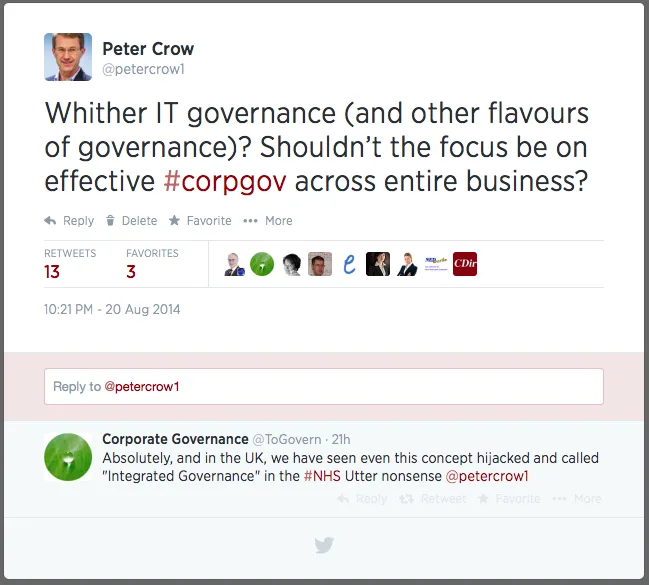
    I got a bit frustrated yesterday. Three messages arrived from people promoting IT governance—heavily. The problem wasn't so much the topic per se, but rather the brow-beating that accompanied it. According to the messages, companies need IT governance, and it is important for CIOs to be appointed to boards. Really? The board's responsibility is to think about the company as a whole—to set strategy; to make decisions; and, to monitor strategy implementation to ensure goals are achieved. I couldn't find a credible explanation as to why IT governance was crucial, so decided to ask the question:
    Picture
    To my surprise, the question was retweeted to tens of thousands of others. Several influential people replied privately to say they were puzzled. @ToGovern replied publicly, as you can see. As I've thought about it some more, I've found myself wondering why people find it necessary to grab concepts, re-name them and re-apply them, often inappropriately. For example:
    • Why isn't the process of managing the implementation of a major technology system called 'project management' any more? Surely the board would be more interested if the Project Manager provided a straightforward report to each board meeting, to enable it to monitor and verify the implementation of its earlier decision to approve the project investment?
    • If technology looms large within a strategic priority, or has the prospect of becoming a disruptive influence on the company's business model, why wouldn't a board co-opt a specialist advisor (or several, if the topic is sufficiently complex) for a period, to help it work through the issues and reach an informed decision?

    The board's interest in the first example is verification, and strategic decision–making in the second—both of which are important parts of the corporate governance remit. The information feeds to inform these matters are just that, information feeds. If IT professionals want boards to understand what they do; what they want to do; and, what the emerging trends are, they need to think and speak like boards do. Proposals need to be in the context of approved strategy. Project and management reports both need to demonstrate progress towards agreed corporate goals. Market reports needs to demonstrate relevance to, or impact on, the corporate strategy. If managers write their board reports and provide information in this way, and advisors provide sound advice, directors should have no problem asking appropriate questions in order to understand the issues. If this happens, technology-related topics can be handled by boards in the same way as any other major agenda item, can't they?