• Published on

    Who's actually in control at Yahoo?

    Picture
    The much storied Yahoo Inc. continues to consume column inches (or, pixels if you consume your news online). From bold beginnings, Yahoo has endured a mixed career as an Internet search engine business. Current chief Marissa Mayer has had her fair share of headlines as well, including some stinging criticisms over some of her management decisions. Now, with a proxy fight looming, Yahoo has issued this release, which has been reported by Ronald Brausch on Dealpolitik (and no doubt others)
    The release and associated commentaries make interesting reading, especially for students of corporate governance, strategic management and firm performance: For example, the release implies that ownership of the new strategic plan lies with the CEO. Consider these two statements:
    • Maynard Webb (Yahoo chairman) is quoted as saying, "The Board is committed to the turnaround efforts of the management team and supportive of the plan announced today."
    • ​Brausch writes "I think the board continues to support Ms. Mayer’s plan to turnaround Yahoo...".
    ​These statements raise a really interesting question. They imply that control lies with management. Does ultimate responsibility for firm performance not lie with the board of directors? Why has the board chosen to stand a little aloof from this? Are these statements simply examples of sloppy copywriting within Yahoo and on Brausch's part, or does control over the company strategy actually lie with the CEO?
    While I have no doubt that some investors are keen to gain partial or complete control of the company (as Brausch reports), the commentary suggests that a more pressing challenge needs to be addressed if Yahoo is to become great again. The question of whether the board or the CEO is calling the shots and, therefore, is actually in control needs to be resolved, and quickly.
  • Published on

    Can strategy and execution be usefully distinguished?

    Image description
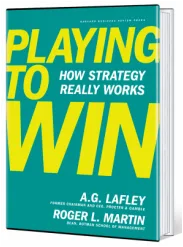
    Roger L Martin, a respected professor at Rotman School of Management and co-author of Playing to Win, has put the cat amongst the pigeons, with this commentary, itself a response to this widely circulated article. The authors of the original article reported findings from a study, which showed that only eight per cent of leaders are good at both strategy and execution. Martin contends that most leaders who are very effective at either strategy formulation are also very effective at execution. Quite a different view. Two different perspectives. Who is correct?
    As with any report involving statistics, context is crucial. If you consider all leaders (as Leinwand, Mainardi and Kleiner did), only eight per cent are "very effective" at both formulating strategy and executing strategy. However, if you only consider only those that are "very effective at strategy", fully two-thirds are also good at execution (Martin's point). Thus, both authors are 'correct'. But which commentary is more helpful to leaders and those intent on achieving business success?
    The shocking statistic is that just sixteen per cent of leaders are "very effective" at strategy formulation or execution or both. Turbulent times demand outstanding leadership, both to determine strategy and to ensure it is executed with excellence. Poor, neutral and even "effective" contributions have little chance of moving companies toward their goals if they are competing against "very effective" leaders. Consequently, 84 per cent of leaders will be found wanting (notice the Pareto Principle?). Rather than debate statistics, it may be more useful to move the discussion to discovering how to move more leaders into the "very effective" sector.
    Another perhaps more important question—for boards of directors in particular—centres on Martin's assertion that strategy and execution are the same thing. Can the two tasks can be distinguished? 
    Strategy formulation and execution are two of the four pillars of strategic management (development, approval, implementation and monitoring). My research suggests that business success is dependent on two things: having a clear sense of purpose and an effective strategy, and great execution. The former is an important task that boards and managers should work on together and the latter is the domain of management (only) once strategic decisions are made by the board. However, some flexibility is required because things change. Decisions and adjustments are required from time to time. If companies are to react and respond quickly, strong leadership is crucial to avoid mayhem. So where does that leave Martin's assertion, that formulation and execution cannot be usefully distinguished? What is your experience?
  • Published on

    The 'call' of the digital boardroom

    Much has been made of the value of board 'going digital' in recent years. Many software-based systems have been produced including offerings from Boardpad, Diligent, Boardpacks and Board Management, amongst others. The benefits of these systems are reasonably self-evident: improved coordination and management of board reports, reduced administrative costs and improved security, not to mention far less weight to carry to and from meetings.
    However, 'going digital' is not without its challenges. Some perhaps less credible claims have been made about software-based systems for boards, leading to misplaced optimism. Take the promise of increased engagement for example. Glance around the table at your next meeting. How many directors are listening intently, fully engaged in the discussion, and how many are covertly checking their devices for messages? Engagement with devices and systems has certainly gone up, but what of engagement between directors and with the topic at hand?
    In my experience (hundreds of board meetings over the last fifteen years, as a director or an observer), the task of direction is a full-time commitment requiring total concentration, especially if the board is large and/or the topic at hand is complex. It's a tough job, with a hidden twist to boot. While directors attend board meetings, they don't make decisions—boards do. If directors are to do their job well, they need to express their opinions and concerns; ask questions; debate topics; listen carefully (to hear both what is being said and what is not being said); and, depending on arguments raised, they may need to gather more information and modify their opinions. Messages on electronic devices can wait.
    ​While computer- or tablet-based board productivity systems can improve the administrative aspects of board meetings (and greatly so), directors cannot afford to be at their beck and call. They provide no substitute for discussion, debate and collaboration as directors meet together to carefully consider important matters and make decisions. Let's not forget that.
    [Postscript: Technology and devices are appealing. I get that. I'm happy to support the introduction of any system that improves director effectiveness. The challenge for directors is to learn how to use systems well, so they can concentrate on what they are actually there for—to make decisions.]
  • Published on

    On the DNA of high performing businesses

    Picture
    What makes a successful business successful? Can success be pursued, or are great outcomes largely a matter of luck? Success, it seems, is dependent on companies doing a rather small number of things consistently well. Jim Collins (Good to great), Colin Campbell-Hunt (World famous in New Zealand) and others have studied this question and produced some great insights.
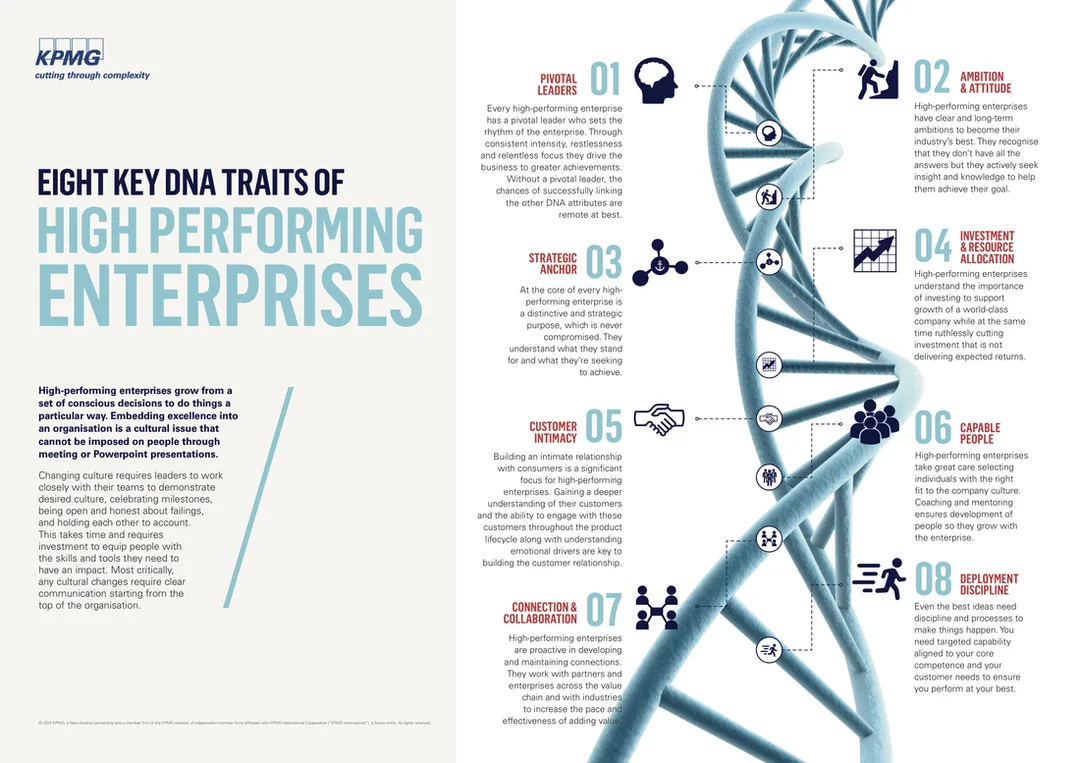
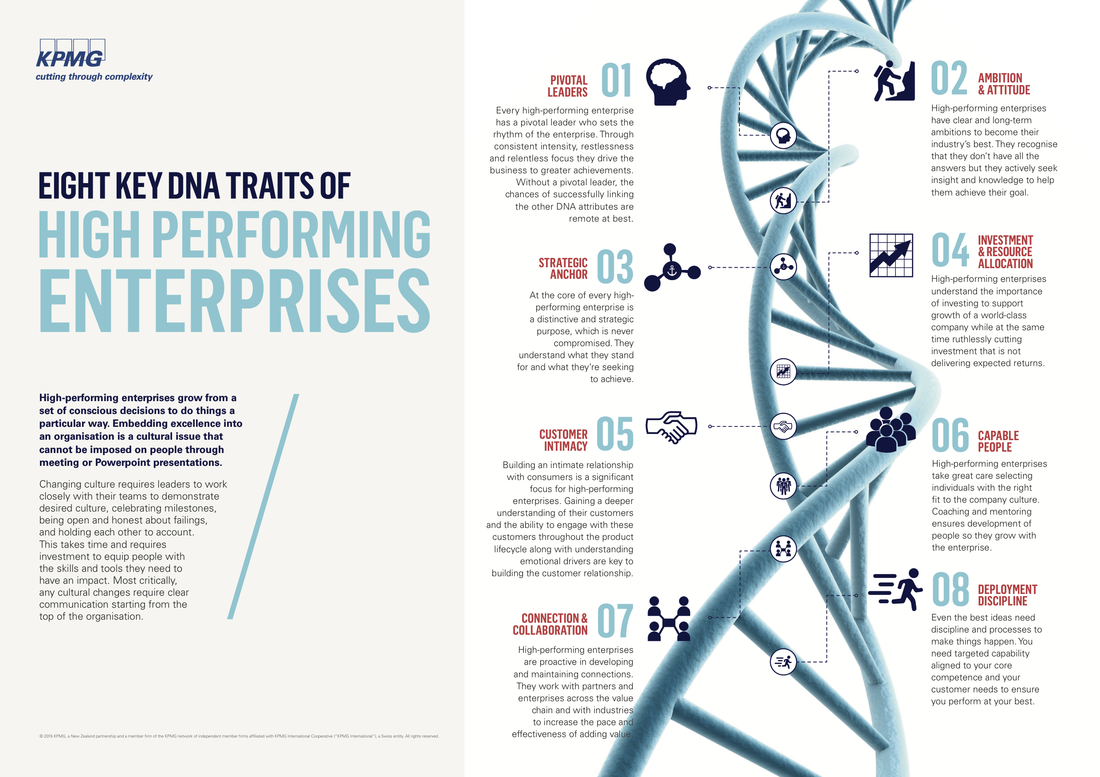
    Recently, business advisory firm KPMG, added their view. The KPMG study revealed eight 'DNA traits' of high-performing enterprises, as follows (click image on right for a larger version):
    • Pivotal leadership
    • Attitude
    • Strategic anchor
    • Investment and resource allocation
    • Customer intimacy
    • Capable people
    • Connection and collaboration
    • Deployment discipline
    Picture
    This guidance is as applicable to smaller companies with big dreams as it is to more mature companies wanting to defend against competitors or push on to the next level. Did you notice that a having great product or a killer app—often lauded as being 'the crucial difference'—does not rate a mention? This point has interesting implications for strategic management, and strategy development in particular. While good products and services are important, leadership, people (customers and team), smart decisions and a sense of purpose are far more significant moderators of business success.
    If you'd like to discuss the implications of these observations for your board or your corporate strategy, please get in touch. I'd be more than happy to be a sounding board.
  • Published on

    On democracy, morals and business performance

    Image description
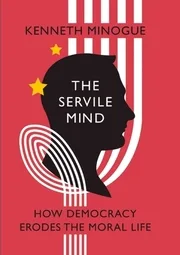
    As 2015 gives way to 2016, many people will be reflecting on the past and looking to the future; thinking about what was and what might have been. I'm no different. One of the books I've been reading while pondering the past and the future this week is The Servile Mind by Kenneth Minogue. A friend recommended it—he wondered whether the commentary might be applicable to directors and boards. My response, having read half of the book so far, is an unreserved 'yes'! Here's the note on the flyleaf:
    One of the grim comedies of the twentieth century was that miserable victims of communist regimes would climb walls, sim rivers, dodge bullets, and find other desperate ways to achieve liberty  the West at the same time that progressive intellectuals would sentimentally proclaim that these very regimes were the wave of the future. A similar tragicomedy is playing out in our century: as the victims of despotism and backwardness from Third World nations pour into Western States, academic and intellectuals present Western life as a nightmare of inequality and oppression.
    In The Servile Mind: How Democracy Erodes the Moral Life,​ Kenneth Minogue explores the intelligentsia's love affair with social perfection and reveals how that idealistic dream is destroying exactly what has made the inventive Western world irresistible to the peoples of foreign lands. The Servile Mind looks at how Western morality has evolved into mere "politico-moral" posturing about admired ethical causes—from solving world poverty and creating peace to curing climate change. Today, merely making the correct noises and parading one's essential decency by having the correct opinions has become a substitute for individual moral responsibility.
    Instead, Minogue argues, we ask that our governments carry the burden of soling our social—and especially moral—problems for us. The sad and frightening irony is that the more we allow the state to determine our moral order and inner convictions, the more we need to be told how to behave and what to think.
    Humbly, I commend this book to all directors who want to govern well and make a difference in 2016.
  • Published on

    Accountability. Is it too much to ask?

    History is littered with many stories of corporate successes and, sadly, almost as many failures. Why do some companies perform well over the long term while others become abject failures? Is it, as Jim Collins remarked in Good to great, a matter of luck, or is some other factor at play? While luck and environmental factors can be influential, I suspect there's more to it. A common thread that seems to weave its way through many of the success (Ford, GE, Johnson & Johnson, Xero, Facebook) and failure stories (Pan-Am, Enron, WorldCom, Satyam, and Toshiba, amongst many others) is captured in the title of this posting: Accountability.
    All directors hold, by law, a fiduciary responsibility. In Australia, New Zealand (where I live) and many other commonwealth countries, that responsibility is to the company. In the USA, it is to shareholders. Tellingly, it is never to self (despite some directors behaving as if it was!). If directors are to serve shareholders (who appoint them) and also the wider stakeholder community well, moral fortitude is a requirement, as is competence and engagement.
    The role of the director is one of service; of acting (read: considering information and making decisions) in the best interests of another party; and, ultimately, of being accountable for decisions made. Consequently, directors cannot afford to be asleep at the board table, nor be selfish in decision-making. Performance, accountability and ethics needs to take precedence over reputation and prestige.