• Published on

    Advancing governance research beyond correlations

    A couple of months ago, I was asked to consider submitting a paper to the British Academy of Management (BAM), for presentation at the annual conference (in Belfast, Northern Ireland this year). The BAM conference is attended by over 850 delegates, from academia and the working world. Once I got over the surprise of being asked to contribute to such an esteemed conference, the challenge of choosing a topic loomed large in my mind.

    The topic I have selected plays to the foundation of my current research work: that of finding a way to move beyond the limitations of the research methods that have been favoured by many governance researchers. Researchers are really good at counting and measuring things, but the process of digging deeper, to explain why something is as it is (in my case, how boards influence company performance) has proved to be much harder. The aim of the paper I have written is two-fold:
    • Challenge the foundational assumptions and normative input-output approach that has dominated the much of governance research agenda
    • Suggest an alternative approach to governance research, to enable the researchers to move beyond correlations toward the postulation of credible explanations and theories 

    The paper was submitted last night. The ideas in it are somewhat contentious, so it will be interesting to see how the paper is received, and whether it is accepted on the programme. Please contact me if you'd like a sneak-peak at the abstract now, or to be sent a copy of the paper after it is presented.
  • Published on

    My multifaceted week: the life of a governance researcher

    Please excuse my silence over the last ten days or so. I have been concentrating on several important research tasks and some family matters, and this has precluded me writing any musings. To give you an idea, here's a list of some of my activities from the last week:
    • Prepared for and observed the February meeting of the Company Alpha(*) board, to collect more research data.
    • Prepared for the next observation of the Company Beta board, to occur in a few days' time. 
    • Attended a PhD forum, a new initiative run by Massey University School of Management to bring its doctoral candidates together from the three campuses for support, encouragement and technical assistance with the process of research.
    • Reviewed feedback provided by my supervisors, of the first substantive draft of the research methodology chapter that I sent them a couple of weeks ago.
    • Continued the refinement process of the methodology chapter, ahead of reforming it into a standalone paper suitable for submission to the BAM conference.
    • Hosted guests visiting from Belgium. Our daughter's host parents from her twelve-month student exchange to Flanders are on holiday in New Zealand at present.
    • Drove our daughter and her gear to Massey University (90-100 minutes drive north of our home), to start her tertiary career. (She's enrolled in the Business Studies programme, and will be living on-campus in one of the hostels.)

    I'm hoping things will settle down a little next week, so I can finalise the BAM paper; spend some more time on data analysis; start thinking about the slidedeck for my presentation to the International Conference on Management, Leadership and Governance in Boston, Mass. on 20–21 March; and, resume normal transmission on Musings. 

    (*) Companies Alpha and Beta are the two companies who have provided me with access to observe their boards in action and collect governance data. Both are quasi-public, high-growth organisations of substance domiciled in New Zealand. Anonymity is a condition of research so all other information that may enable the companies to be identified is withheld.
  • Published on

    The "Learning Board": a good model

    Image description
    Over the last few months, I have re-read quite a few books and articles about models of governance, to see how my doctoral research might build on the suggestions of earlier contributors. Many years ago my father taught me that building on the work of others is smart, but only when the prior work is solid—a stable foundation being crucial to anything that follows.

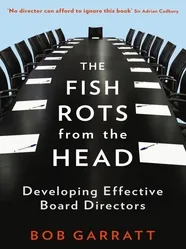
    The "Learning Board", developed and suggested by Bob Garratt nearly twenty years ago, is one of the models that has captured my attention. Garratt published his suggestions in a profoundly titled book The Fish Rots from the Head (3rd edition). Garratt highlights four key tasks of directors within the context of a board's lifecycle:
    • policy formulation and oversight
    • strategic thinking
    • supervising management
    • ensuring accountability.

    He suggests that boards need to balance four intellectual viewpoints simultaneously in order to achieve the four key tasks. When they do, overall effectiveness can be enhanced.
    • An external perspective
    • An internal perspective
    • A short-term perspective
    • A long-term perspective.

    I found this to be very helpful, because it provides a useful context for my work (an investigation of how boards can influence company performance, and the influence of strategic decision-making). Regardless of my efforts though, I commend Garratt's book to aspiring and established directors. It's easy to read, and logical in its approach to the topic.
  • Published on

    What research can we accept then?

    I had a fantastic meeting with my PhD supervisor earlier this week, to review my approach to the research methodology chapter of my thesis. When we stopped for some lunch and a walk outside, James showed me two articles from the 19 October 2013 issue of The Economist. They blew my mind. Entitled How science goes wrong and Trouble at the lab, the articles outlined how much of the so-called scientific research conducted by academics is actually a load of rubbish. For example:
    • Last year researchers at one biotech firm, Amgen, found they could reproduce just six of 53 'landmark' studies in cancer research.
    • A leading computer scientist frets that three-quarters of papers in his subfield are bunk.
    • In 2000–10 roughly 80,000 patients took part in clinical trials based on research that was later retracted because of mistakes or improprieties.

    The examples and supporting narrative floored me—it was sobering reading. The points about how research is conducted, how research articles are reviewed and, most importantly, how research is funded (the funding mechanisms drives the behaviours) were enlightening. The lingering question in my mind, having dwelt on these articles over the last two days, is this: just what research can we accept then? The answer probably lies in the maxim recorded in the first sentence of the 'goes wrong' article: 'trust, but verify'.

    The exercise was a timely and helpful wakeup call for my own efforts, to ensure my work is 'good science'. Thank you James.
  • Published on

    2014: A big year ahead...

    The first couple of weeks of January are usually a fairly laid-back affair in New Zealand. As a population, we tend to 'get away' after the hustle and bustle of Christmas. We camp, we get out on the water, we hike, we read, and we share each other's company over food and drink. Corporate offices and factories are usually fairly quiet, with skeletal staff keeping things ticking over until things get underway again, usually in the second or third week or the year.

    One of my habits during the summer break is to think about the year ahead, to get a sense of where my priorities should lie. When I get back to my desk (6 January this year), I write my ideas down, make some choices and load important dates and deadlines into my diary.

    This year the decision process was easy: my doctorate is the priority. Here's a snapshot of how my year is shaping up at this stage:
    • January: write methodology chapter for thesis; quick personal visit to Sydney
    • February: write paper for British Academy of Management conference; continue boardroom observations; finalise methodology chapter
    • March: speak at International Conference on Management, Leadership and Governance (Babson, Mass); continue boardroom observations; commence analysis of data
    • April: update literature review chapter; continue boardroom observations; continue data analysis
    • May: final boardroom observation; continue data analysis
    • June: continue data analysis; second round CEO & Chair interviews; finalise literature review chapter
    • July: complete data analysis; write paper for European Conference on Management, Leadership and Governance; short winter break
    • August: thesis writing in earnest; think about conclusions
    • September: speak at British Academy of Management (Belfast, Northern Ireland); thesis writing; assemble first substantive draft of thesis
    • October: finalise first substantive draft for review by supervisors 
    • November: update thesis based on feedback from supervisors; speak at European Conference on Management, Leadership and Governance (Zagreb, Croatia)
    • December: complete final draft of thesis; submit thesis! 

    What does 2014 hold for you?
  • Published on

    Signing off for 2013...

    Unless something compelling occurs in the next few days, this blog entry is likely to be my last for 2013. Christmas is upon us, so it is time to pause.

    Christmas can mean different things to different people. For some, the deep spiritual significance of remembering the birth of Jesus is almost palpable. For others, Christmas is an opportunity to buy and give gifts, to eat and to catch up with family and friends. Yet others enjoy Christmas because it is "time off"—a holiday. However you spend Christmas this year, may it be a joyful time for you.

    Overall, I've had a good year. The opportunity to travel (to speak in Australia, Asia and Europe), to meet some wonderful people, and to spend time pondering some pretty tough questions to do with my research, has been amazing. While there have been several times during the year when I've felt becalmed, it's not until I've stopped in the last few days and looked back that I've realised just how far I've travelled. I hope it's the same for you as you take stock this Christmas season. Thank you for your support and encouragement throughout the year, I appreciate it.