• Published on

    Advancing governance research beyond correlations

    A couple of months ago, I was asked to consider submitting a paper to the British Academy of Management (BAM), for presentation at the annual conference (in Belfast, Northern Ireland this year). The BAM conference is attended by over 850 delegates, from academia and the working world. Once I got over the surprise of being asked to contribute to such an esteemed conference, the challenge of choosing a topic loomed large in my mind.

    The topic I have selected plays to the foundation of my current research work: that of finding a way to move beyond the limitations of the research methods that have been favoured by many governance researchers. Researchers are really good at counting and measuring things, but the process of digging deeper, to explain why something is as it is (in my case, how boards influence company performance) has proved to be much harder. The aim of the paper I have written is two-fold:
    • Challenge the foundational assumptions and normative input-output approach that has dominated the much of governance research agenda
    • Suggest an alternative approach to governance research, to enable the researchers to move beyond correlations toward the postulation of credible explanations and theories 

    The paper was submitted last night. The ideas in it are somewhat contentious, so it will be interesting to see how the paper is received, and whether it is accepted on the programme. Please contact me if you'd like a sneak-peak at the abstract now, or to be sent a copy of the paper after it is presented.
  • Published on

    My multifaceted week: the life of a governance researcher

    Please excuse my silence over the last ten days or so. I have been concentrating on several important research tasks and some family matters, and this has precluded me writing any musings. To give you an idea, here's a list of some of my activities from the last week:
    • Prepared for and observed the February meeting of the Company Alpha(*) board, to collect more research data.
    • Prepared for the next observation of the Company Beta board, to occur in a few days' time. 
    • Attended a PhD forum, a new initiative run by Massey University School of Management to bring its doctoral candidates together from the three campuses for support, encouragement and technical assistance with the process of research.
    • Reviewed feedback provided by my supervisors, of the first substantive draft of the research methodology chapter that I sent them a couple of weeks ago.
    • Continued the refinement process of the methodology chapter, ahead of reforming it into a standalone paper suitable for submission to the BAM conference.
    • Hosted guests visiting from Belgium. Our daughter's host parents from her twelve-month student exchange to Flanders are on holiday in New Zealand at present.
    • Drove our daughter and her gear to Massey University (90-100 minutes drive north of our home), to start her tertiary career. (She's enrolled in the Business Studies programme, and will be living on-campus in one of the hostels.)

    I'm hoping things will settle down a little next week, so I can finalise the BAM paper; spend some more time on data analysis; start thinking about the slidedeck for my presentation to the International Conference on Management, Leadership and Governance in Boston, Mass. on 20–21 March; and, resume normal transmission on Musings. 

    (*) Companies Alpha and Beta are the two companies who have provided me with access to observe their boards in action and collect governance data. Both are quasi-public, high-growth organisations of substance domiciled in New Zealand. Anonymity is a condition of research so all other information that may enable the companies to be identified is withheld.
  • Published on

    The "Learning Board": a good model

    Image description
    Over the last few months, I have re-read quite a few books and articles about models of governance, to see how my doctoral research might build on the suggestions of earlier contributors. Many years ago my father taught me that building on the work of others is smart, but only when the prior work is solid—a stable foundation being crucial to anything that follows.

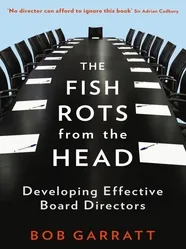
    The "Learning Board", developed and suggested by Bob Garratt nearly twenty years ago, is one of the models that has captured my attention. Garratt published his suggestions in a profoundly titled book The Fish Rots from the Head (3rd edition). Garratt highlights four key tasks of directors within the context of a board's lifecycle:
    • policy formulation and oversight
    • strategic thinking
    • supervising management
    • ensuring accountability.

    He suggests that boards need to balance four intellectual viewpoints simultaneously in order to achieve the four key tasks. When they do, overall effectiveness can be enhanced.
    • An external perspective
    • An internal perspective
    • A short-term perspective
    • A long-term perspective.

    I found this to be very helpful, because it provides a useful context for my work (an investigation of how boards can influence company performance, and the influence of strategic decision-making). Regardless of my efforts though, I commend Garratt's book to aspiring and established directors. It's easy to read, and logical in its approach to the topic.
  • Published on

    On leadership: there is no silver bullet

    The production of silver bullets—panaceas—is a growth industry. New books, all claiming to contain "the" answer, appear in the bookstores almost daily. Sadly, many are far more self-indulgent than helpful to the reader. Yet we lap them up, as we search for ways to be more effective in our professional and personal lives.

    I've become a bit jaundiced by the self-help gravy-train of late, however one of the books from my summer reading list has restored my faith somewhat: History Lessons: what business and management can learn from the great leaders of history. Jonathan Gifford, the author, asserts that there is no one model leadership model or kind of leader that can hope to be effective in all situations. Leadership is a complex phenomenon, and different attributes need to come to the fore in different situations. What a breath of fresh air.

    Gifford identifies eight skills and abilities that represent many of the essential things that any leader should be able to do and—ideally—be good at. He uses great leaders from history (not all of whom will be well known in the Western world) to illustrate his points.
    • Changing the mood
    • Boldness of vision
    • Doing the planning
    • Leading from the front
    • Bringing people with you
    • Making thing happen
    • Taking the offensive
    • Creating opportunities

    The book is easy to read. I commend it as a great investment, to aspiring and established leaders. But be warmed: it will make you think about your current leadership situation.
  • Published on

    How is a researcher different from a consultant?

    Last week, I explored the difference between an advisor and a consultant. The question stimulated a strong response (thank you!), thus this encore. The difference between a researcher and a consultant might seem to be more clear cut. Most of us think of researchers as those boffins that inhabit our learning institutions, whereas consultants are typically suited and found in business environments. Does that make them completely different beasts? Consider this:
    • A researcher defines problems and tries to solve them. So does a consultant.
    • A researcher is a knowledge worker. A consultant is as well.
    • Researchers tend to work alone. Many consultants do as well.

    At this level, the roles appear to be very similar, so are the two terms simply two different names for a very similar activity? Possibly, but I don't think so. A key difference between the roles is emphasis. A consultant is most interested in practice, and good consultants use theory to contribute to their work. In contrast, a researcher is most interested in theory (be it testing theories or developing new ones), and good researchers use data from practice to inform their work (testing theories or developing new theory).

    The roles are different, but they are closely coupled. Given this, why do so many consultants look down their noses at academic researchers (and vice versa)?
  • Published on

    Governance, by looking backward

    The NACD's annual missive, of the burning issues likely to light up the corporate governance firmament in 2014, has just been published. The article, which claims to provide a comprehensive assessment of what's on the board director's horizon, makes interesting reading—as much for its omissions as its inclusions. Sadly, the reportedly burning issues, which were "gleaned from interviews with directors and corporate governance leaders", are historical, defensive or operational in nature.

    I have no doubt the reported issues are the ones that were on the top of director's minds when they were interviewed. They are important, and need to be dealt with. However, the omission of issues that can make a difference to company performance is very revealing. Boards are responsible for optimising company performance in accordance with the shareholder's wishes. If the published list is any indicator, few boards will spend much time actually looking ahead in 2014 to issues that matter, like strategy, boardroom performance and accountability.

    The question that drops out of this discussion is a tough one: Why do shareholders continue to appoint directors and accept boards that spend the bulk of their time looking backward?