• Published on

    Towards a better understanding of corporate governance

    Picture
    Research is a funny thing. On one hand, experience can be greatly helpful: knowing what one is looking for or expecting to see is a boon. On the other, experience can be a hinderance: knowledge often resulting in bias and  preconception, and the very real possibility of missing vital clues. This is one of the great dilemmas for board and governance research.
    Some forty years have now passed since researchers started investigating boards in earnest. That an answer to the question of the role of the board and how they influence firm performance (i.e., what corporate governance is and how it is practiced) remains elusive is an indictment on the research community. Directors and boards need clear and well-founded guidance so they can become effective in role.
    Medical research is conducted by medics; cultural research is conducted by anthropologists; and, engineering research is conducted by engineers, so why is board research typically conducted by academics with little if any business experience? How might a researcher who has never been inside a boardroom hope to recognise the normative practices of board meetings? Or that a subtle interaction between two directors might actually be material to a pending decision?
    That most board and governance researchers have never been in a boardroom or served as a director is alarming. Yes, gaining access to observe boards directly is difficult to achieve. But to restrict board and governance research to counting isolated attributes of boards from outside the boardroom is folly. To be useful, recommendations need to account for the socially-dynamic nature of boards and the behaviours of directors (both of which can only be reliably discerned through direct observation).
    If the question of explaining how boards influence firm performance is to be answered, three things are needed: 
    • Researchers need to get inside boardrooms, to observe boards in action. (What directors actually do can be quite different from what they say they do when interviewed.)
    • Research needs to be conducted through the lens of experience.
    • Recommendations need to be holistic, accounting for both the activities of boards (what they do) and behaviours of directors (individually and collectively). That the structure and composition of boards is, relatively speaking, far less important.

  • Published on

    Embracing a brave new world

    Picture
    Netflix has been in the news a bit lately, aided no doubt by public interest in its rapidly increasing 'reach', meteoric rise in its stock price and membership of a new generation of behemoth—the FAANG club. Now, the actions of the board of directors have seen Netflix become even more newsworthy, principally a consequence of this article published in Harvard Business Review. ​The board of directors operates quite differently from many others and, indeed, conventional wisdom. Could this be a contributing factor in Netflix's success?
    Conventional wisdom, supported by both agency theory and 'best practice' recommendations of directors' institutes (in the western world, at least), suggests that 'distance' (a clear separation between the board and management) is important if boards are to objective in decision-making. The listing rules of most stock exchanges specify that at least two directors must satisfy established independence criteria at all times. Independence is de rigeuer, even though no consistent link between director independence and firm performance has ever been identified!
    Back to Netflix. Two researchers, David Larcker and Brian Tayan of Stanford University, gained permission to investigate how the Netflix board keeps up to date and informed, a prerequisite of effective decisions. They found that the Netflix board does not embrace conventional wisdom. The full research report, from which the HBR article was derived, is available on the SSRN website.
    The Netflix approach is based on proximity not distance. The approach has been adopted to help directors resolve a fatal flaw present in most boards: Five out of every six directors do not have a comprehensive understanding of the business being governed. Specific measures in place at Netflix include:
    • Governance by walking about: Directors are actively encouraged to view the company "in the wild". This includes attending executive meetings (albeit in silence, as an observer), and the freedom to wander around the office, chatting and asking questions (but not offering guidance nor providing instruction).
    • Pragmatic reports: Memos are both brief and insightful. They must be less than 30 pages long and, in addition to providing links to detailed information, they provide open access to all relevant data on the company's systems.
    The combined effect of these measures has been profound: directors are much more well-informed than they would have otherwise been. The handicaps of lack of transparency or hard-to-assess information are removed. The perennial problem of information asymmetry that besets boards globally has been, it seems, solved—in Netflix's case at least.
    Standing back a little from the Netflix case, several learnings are available for boards, as follows:
    • Proximity trumps distance: If boards are to govern effectively, directors need to  be adequately knowledgeable of the business and the wider operating context including emerging trends and technologies. Information needs to be elicited from multiple sources. Barton and Wiseman's report highlights this. But the Netflix case goes further; boards need to get a lot closer to managers, to establish and maintain a strong relationship founded on trust and expedite the flow of high quality and relevant information. My own research (here and here) provides supporting evidence. But don't be deluded, the recommendation comes with a warning: high levels of maturity are  required, to discern the appropriate proximity, and to minimise the chance of directors becoming 'captured' by managers.
    • Real knowledge takes time to acquire: Conventional wisdom, supported by recommendations emanating from many consultants and directors' institutes, suggests that directors should allocate two hours in preparation for every one hour of board meeting time. Yet the evidence suggests that this is probably insufficient. Real, relevant knowledge (read: deep understanding, wisdom even) takes time to acquire. The Netflix case adds weight to this argument. And knowledge needs to extend beyond the business and ecosystem, to include emerging trends and technologies, and theoretical perspectives as well. Together, this demands that directors invest considerably more time than the two-to-one rule-of-thumb if they are to be well-informed and make meaningful contributions. When asked, I propose five hours for every one hour of board meeting time, and double for the Chair. Established directors, including those who happily describe themselves as 'professional directors' often baulk at this, saying they don't have time. This is not an adequate defence. 
    Many boards and directors do take their role and responsibility very seriously. But, sadly, a significant number do not display appropriate levels of commitment. If boards are to become more consistently committed to the cause—the pursuit of high firm performance and longer-term value creation—they could do a lot worse than take a page from the Netflix playbook and the advice shared here. If you want to learn more, including scheduling a discrete briefing to explore how a mechanism-based understanding of corporate governance can contribute to improved board effectiveness, please get in touch.
  • Published on

    Living in interesting times

    Picture
    I arrived in London yesterday, ahead of what promises to be an interesting week. Formal commitments include delivery of the CBiS seminar in Coventry; planning for a future board research initiative; and a miscellany of meetings in which corporate governance, effective board practice and this recent article will be discussed. Two recent events, Carillion's fall from grace, and the now-public machinations at the Institute of Directors (which have resulted in the resignations of the chairman, Lady Barbara Judge, and deputy, Ken Olisa), are likely to invigorate discussions. Already, I've been asked to comment publicly on the Institute's troubles.
    The problems at the Institute of Directors in particular are troubling. They strike at the heart of what many say is wrong with boards and corporate governance; the Institute becoming a laughing stock in some quarters. The Institute's effectiveness as a professional body is contingent on it being the epitome of good board practice. The IoD chief executive, Stephen Martin, said on Friday that the resignations are a victory for good governance. They are not. Rather, they are an indictment of poor governance.
    Sadly, the Carillion and Institute of Directors cases are not unique. They are but two of many examples of poor practice that reinforce perceptions that boards are not effective. The ancient Chinese saying (more correctly, curse) seems especially applicable just now. 
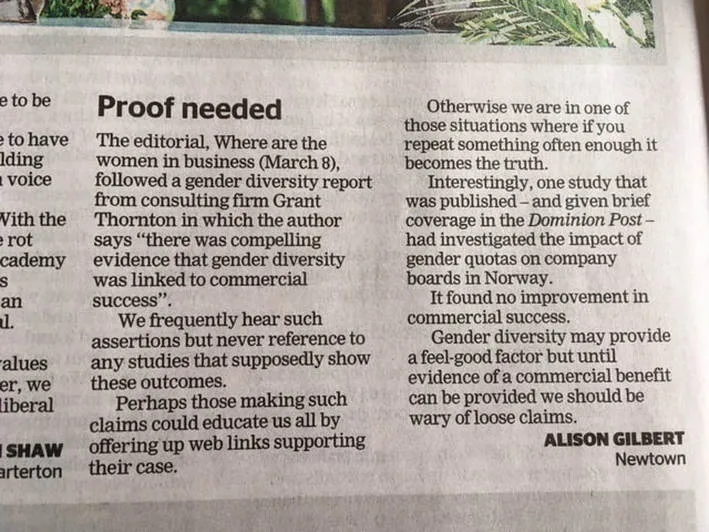
    If trust and confidence is to be restored, the power games, hubris and ineptitude apparent in some boardrooms need to be rectified. Flawed understandings of what corporate governance is and how it should be practiced also need to be corrected, especially the misguided belief that any particular board structure or composition is a reliable predictor of firm performance (the following letter highlights the conventional wisdom problem).
    Picture

    Source: Letters to the Editor, Dominion Post, 10 March 2018

    The scene is set for some fascinating discussions this week. I'll let you know how I get on.
  • Published on

    Blackrock speaks: A new dawn rising?

    Picture
    Larry Fink, co-founder and CEO of influential investment firm Blackrock may have just moved the goalposts. 
    Writing in his annual letter to CEOs, Fink argued that companies think beyond shareholder maximisation, a maxim that has dominated investor thinking since the early 1970s. Companies need to determine their raison d'être, their reason for being, towards which all effort should be aligned. Fink could not have been more clear:
    Without a sense of purpose, no company, either public or private, can achieve its full potential. Ultimately, it will provide subpar returns to the investors who depand on it to finance their retirement, home purchase, or higher education.
    Fink directly associates strategy, board and purpose—and in so doing Blackrock's expectations are spelt out. Simply, boards need to take their responsibility to ensure the long-term performance of the companies they governs much more seriously. Specifically, the board should both determine and agree several things, namely, the reason for the company's existence (its purpose); how the purpose will be achieved (strategy); and, how the progress towards the agreed purpose and strategy will be monitored, verified and reported.
    Together, this is corporate governance.
    To have such an influential firm speak so boldly is wonderful. Mind you, I am rather biased: my research findings and experience working directly with boards over many years now is consistent with Fink's assertions. 
    I commend the letter to all boards. Two rather obvious questions boards may wish to discuss having read it:
    • How might boards to put these above-mentioned assertions into practice? The mechanism-based model of corporate governance that I emerged from my work with high-growth company boards is one option. 
    • Will Fink's missive portend a new dawn for board practice and effective corporate governance? While it's a little too early to know, I certainly hope so. Every bit of pressure brought to bear helps.
  • Published on

    Global Drucker Forum: Standing amidst giants

    Picture
    I had the distinct privilege of attending the 9th Global Peter Drucker Forum in Vienna this week. Approximately 500 people attended the two day forum held in Aula der Wissenschften (Hall of Sciences). The programme included fifteen plenary sessions and a parallel session (four tracks). The very full programme was run to time; a Swiss watch operated with Germanic efficiency, in the birthplace of Drucker.
    Many global authorities in strategy, innovation, entrepreneurship and related addressed those in attendance (and many more utilising the live feed option). Presenters included Richard Straub; Angelica Kohlmann; Jenny Darroch; Hal Gregersen; Roger L. Martin; Anil K. Gupta; Bill Fischer; Rita Gunther McGrath; Sidney Finkelstein; Tammy Erickson and Carlotta Perez, and more. The forum produced many insights; the following commentary merely a portion lifted from my 28 pages of notes:
    Richard Straub, President of the Peter Drucker Society, set the scene by noting that Drucker, a man genuinely interested in the bigger 'why' questions, maintained a strong focus on business performance. He avoided cookie-cutter 'solutions', a reflection perhaps that such solutions don't work within the dynamic and social context of modern organisations. Straub went on to say that management is most accurately conceived as a liberal art [to be understood holistically], not as a social science that can be reduced to constituent elements.
    Lisa Hershman, DeNovo Group, posed the question, "How do we generate growth and ensure more people participate in it?" This was not a veiled call to embrace left-leaning socialist ideals and anti-business practices, but rather a clarion call for 'inclusive capitalism'. (I've been using an equivalent term in speeches in the last couple of years: 'capitalism with a heart'.) Hershman noted that around half of the young people in the United States say they prefer socialism over capitalism. This, she said, is a clear indication that something is wrong. Business leaders have become too focussed on themselves and shareholders, to the exclusion of others. This collapse of confidence needs to be addressed by business leaders. If it is not, companies are likely to find it increasingly difficult to recruit motivated and capable young people. Why? Because they are not interested in working for poor leaders who they do not believe in, much less aspire to.
    Jenny Darroch, Dean, US Peter Drucker School, explored the essence of an effective business and societal ecosystem. She described five key interests (characteristics), namely, a functioning society, where all can participate; recognition that management is a liberal art, not a simplistic of formulaic process; that self-management is important, because neither the state nor business 'owes' people work; that performance [actually] matters; and, 'transdisciplinarity' (i.e., looking beyond the immediate context, sector, role, team) is crucial. These comments set a solid platform for what was to follow.
    Hal Gregersen, MIT Leadership Center, spoke on the important topics of community and communication. He asserted that isolation is the number one enemy of innovation. The world is far too complex for one person acting alone to be effective. Leaders that sit in their office and wait for input are far less effective that the best leaders, who actively seek to reduce (to zero, if they can) barriers in pursuit of the best possible information to understand current reality and what might be possible, so as to inform effective decision-making. The best leaders also encourage dissent, inviting people to both ask and respond to uncomfortable questions, because they want to discover what is wrong and what can be improved. Asking the right questions and, importantly, getting authentic responses (but not necessarily simple answers) depends on being in the right place (read: with staff, customers, in the market) and inviting people to challenge the status quo.
    Roger L. Martin, Rotman School of Management, built on Gregersen's comments by observing the prevalence of certitude (that sense of 'being right' common amongst leaders especially so-caleld alpha males and queen bees. Rather than stridently asserting preferences and blindly applying models (which are often wrong because they are simplifications of reality), Martin recommended that leaders reframe their statements as follows. "I'm modelling the world, but my model is incomplete. What can you add?" Great leaders pursue multiple models, combining and building to make something better (note, a better solution not a compromise). According to Martin, this always leads to better outcomes.
    Several speakers addressed the question of whether growth is actually an imperative. No speaker spoke against growth or its optionality. Rather than almost assumed the answer is 'yes', and moved quickly to consider how growth might be achieved. Anil Gupta, for example, noted that China is responsible for 27 per cent of global carbon dioxide emissions, and India 6.6 per cent. He opined that if India is to grow out of poverty then growth must be coloured—green—to avoid killing the very people it seeks to lift out of poverty. The recommended route is to industrialise, but to do so with smart technology to avoid the avoid the environmental mistakes (and their negative consequences) experienced by China and others. 
    Martin Reeves, Boston Consulting Group, added that while growth is necessary, it is beomcing increasingly elusive. As a consequence, companies operating in developed nations need to change their focus. Rather than growth at any cost, companies need to discover and pursue the right type of growth. Invoking Aristotle, Reeves observed that companies that embrace both economic and social goals (oikonomic companies) do better in the long term. Specific recommendations (boards and directors, take note) include:
    • Define purpose
    • Diversify guiding metrics (beyond financial measures)
    • Emphasise the future
    • Invest in technology 'front to back'
    • Retrain employees
    • [Re]shape the future of work
    • Foster ecosystems
    • Embrace a new (inclusive) narrative for growth
    Allyson Stewart-Allen, International Marketing Partners, and Julia Hobshawn, Editorial Intelligence, sounded a warning, arguing that the unfettered pursuit of connectedness—networking in pursuit prosperity, health and whatever else—has a dark side: info-besity. An over-reliance on social media networks have the unwanted effect of starving people of what actually matters: deep socail connections. People are human beings, not human doings, and social connections matter much more than activity masquerading as social connectedness. Pointedly, sustainable relationships and business sustainability is dependent on people, and their interaction and curiosity not social media. I found myself thinking, "Isn't this obvious?". Maybe so, but a quick glance around the room suggested maybe not: almost everyone within eyesight has their eyes down, using a smart device as the speakers continued.
    Joseph Ogutu, Safaricon, and Haiyang Wang, China–India Institute, provided insights from a developing nation perspective. Whereas many Westerners perceive social disparity to be limited in developing nations, the reality is somewhat different. Disparity between people groups in developing nations is actually higher than in developed nations. Further, many African nations have de-industrialised since gaining independence. The speakers made strong calls for developing nations to embrace manufacturing as a means of achieving the economic growth needed to lift millions out of abject poverty. While many entrepreneurs and investors stand ready to fund initiatives, local communities need to pursue partnerships, lest they suffer new forms of dependency.
    Steve Blank, entrepreneur, and Bill Fischer, IMD, observed that the pressures faced by chief executives in the twenty-first century are different from those in the twentieth century. Then, if CEOs met the expectations of their boards (however expressed) and responded to competitive pressures, then they were reasonably safe in their role. But things have become more complex since the turn of the century. Two additional forces have emerged, namely, activist investors (read: corporate raiders) and disruption. If CEOs are to respond well to this new reality, they need to become comfortable with ambiguity and chaos. Helpfully, Blank and Fischer offered four additional suggestions to enhance leadership effectiveness in the twenty-first century:
    • Working out loud (prototyping, sharing and testin ideas early)
    • Ambient awareness (narrow specialists area problem)
    • Quantified self and gamification (enumerate wherever possible)
    • Collective wisdom (no one person has all the answers)
    Rita Gunther McGrath, Columbia Business School, introduced the forum to a tool to help leaders and investors undertsnad the future growth prospects of any given company. The 'ImaginationPremium' is, simply, a ratio of a company's market capitalisation and value from operations. If the imagination premium is high (but not too high to become hype—Tesla), the sustainable growth is likely. Conversely, low ratios suggest growth is unlikely. The extreme case of a ratio less than 1 suggests shrinkage.
    On strategy, innovation and disruption. Several speakers outlined cases to demonstrate that a coherent, longer-term strategy is actually more, not less, important in times of change and disruption. They noted that well-formed strategy, not detailed plans (often, incorrectly, called strategic plans), helps lift the gaze of both leaders and staff above immediate technologies and disruptions, to focus on purpose, the customer and longer-term goals.
    General observations. Standing back a little, the investment to attend was well-spent. To be amidst giants, and chat with some of them (all were accessible and none pretentious) was a privilege and an honour—I learnt a lot. The only disappointment from my perspective concerned the speaking roster. While about 20–25 per cent of the speakers were world-class (both content and delivery), a similar percentage were disappointing. The lesser speakers either repeated what others had said, or their presentations were thinly-veiled sales pitches. Upwards of ten attendees, including some speakers, voiced similar concerns in private. My hope for future editions is that the organisers review speaker candidates more closely, to ensure a consistently high standard. Stepping beyond that, the general calibre of the forum (organisation, content, delivery) was very high. My intention is to return to Vienna in November 2018, for the the 10th edition of the Global Peter Drucker Forum. Hopefully, I'll be able to share the platform, offering some insights relevant to the theme.
  • Published on

    EIASM'17: Day two summary

    The 14th edition of the Corporate Governance Workshop convened by the European Institute of Advanced Studies in Management (EIASM) was held in Brussels, Belgium this week. A summary of the key insights from the second day follows below (click here to read the day one summary).
    • Messrs Bob Garratt (world-class governance thinker and practitioner), W. Lee Howell (World Economic Forum) and Thomas Donaldson (Wharton Business School, Philadelphia) opened the second day with a shared keynote. There were so many insights from this session that I've reported them separately.
    • Gerrit Sarens (KU, Leuven and Belgian company director) summarised findings from a lengthy study, a critical evaluation of the role of the board of directors in crisis detection and response. Informed by the analysis of 17 cases, Sarens observed that boards often fail to discern the onset of a crisis: they were quick to discern and act on an emergent crisis in just three of the 17 cases studied. This blindness (the board did not detect the onset of a crisis in 14 of the 17 cases studied) prompts some rather awkward question: why? While each case was different, Sarens noticed a consistent pattern of behaviour and practice across the 14 boards including hubris and overconfidence; low levels of board–management transparency; lack of critical attitude and genuine independence, appropriate expertise and relevant knowledge; and, tellingly, a low level of commitment.
    • Most of the other papers and presentations on the second day were reductivist studies of board and director attributes: detailed statistical analyses of typically quantitative data collected from public sources and databases. Sadly these studies added little to what is already known: that the structure and composition of board is, largely, immaterial to effective board practice and business performance. During the afternoon session, one colleague made a particularly telling observation: "I'm getting frustrated. The dominant theme of board research needs to change, from searching for regular patterns of what boards should look like, to understanding and explaining the contextually relevant (and contingent) relationship between boards and business performance". I've been beating a similar drum for a while now: if we are to understand how boards contribute to business performance (read: fulfil the value creation mandate), then researchers need to get inside the boardrooms of successful companies to see what those boards actually do and don't do.