• Published on

    Effective boardroom practices: Dispatches from Singapore

    ​Nearly fifty chairmen, directors and company secretaries from around South-east Asia, the Middle East and Northern Africa gathered at the Ritz–Carlton Millenia Hotel in Singapore this week for The Boardroom Agenda conference. Delegates received presentations, shared stories and debated issues over two days (23–24 November), under the Chatham House rule. I had the honour of contributing to the discussion on the second day. Here are some of the takeouts:
    • Neal Cross, Managing Director and Chief Innovation Officer at DBS Bank provided a stirring keynote presentation to kick off the day. Disarmingly frank in delivery, his topic Fostering innovation in the boardroom was both challenging and well-received. Cross asserted that banks simply must innovate, and radically so, lest their market collapses around them as fintechs and large technology companies (read: Google, Amazon, Apple, others) eat the bank's lunch. He then outlined the DBS approach to innovation, which includes a three-day 'hackathon', whereby teams of staff are set up to create new product ideas. The resultant ideas are pitched to the board, and funding is provided to commercialise the best ones—entrepreneurship in action.
    • Raoul Chiesa, Board Member on the Italian Association of Critical Infrastructures delivered a wake-up call to delegates. Speaking straight off a flight from Europe, Chiesa, an expert of information security matters, summarised the history of hacking and the crucial need for boards to take information security seriously—all with some powerful (and quite alarming) case studies and real-world examples. Delegates were amazed at the scale of the problem and the material risk to commerce that 'the bad guys' present. The cyberthreat is widespread and poorly understood, especially in boardrooms. The message was clear: boards need to get up to speed, by receiving presentations and updates from experts; asking probing questions; taking a strategic view of risk; and, empowering the CEO to act.
    • The pre-lunch session took the form of a panel discussion and dialogue with delegates. I joined Ralph Ward at the front of the room. A wide range of topics were explored including the merit of codes of conduct; diversity in the boardroom;  the conundrum of balancing conformance and performance; confidentiality; conflict management; the conduct of effective board evaluations; and, the difference between so-called independent directors and independence of thinking. Delegates seemed to appreciate the candid responses from panelists, including recognition that no one-answer-fits-all; best practice often isn't; and that the work of the board can be messy.
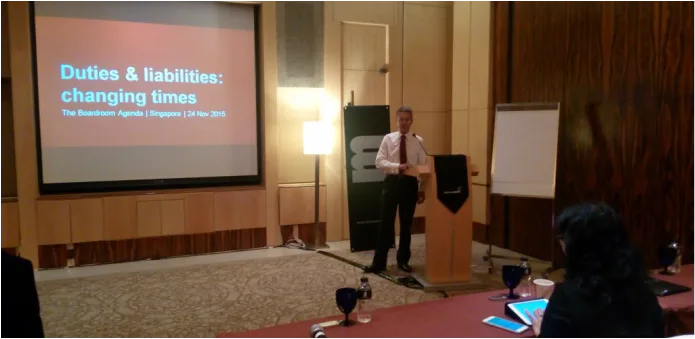
    • After lunch, delegates attended one of two streams. I chaired the Board Insiders one. Dr Lim Lan Yuan, a Singapore-based business and law scholar and company director spoke first. He managed to squeeze forty years of experience into a thirty-minute talk. It was a sight to behold. Delegates were enthralled with his summary of how boards should work; how they actually work (or don't); the importance of a clear division of responsibility between board work and management activity; the importance of the board undertanding the business of the business, strategy and market trends; boardroom dynamics; and, anecdotes of associates that messed up (badly) and went to jail. That Dr Lim was able to move seamlessly between theoretical concepts, practical recommendations and real-life stories as he spoke helped the delegates gain considerable value from the talk. The only person who struggled with his commentary was me: Dr Lim covered off several of the points that I was going to discuss in the following slot. Consequently, a few on-the-fly adjustments were needed to extend the discussion to related areas of interest (see pic below). That the delegates heard similar stories and recommendations from two different speakers with different cultural and business backgrounds was hopefully encouraging—and supportive of the notion that 'good practice' is good practice almost anywhere.
    • The final session of the day was a 'deep dive', whereby delegates gathered around one of two tables to consider a table-question and to share experiences. One table was asked to identify factors that contribute to both good and bad dynamics in a boardroom, and the other was asked to discuss how a board should function in the event of a major crisis. The groups had 30 minutes or so to wrestle with the assigned question and then report back. The insights shared were great, and the good-natured banter demonstrated that the delegates had built a good rapport with each other. Thank you to Dr Lim and Curtis Chin who moderated the table discussions. You made my job of session chair very straightforward.
    • The conference was organised by marcusevans. Their people did a great job, both in the weeks leading up to the conference and at the venue itself. If you get the chance to work with them, take it.
    Picture
    ​I've come away from the conference with the impression that the quality of corporate governance and board practice in Asian and Middle Eastern economies is rapidly improving. Overall, the hunger to improve board effectiveness was plain to see, as was the desire to learn from those with experience gained elsewhere (if the many conversations, requests to return and business cards in my satchel are any indication). However, care must be taken to ensure that models and frameworks in use in the Anglosphere are not blindly implemented in this region. Such colonialism is unwarranted and patronising, and it may be culturally demeaning as well.
  • Published on

    48 hours in (close to) paradise

    When travelling, what's your favourite destination? Mine—from a work perspective anyway—is anywhere where board directors and executives who are eager to debate issues of boardroom practice and business performance. Since Tuesday evening, I have been in Dublin, Belfast and Dublin (again) doing exactly that—addressing groups of directors and answering questions. Matters of strategy in the boardroom; diversity; board structure; accountability; and, culture, amongst other topics, were discussed with vigour.
    To work with well over 70 directors and executives, all of whom were motivated by the discovery of board practices that might lead to improved business performance outcomes, has been wonderful. Thank you to the Ulster University Business School and the Irish Times Training for inviting me to visit the Emerald Isle to work with such influential people. That these busy directors and executives gave their time to debate important issues bodes well for the future performance of Irish businesses and social enterprises. I look forward to hearing great stories of success in the months to come!
  • Published on

    The emerging role of the board in business performance

    Fifty leading board researchers, directors and company secretaries assembled in London this week to consider the topic Corporate governance for a changing world: capturing long-term value. The event was hosted by Tomorrow's Company and Frank Bold, at Cass Business School. I had the privilege of joining the discussion.
    Dr Roger Barker, Deputy-Director at the Institute of Directors, provided the catalyst for a lively discussion amongst the attendees. He offered some rather provocative comments about boards, short-termism and business performance in the longer-term, as follows:
    • The current [conformance oriented] corporate governance model does not appear to be particularly conducive to longer-term thinking nor value creation.
    • Despite challenges and concerns raised amongst a broad constituency, many people who work in The City (of London) think that the current system of corporate governance is 'good'—they do not recognise short-termism as a problem.
    • Executive pay is essentially an issue of balancing short-term financial engineering against longer-term value creation.
    • Despite efforts by legislators, regulators and stock exchanges (not to mention the OECD itself), the notion of a one-size-fits-all model of company law and corporate governance is not well suited to all types and sizes of companies.
    Several interesting thoughts emerged from the group and plenary discussions that ensued:
    • That the predilection with short-termism is 'probably' the antithesis of sustained business performance over time.
    • That the conformance–performance pendulum has probably swung too far towards conformance. A renewed focus on company performance and longer-term value creation is needed.
    • Despite the best intentions of the authors, codes and associated regulations have not delivered any meaningful business value.
    • The shareholders and boards need to return to basics by focussing on (and agreeing) the purpose of the company and the strategy by which or through which the purpose will be pursued. [This point was music to my ears, for it is consistent with my research findings.]
    I came away from the meeting in good spirits. That a group of influential academics, researchers, directors and company secretaries are both in agreement that the current model of corporate governance is problematic (flawed, even?) and that a new model perhaps via purpose and strategy might offer hope if boards are to make meaningful contributions in pursuit of longer-term value creation and a sustainable future.
    The informal discussion and private comments over drinks after the roundtable session served to reinforce these points; especially that well-intentioned leaders are committed to realising the potential of the businesses they lead or govern and that there is a hunger for 'answers'. My hope is that these messages are both transmitted and heard amongst a wide constituency, and that people get on board. I am committed to playing my part. If you have questions or would like to know more, please get in touch.
  • Published on

    Want to learn about emerging corporate governance and board practice themes?

    Is effective corporate governance and board practice, in pursuit of high business performance, an important priority for you and your colleagues? If so, please read on. 
    From 1 September, I will be meeting with directors, executives and researchers in several UK cities (London, Wolverhampton, Leeds, Dublin, Belfast and Canterbury) to discuss the role of the board in influencing business performance. While the schedule for my eleven-day visit is fairly full, some gaps remain for additional meetings. Please get in touch if you wish to meet or have a private chat. Alternatively, you may wish to introduce yourself at one of these public events:
  • Published on

    Speaking & advisory tour to UK & Eire—programme is filling fast

    Wow, that was quick! Six days ago, plans for my Spring speaking and advisory tour to the UK and Ireland were 'starting to come together'. Now the eleven-day tour—to discuss corporate governance, value creation and board practice topics—is nearly full subscribed. Thank you! Three masterclasses, four 'general' speaking engagements, a masters-level lecture and several private meetings are confirmed on the programme. (Details of the 'public' events will be published by the event sponsors in due course.) In addition, two parties have requested planning meetings to discuss future advisory or speaking engagements, to occur in early 2016. If you think you might want to book me but want to talk about it first, that's entirely fine. Just let me know.
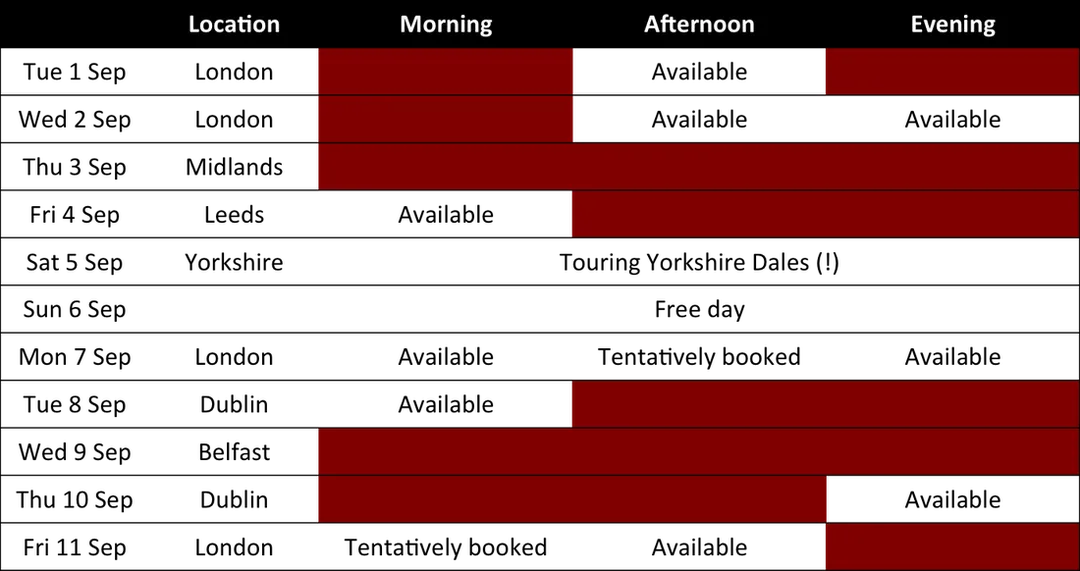
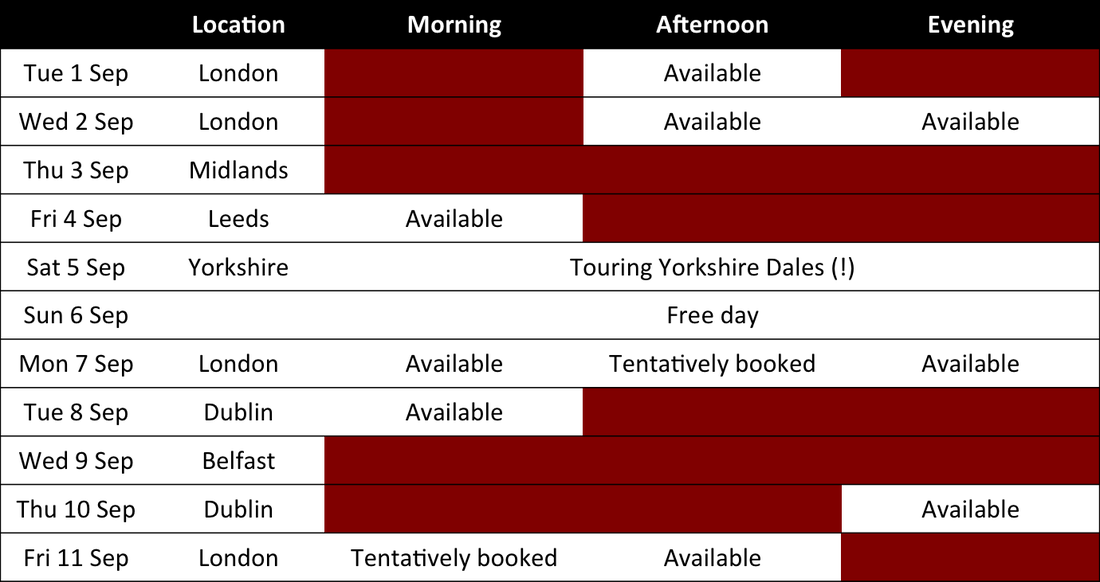
    As of today, just one full day (2 Sep) and one part-day (7 Sep) remain available to be booked. I'll be in London on both days as you can see. If you are based in London (or the home counties) and you want to book a meeting or speaking engagement, please get in touch soon--before it's too late!

    Picture
  • Published on

    Spring speaking and advisory tour: Reserve your space now

    Picture
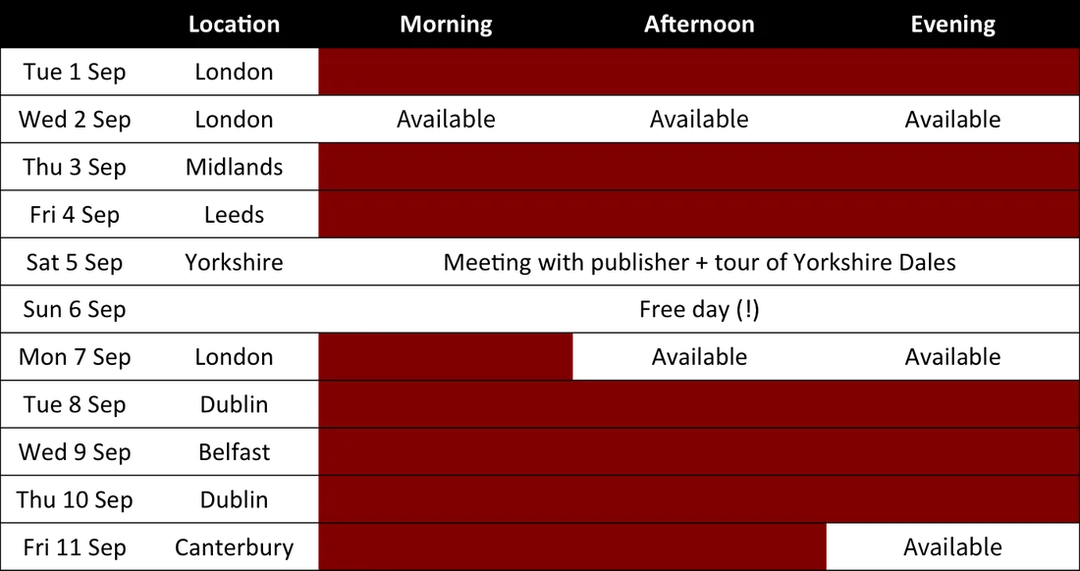
    Plans for my next trip to Great Britain and Ireland—a speaking and advisory tour to share insights from my latest research and practical experience in boardrooms—are starting to come together. My schedule is filling up—only a third of the available slots are still available. Thank you to everyone who has already reserved space. The dates and times you have requested are secure.
    If you are based in London (or the home counties), Leeds (or elsewhere in Yorkshire) or Dublin; and you want me to address your board or executive team, discuss a future speaking or advisory engagement, or chat privately about a difficult challenge, please get in touch soon to avoid disappointment. I look forward to hearing from you, and then to discussing any aspect of board practice, corporate governance, strategic management, value creation or business performance that is of interest to you.