• Published on

    Boardroom behaviours: What role culture?

    I've been reading back through some older Musings this week, to review (and smile at) ideas that were front-of-mind a couple of years ago. Which ones have been superceded or discredited; which has been forgotten; and, which are still topical?
    This one, on boardroom motivations and habits, appears to still be topical today—perhaps even more so than when it was written in April 2012. How so? I was party to a discussion on boardroom behaviour today and a question of culture was raised. To what extent might culture drive conduct and ultimately business performance? The results of a recent survey conducted by Grant Thornton suggest that culture is a huge factor in corporate governance and strategy. There is much evidence to suggest that good business performance is an outcome of 'good' culture (here's one piece).
    However, culture is complex. Consequently, when one of the discussants said that a senior leader at ASIC is looking for policies and procedures to support [a positive] culture in boardrooms I was bemused, to say the least. How might one successfully codify—much less 'legislate'—culture, in pursuit of good conduct and presumably good business performance? 
    A long time ago, Drucker famously said that culture eats strategy for breakfast. Might the corollary be that a well-written code of ethical conduct that is periodically discussed, agreed and pursued by directors trump any attempt to 'legislate' any particular culture into being?
    Compliance-based regimes rarely achieve much more than to incur expense, resentment and, sometimes, avoidance. That is well-known. However, while codes are by no means fool-proof they can be helpful if every director 'signs up' and willingly embraces them. My research suggests that the key lies with director behaviour and social interactions in the boardroom, not the code per se
    That said, why all boards that are serious about creating a positive culture both within the boardroom and the wider business they govern have not implemented a suitable code of conduct is beyond me. It is a matter of accountability. Perhaps boards that decline to travel this path have not realised that the fish rots from the head!
  • Published on

    Director's fees: Please sir, can we have some more?

    The results of the annual director remuneration survey are in. (Read the media release here, and press reports here and here.) Fees have climbed about four per cent in the last twelve months, slightly ahead of CPI. The survey results also indicate that director workload has increased by 41 per cent over the same period.
    A cursory analysis suggests that the workload increase is, to a large extent, a consequence of increased compliance requirements: more rules and regulations. While a 'more work, more pay' argument is eminently justifiable, is it fair? Moves to increase directors' fees as a consequence of increased compliance workload may deliver an unintended consequence: a back-to-the-future experience. Boards are likely to become more defensive and cautious, contributing relatively little to what they are there for—the pursuit of company performance.
    Rather than peg directors fees to time and compliance activity, it might be more productive to ask whether company value (however that might be expressed) is growing as a consequence of board contributions. Many leading commentators (Bob Monks, Bob Garratt, Morten Huse and Richard Leblanc, amongst others) have suggested that boards need to become more strategic, by looking to the future. Yet statutes and regulations cannot be ignored. Boards and shareholders need to wrestle with this tension. Questions of strategy, decision-making, division of labour, accountability and ethics need to be debated and resolved. Ultimately, viable resolutions are most likely to emerge from a joint commitment to the long-term purpose of the company.
    The board needs to drive company performance in pursuit of shareholder wishes, while also ensuring that statutory and regulatory requirements are appropriately satisfied. If the board demonstrably leads the company forward, and does so in accordance with both the agreed purpose of the company and relevant statutes, shareholders are unlikely to baulk at proposals to reward the contributions of directors appropriately.
  • Published on

    Health sector seminar: Board governance, a reality check

    Every day, around the world, leaders in the health sector face a formidable challenge. On one hand, insatiable demands press in as people expect physical and mental health (foundational to our well-being). On the other, resources are limited—providers simply can't do everything. Consequently, tough choices need to be made, to ensure the appropriate services are delivered, efficiently and effectively. The complexity of the problem means 'best practice' answers are few and far between. However, progress should be possible if a clear sense of purpose, appropriate strategy and effective monitoring systems are all in place.
    The England Centre for Practice Development is hosting an interactive seminar on 11 September, to help health and social care sector leaders explore these key issues and challenges. I have been asked to facilitate the seminar, and to share insights from research and experience in boardrooms. Topics to be discussed include:
    • Lessons from the coalface ‘School of hard knocks’
    • Emerging international research
    • Keeping strategy on the agenda
    • Driving (the need for) efficiency and effectiveness
    • Ensuring accountability and performance
    • A pathway forward: An integrated strategy framework for boards
    If you are a board director or an executive of a clinical commissioning group or health provider; a policy maker; a researcher; or, an interested party, I encourage you to join the debate
  • Published on

    On the sources (and a possible remedy) of so-called "governance failure"

    The much-storied scandals at FIFA, HSBC and Toshiba have highlighted a plethora of weaknesses in the way large companies are led and run. Fingers have been pointed and blame apportioned. Management has copped a fair bit of flak, but the board has not been immune either. While the media has had a field day, finger pointing and broad statements provide little comfort to those in pursuit of long-term performance. Remedies are required.
    Reputability has studied a number of failures recently(*), in pursuit of remedies. The analysis identified nine prominent categories of weakness, the first six of which were influential in the majority of failures:
    • Board skill and NED control
    • Board risk blindness
    • Defective information to or from board
    • Leadership on ethos and culture
    • Risk from incentives
    • Risk from complexity
    • Risk glass ceiling
    • Charismatic leader
    • Poor crisis management
    When these factors are considered holistically, the stark implication is that failure appears to be associated with board weakness in at least three areas (engagement, strategy and risk). If boards are to make effective contributions, these weaknesses need to be resolved. And therein lies a challenge: a return to first principles, and a different conception of corporate governance is likely to be necessary. Will boards embrace such a change in pursuit of better business performance? Let's hope so.
    (*) The full Reputability Report, entitled Deconstructing failure—Insights for boards, is available here.
  • Published on

    Success attributed to board: Lessons for all

    How valuable is a board of directors to the performance of the business it governs? Does it influence business performance; or does it act as a policeman, "simply" monitoring the chief executive; and, do we even know? Many have attempted to answer this question. More often than not, the responses have been based on statistical analyses of secondary data (surveys, questionnaires, public data). Descriptions of what actually occurs in the boardroom typically remain hidden. Insights from direct observations of boards in action or from first-hand interviews are rare, so it pays to take note when they become available—as occurred when Nigel Bamford, chief executive of fireplace manufacturer Escea went on record this week. His comments, reported here, provide some interesting insights for boards to consider:
    The Bamford interview provides a much-needed glimpse into the boardroom of a successful company. However, and thankfully, the Escea experience is not unique. The insights are consistent with emerging research about what boards need to do if they are to exert influence on business performance. Consequently, important questions for your own board to consider include:
    • The Escea board meets monthly, for two hours per meeting. Despite this small amount of time spent together, the board manages to monitor past performance and look ahead. This suggests that the chairman has a disciplined approach to meeting protocol, and that the board has at least one eye on the future success of the business.
    • The board is comprised of directors with "a whole range of different perspectives and different disciplines". Decision quality appears to have benefited as a consequence.
    • That the board is comprised of three company founders and two external directors suggests that technical independence (as promoted in many corporate governance codes) is not necessary for board effectiveness including effective decision-making.
    • The emphasis in Bamford's comments is on debate and diversity of thought. Gender and other forms of observable diversity were not mentioned.
    • The Chief Executive expects the board to 'add value' by challenging proposals and driving the decision-making process.
    • A one-size-fits-all approach to board practice and corporate governance is not appropriate.
    • While the Escea board looks ahead, strategy was not explicitly mentioned. Whether the board works with management on the development of strategy, or critiques strategic options and proposals presented by management is unclear.
    Bamford's final comment is perhaps the most telling. "In time, a board is useful for all businesses of reasonable scale and ambition." Two important lessons emerge from it:
    • Formalised boards and board practices are helpful once ambitious (growth oriented) businesses have achieved reasonable scale, and if attention is focussed on the future.
    • Formalised board structures and practices are not always necessary (beyond statutory requirements), especially very small businesses where the same person or group of people both own the company shares and manage the business. Meet your statutory requirements but don't burden the business with unnecessary corporate governance and board practices. They are not required.
    • How might the insights discussed here help your board lift its performance in pursuit of business success and value creation?
    • Might a discussion at your next board meeting, to consider the appropriateness of your current board practices be useful? 
  • Published on

    Speaking & advisory tour to UK & Eire—programme is filling fast

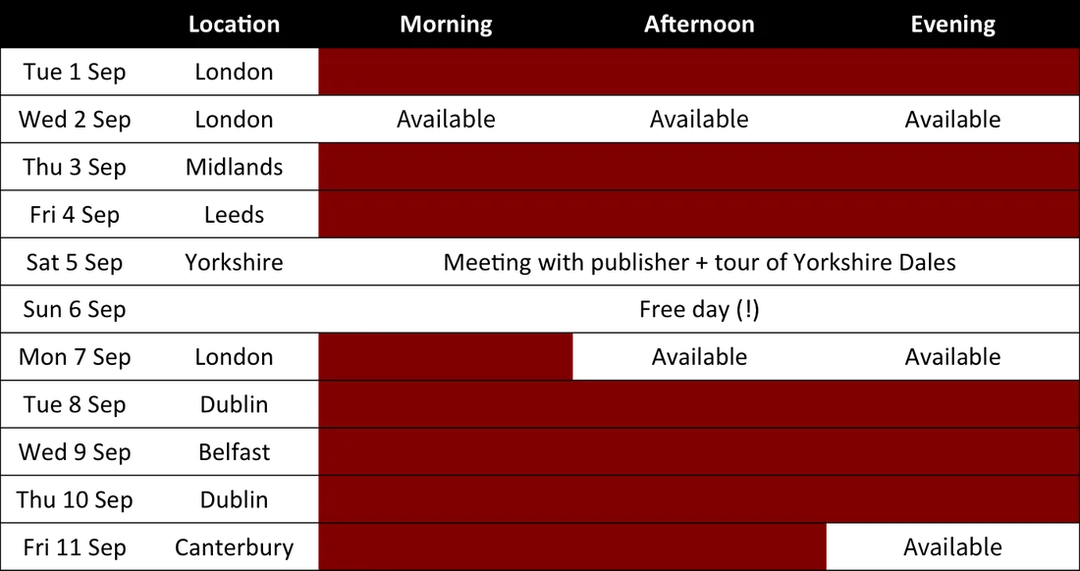
    Wow, that was quick! Six days ago, plans for my Spring speaking and advisory tour to the UK and Ireland were 'starting to come together'. Now the eleven-day tour—to discuss corporate governance, value creation and board practice topics—is nearly full subscribed. Thank you! Three masterclasses, four 'general' speaking engagements, a masters-level lecture and several private meetings are confirmed on the programme. (Details of the 'public' events will be published by the event sponsors in due course.) In addition, two parties have requested planning meetings to discuss future advisory or speaking engagements, to occur in early 2016. If you think you might want to book me but want to talk about it first, that's entirely fine. Just let me know.
    As of today, just one full day (2 Sep) and one part-day (7 Sep) remain available to be booked. I'll be in London on both days as you can see. If you are based in London (or the home counties) and you want to book a meeting or speaking engagement, please get in touch soon--before it's too late!

    Picture