• Published on

    ICGN'15: The demands on boards in the future

    The second panel discussion of the third (and last) day of the ICGN conference looked to the future. The topic brought together many of the discrete threads from earlier conversations. Here are some of the takeaways:
    • Directors' expectations of themselves are climbing. About 30 hours per board per month is now considered to be average. The trend towards much higher levels of involvement and accountability is well established.
    • There appears to be a significant difference between the amount of time that the directors spend working on the boards of publicly-listed companies and private-held firms. PLC boards tend to be 'low touch' with a monitoring and compliance emphasis, whereas PHF boards tend to be 'high tough' and the focus is on strategy and business performance. 
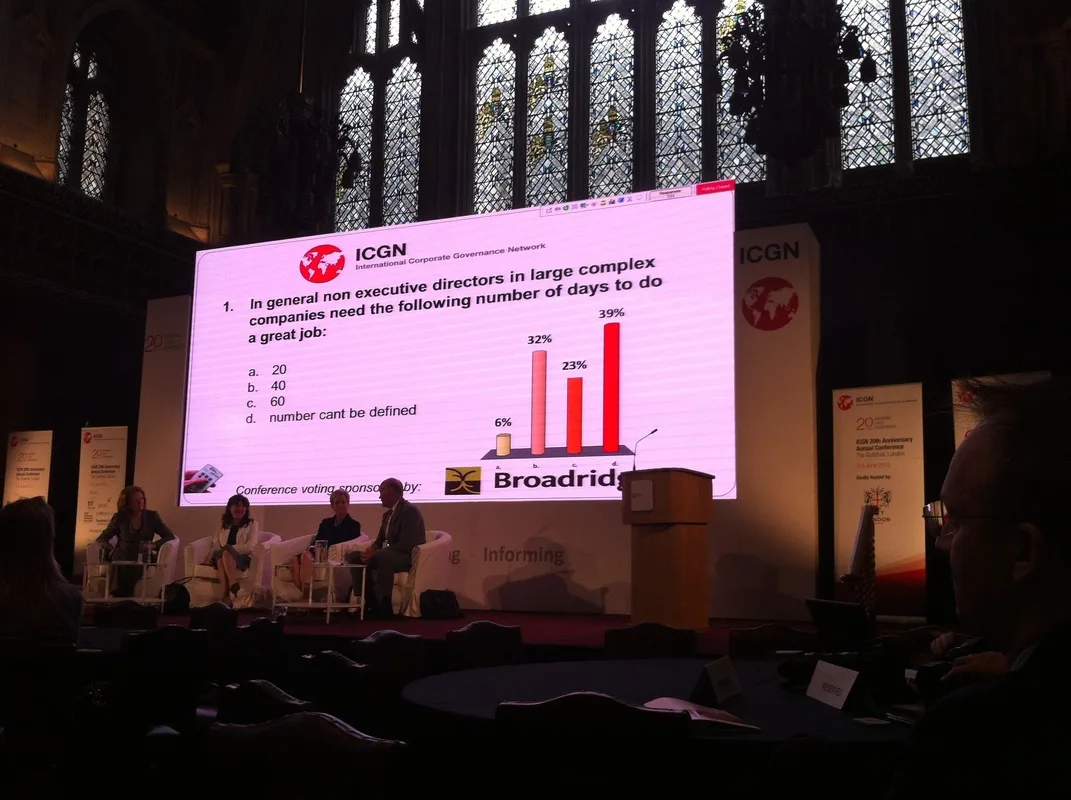
    Picture
    • Boards need to get far more involved with the consideration of strategic options than most do now (cf. my research, which suggests that an active involvement in strategy development is crucial).
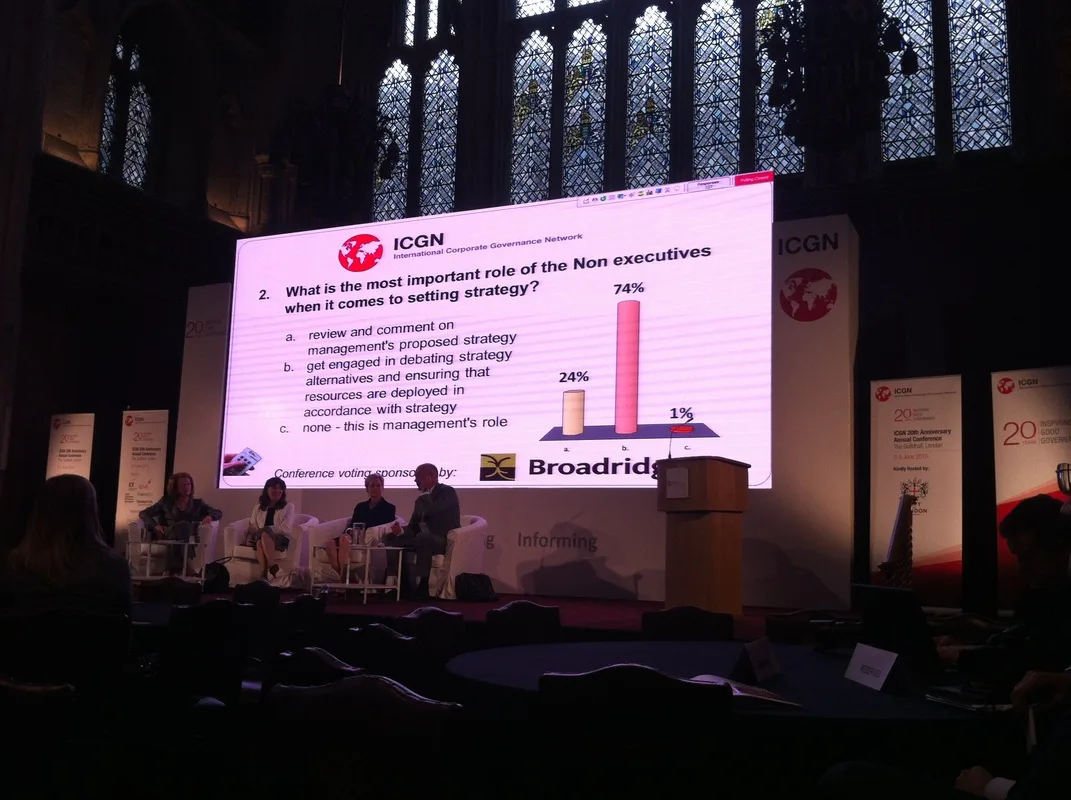
    • Most shareholders and institutional investors 'know' that boards need to be involved in strategy development (per the survey result below), yet precious few boards actually take the task of strategy development and strategy management as seriously as the survey suggests is required.
    Picture
    • Directors need to be fully informed on all material matters. Suggested channels included formal due diligence; asking probing questions of rhe chair executive during board meetings; eliciting information from multiple sources; asking for information to be presented in a particular format.
    • Boards need to be high-trust environments, whereby directors are free to debate the issues (heatedly sometimes) in the pursuit of an agreed company purpose and strategy.
    • One panel member took the position that expecting that 'board involvement in 'strategy' might be expecting too much from directors (even though directors have a duty of care to make enquiries and become adequately informed.
    These takeaways demonstrate that boards are starting to thinking about future business performance. However, there is much work to do, both by boards to determine an appropriate division of labour between the board and management, and by shareholders to express their wishes more clearly than perhaps now is the case.
  • Published on

    ICGN'15: Inside the boardroom black box

    For many of us, the boardroom is an opaque structure, whereby those on the outside can only but guess what might (or might not) happen on the inside. And that's the way many directors like it: strong norms of privacy and claims of confidentiality are held up as defences against such things as professionalism and accountability. While many boards try to do their job well, some directors are victims of hubris, arrogance, laziness and, in some more extreme cases, a perception of being above or beyond the law (the slippery slope that often leads to fraudulent activity). It's little wonder that the level of distrust (of directors) is at an all-time high.
    The second plenary of the second day of the ICGN conference tackled the topic of what does (well, should) happen in boardrooms. The panel prized open the corner of the blackbox.Here's some of the takeouts from the discussion:
    • Directors, you need to think about who you represent (Clue: the constituency that put you there is not the correct answer).
    • Many boards focus on risk (at the expense of future performance, value creation and shareholder wishes) far too much.
    • All boards have a culture, but not all board cultures are aligned with corporate culture.
    • Groupthink is an ever-present problem for boards. Diversity can help.
    • The highest standards of integrity and probity are crucial, and especially so for the chairman. If either of these are compromised or perceived by others to be compromised, then the director concerned needs to leave the board, immediately.
    • High levels of trust between directors and with the chief executive are crucial, to provide a suitable foundation for vigorous debate to occur.
    • Boards need reliable / accurate / unfiltered information to make informed decisions. That which is received via the chief executive is, often, biassed in some way. The panel thought board–staff conversation was to be encouraged (within an agreed framework or protocol) as a means of eliciting a more complete picture.
    • "What happens in the boardroom stays in the boardroom".
    My experience, both as a serving director and as a silent observer is that the characteristics listed above are probably necessary to board effectiveness. However, they are by no means sufficient  nor do they necessarily guarantee business performance outcomes will be achieved.
    I was surprised that little attention was paid by the panel to time splits (compliance / monitoring / forming future strategy) or to the importance of strategy as a board agenda item. This would have been useful guidance for serving directors. However, it is probably a touchy subject. Most directors 'know' how much time they perhaps should spend on strategy (and they'll 25–40 per cent if asked), whereas most boards actually spend far less time on this activity (typically five per cent). Perhaps this discrepancy is a source of embarrassment to directors and, therefore, it does not get discussed. Notwithstanding this, this discussion as probably the most useful of the conference to date—because it was about boards and what boards [should] do (ie. corporate governance).
  • Published on

    ICGN'15: A timely call to action

    Image description
    Robert AG (Bob) Monks is a experienced shareholder activist and pioneer in corporate governance. The tall octogenarian has spent a lifetime influencing boards and board performance, especially in corporate America. Monks was invited to deliver the keynote address the ICGN conference.
    Monks, a gifted orator, spoke from the heart, and he had the gathered delegates enthralled as he did so. Reviving memories of the wartime leader Winston Churchill, Monks reminded delegates that, while they had come far, they were not at the end (ie. 'arrived') nor were they at the beginning of the end. They were, he said, "at the end of the beginning". He went on to suggest:
    • Boards and shareholders (particularly institutional investors) had barely started on the journey of convincing management that an engaged shareholder more likely to be helpful than a hindrance. I suspect this was a wake-up call for many, particularly those that think they 'do' corporate governance well and that shareholders should be kept at arms' length.
    • Too many chief executives and executive teams had autocratic control of the levers of power. They were feathering their own nest and allocating resources in favour of short-term outcomes—and boards were allowing chief executives to get away with such behaviours. Thus, chief executive accountability is largely a myth.
    • Much of what actually happens in boardrooms is not corporate governance or even an approximation of corporate governance. Rather it is a shadow play, orchestrated to give he appearance of the board doing the things that it should be doing. The statement that corporate governance is a high-profile smokescreen was as telling as it was damning. 
    Monks continued by offering several recommendations to the audience (comprised largely of institutional investor representatives but also other participants in the corporate governance community including academics and advisors). He said that shareholders need to be genuinely engaged (by specifying what they want from their investment); that integrated reporting is crucial (to provide clarity around actual business performance); and, that all publicly-listed companies need to have real (identifiable) owners (to satisfy the engagement challenge.
    Monks received a standing ovation from some of the delegates, such was the power of his oratory and the high esteem in which he is held. One surprise: neither value creation or strategy was mentioned. I wonder what Monks thinks about these activities and the board's role therein. Rather than guess, I'm going to ask him. Congratulations to the conference organisers for securing Bob Monks' contribution to the debate.
  • Published on

    NACD announces "long-term value creation" commission

    The National Association of Corporate Directors (NACD) has announced the establishment of a Blue Ribbon Commission to investigate the board's role in driving long-term value creation. You can read the full announcement here.
    Twenty-six "distinguished corporate leaders and governance experts" have been appointed as commissioners. Surprisingly, no corporate governance academics have been appointed. This begs the question of how the BRC intends to go about its work, and to conduct empirical research in particular. I hope the opportunity to investigate what value creation is—and how it is created—is not lost.
    I'm in two minds about this investigation. On one hand, it confirms the profession has a serious problem: that we simply don't know how boards add value or influence performance begs the question of what directors and boards actually do. On the other hand, congratulations are due to the NACD taking the bold step of commissioning the investigation. The subject is topical (in the last six months alone, I have been party to well over 100 conversations and debates on the topic of strategy in the boardroom), to the point of being somewhat personal (the subject is at the heart of my doctoral research).
    Consequently, I intend to watch developments closely especially as the commission seems to be very similar to a study undertaken last year. If asked, I will make my research findings available to the BRC.
  • Published on

    Boardroom authenticity: are director actions consistent with their claims?

    The NYSE has just published the results of its 12th annual director survey. The survey, conducted by Spencer Stuart, makes for interesting reading. For example, strategy and performance features as a "perennial concern" of respondents—directors claim a strong interest in strategy. However, the responses do not bear this out. When asked to identify board actions that are critical to company performance, the top six responses from directors were:
    Directors say they know strategy and performance is important. That's clear. So why, when directors are asked specifically, do 'monitor' and 'control' activities feature more highly? Ouch! Why are some director's actions inconsistent with their claims?
    Do you notice anything unusual these responses? Apart from reviewing the strategic plan (presumably developed by management), none are practices of strategic management at all! If the board is responsible for business performance, why isn't it directly involved in the development of strategy, or monitoring strategy implementation, or verification of business performance goals? Why don't these elements, which are crucial to any influence the board might exert on business performance (watch for my forthcoming research), feature at all?
    • Regular CEO evaluation 96%
    • Strategic plan review 91%
    • Review of bench strength 83%
    • Capital use review 83%
    • M&A analysis 73%
    • Meeting on-site managers 62%
  • Published on

    Telling the emergent #corpgov story

    About three and a half years ago, I had the privilege of listening to a leading thinker speak about some of the problems with boards, board practice and the phenomenon of corporate governance. The comments were as contentious as they were disarming: we don't know nearly as much as we would like to think we do. Further, many of the widely discussed measures (women on boards, board size, an independent chair) provide little if any guarantee of increased business performance.
    My initial reaction was to dismiss the comments. They stood apart from the prevailing opinions of many practitioners and consultants. However, there was something compelling about the the way the story was told. Something made sense, so I dug deeper. Pretty soon, I found myself on the quest that became my doctoral journey, to try to work out how boards can influence business performance in real terms.
    Jun 3–5

    Jun 11–12
    Jun 17–20
    Week 1 Sep
    Sep 8
    Sep 9
    Sep 10
    Oct 29–30
    Nov 12–13

    Nov 23–27
    International Corporate Governance Network  annual conference
    (London, England)
    International Governance Workshop (Barcelona, Spain)
    European Academy of Management conference (Warsaw, Poland)
    * available in UK and Western Europe
    Masterclass: Corporate Governance (venue tbd, Ireland)
    Masterclass: Boards and Performance (Dublin, Ireland)
    Guest lecturer: University of Ulster (Belfast, Northern Ireland)
    EIASM conference (Brussels, Belgium)
    European Conference on Management Leadership & Governance
    (Lisbon, Portugal)
    Reserved for Singapore event and meetings
    (The prospect of some meetings in Australia and the US is being discussed as well, but nothing is confirmed yet.)
    That quest continues today. However, the doctorate is nearly complete so the time to package the learnings (there have been many), tell the emergent corporate governance story and discuss implications for boards and businesses has arrived. To this end, I will be travelling internationally in June (as signalled yesterday), September and November as follows:
    If you want to know more about any of these events, or want me to meet your board or executive team, please get in touch.