• Published on

    The [high] value of white space

    Picture
    When was the last time you stopped and thought about your work, your contribution and the value you offer others? Are you adding value, or simply occupying space? 
    Most leaders say taking time for self-reflection and to think is important, if high performance is to be sustained. But many do not follow through. Instead, they remain 'on': making lists, completing tasks, checking emails, and responding to social media feeds—all in the name of getting things done. Some even speak, proudly, of workaholism and busyness. Such behaviour is lauded in many modern societies. But is 'always on' and busyness conducive to high performance? Or is it a delusion? What of personal and professional relationships; of curiosity; of gaining new insights; of becoming a better person?
    Allocating uninterrupted time—white space—for reflection, thinking and dreaming is critical if organisational leaders (especially board directors!) are to have any hope of contributing well. 
    The idea of dedicated white space was an anathema for me through the first half of my career. But as I got underway with my doctoral research (circa 2012), something changed. Gradually, the guilt I felt when stepping away from my desk when I was stuck subsided: the act of changing neural activity (from sitting staring at a problem, to going for a walk or riding my bike) often had the effect of helping clear the mental block I had been struggling with!
    Since completing my doctoral research in 2016, I continued to prioritise white space, as follows:
    • Early morning (0530–0700, six days per week), to read inspirational texts, news feeds and topical articles.
    • Daily walks, to activate my cardiovascular and musculoskeletal systems.
    • Evening (a 60-minute block before retiring for the night, at least five nights per week), to read what a close friend calls 'brainy books'—books on philosophy, psychology, neuroscience, human nature, history and trekking, but also the 'great books'. 
    • Long-haul flights have become precious white spaces too, because I am left alone to do what you want. I keep a pencil and paper to hand, and record my thoughts (often my best ideas!)
    None of this makes me good, or any better than anyone else. However, my dedication to allocating white spaces and holding them sacrosanct has seen me become more curious. My mind seems to have become more malleable too. Hopefully, my contributions have become more valuable as a result—but this is best assessed by others, not me. 
    Does the idea of white space resonate for you? If so, would you mind sharing your experiences, so others can benefit from them?
  • Published on

    Reading through the seasonal break

    Picture
    I have the good fortune of meeting many hundreds of people every year—aspirational and established directors, board chairs, executives, journalists, shareholders, MBA students, doctoral candidates, lobbyists, regulators, policy analysts, conference organisers, and more besides. Sometimes, contact is fleeting; sometimes it is enduring, as we work together to gain insight, educate, or tackle a difficult problem.
    One question that keeps coming up (besides the big three, namely, what is corporate governance; what is the role of the board; and, how should governance be practiced) is, "How do I stay current and relevant?"
    The answer is straightforward. I read, a lot.
    Every morning—well, at least six days a week—I dedicate 90 minutes or more, to check newsfeeds, blog posts and emails that have arrived overnight. The primary goal is to ensure I have sufficient awareness to engage well with colleagues and clients on topical matters. Some people call this continuing professional development. I prefer a simpler description: reading to keep up.
    This commitment is, I find, a bare minimum because it does not afford space to read widely and think deeply about ideas, perspectives and the human condition. For that, I read books; sometimes in the evenings, but most often on flights and during holiday breaks. Why? Because I have time to think and mark (in pencil in the margin if a physical book, or electronic bookmark if an e-book) specific points to investigate further.
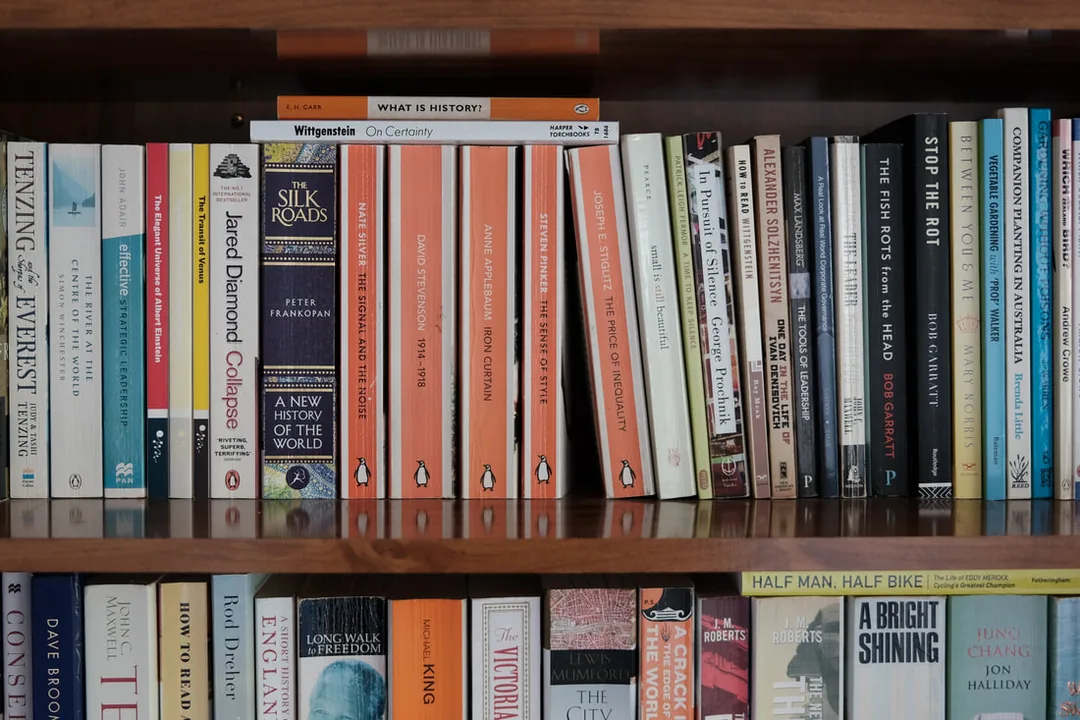
    Several people have asked what I'm reading. Here is a list of books either under way or to be read this summer break. Notice only one is directly linked to my board and governance work. That is intentional. Reading widely means, to me, reading beyond normal boundaries to discover new ideas and ways of thinking about things.
    This list is a selection of the books awaiting my attention. If you read, I'd love to hear any recommendations!
    Enlightenment Now
    Steven Pinker
    The Matter with Things
    Iain McGilchrist
    The Evolution of Corporate Governance
    Bob Tricker
    On Certainty
    Ludwig Wittgenstein
    SOE (Special Operations Executive)
    M. R. D. Foot
    Seven Pillars of Wisdom
    T. E. Lawrence
    Nine Quarters of Jerusalem
    Matthew Teller
    The Unbroken Thread: Discovering the Wisdom of Tradition in the Age of Chaos
    Sohrab Ahmari
    South
    Sir Ernest Shackleton
  • Published on

    Teamwork, to enhance the learning experience

    The sharing of knowledge with clients and conference attendees is an activity that I find very fulfilling, mainly because it is a two-way activity. Be it facilitating a professional development course, speaking at a conference or dinner event, or facilitating a private learning workshop, the opportunity to both share knowledge with and learn from attendees is one to be taken seriously.
    On several occasions recently, I have had the privilege of seeing this operate at yet another level: a team-based delivery model whereby two presenters work together to share insights, answer to questions and learn from the assembled group. The positive response from attendees to a team-based model was a sight to behold. The levels of engagement; esprit de corps; and, quality of learning amongst the assembled group (not to mention the banter between the presenters) really lifted the learning experience. The following examples provide windows into two of my recent experiences, and then the learnings to emerge follow.
    Rural Governance Development Programme
    Earlier this year, Peter Allen of Business Torque Systems invited me to join a team to refine the five-day Governance Development Programme (a popular course previously run by DairyNZ for dairy businesses) to suit all of rural businesses. In updating the course, a decision was made to use a team-based delivery model, with two presenters working together with attendees. The hope was that this would provide better coverage of the material, as well as enabling attendees (directors, shareholders and chief executives of rural businesses) to a hear different perspectives as the course progressed. And so we jumped in...
    Picture
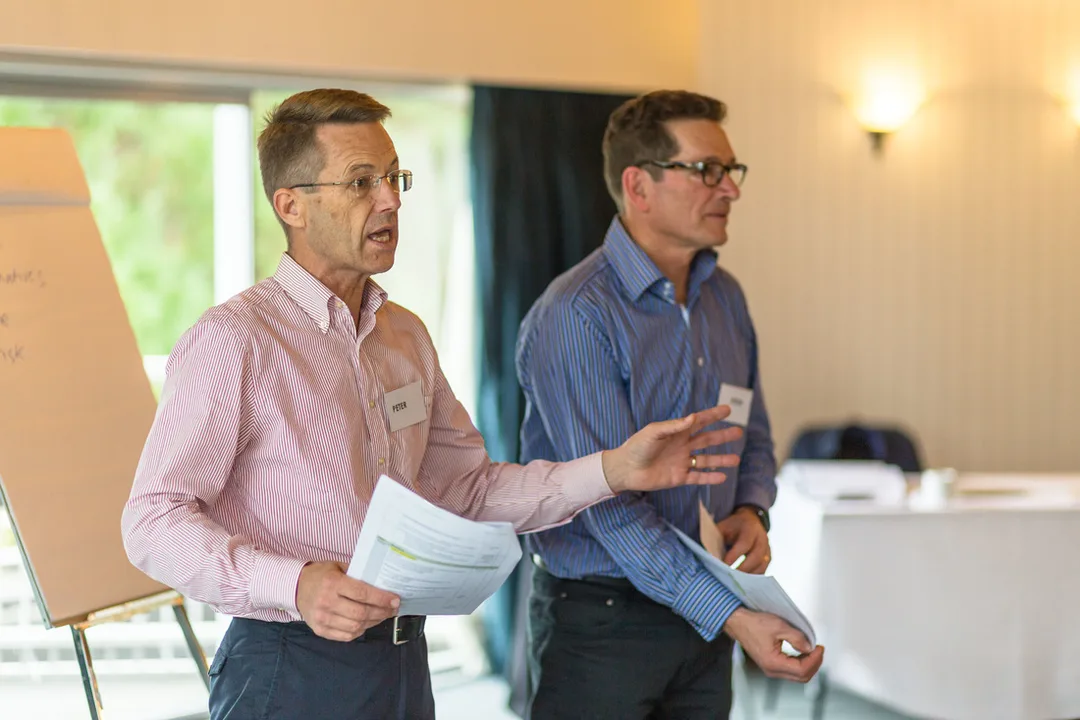
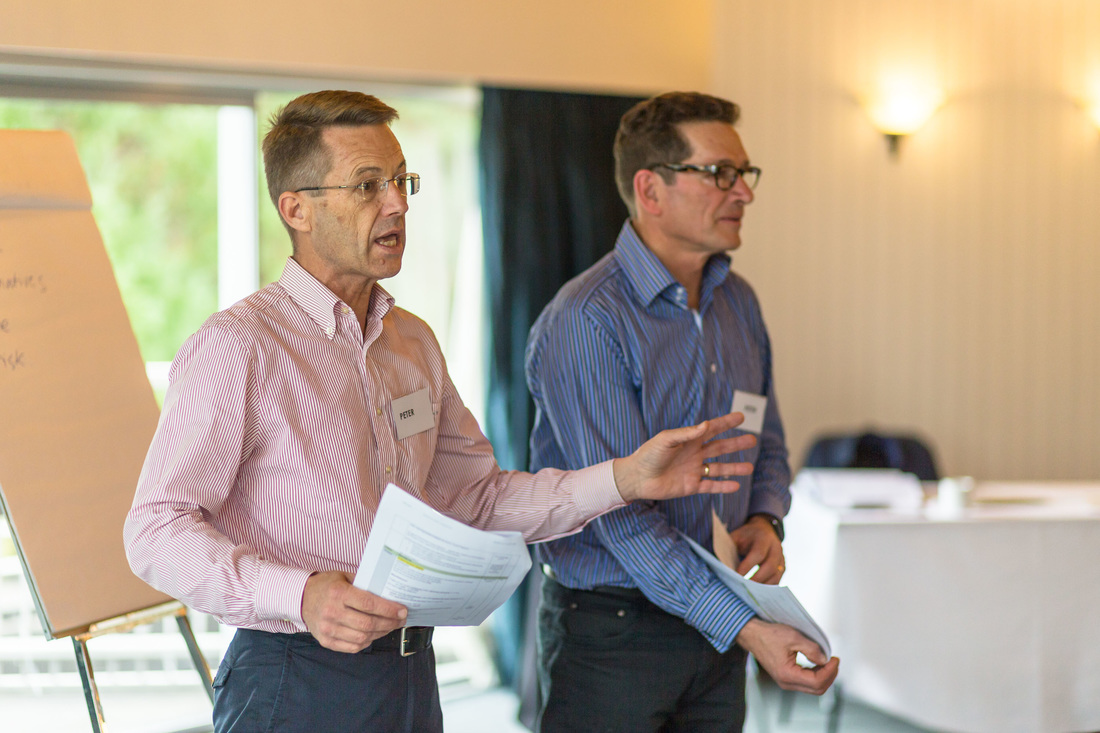
    We resolved to work from the front of the room together, sharing the speaking and listening roles...
    Picture
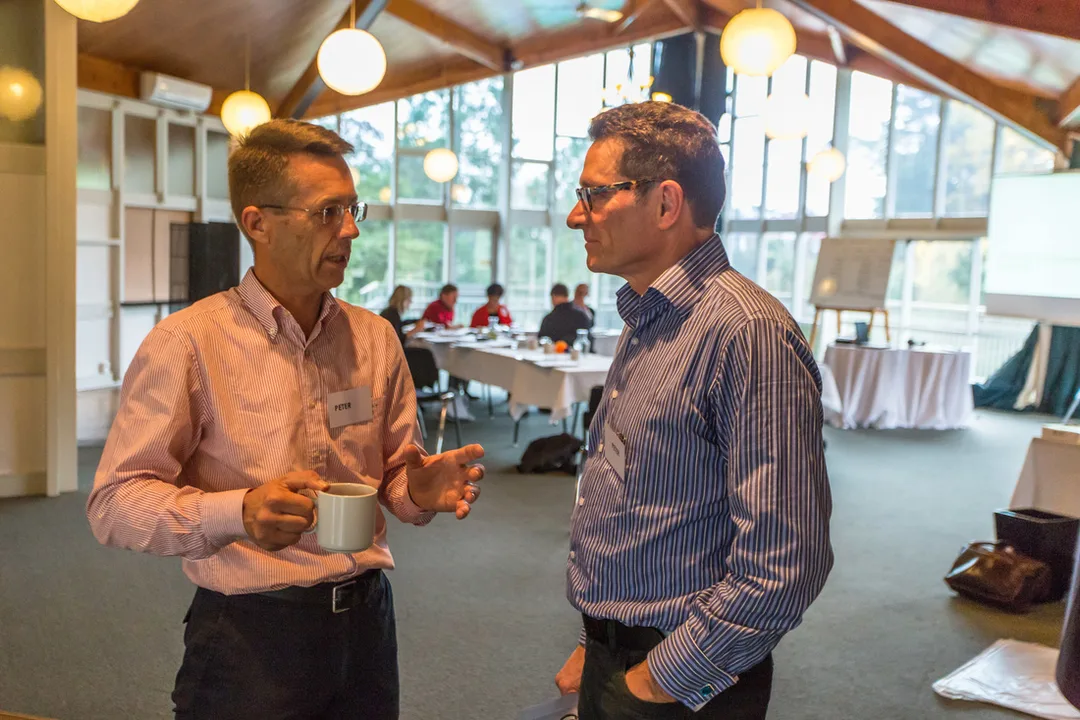
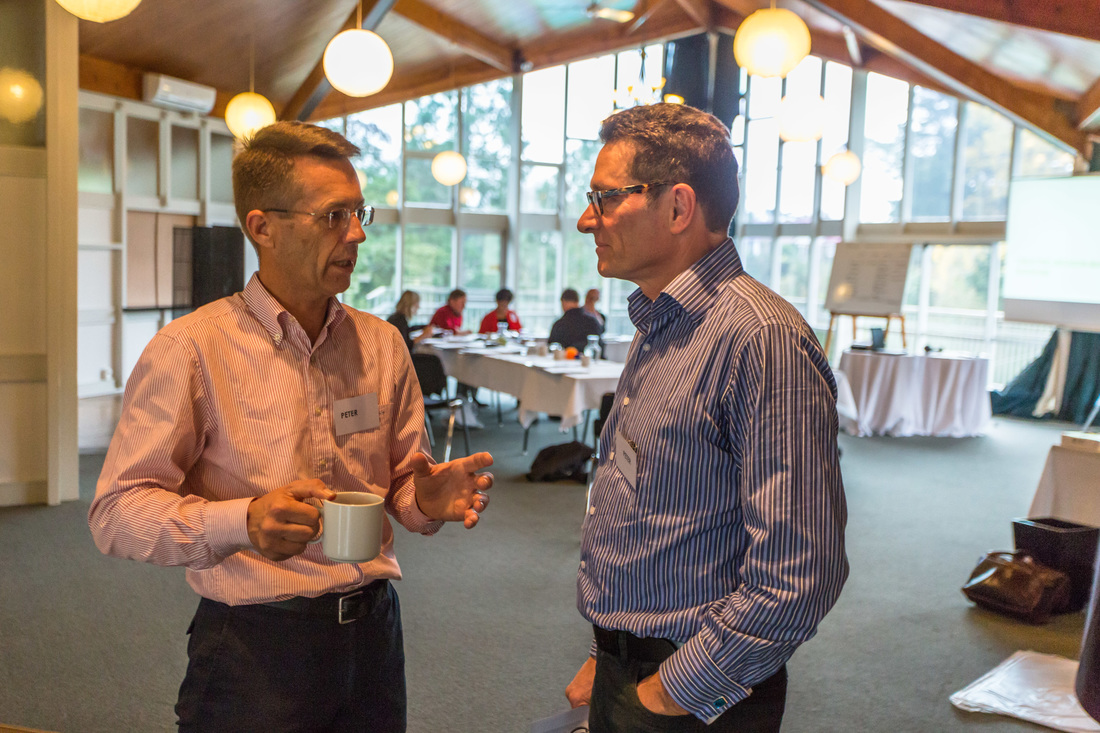
    We stepped aside, to check in and make adjustments... This ​picture, taken on the third day (of five—the course days are spread over a ten-month period so delegates can apply their learning in practice and bring questions and experiences back to the next session), captured us discussing a couple of 'in-flight' adjustments while participants worked on an exercise to improve their strategic decision-making skills in a boardroom setting.
    Health sector board member development workshop
    The second example relates to the delivery of a professional development session for the board members and executives of three primary health organisations (PHOs). They wanted a refresher on board effectiveness and strategy in the boardroom—topics dear to me. The organiser was keen on a two-person delivery model as well, which created another opportunity to explore and experience the effectiveness of the team-based model.
    I organised to work with a trusted colleague, Murray. We know each other well and share a commitment to excellence but have slightly different styles. After introductions and scene-setting, we asked the group to tell us what they wanted to get from the session and to mention specific areas of interest. Then it fell on me to lead the first session (board effectiveness) with Murray chipping in regularly to help answer questions and share examples from his experience. The roles were reversed for the second (strategy) session later in the afternoon. Finally, we jointly ran an free-flowing plenary session to check all of the areas of interest had been addressed and answer any remaining questions.
    Learnings
    Feedback from the attendees (informal plus evaluation sheets) from both the rural course and the health sector learning session indicated that the double-teaming model works. Attendees said they got more from the session than they thought they might have gained had there been one presenter. They could listen to and tell stories to connect ideas with practice; ask similar questions and get a different (!) responses; and, they said they benefitted from tapping into a broader pool of knowledge and experience than what would otherwise have been possible.
    One board member went as far as saying that the session was "the best learning session ever organised by <PHO-name omitted>", gratifying feedback indeed. The levels of trust and interaction in the room in both the rural course and the health sector session were also noticeably high. (Whether this is a reflection of what is being modelled from the front of the room or it is simply an expression of the delegates' innate character and desire to learn is open for debate!)
    Where to from here? Though not without its challenges (working so closely together requires considerable planning and trust, for example), the early experiences have been positive. There is also a 'cost' of putting two people in the room. However, the benefits in terms of enhanced learning outcomes tip the balance in favour of the team-based model—especially for advanced topics and multi-day courses. The learning theorists are probably all across this, so I'll need to play catch-up.
    If you have any experiences to share—positive or negative—I'd be keen to hear from you. Please respond by posting a reply or send me an email.
  • Published on

    The importance of catching one's breath: time-out is not time wasted

    Picture
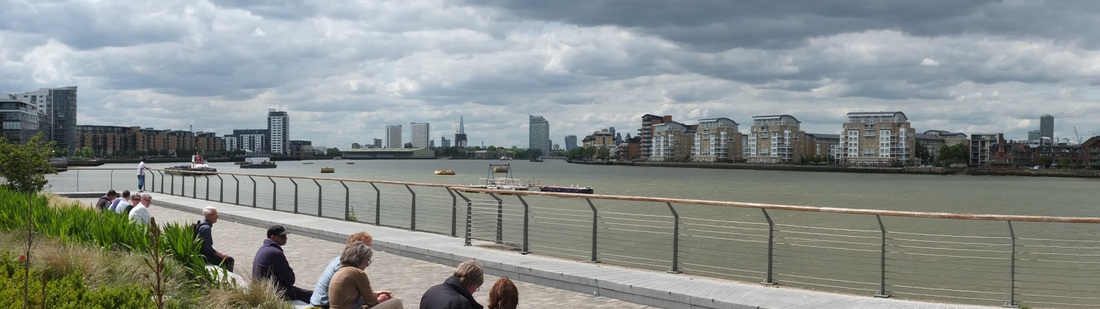
    When I was in London most recently, in June, I fortunate to visit Greenwich. A friend had told me that Greenwich Village is 'different' and that a visit was in order. And it was! In contrast to the hustle and bustle of the City, Canary Wharf and the West End, the people of Greenwich are more laid back. They smile, they say 'hello' and they walk more slowly than their neighbours across the Thames. Many, like the twelve in the picture, happily sit and peer into the distance, taking it all in. Who knows what they were thinking or even looking at. It probably doesn't matter, I guess.
    Why am I relating this story? My short visit occurred three-quarters of the way through a hectic three-week multi-country trip. It reminded me of the importance of downtime. With hindsight, the interlude—to gather my thoughts—probably made the difference between just making it through the final week of the trip, and finishing the trip well.
    Today, as I was working on a presentation to be delivered on my next trip (1–11 September), thoughts of that Greenwich interlude entered my consciousness. The upcoming trip is packed with seventeen significant commitments including two master classes, three presentations, two important dinners and several planning and roundtable meetings; in London, Canterbury, Leeds, Wolverhampton, Dublin and Belfast. It'll be a busy trip. To top it off, our elder son, who is working in Germany at present, has just asked if we can meet up in London while I'm there. Of course, but when? Then the penny dropped. Rather than pursue two remaining 'pencilled in' meetings, why not spend an afternoon with Tim? Two carefully crafted emails later, some 'Greenwich Time' was locked in. I'm looking forward to it already.
    As you move through Friday, my hope is that you too will have the opportunity—better still, take the opportunity—to run on Greenwich Time this weekend. If we are to perform well when it counts, we need to set time aside to relax, recharge and to prepare—mentally, physically and spiritually—for that which lies ahead.
  • Published on

    ICMLG'14: closing remarks

    Well, ICMLG is over for another year. The ACP organisation, and hosts Babson College (Phil Dover and Sam Hariharan, in particular), organised a great conference. Delegates assembled from over 20 countries from the five major continents. The theme of entrepreneurship provided a linking thread between the keynote speakers (Isenberg and Schlesinger), the paper streams and many conversations over coffee and food.

    I particularly enjoyed the provocative sessions of Isenberg and Schlesinger, and appreciated the opportunity to test some of the ideas that are emerging from my research, especially with researchers from outside the Anglosphere. That feedback will result in some adjustments to the way that my thesis is written up. To everyone who offered feedback: thank you!

    I commend this conference to all management, leadership and governance researchers, and practitioners with an interest in these and related fields. Next year, the conference venue is in the southern hemisphere, in Auckland New Zealand. The co-hosts will be AUT and Massey University. Certainly, I am looking forward returning the hospitality afforded to me in the international conferences that I've been fortunate enough to attend in the last couple of years.
  • Published on

    What research can we accept then?

    I had a fantastic meeting with my PhD supervisor earlier this week, to review my approach to the research methodology chapter of my thesis. When we stopped for some lunch and a walk outside, James showed me two articles from the 19 October 2013 issue of The Economist. They blew my mind. Entitled How science goes wrong and Trouble at the lab, the articles outlined how much of the so-called scientific research conducted by academics is actually a load of rubbish. For example:
    • Last year researchers at one biotech firm, Amgen, found they could reproduce just six of 53 'landmark' studies in cancer research.
    • A leading computer scientist frets that three-quarters of papers in his subfield are bunk.
    • In 2000–10 roughly 80,000 patients took part in clinical trials based on research that was later retracted because of mistakes or improprieties.

    The examples and supporting narrative floored me—it was sobering reading. The points about how research is conducted, how research articles are reviewed and, most importantly, how research is funded (the funding mechanisms drives the behaviours) were enlightening. The lingering question in my mind, having dwelt on these articles over the last two days, is this: just what research can we accept then? The answer probably lies in the maxim recorded in the first sentence of the 'goes wrong' article: 'trust, but verify'.

    The exercise was a timely and helpful wakeup call for my own efforts, to ensure my work is 'good science'. Thank you James.