• Published on

    Decisions-making, amidst complexity

    Picture
    That life is complex and unpredictable is a truism. And, though the frequency and impact may vary, change is a constant, it seems. If one is to thrive (succeed, realise goals) in such an environment, adaption is critical having detected something has changed. To ignore or pay lip-service to change is folly, and to guess how to respond is about as reliable as gambling.
    The same principle applies in organisational and boardroom settings. As in life, some of what is seen, heard or read is reliable, but much is not—to the extent that descriptors such as misinformation and  disinformation have become commonplace, even hackneyed. Consequently, those charged with providing effective steerage and guidance need to be alert, to ensure decisions about how to proceed are underpinned by accurate data from reliable sources, and insights from conversations and analysis.
    Two techniques I have found useful when considering decisions with strategic implications:
    • Take stock: Rarely does anyone have everything needed to make an informed decision off the bat. Acknowledge the existence of gaps. Ask probing questions to try to understand what is going on and bridge the gaps. Test everything (on the assumption that what seems at first to be the case may not be). Hold options lightly. Invoke an advocatus dialboli mindset, to explicitly draw out alternative perspectives. Listen carefully. Draw on prior experience too, for the likelihood of historical experiences being relevant is high.
    • Take time: Rarely does a so-called strategic decision need to be made immediately, despite first appearances and temptations in modern society to be seen to be agility, and to embrace pace and an urgency mindset. Clarify and agree when the decision needs to be made. Agree the pathway to the decision, and what intermediate decisions can be made to de-risk the strategic decision.
    If boards are to make sound decisions, directors need to breathe—to create space and time to consider options well. Boards should also agree on the decision criteria, process and timing at the outset; guard against being drawn into irrelevancies along the way; and, employ a strategic mindset throughout. How does your board measure up in this regard?

  • Published on

    Bridges: a metaphor

    Picture
    I have a thing about bridges. They are, in my mind at least, points of connection: not only between physical locations separated by water or chasm, but also between people, and between seemingly discordant ideas. 
    This week I have been in the United States and Canada: in Chicago, to deliver a keynote at the Private Directors Association national conference, lead two masterclasses and fulfil other engagements; in Toronto, to speak at a Governance Professionals of Canada event and attend other meetings; and, in Knoxville, to catch up with a dear friend of some 45 years and take in some local history.
    In my downtime, I have done as I usually do: sate my curiosity—taking in the local sights, sounds and smells, and getting a sense of the history. From lakes (Michigan and Ontario), rivers (Tennessee) and vistas, to monuments, plaques and people, the social fabric that makes a place, well, a place is plain to see and feel. And, as I walked, I stopped periodically, to ponder those who went before, what they might have thought, and their intentions and actions as they went about their lives.
    Picture
    Then, last night, as I enjoyed hospitality in Knoxville, my mind was drawn to a comment my father shared many years ago, “Bridges are made for crossing, not burning.” Now, five decades on, I would add, “Bridges should be built and then crossed.” 
    Picture
    To cross a bridge as it is being built is folly. Not only is this a poor use of resources, the likelihood of arriving at the intended destination is low. But this is what many executive teams and boards seem to do—they work it out as they go, or they assume that someone else has the matter in hand. Sometimes, they are so busy operating that they do not look past the here and now. But that is hardly a sound way to create value or a thriving business that endures over the longer term.
    The role of the board of directors is to govern, meaning to provide effective steerage and guidance. And, one of the four principles of corporate governance is ‘set direction’, meaning, to determine corporate purpose and strategy. And therein lies an awkward bridging question: If a company’s board has not set direction, what hope should the executive have of leading well; or the staff being productive; or, ultimately, of the potential of the company being realised?
    The strategic governance framework is one option boards may wish to consider, as they strive to see around corners and govern with impact.
    PS: For curious readers: The bridges pictured are the Gay Street Bridge in Knoxville, and the Michigan Avenue Bridge in Chicago.
  • Published on

    When things go wrong...what can be done?

    Boards, and an oft-mentioned but mysterious concept—governance—are topical. Daily, it seems, these terms feature in our newspapers and on social media, usually because something has gone wrong. And when it does, ​the chattering class is not slow to react. Typically, the targets of their comments are the board and management of the organisation.  That seemingly strong organisations suffer significant missteps—or even, fail outright—on a fairly regular basis is worrisome; the societal and economic consequences are not insignificant. What can be done?
    Recently, the inimitable Mark Banicevich invited me to discuss boardroom success and failure, and to offer guidance that boards wanting to lift their game may wish to consider. 
    Hopefully, our discussion is helpful and enlightening. Regardless, I welcome questions and comments, either here or send me an email.
    This is my second conversation with Mark (the third will be published in May). If you missed the first, you can access it here: Governance around the world.
  • Published on

    The words we utter: Do they matter?

    Picture
    As regular readers know, I read widely; topics I explore span (in addition to core themes of corporate governance and strategy) include philosophy, neuroscience, business, history, military strategy and more besides. I usually take notes, as an aide memoire for later reference. 
    Some articles are memorable, others less so. This one recently-published article piqued my attention because it reminded me of a question I face most weeks: "What do you do?" Most enquirers expect to hear a job title or a profession, to enable them to 'position' me, which is fine if the 'job' is a well-known profession or vocation, such as a doctor, teacher, plumber or lawyer. But what about a director, or an advisor? Is offering a one-word response helpful? Might it enlighten or obfuscate? 
    For those who understand the roles of director and advisor, one-word descriptors are adequate. But for others (the majority, even most?), the response is more likely to an awkward smile, as if to say, "I wonder what one of those is or does? Does he mean a company director, a movie director, an orchestra conductor, or something else?" or, "What is an advisor? It sounds like a fancy name for a consultant." What an unhelpful interaction!
    Clarity and simplicity are vital if we are to communicate effectively. And the effectiveness of what we utter—whether our message got through—is determined by the listener not the speaker.
    With this in mind, I try to read the person before answering. If they appear knowledgeable of business matters, I tend to say I work with boards, sometimes adding that I help them see around corners and govern with impact; an advisor. But if not, I say I'm a troubleshooter who works with business leaders, or something along those lines. One thing I never say: I'm a consultant—they are people who make decisions and implement things for others. I don't. Rather, I ask questions to gain insight and make suggestions. Whether the client takes up the advice or not is their decision. 
    So, returning to the headline question. The words we utter: do they matter? Yes, they surely do, if we are to communicate well. 
  • Published on

    Checking the big picture: Are we still on track?

    Picture
    The prospect of looking back on the year past at this juncture seems a little odd, even presumptuous, given five weeks remain in 2023. And yet, with the onset of the holiday season (Christmas, Hanukkah, Diwali, as relevant in your cultural setting), I have noticed minds are starting to turn; casual comments in my hearing indicate some people are starting to reflect on the year soon-to-be-gone; others upon what the future might hold.
    As someone called on to think broadly about organisational challenges and opportunities, and to share insights that might be helpful to helping boards govern with impact or realise organisational potential, I too, take time to ponder. To think about what has passed, what lies ahead, and how one can help is not only smart, it is vital—if one is to learn, make adjustments to stay on track and achieve goals and, over time, become a better person.
    Turn now to the person you see in the mirror. What did you set out to achieve in 2023? Did you set specific goals? If so, have you checked progress? Are you still on track? ​Have you taken into account changes in the environment around you and made adjustments, or have you pressed on in spite of changing circumstances? As a leader, you owe it to yourself—and all those you interact with—to check progress periodically and make adjustments if you have veered off track or lost sight of the goal.
    For the record, my goal for 2023 was audacious; to ensure every director and board I had the privilege of serving, globally, derived some benefit from the interaction. The goal was audacious because 'every' set a high bar; essentially, it left no room for slippage! Thankfully, feedback to date suggests I'm doing OK. Hopefully, the feedback still to come is consistent with that received through the year. If it is, I'll wrap up the year contented; tired but contented.
  • Published on

    A journey, in thought and deed

    Picture
    When I was a boy, milk was free (I was raised on a dairy farm), but you could buy it in a glass bottle with a silver foil top (pasteurised but not homogenised) for four cents a pint at the general store. Television (once we got one, in 1969, to see the Apollo 11 moonshot) was a grainy, black-and-white experience, with a single channel available. You got to watch whatever the broadcaster chose to deliver across the airwaves.
    Now, milk costs several dollars a litre, but it comes in many different styles (blue, light blue, skim, lo-fat, full-cream, calcium fortified, lo-lactose and UHT—as well as products called milk that contain no milk at all, such as oat milk and almond milk, in a wide variety of packaging options). Television has changed too: from a take it or leave linear broadcast experience via rabbit-ear antennae, to a plethora of video-on-demand (streaming) options via the internet. 
    These are but two of thousands of examples that illustrate the onwards match of technology. Oh how life has changed, even in my lifetime.
    The onward march has also affected the way we communicate, not only personally with family and friends, but also with clients, suppliers and the general public as well. The notion of using a fountain pen to handwrite a letter, or making a toll call, seems quaint now—but some of us still value these moments. The emergence of social media has extended our reach in ways not thought possible twenty years ago. Sharing business cards, once commonplace, is now rare. If people want to contact me or learn about me, they tend check my LinkedIn profile (notice the assumption, that I have one), even before mentioning Google or asking about a website or blog. 
    And that brings me to the point of this muse, which is to share one aspect of a conversation with an esteemed company director, in the hope it might encourage others committed to serving the director community. Yesterday, I was asked about the role of social media in my business life, what channels I use and how long had I been using these. The first two questions were readily answered; the third took a little longer—because I needed to find the menu option!
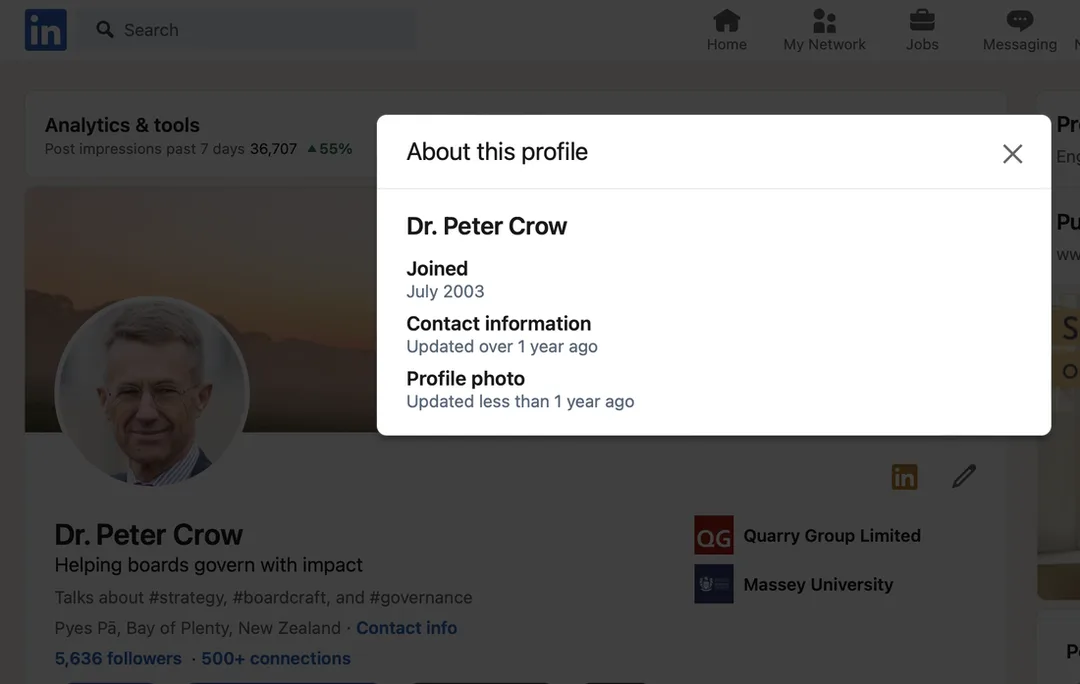
    • Social media: LinkedIn is the only social platform I use. It complements my website and blog, as a forum to comment on topical issues, share articles written by other people and, candidly, reach boards and directors who make use of Linkedin as a trusted source of information. Previously, I used Twitter, but that did not last long for the platform was, I thought, little more than a soapbox for people to shout at each other. When I checked my LinkedIn profile, I was surprised to see I had first used the platform in July 2003, over twenty years ago and just three months after the platform was officially launched by Reid Hoffman!
    • Website: petercrow.com was first launched in November 2001, the month after I left paid employment and founded QuarryGroup, the global board advisory practice. Musings, the blog, came later, in March 2012. The websites were (and remain) online brochures, whereas the blog was created as a place to share my thoughts and test ideas while working on my doctorate. Since 2016, Musings has become a forum for a wider range of board and governance topics. Today, approaching 750 entries later, Musings is read widely, by a global audience.
    Thank you for permitting me to share my experience. I hope anyone considering using social media or a blog as a channel might be encouraged—not only to do so, but to stick at it over the longer term. My journey to date has been fulfilling; I have met thousands of people from many walks of life and, I hope, they have valued the interaction as much as I have.