• Published on

    A nomadic life...temporarily, but for a good cause

    Sunday 5 March is less than two weeks away. For many it is just another day. However, it is significant for me because it signals the onset of an eight week stretch of advisory, speaking, board evaluation and confidential briefing commitments in several countries. Consequently, I will temporarily embrace a nomadic lifestyle: hotel rooms, flights and airline lounges will dominate my world. Here's the schedule as it stands today:
    March 5–6
    March 7–9
    March 10
    March 12–14
    March 16
    March 18
    March 19–20
    March 20–21
    March 22
    March 22–25
    March 26–28
    March 29–31
    April 1–3
    April 3–5
    April 7–21
    April 25–27
    ​April 28
    Timaru, New Zealand
    Rotorua, New Zealand
    Christchurch, New Zealand
    Whakatane, New Zealand
    Wellington, New Zealand
    en route to UK & EU (trip details here)
    London, England
    Rotterdam, Netherlands
    Amsterdam, Netherlands
    Helsinki, Finland
    London, England
    Cambridge, England
    en route to NZ
    Hawera, New Zealand
    Caloundra and Cairns, Australia (holiday!)
    ​Dunedin, New Zealand
    Wellington, New Zealand
    While the schedule will be demanding, the cause is compelling: to speak into literally hundreds of situations in which boards and directors have sought guidance to improve their practices and performance will be both a great honour. That they have reached out to me is deeply humbling. I shall do my best to make a difference.
  • Published on

    Helping entrepreneurs understand the role of the board

    Entrepreneurs—that group of individuals who put their resources and, often, their reputation on the line, in pursuit of a big dream—are interesting people. Some are brash and larger than life; others are quieter and more considered. Despite variations in style and personality, one common thread that binds entrepreneurs is the importance of leveraging (often limited) resources to best advantage to maximise the chance of seeing their dream realised. One important and oft-overlooked resource is the board of directors. Some of the questions I've heard entrepreneurs ask include:
    • What is a board, what is corporate governance and why even have a board?
    • What role can the board of directors play in the success of entrepreneurial businesses?
    • Don't boards just get in the way most of the time?
    • What viable models exist, to ensure the board adds value?
    • How should the board–manager relationship be managed?
    • How can I leverage the board's knowledge without them 'getting in the way'?
    I will be in Brisbane Australia on Tue 7 February 2017 to help entrepreneurs and directors of entrepreneurial businesses explore these questions. The Brisbane branch of Entrepreneurs' Organisation, a global network of more than 10,000 business owners in 42 countries, has invited me to deliver a talk and to host a workshop for members. The title of the two sessions are as follows:
    • The board as a value-creating engine (talk over breakfast)
    • Boards, corporate governance and so on—what does it all mean, and who cares? (morning workshop)
    If you would like to know more, follow the link, or get in touch with the team at EO Brisbane Events.
  • Published on

    GIAconf'16: Post-conference reflections

    The 33rd Governance Institute of Australia national conference was held in Sydney recently. Previously, the Governance Institute (GIA) was known as Chartered Secretaries Australia, an outpost of the Institute of Chartered Secretaries and Administrators (ICSA). The name change, implemented several years ago, implies that the body is moving beyond serving the company secretary as its core constituency. 
    Picture
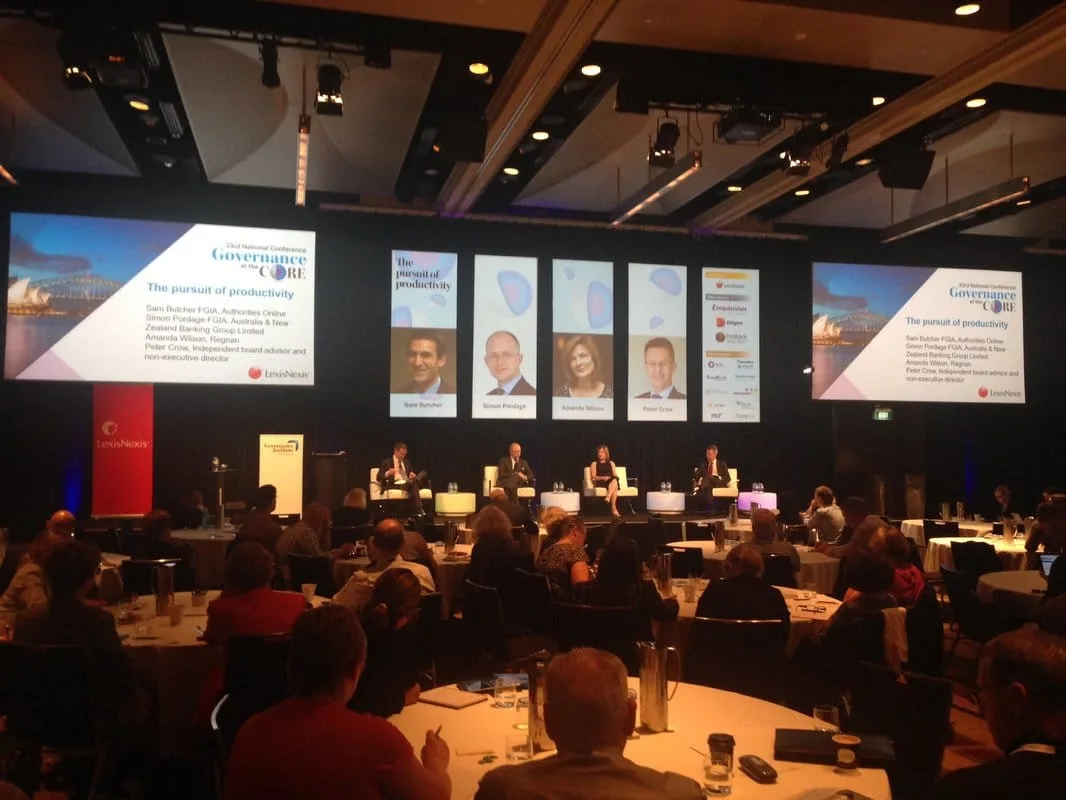
    I attended to observe; meet others; serve as a panelist (topic: The pursuit of productivity, see picture); debate topical challenges for boards; and, learn more about the practice of corporate governance, especially the GIA's role in encouraging boards in their value-creation mandate. As this was my first GIA conference, some post-conference reflections are appropriate:
    • The conference was somewhat smaller than I expected. Whereas over 450 people attended the New Zealand Institute of Directors' conference in 2016, the GIA conference attracted fewer than 200 'governance professionals' (more on this term below). The paucity of company directors was also surprising, especially given the GIA's claim to be "the only independent professional association with a sole focus on whole-of-organisation governance".
    • During the conference, I asked several people about the term 'governance professional'—my presumption being that it is a reference to the role of director and, possibly, an attempt to differentiate the GIA from the Australian Institute of Company Directors. However, this did not seem to be the case. While not excluding directors, the intention is to embrace a far wider group of people and roles—risk managers, company secretaries and other staff who perform reporting, compliance and administative activities; those who are "not served by the AICD" as one person politely suggested.
    • The repositioning of governance as a whole-of-organisation phenomenon is curious, especially when corporate governance is understood to describe the structure and functioning of the corporate polity (i.e., the board of directors) or, as Sir Adrian Cadbury so ably wrote, "the means by which companies are directed and controlled".  Why the GIA has chosen to extend the understanding of governance well beyond the boardroom to include functions of management, operations and leadership is something that remains unclear (to me at least). However, I will continue to watch developments with interest.
    • The GIA, like the IoDIoDNZ, AICD, NACD and a growing number of commentators now advocate the board's role in ensuring company performance. However, the frequent use of 'governance frameworks' and compliance-oriented language during the conference served to undermine this aspiration somewhat. It suggested that the mindset of many remains planted in conformance—when 'corporate governance' is uttered, many still internalise the tasks of 'monitoring' and 'compliance'. Clearly, more work is needed if boards, directors and managers are to embrace the value-creation mandate of boards. 
    • The speakers assembled by the conference organisers were, in general, fantastic. Most delivered insightful commentaries and updates on topics of interests to directors and company secretaries. The audience also had the opportunity to engage speakers and panelists, which seemed to be appreciated.
    • The conference was well-organised (one of the better ones that I have attended in recent years). The adoption of a conference app (something I haven't experienced before) was a novel and useful development—delegates could simply reach fo their smartphone or tablet rather than fumbling pieces of paper and lugging a heavy conference pack around. 
    • Toby Travanner's contribution as conference emcee was outstanding. Organisers of other Australian-based conferences who are looking for a top-shelf front-man should consider Toby.
    In sum, the conference revealed some interesting insights (see summaries in other blog entries below) and attendance was well worthwhile. However, I couldn't help but wonder whether the organisers missed an opportunity—to engage the group that actually carries ultimate responsibility for company performance; company directors.  If the GIA is to make further progress towards its stated purpose, it is vital that company directors are active participants in the discourse. 
  • Published on

    GIAconf'16: Update #3

    This is the third update of several to summarise observations from the 33rd Governance Institute of Australia National Conference being held in Sydney this week. Here are the links to the first and second updates. (The final update, covering the second day, will be published tomorrow.)
    This update includes observations from the late afternoon session.
    The session was dominated by a panel discussion on the topic of culture and why it matters. John Price and Judith Fox, both of whom had addressed the conference earlier were joined by Peter WIlson (Chairman of the Australian Human Resources Institute) to discuss this important topic.
    Fox and Price quickly established the strong correlation between positive organisational culture and company performance, although they did so through the 'back door': asserting the poor culture often leads to erosion of value. While this assertion is intuitively accurate, the next statement caught many in the audience off guard. The statement was, and I quote, "Good governance frameworks lead to good culture". Really? I looked forward to hearing how this might be. Sadly, the claim was not substantiated—the audience was left hanging. I was hoping for something more substantive than a straightforward claim. Fortunately, Wilson provided it—his comments  caught the audience's attention.
    Wilson tackled several myths of culture head on, reminding the audience that culture and performance are different; that a good culture is not a reliable predictor of high company performance (although the opposite is more reliably true as Fox and Price made clear); and, that culture can actually be measured, despite assertions to the contrary. Wilson backed up each of these claims with stories and/or evidence, all of which had strong practical undertones. Most notably, Wilson called out the importance of the board to set the 'tone at the top', and to insist (through reporting and walk-throughs) to ensure that the 'mood in the middle' is consistent and not, as is more common a 'muddle in the middle'. 
    Beyond the panelist's comments, my thoughts wandered to the title of Garratt's helpful book The fish rots from the head​ several times throughout the session. If the board is not leading by example, it is not leading at all. 
  • Published on

    GIAconf'16: Day One (continued)

    This is the second update of several to summarise observations from the 33rd Governance Institute of Australia National Conference being held in Sydney this week. You can read the first update (opening session) here. This update includes observations from the late morning and early afternoon sessions.
    The question explored by the panel in the late morning session was "Creating a safe harbour: Beyond the business judgement rule". Judith Fox (GIA Policy Director), Prof. Pamela Hanrahan (UNSW Business School) and John Stanhope (Chairman, Australia Post) discussed proposed changes to company law (safe harbour provisions). The panel noted that the establishment of a 'safe harbour' clause might lead to inappropriate incentives for directors and executives. Whether this possibility is any better or worse than the current situation (of boards providing little if any guidance in their forward looking statements) was discussed at length. The question was not resolved explicitly. However, the panel did agree that it is reasonable to expect boards to provide shareholders with 'fair' and 'reasonable' guidance' to indicate strategic intent, so that shareholders could make informed decisions about their ongoing interest in holding shares and director selections.
    The early afternoon session spoke to emerging trends that directors and boards need to be aware of if they are to contribute meaningfully to the future performance of the company. Specifically, the topics were the Internet of Things and Innovation. Mike Briers grabbed the audience's attention by demonstrating how pervasive the IoT phenomenon is becoming: the level of connectedness and quantity of data generated as a result of millions of connected devices is expected to dwarf every other sector of commerce and life except, perhaps, astronomy. The challenge that IoT presents for boards relates entirely to strategy. How can or should boards respond to the ever advancing wave of technological innovations? What impact might any of these innovations have on current business models and markets? Boards need to create space in their meetings (and perhaps add meetings to the calendar) to grapple with these questions directly. Briers suggested that the rate of innovation is occurring at such a pace and complexity that boards and executives will struggle to understand, let alone respond well. Therefore, boards need to seek symbiotic relationships with other companies and experts. Collaboration is no longer an option. Companies should also prioritise investments in 'complex integration solutions' over behemoth systems. Amongst the turmoil, one thing was clear: if companies are not actively investigating emerging trends and technologies including the Internet of Things (amongst others) they risk becoming irrelevant to their current and future customers.
  • Published on

    GIAconf'16: Opening session

    The 33rd Governance Institute of Australia national conference got underway in Sydney this morning. Some 160 'governance professionals' assembled from around Australia to explore the role of the company secretary, and emerging governance thinking and practice. This, the first of several conference reports, covers the first session of the two-day conference. (Note: these updates are not exhaustive accounts of ever session. Rather they provide summaries of key points made by presenters and observations from an interested delegate.)
    • The conference was opened by the GIA President Simon Pordage, after which Hon. Kelly O'Dwyer, the Minister for Revenue and Financial Services delivered a welcoming address by video link. O'Dwyer spoke about the government's legislative programme aimed at improving protection for shareholders. The brief message appeared to be well received by the audience, although the significance of the signal that the Turnbull government plans to implement a 'user pays' model at ASIC appeared to waft over most delegate's heads.
    • A panel of three regulators (John Price, ASIC; Geoff Summerhayes, APRA; and, David Barnett, ASX) were welcomed to the stage following O'Dwyer's welcome, to present a regulatory update. Each panel member offered a perspective including some rather candid observations including that many small companies treat corporate governance as a box-ticking exercise; and, that directors tend to view their own contributions optimistically (on the basis that we judge ourselves by intent, others by impact). Notwithstanding this, the overarching priority of the regulators and regulatory framework was then restated: to create an environment for efficient markets, fair rules and to catch miscreants.
    • Price noted that ASIC has an important role to play in terms of establishing trust and confidence in the equity market, after which Summerhayes added that this was crucial because the financial services sector (in particular) has taken its social licence for granted for many years. The panel then postulated that high levels of trust are an important indicator of a good culture and that culture is an indicator of (firm) performance.
    • The panel then moved on the present a raft of helpful technical updates, and to respond to questions from the conference floor.
    The 33rd GIA conference promises much. The organisers have assembled a good programme and a strong line-up of speakers. However, the opening session felt like an opportunity missed. Why the organisers chose to lead out with a regulatory update (instead of a thought provoking message from a gifted communicator to reinforce the core theme of the conference) was beyond me and most of my table neighbours. Regardless, I look forward to the sessions that follow. More soon.