• Published on

    The important role of company secretary: Changing times?

    The company secretary, a role defined in law in most jurisdictions, is an important actor in company boardrooms; a servant of the board with a mandate to ensure the smooth running of the board and its activities. Specific tasks include supporting the chair and chief executive in assembling board documentation; ensuring effective communications between key actors and external parties; recording and publishing minutes of meetings; and providing process support to the board as and when needed. Such a role seems clear.
    But in recent times, company secretaries have assumed greater roles including speaking at meetings; exerting influence over decision-making processes, even to the point of presenting papers; and speaking for the board in the market square. This has been encouraged by associations representing company secretaries with the term 'governance professional'. Times are changing, for sure, but are these developments sound? Most of the contributions listed here come dangerously close to the secretary acting, or being seen to act, as a director. 
    But the company secretary is not a director.
    Rightly understood, the role of board secretary should—indeed must—remain one of servant to the board, not part of the board. If governance is a profession (a debatable point, given almost anyone can be a director and professional standards are not enforced), then it is directors not secretaries who are the rightful claimants of the title 'governance professional'. Some other questions boards may wish to consider are:
    • ​The company secretary's modus operandi needs to founded on service, discretion and trust, not power. Is this reasonable, or do you disagree? 
    • How does your board secretary actually operate? How should they?​​
  • Published on

    Governance: An act of leadership or service, or both?

    Picture
    I have just returned home from a busy but most invigorating week on the East Coast of the United States. The purpose of the trip was two-fold. First, to invest in myself by attending a course; and second, to participate in a series of meetings and discussions to explore matters relating to boards, board effectiveness and how high performance might be achieved.
    The following paragraphs summarise some of my learnings. If you want to know more, please get in touch.
    • The Boards that lead programme at Wharton Business School attracted 49 serving and aspirational directors from ten countries. Professors Michael Useem and Ram Charan and their colleague Dennis Carey led the course incredibly well; a highly interactive exploration of when boards should lead, when they should follow and when, simply, they should get out of the way. The insights and commentaries from both the course leaders and several highly-esteemed company chairs, activists and academics during 'fireside chats' provided great assurance that it is possible to make a difference. A notable theme was that directors cannot afford to be aloof in their role. If [strategic] decisions are to be informed and value is to be created, directors need to ensure they understand the business of the business well—and that takes time. 
    • Many boards in the United States are still caught in the 'compliance' trap—the protection of personal and professional reputation continues to be a more pressing priority for many directors (than the achievement of performance goals). As a consequence, boards are not paying sufficient attention to the strategic future of the companies they govern. While compliance matters are by no means discretionary, boards need to get more courageous with their time allocation, and also demand better reporting, to ensure compliance matters do not dominate the agenda. 
    • Several directors lamented—some at length—that the promotion of ESG in recent years has been counter-productive. Rather than focussing boards on performance dimensions beyond money (the intention), boards have in practice become more concerned about adherence to prescribed 'best practice' frameworks. The directors I spoke with said that 'G' (governance) element in particular is problematic—adding little in terms of focussing boards on the creation of value over the longer-term. The alternative that sits more comfortably with directors I spoke with is SEE (social, environmental, economic).
    • The value of purpose reared its head in several discussions—director awareness of the need for clarity in relation to why the companies they govern exist is increasing. However, more needs to be done, to ensure a collective understanding is achieved. Time spent explicitly sharing thoughts and assumptions, with the intention of reaching agreement on a single, stated purpose is crucial: A North Star for decision-making.
    • The diversity discourse continues to evolve. Thankfully, a growing cohort of directors are realising that physical attributes of boards (number of directors, ethnic or racial heritage, or gender diversity, for example) provide little assurance of board performance let alone company performance. A more sophisticated understanding is crucial. My colleague, James Lockhart, has been vocal on this point for some time.
    • I was asked on several occasions to explain the Strategic Governance Framework, a key finding to emerge from my doctoral research completed in 2016. Both individual directors and boards were fascinated to learn that a framework for better board effectiveness (one informed by actual board observations) is now available for consideration and deployment. This was most gratifying. Boards interested in exploring this framework further should contact me directly for a private discussion.
    • Capping off the week, I spent 36 hours in Washington DC, taking in the sights and sounds of the National Mall, and visiting a couple of two of the Smithsonian Institution's fine museums. Returning to the hotel, the last eighteen words of Lincoln's address at Gettysburg rang in my ears. If companies are to prosper in the future, boards need to embrace a strong sense of purpose and service—to the company and legitimate stakeholders. Anything less is not only selfish, it is unsustainable.
    • Finally, and more personally: to the many unnamed folk I met through the week, thank you for your generosity. If the high level of interest throughout the week is any indication, the likelihood of me spending more time in the United States, to wrestle with both the opportunities and challenges of rethinking board effectiveness, and concentrate on company performance more so than compliance tasks (although such tasks cannot be neglected), is high.
    If you would like to discuss any aspect of this summary, challenge my observations, or explore implications for your board, please get in touch, I'd be delighted to hear from you..
  • Published on

    Will board effectiveness improve in 2019?

    Picture
    With 2018 consigned to history and holiday season break all but over, most business leaders and boards of directors are turning their attention to what the year ahead (and beyond) holds. Even a cursory glance reveals a plethora of issues that may have an impact on business continuity and, potentially, continuance. 
    Consider these indicators:
    • ​Rampant economies that have powered much of the global growth over the last decade may be running out of steam. Many Asian 'tiger' economies are growing less rapidly than before, Apple and other tech giants have issued warnings, indicating that a correction may be just around the corner.
    • Populism and nationalism are no longer words heard only in political and academic hallways.
    • The climate is changing.
    • Medical and social developments are impacting the lives of untold millions around the world.
    • Disruptive technologies and business models are fundamentally changing commerce.
    • Weaponising of biological 'forces' to reshape nations, economies and mindsets.
    • March 29, 2019 is shaping as a watershed date for Britons and Europeans in particular, but also others.
    • The US-China trade war and disquiet in the Middle East have the potential to disrupt international trade.
    • The emergence and potential impact of identity politics and various lobby movements (#MeToo and #GilletsJaune are two examples amongst many).
    • In several countries, general and/or local government elections are occupying the minds of many.
    And that's just the start.
    As is usual at this time of the year, business and governance commentators have stuck their collective necks out, promulgating a variety of predictions given the indicators (as real or imagined as each indicator may be); each behaving as if they possess levels of predictive insight beyond what a reasonably educated person might be able determine by tossing a coin. But do they? They cannot all be correct—in fact, none may be. 
    The challenge for boards, of course, is working out how to respond well. 
    What is becoming increasingly clear is that boards have become confused by what's going on around them. Increasing numbers have grown quite tired of 'conventional wisdoms' and so-called 'best practices' (plurals intentional). Some have responded by taking defensive positions, and others are boldly trying things without first understanding the contextual relevance.
    My response to enquiries from boards is straightforward: open your eyes to the possibilities, think and act strategically, but don't be impetuous. Check the current context, because things change, often in unexpected ways. Helping boards respond well typically involves sharing insights from research and practice; facilitating discussions; and providing contextually-relevant and evidence-based guidance. If you want to discuss options to respond well to a changing world around you, or lift the effectiveness of your board, please get in touch
  • Published on

    Value creation: A commonly used term, but what does it mean?

    Picture
    Much has been written about the notion of value creation since the phrase became 'hot' in business circles several years ago. Today, one does not have to listen for long to hear questions such as "Does XYZ add value?' or "What's our value proposition?"The term is dropped into sentences hither and thither, flowing from the tongue freely, as if it were an old friend. This implies that 'value creation' is front-of-mind; something that is not only topical but also to be striven for. 
    But what is 'value creation', and how is value created? Here's one view:
    Value creation is the primary aim of any business entity. Creating value for customers helps sell products and services, while creating value for shareholders, in the form of increases in stock price, insures the future availability of investment capital to fund operations. From a financial perspective, value is said to be created when a business earns revenue (or a return on capital) that exceeds expenses (or the cost of capital). But some analysts insist on a broader definition of "value creation" that can be considered separate from traditional financial measures. "Traditional methods of assessing organizational performance are no longer adequate in today's economy," according to ValueBasedManagement.net. "Stock price is less and less determined by earnings or asset base. Value creation in today's companies is increasingly represented in the intangible drivers like innovation, people, ideas, and brand."
    This description, from Reference for Business, reveals that 'value' can mean different things to different people. As with many concepts within the social sciences and liberal arts (of which management and governance are expressions), context is crucial. Clarity of language is needed if leaders are to be effective and businesses are to prosper. Listeners and readers must be able to comprehend messages readily. The following questions provide a useful starting point for such an enquiry:
    • Who is the recipient of the intended value?
    • What is valuable to them, and why?
    • Can this value be created cost-effectively?
    • How will 'success' be measured?
    Rather than make assumptions or assertions (think how often have you heard people claim a 'unique value proposition'), put these questions to the beneficiaries (because, rightly understood, the 'value' of anything is determined by the recipient not the creator). 
    Start your enquiry at the 'top' of a company. Boards should sit with shareholders and ask (or propose, if the shareholder is unclear) what 'value' looks like to them. This is the 'core purpose' question. Responses might include increased share price; a long-term market position or business model; increased market share; a social priority; or some combination of these, or even something completely different. Senior managers and staff should meet with customers (or prospective customers) and ask the same question. Ask staff themselves as well: the motivations of employees are likely to be different from those of shareholders and customers. 'Great solutions' that 'add value' to are highly unlikely to hold any sway at all if the intended beneficiary does not recognise, or is not interested in, the 'value' that is supposedly being offered. As with strategy, boards need to take the high ground, by ensuring that value created for one recipient does not erode value elsewhere. Boards need to work with management and together become crystal clear about value in a holistic sense: what it is, who the recipient is, and how it is created. ​
    Once the value matrix (what, to whom, how and why) is understood and agreed, the answers need to be communicated in a clear and concise manner, so that effort and expectations can be aligned accordingly.
    ​Finally, a note to boards: You have an ongoing responsibility to ensure that purpose, strategy and managerial and operational activity are not only aligned, but also the desired value (outcome, strategic goal) is actually being achieved and that it is recognised by the intended recipients. The importance of ask probing questions cannot be overstated.
    An earlier version of this article first appeared in 2015.
  • Published on

    Skin in the game: A boardroom perspective

    Ten days ago, I was in Vienna to attend the Global Peter Drucker Forum, as an observer and participant. However, at the last minute—actually, three days before the Forum—the organisers asked me to 'jump in' to cover for a panelist who was a withdrawal. The session, which was recorded, was entitled "Managing like you have skin in the game". I was asked to provide a boardroom perspective. My comments start at 41m 35s:
  • Published on

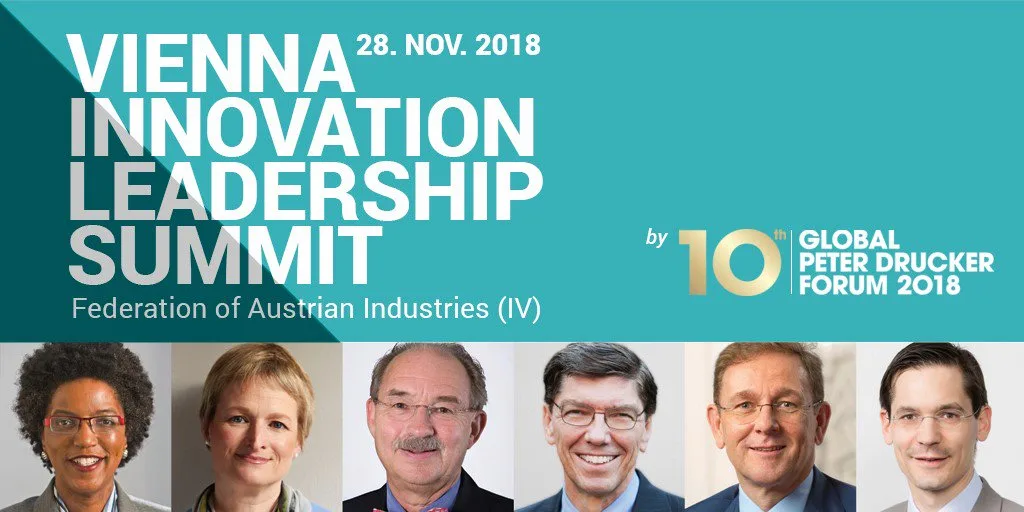
    Global Peter Drucker Forum: Innovation Leadership Summit

    Picture
    The third stopover of my trip across Western Europe sees me in the beautiful city of Vienna, for the Global Peter Drucker Forum on 28–29 November. This year, the organisers expanded the programme to include a half-day 'innovation leadership summit' (summarised here) and an afternoon of round table and workshop sessions (more on that later).
    About 170 people gathered at the House of Industry, the headquarters of the Federation of Austrian Industries. The beautiful building was inaugurated by Franz Josef in 1911. The format  of the summit was straightforward: three panel-based sessions—discussions that explored innovation from three perspectives. A lot of thought-provoking material was shared. Here's a few of the insights that stood out (for me, anyway):
    A new innovation landscape
    Julie Teigland, Regional Managing Partner of EY Germany, Switzerland and Austria, chaired the first session. Panel members included Curtis Carlson, Founder and CEO of The Practice of Innovation and former CEO of SRI (who developed SIRI); Rita McGrath, Professional at Columbia Business School; and Georg Kopetz, Co-founder of Executive Board TTTech.
    Insights: McGrath kicked off the discussion by asserted that strategy and innovation "go together". We can't talk. about one without also discussing the other. 'Digital' is a game-changer because it undermines many of the obstacles (barriers to entry) of market-based contracting. Barriers to entry and the ability to scale are undermined. With it, a fundamental shift, from firms to markets, is underway.
    Carlson picked up the discussion by asking whether entrepreneurship is the 'right' thing to be focused on. He noted that, since 1987, fewer than 20 per cent of startups have created any value at all. The problem is that entrepreneurs are pursuing two vital activities in the wrong order. The creation of value needs to precede entrepreneurship. When entrepreneurs focus first on value, then magic can, and often does, happen.
    Kopetz entered the discussion by asserting the 'born digital' means 'born global'. There is no option. If you are operating in the electronic world, sovereign borders are meaningless. However, scaling is tough; and collaboration is necessary. Interestingly, nearly all major innovations and step changes occur outside major companies, despite such companies being better resourced the most start-ups.
    Making innovation work
    Denise Kenyon-Rouvinez, Director of the IMD Global Family Business Center, chaired the second session. Panel members included Betsey Zeigler, CEO of 1871; Alex Osterwalder, Entrepreneur and Business Model Innovator; Yoshi Takashige, VP Marketing Strategy and Vision at Fujitsu; and Hal Gregersen, Executive Director of the MIT Leadership Center and MIT Sloan School of Management.
    Insights: ​Having set the scene in the first session, the purpose of this session was to 'talk dirty'. Innovation is most likely to occur when people crash into each other. When the do, they tell stories, share ideas and commit to dreams. The natural; outflow is an intelligent human-centric society; one that places people at the centre, not processes or things.
    Gregersen added that the 'digital economy' emerged, in effect, from the convergence of globalisation, innovation and transformation. Being new, all of these elements operate on the edge of uncertainty. Success (in terms of establishing capability) is dependent on leaders being happy to be wrong, create uncomfortable spaces and remain quiet as they listen carefully for weak signals. Yet somewhat paradoxically, isolation (quiet) is the enemy of innovation; and discovery depends on contact.
    CEO perspectives
    Linda Hill, Professor of Business Administration at Harvard Business School chaired the third session just before lunch. Panel members included Vineet Nayar, CEO of Sampark Foundation; Peter Oswald, CEO of Mondi Group; Gilbert Rühl, CEO of Klöckner & Co SE; and Helmut Reisinger, CEO of Orange Business Services.
    Insights:​ The purpose of this session was to listen to established chief executives as they offered coal-face insights about innovation, leadership and 'getting things done' in an increasing volatile world. A natural curiosity, combined with a well-developed propensity to both ask questions and listen carefully to answers, is crucial if the protagonistics are to be effective leaders.
    Standing back, this Summit created space for interactions between delegates and with the speaker panel. As such it provided a wonderful 'on ramp' to the main event, the Global Peter Drucker Forum, but more on that soon.