• Published on

    The wildcard in family-controlled firms: undue influence

    Picture
    The limited liability company is a great construct; an efficient vehicle for commerce, through which to pursue an overall aim (purpose) and to distribute wealth (however defined) over an extended period. What's more, mixed levels of ownership are possible; greater economies of scale are attainable (beyond what a sole trader or entrepreneur could typically achieve); and, importantly for absentee shareholders, liability is limited to the extent of the capital invested. 
    Though they offer many benefits, the limited liability company is not without flaws—it is a social construction after all, and a complex dynamic one at that. The motivations, priorities and interests of various interested parties (shareholders, directors, managers and staff, amongst others) are often different. Contexts change, and egos can get in the way as well. Left unbridled, differences can fester, morale can suffer and, in more extreme cases, the company can be torn apart. Wynyard Group and Carillion are two recent example but there are many others. Family firms are not immune to such challenges. In fact, when the wildcard of family dynamics is added to the mix, family firms are actually more, not less, susceptible. Though not always visible, the spectre of undue influence often lurks as a contributing factor, as the following discussion reveals:
    Failure to differentiate the roles of 'shareholder' and 'director': Let's start with some definitions. A shareholder is a person or entity that owns shares in a company. Ownership of shares affords certain rights, such as, selecting directors, receiving dividends and participating in major decisions. But those rights do not extend to running the business. That is the responsibility of managers, a delegation via the directors. In family firms, the roles of shareholder, director and manager can become blurred, especially when an influential family member holds multiple roles.
    The most common expression of undue influence that I've seen over the years relates to decision-making at the board table: a director with a significant shareholding 'expects' to influence significant decisions in their favour because they own a large parcel of shares. The important distinction that is lost (sometimes it is 'conveniently' neglected) in such situations is that the board meeting is not a proxy for a shareholder meeting. Shareholders and directors vote differently. Shareholder voting is conducted on a 'one vote per share' basis, whereas each director has a single vote at the board table. Regardless of whether directors hold shares or not, every director has an equal say.
    If situations like this arise, they need to be nipped in the bud. If they are not, board meetings become a farce; the other directors puppets. This is far from acceptable, especially when the duty of acting in the best interests of the company (not any particular shareholder) is factored in. In most cases that I have observed, attempts to exert such [undue] influence tends to stem from ignorance and a desire to do what they think is fair, not malice. Usually, a quiet discussion with the director concerned is often all that is needed to resolve the matter. Another family member or an outsider (an independent director if there is one, or some other trusted advisor) are useful candidates for this task.
    Treating the company as little more than a personal bank account:​ If I had a dollar for each time I've seen this in family firms... Recently, while observing a board meeting as part of an advisory engagement, a director asked, "Why are we always so short of cash when we are supposedly highly profitable?". The discussion that followed was both enlightening and disturbing—and, sadly, it was not the first time that I'd heard it play out. One director with banking access had been buying personal items with company funds and, from time to time, had been taking 'petty cash' for personal use. He saw nothing wrong with this because "it's my firm anyway".
    If a director or shareholder uses company funds to acquire personal items, or uses the company bank account as if it were their own, they are acting in their own interests (whatever those may be). Their actions may put the viability of the company at risk as well. Neither of these motivations is permissible in law. Any shareholder wanting money from the company needs to ask the company, not just take it (that's theft!). Valid payment options include shareholder salaries (payment for effort/services rendered), dividends (a share of the profits), donations (but these may be taxable) and director's fees. ​The company may also agree to lend money to the shareholder. Regardless of the motivation or the payment option, a written policy which outlines the rules and conditions pertaining to payments to shareholders can help mitigate misunderstandings.
    Employment of family members and related matters: ​Another expression of undue influence is the situation in which a family member 'pulls rank' to secure employment for themselves or another family member. While any family member may nominate anyone else (including other family members), to foist a particular person onto a manager is completely unreasonable. If managers are to be held accountable for performance, they  need to be free to make reasonable employment decisions themselves, in accordance with employment policy. In family firms, it is a good idea to add a section entitled 'Employment of family members' in the policy, to set out the rules the be applied whenever a family member is being considered for a role. 
    While none of these examples of undue influence is unique to family firms, they are usually more visible (and often more destructive) in family firms. Once discovered, they need to be resolved. If not, family relationships can become strained, even to the point of breaking down. Actions that families might consider taking to prevent or at least mitigate the types of problems summarised here include:
    • A set of written policies, that specify various operating boundaries. Employment of family members and payments to family members are two areas in which policies can be especially beneficial.
    • A shareholder's agreement, which specifies how family members will interact with the company in matters relating to the company including acquiring and disposing of shares, employment, major decisions, dividends and voting rights, amongst others.
    • A functional board of directors (and associated governance framework), to set strategy, approve policy and oversee the operation of the firm (in accordance with the approved strategy and policy).
    • A communications framework, which outlines both the frequency and form of communications between the company and shareholders (and other stakeholders including non-shareholding family members).
    Boards wanting to explore matters mentioned here should get in touch directly to arrange a private briefing.
    This article is the second of three on the topic, 'Governance in family-controlled companies'. The first explored some items that are currently front-of-mind for many directors and shareholders of family-controlled firms. The third article, which will present recommendations to improve board effectiveness, will follow in late 2018.

  • Published on

    The board of directors: a family business perspective

    Picture
    From entering the business lexicon less than quarter of a century ago, 'corporate governance' has come a long way. Prior to 2000, the term was rarely mentioned in business discussions much less amongst the general public. Boards and directors directed the affairs of the firm, and that was it. Now the term is ubiquitous. Its usage has changed over time as well: from describing the functioning of the board of directors, the term is now used to describe all manner of corporate activity, much of which bears little if any semblance to the board or governance at all.
    The proclivity to use the terms 'governance' and 'corporate governance' has trickled down from big business to now infect family-controlled firms. Well-intentioned but inappropriate usage—notably advisers (typically, but only accounting firms) making assertions such as "You need governance"—has had unintended consequences. When attention is diverted away from running and overseeing the business to "implement governance" (whatever that means or entails) without justification, costs have a tendency to go up not down, and a whole new set of problems including confusion, consternation and strained relationships often follow.
    Over the last two decades, I've had the privilege of working with the directors and shareholders of hundreds of family-controlled firms, ranging from 'mom and pop' operations to much larger (multi-hundred million dollar) enterprises. Awareness of (and interest in) governance has become palpable, more so if a director has just read an article or heard a talk from an expert purporting a 'best practice' governance solution. Yet directors know that a single answer rarely works everywhere. Context is crucial in business; every situation is, to a greater or lesser extent, unique. As a consequence, the universal application of a formulaic 'best practice' solution does not make much sense. Recognition of this gives rise to many questions, especially from the shareholders and directors of family-controlled firms. Here is a selection of the more frequently asked ones:
    • Do we actually need a board?  If the business is a company, yes. But remember that a board is, straightforwardly, a term used to describe the directors collectively.
    • Do we need governance? This question often masks another question: whether the 'practices' of governance are always required. The answer to both is 'it depends'. If all of the directors are also managers and shareholders, and all of the shareholding is held by serving directors (as is generally the case in small firms), then the practice of meeting regularly as a board to set strategy and policy, hold management to account and provide an account to shareholders is redundant. However, once a modicum of separation between shareholding, directors and managers starts to emerge (i.e., some shareholders are no longer directors, or vice versa; or some directors do not work in the business), then its makes sense to embrace board meetings and associated reporting. Another trigger for establishing normative governance practices is the appointment of an independent director.
    • We've been told to appoint at least one independent director, because that is best practice. Is it? Not necessarily. Independence has long been held out as a proxy for better decision-making. For example, most stock markets specify a minimum number of independent directors if the company is to be listed. Yet no categorical link between independence and decision quality, much less better firm performance has been found. However, that is not to say that shareholders should avoid appointing an independent director. If the board lacks some important expertise or needs an extra perspective, an external appointment can be incredibly helpful to the quality of board deliberations and decisions.
    • Our accountant has offered to be a director. Should we take up the offer? Probably not, because to do so introduces an inherent conflict of interest. The accountant (or, accounting firm) is a servant of management, charged with providing specialist financial and reporting expertise. If he/she also sits on the board, then they are, in effect, monitoring themselves, 'marking their own work'', so to speak. Boards that lack financial acumen (for example) should seek such expertise from an external director; there are plenty of highly-skilled people with the requisite technical and governance expertise available. 
    • We are not sure that our 'independent' director is acting in our best interests. What options do we have? First, every director has a duty to act in the best interests of the company, not the shareholder or any other party. If a director, regardless of whether they hold shares or not, demonstrates biases for a particular stakeholder or appears to lack independent judgement, the matter should be raised with them. If the behaviour continues, consider releasing them. 
    • How often should the board meet? There is no hard and fast rule, other than the legal requirement for the board to meet at least once per year. Practically speaking however, the recommended frequency is "as often as is needed to fulfil duties". The boards of family-controlled businesses domiciled in the UK, New Zealand and Australia tend to meet once per month or once every two months, whereas the boards of US-based firms typically meet quarterly. 
    • We've been told to create an advisory board. Is this a good idea?No
    These questions are typical of those that have been front-of-mind for the directors and shareholders of the family-controlled firms that I've interacted with in recent months. Curiously, questions about social interaction, boardroom behaviour and family dynamics (the human dimensions) are asked far less often. This, despite the board being a collective of directors—people—who are required to work together in the best interests of the firm. Boards that resolve these so-called 'soft' questions tend to be more effective. But more on that next time.
    This article is the first of three on the topic of 'Governance in family-controlled companies'. The second, which explores undue influence and the impact of family dynamic is available here. A final instalment, which will make suggestions to improve board effectiveness, will follow in late 2018. Boards wanting to discuss matters raised in these articles should get in touch directly to arrange a private briefing.

  • Published on

    Embracing a brave new world

    Picture
    Netflix has been in the news a bit lately, aided no doubt by public interest in its rapidly increasing 'reach', meteoric rise in its stock price and membership of a new generation of behemoth—the FAANG club. Now, the actions of the board of directors have seen Netflix become even more newsworthy, principally a consequence of this article published in Harvard Business Review. ​The board of directors operates quite differently from many others and, indeed, conventional wisdom. Could this be a contributing factor in Netflix's success?
    Conventional wisdom, supported by both agency theory and 'best practice' recommendations of directors' institutes (in the western world, at least), suggests that 'distance' (a clear separation between the board and management) is important if boards are to objective in decision-making. The listing rules of most stock exchanges specify that at least two directors must satisfy established independence criteria at all times. Independence is de rigeuer, even though no consistent link between director independence and firm performance has ever been identified!
    Back to Netflix. Two researchers, David Larcker and Brian Tayan of Stanford University, gained permission to investigate how the Netflix board keeps up to date and informed, a prerequisite of effective decisions. They found that the Netflix board does not embrace conventional wisdom. The full research report, from which the HBR article was derived, is available on the SSRN website.
    The Netflix approach is based on proximity not distance. The approach has been adopted to help directors resolve a fatal flaw present in most boards: Five out of every six directors do not have a comprehensive understanding of the business being governed. Specific measures in place at Netflix include:
    • Governance by walking about: Directors are actively encouraged to view the company "in the wild". This includes attending executive meetings (albeit in silence, as an observer), and the freedom to wander around the office, chatting and asking questions (but not offering guidance nor providing instruction).
    • Pragmatic reports: Memos are both brief and insightful. They must be less than 30 pages long and, in addition to providing links to detailed information, they provide open access to all relevant data on the company's systems.
    The combined effect of these measures has been profound: directors are much more well-informed than they would have otherwise been. The handicaps of lack of transparency or hard-to-assess information are removed. The perennial problem of information asymmetry that besets boards globally has been, it seems, solved—in Netflix's case at least.
    Standing back a little from the Netflix case, several learnings are available for boards, as follows:
    • Proximity trumps distance: If boards are to govern effectively, directors need to  be adequately knowledgeable of the business and the wider operating context including emerging trends and technologies. Information needs to be elicited from multiple sources. Barton and Wiseman's report highlights this. But the Netflix case goes further; boards need to get a lot closer to managers, to establish and maintain a strong relationship founded on trust and expedite the flow of high quality and relevant information. My own research (here and here) provides supporting evidence. But don't be deluded, the recommendation comes with a warning: high levels of maturity are  required, to discern the appropriate proximity, and to minimise the chance of directors becoming 'captured' by managers.
    • Real knowledge takes time to acquire: Conventional wisdom, supported by recommendations emanating from many consultants and directors' institutes, suggests that directors should allocate two hours in preparation for every one hour of board meeting time. Yet the evidence suggests that this is probably insufficient. Real, relevant knowledge (read: deep understanding, wisdom even) takes time to acquire. The Netflix case adds weight to this argument. And knowledge needs to extend beyond the business and ecosystem, to include emerging trends and technologies, and theoretical perspectives as well. Together, this demands that directors invest considerably more time than the two-to-one rule-of-thumb if they are to be well-informed and make meaningful contributions. When asked, I propose five hours for every one hour of board meeting time, and double for the Chair. Established directors, including those who happily describe themselves as 'professional directors' often baulk at this, saying they don't have time. This is not an adequate defence. 
    Many boards and directors do take their role and responsibility very seriously. But, sadly, a significant number do not display appropriate levels of commitment. If boards are to become more consistently committed to the cause—the pursuit of high firm performance and longer-term value creation—they could do a lot worse than take a page from the Netflix playbook and the advice shared here. If you want to learn more, including scheduling a discrete briefing to explore how a mechanism-based understanding of corporate governance can contribute to improved board effectiveness, please get in touch.
  • Published on

    Towards great: learning from recent #corpgov failures

    Picture
    The chattering class has been very active of late, responding vociferously as case after case of corporate failure and misstep has come to light.  Carillion plc and the venerable Institute of Directors (both UK), AMP (Australia) and Fletcher Building (New Zealand) are the latest examples that have resulted in consternation and angst.
    That seemingly strong and enduring organisations continue fail (or have significant missteps) on a reasonably regular basis is a cause for much concern; the societal and economic consequences are not insignificant. Many commentators (primarily, but by no means exclusively, the media) have responded by berating company leaders (the board and management specifically), placing 'blame' squarely at their feet. This is a reasonable: ultimate responsibility for firm performance lies with the board after all. 
    Calls for tighter regulation and stiffer codes abound. Yet the geographical spread of these failures implies that local statutes probably aren't a significant contributory factor. The responses of the boards have been telling: some have circled the wagons (a demonstration of hubris?), others have cast out the chairman or chief executive (diverting blame elsewhere?), and some individuals have simply walked away.
    At this point, it would be easy to join the chattering class; to stand on the margins and berate all and sundry. But let's not go there. Instead, let's try to identify repeated patterns of activity may have contributed to the situations, in search of learnings. Several things that stand out:
    The role of the auditor:​ Most if not all of the firms mentioned above were attested by their respective auditors to have been operating satisfactorily. Yet they were not, clearly. Whether the auditors were in cahoots with management or the board, failing to discharge their duty to provide an accurate assessment or, even, inept remains to be seen. Regardless, something is amiss. To date, few commentators have called out the audit profession as being an accessory (Nigel Kendall is a notable exception). 
    Business knowledge: Remarkably few of the directors of the companies identified here seem to understand the business of the business they were governing. Many directors are recruited for their technical skills (notably, legal and accounting expertise), but few if any have any significant experience in the sector that the business operates in—research by McKinsey shows that one director in six possess such knowledge. How any board can make informed decisions when most of its directors do not understand the wider operating context well is perplexing—it would struggle to detect important though weak signals, much less understand the implications of them.
    Board involvement in strategy: ​ The boards of all of the firms identified here relied heavily on management to prepare strategy. Directors backed themselves to ask questions in response to proposals when they were presented. While most directors are capable and well-intentioned, such a heavy reliance on management is unwise. If the board is not involved in the development of strategy in some way, as many researchers and commentators recommend, the likelihood of the board understanding what it is being asked to approve and subsequently providing adequate steerage and guidance is low.
    If boards are to learn from the failure cases noted here (amongst others), the first and, frankly, most pressing priority is to mitigate apparent weaknesses and focus on what matters. My research suggests that high levels of firm performance are contingent on several factors including:
    • Ownership:​ The board is the apex decision-making authority in every company, meaning the board is responsible making the very biggest decisions. Consequently, if the board expects to have any influence over performance at all it needs to take responsibility—directly—for the big calls.
    • Purpose: If performance is to be achieved and sustained over time, all contributors need to understand their role and why it is important. Sadly, many directors bypass the 'why': they do not understand (and, therefore, cannot describe) why the company exists (activity trumps reason, it seems). Even if they can, they often do not hold a single view. Agreement on why the company exists—its purpose—is crucial; it provides the touchstone against which all other decisions can be made and performance assessed.
    • Strategy: Purpose alone is insufficient. Strategy is the course of action required to achieve the agreed purpose. While no one model (of strategy development) fits all situations, the board should roll its sleeves up and get involved in the formulation of strategy, together with management.
    • Effective board practice: This is the biggie. Check this link, it paints the full picture.
    Some commentators have suggested that the success of the board is entirely a matter of luck. I disagree. While outcomes are not guaranteed, my doctoral research and experience shows that boards can exert influence beyond the boardroom, including on firm performance, but only if they focus on 'the right things'. Unless and until boards start taking their responsibility for the performance for the company seriously the hope of much changing remains, sadly, dim.
  • Published on

    Living in interesting times

    Picture
    I arrived in London yesterday, ahead of what promises to be an interesting week. Formal commitments include delivery of the CBiS seminar in Coventry; planning for a future board research initiative; and a miscellany of meetings in which corporate governance, effective board practice and this recent article will be discussed. Two recent events, Carillion's fall from grace, and the now-public machinations at the Institute of Directors (which have resulted in the resignations of the chairman, Lady Barbara Judge, and deputy, Ken Olisa), are likely to invigorate discussions. Already, I've been asked to comment publicly on the Institute's troubles.
    The problems at the Institute of Directors in particular are troubling. They strike at the heart of what many say is wrong with boards and corporate governance; the Institute becoming a laughing stock in some quarters. The Institute's effectiveness as a professional body is contingent on it being the epitome of good board practice. The IoD chief executive, Stephen Martin, said on Friday that the resignations are a victory for good governance. They are not. Rather, they are an indictment of poor governance.
    Sadly, the Carillion and Institute of Directors cases are not unique. They are but two of many examples of poor practice that reinforce perceptions that boards are not effective. The ancient Chinese saying (more correctly, curse) seems especially applicable just now. 
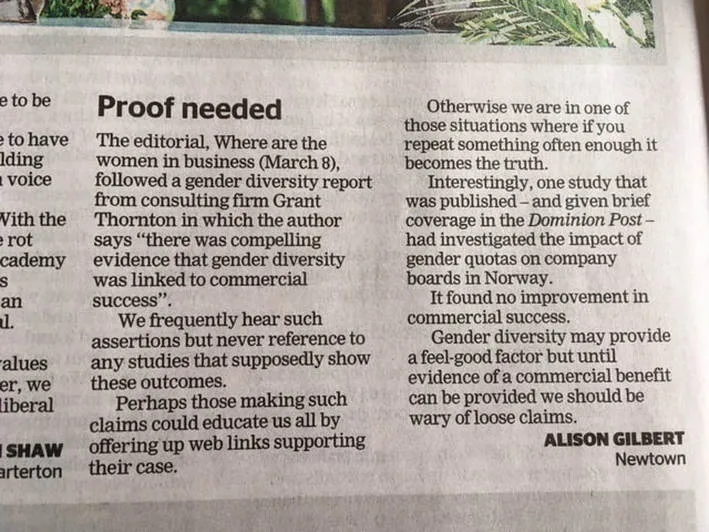
    If trust and confidence is to be restored, the power games, hubris and ineptitude apparent in some boardrooms need to be rectified. Flawed understandings of what corporate governance is and how it should be practiced also need to be corrected, especially the misguided belief that any particular board structure or composition is a reliable predictor of firm performance (the following letter highlights the conventional wisdom problem).
    Picture

    Source: Letters to the Editor, Dominion Post, 10 March 2018

    The scene is set for some fascinating discussions this week. I'll let you know how I get on.
  • Published on

    Brevity and clarity are necessary, but are they sufficient?

    Picture
    GE, a company with a strong history of success including a reputation of being the world's best-run firm, has hit turbulent times. Profit forecasts have dropped by half in the past two years, with the inevitable knock-on effect on the share price. It seems that the size and complexity of the business, and probably some poor decisions in the past, is proving to be a challenge for the board and its ability to fulfil its duties.
    Consider the following indicators, reported in an article published in The Economist:
    • There is no consistent measure of performance
    • Some divisions use flattering definitions of key words, notably 'profit'
    • Performance is not assessed on a geographical basis
    • Little attention is given to total capital employed
    • Sustainability of debt levels are hard to determine
    • Strength of GE's financial arm is unclear
    • Risks to GE shareholders are difficult to calibrate
    • Accuracy of balance sheet is unknown
    How the GE board can make meaningful decisions given these indicators, much less lead the firm intentionally into the future, is hard to imagine. Sadly, this is not a unique case. Wells FargoWynyard Group and, most recently, Carillion are examples of companies that have suffered through poor reporting, weak engagement and the seeming inability of the board to make courageous decisions.
    Fortunately, boards finding themselves in a similar situation are not without options. If they are prepared to retake control of the firm they govern (which will probably require some decisive actions; brevity and clarity of reporting being necessary but insufficient) and take an active interest in its strategic future, then the likelihood of actually making a difference is greatly enhanced.