• Published on

    What are the keys to effective leadership?

    Picture
    As a devotee of life-long learning and a student of history, I keep an eye out for ideas and examples to share with boards and directors—in the hope that some might prove useful to help boards lead more effectively, from the boardroom. Amongst the news feeds and magazines that cross my desk (actually, computer screen), this journal often contains thought provoking articles. Recently, I was looking through some older issues and stumbled across this item, which explores effective leadership. The author offers seven 'keys' to effective leadership, as follows (I've taken the liberty of attaching a comment to each—a consideration for boards and directors):
    • Provide the why: Why does your firm exist? People get behind causes, not things. Simon Sinek makes the point better than anyone else I know. Purpose first, then strategy
    • Embrace variety and listen: Cookie cutter approaches to strategy rarely work. When your board and management team goes off-site to form strategy (yes, together), are customers, suppliers and industry experts invited into the tent, to explain what's important to them and their success? In my experience both as a director and a facilitator, the value these people provide is priceless.
    • Influence: Boards do not operate companies directly, that role is delegated to the chief executive. The only way boards can get things done is through the actions of others (who need to agree to act). Effective working relationships are crucial, and everything needs to be tied back to the agreed purpose and strategy of the enterprise.
    • Read, think, write: How busy are you as a director? Companies and the markets they operate in are complex and fluid. If directors are to contribute effectively and boards are to make good decisions, they need understand the business of the business. Getting up to speed and staying there takes time. 
    • Lead education and change: It all starts at the top. Bob Garratt made this point deftly about twenty-five years ago. His book should be on every director's reading list. Another suggestion: directors need to commit to continuing professional development (ideally, through an accredited provider or local directors' institute ). 
    • Understand failure and take risk: I re-read this article when preparing to facilitate purpose and strategy development workshops, or to complete a board effectiveness assessment: "True strategy is about placing bets and making hard choices. The objective is not to eliminate risk but to increase the odds of success." Enough said.
    • Understand surprise and chaos: As much as directors and chief executives like to think they can, they cannot predict the future. If Covid-19 is to teach us anything, it is that. Companies that have endured over generations get this. Learn from them.
    Comments?

  • Published on

    Is corporate governance a framework, or something to be practiced?

    Picture
    English can be a confusing language. The same word can have different meanings in different contexts (by 'bear', do you mean the animal, taking up arms, or putting up with someone; and is a 'ruler' a measuring instrument or a monarch?). Meaning and usage matters; more so because it is not static. Language evolves, whether by design or in response to an evolutionary development. Some refinements improve our ability to communicate effectively, others to defy logic.
    The understanding and usage of the terms 'governance' and 'corporate governance' are topical cases in point. While the term 'governance' is derived from the Greek root kybernetes meaning to steer, to guide, to pilot (typically a ship), a plethora of usages have emerged over time. Today, many different usages have become commonplace. These include the oversight of managers and what they do; the activities of the board; and the framework within which shareholders exert control and boards operate.  It is also used to describe the board itself ("we'll need to get the governance to make that decision"). ​The term has also been applied in an even broader context, the business ecosystem (i.e., system of governance). The most extreme example I have heard is, "Governance can mean almost anything, it is completely idiosyncratic; different for every organisation".
    Things are made worse when two related but distinct concepts are conflated. Consider the definition of corporate governance and the practice of corporate governance. The former is relatively stable. Eells (1960) coined the term, to describe the structure and functioning of the corporate polity (the board). Later, Sir Adrian Cadbury (1992) added that 'corporate governance' is "the means by which companies are directed and controlled". The fundamental principle here is that corporate governance is a descriptor—the activity of the board. Compare that with the practice of corporate governance--how a board enacts corporate governance when it is in session. The means by which boards consider information and make decisions can and must be fluid depending on the situation at the time.
    The wider context merits a brief comment—the rules under which companies and their boards operate (statutes, codes and regulations), and the consequential impact of the board's decisions. These are necessary, because they define the wider environment; what is allowed and what is not. In recent years, ​I've heard many people include regulations and codes within their understanding of corporate governance. Similarly with the consequential impact of the board's decisions beyond the boardroom. Are either of these corporate governance?
    If you'll allow a sporting analogy, it's important to distinguish between the rules of the game, the game as played, and the final score. All are necessary, but only one is the game. To embrace an all-encompassing understanding suggests that corporate governance is ubiquitous, extending across the entirety of the company's operations and the functions of management, leadership and operations—not to mention the wider system of rules of regulations. This, I am convinced, takes us close to the root of the confusion that besets many directors. Every time I'm asked, I invoke Eells and Cadbury. A framework of laws and regulations is necessary, for these define the operating boundaries. But they are not corporate governance. In asserting that corporate governance is the means by which companies are directed and controlled, Cadbury was saying that corporate governance is the descriptor for the work of the board. And work, straightforwardly, is something to be practiced. Let's not lose sight of these distinctions. The continued 'sloppy' use of language serves only one purpose: to obfuscate. 
  • Published on

    Observations from interactions with 520 directors

    Picture
    Today marks the beginning of a lull following a busy programme of international and domestic commitments since early February. Over a 110-day period, I have spent time in Australia (four times), England (twice), the US (twice), Germany (twice), Ireland, Sweden and Lithuania—and at home in New Zealand; interacting with over 520 directors, chairs and chief executives from 19 countries. Formal and informal discussions at conferences, seminars, masterclass sessions, education workshops, dinners, advisory engagements and board meetings were instructive to understanding what's currently top-of-mind for boards around the world. The following notes are a brief summation of my observations. I hope you find them useful.
    Diversity and inclusion: These topics continue to dominate governance discussions in many countries. But, and noticeably, the discourse has matured somewhat over the last six months. The frequency with which the rather blunt (and often politically-motivated) instruments of gender and quota is mentioned is starting to subside, as directors and nomination committees start to realise the importance of diverse perspectives and options to inform strategic thinking and strategising. Long may this continue, as board effectiveness is dependent on what boards do, not what they look like.
    Big data and AI: What a hot topic! Globally, boards are being encouraged by, inter alia, futurists, academics and consultants to get on board (if you'll excuse the pun) with the promise that developments in this area will change the face of decision-making and improve corporate governance. Some assert that these developments will obviate the need for board of directors in just a few years. The directors I spoke with agree that these tools can help managers make sense of complex data to produce information, even knowledge. But these same directors have significant reservations when it comes to strategic decision-making. Automated systems are poor substitutes for humans when it comes to making sense of (even recognising) contextual nuances, non-verbal cues and other subtleties. Unless and until this changes, the likelihood that boards will continue to be comprised of real people engaged in meaningful discussion remains high.
    Corporate governance codes: The number of corporate governance codes introduced in markets has been steadily rising over the last decade. Most western nations, and a growing number of Asian and developing nations, have implemented codes to supplement statutory arrangements. Many directors and institutions around the world continue to look to proclamations that the UK is the vanguard when it comes to corporate governance thinking and related guidance: the recently-updated UK corporate governance and stewardship codes are held up as evidence of good practice. While the quality of board work in the UK has improved over the last decade, a strong compliance focus continues the pervade director thinking—across the business community in the UK and beyond. The reason is stark: codes are little more than rulebooks. Further, rules don't drive performance, they define boundaries. The more time boards spend either complying with the rules or finding ways to get around them, the less time is left for what actually matters, company performance. In many discussions over the past few months, I've pointed people to the ground-breaking work of contributors such as Bob Tricker, Sir Adrian Cadbury and Bob Garratt. These doyens provided much-needed impetus to help boards understand their responsibility for company performance. The emergent opportunity for regulators and directors' institutions is to consider alternative responses to ineptitude and malfeasance: instead of creating more rules all the time, why not hold boards to account to the existing statutes, most of which seem to be eminently suitable?
    Best practice: Many individual directors (and boards collectively) are starting to move beyond 'best practice' as an aspirational goal. Further, directors and boards are demanding to hear educators and thinkers who are also practicing directors, not trainers delivering off-the-shelf courses. Context is everything. The evidence? When a director asks to explore the difference between theory and practice you know something in his prior experience has missed the mark. Practising directors know that the board is a complex and socially-dynamic entity, and that the operational environment is far from static. Directors' institutes, consulting firms and trainers need to stake stock and move beyond definitive 'best practice' claims, lest they be left behind and become monuments to irrelevance. Enough said.
    Governance remains a fashionable topic: ​If I had a dollar every time I've heard 'governance' promoted as a career in recent months, or the term used in discussions (including, sadly, often inappropriately), I would be really well off. But the act of invoking a term during a discussion is no panacea to whatever situation is being discussed. More capable directors are needed to contribute to the effective governance of enterprises, of that I am sure. But the established pattern of selecting directors from a pool of seemingly successful executives—as if a reward—is folly. The findings from a growing number of failure studies from around the world attest to this. The role of a director is quite different from that of a manager or executive. Managers and executives have hierarchical authority and decisions are made by individuals. In contrast, directors lead by influence and decisions are always collective. The challenge for those aspiring to receive a board appointment is to set their managerial mindset aside, to enable a more strategic mindset and commitment to the tenet of collective responsibility to emerge. 
    Picture
    Standing back from these interactions, the board landscape seems troubled. But I remain hopeful. Progress is being made (albeit more slowly than many would wish) and a pattern is slowly emerging. Increasing numbers of directors are acknowledging that the board's primary role is to ensure performance goals are achieved, and that the appropriate motivation for effective boardroom contributions is service, not self. 
    The challenge is to press on. If the number of requests from those wanting to understand what capabilities are needed in directors, what boards need to do before and during board meetings, and desirable behavioural characteristics is any indication, boards are getting more serious about making a difference—and that points to a brighter future. If a tipping point can be reached, arguments centred on board structure and composition that have dominated the discourse can be consigned to their rightful place: history. I look forward to that day.
  • Published on

    Governance: An act of leadership or service, or both?

    Picture
    I have just returned home from a busy but most invigorating week on the East Coast of the United States. The purpose of the trip was two-fold. First, to invest in myself by attending a course; and second, to participate in a series of meetings and discussions to explore matters relating to boards, board effectiveness and how high performance might be achieved.
    The following paragraphs summarise some of my learnings. If you want to know more, please get in touch.
    • The Boards that lead programme at Wharton Business School attracted 49 serving and aspirational directors from ten countries. Professors Michael Useem and Ram Charan and their colleague Dennis Carey led the course incredibly well; a highly interactive exploration of when boards should lead, when they should follow and when, simply, they should get out of the way. The insights and commentaries from both the course leaders and several highly-esteemed company chairs, activists and academics during 'fireside chats' provided great assurance that it is possible to make a difference. A notable theme was that directors cannot afford to be aloof in their role. If [strategic] decisions are to be informed and value is to be created, directors need to ensure they understand the business of the business well—and that takes time. 
    • Many boards in the United States are still caught in the 'compliance' trap—the protection of personal and professional reputation continues to be a more pressing priority for many directors (than the achievement of performance goals). As a consequence, boards are not paying sufficient attention to the strategic future of the companies they govern. While compliance matters are by no means discretionary, boards need to get more courageous with their time allocation, and also demand better reporting, to ensure compliance matters do not dominate the agenda. 
    • Several directors lamented—some at length—that the promotion of ESG in recent years has been counter-productive. Rather than focussing boards on performance dimensions beyond money (the intention), boards have in practice become more concerned about adherence to prescribed 'best practice' frameworks. The directors I spoke with said that 'G' (governance) element in particular is problematic—adding little in terms of focussing boards on the creation of value over the longer-term. The alternative that sits more comfortably with directors I spoke with is SEE (social, environmental, economic).
    • The value of purpose reared its head in several discussions—director awareness of the need for clarity in relation to why the companies they govern exist is increasing. However, more needs to be done, to ensure a collective understanding is achieved. Time spent explicitly sharing thoughts and assumptions, with the intention of reaching agreement on a single, stated purpose is crucial: A North Star for decision-making.
    • The diversity discourse continues to evolve. Thankfully, a growing cohort of directors are realising that physical attributes of boards (number of directors, ethnic or racial heritage, or gender diversity, for example) provide little assurance of board performance let alone company performance. A more sophisticated understanding is crucial. My colleague, James Lockhart, has been vocal on this point for some time.
    • I was asked on several occasions to explain the Strategic Governance Framework, a key finding to emerge from my doctoral research completed in 2016. Both individual directors and boards were fascinated to learn that a framework for better board effectiveness (one informed by actual board observations) is now available for consideration and deployment. This was most gratifying. Boards interested in exploring this framework further should contact me directly for a private discussion.
    • Capping off the week, I spent 36 hours in Washington DC, taking in the sights and sounds of the National Mall, and visiting a couple of two of the Smithsonian Institution's fine museums. Returning to the hotel, the last eighteen words of Lincoln's address at Gettysburg rang in my ears. If companies are to prosper in the future, boards need to embrace a strong sense of purpose and service—to the company and legitimate stakeholders. Anything less is not only selfish, it is unsustainable.
    • Finally, and more personally: to the many unnamed folk I met through the week, thank you for your generosity. If the high level of interest throughout the week is any indication, the likelihood of me spending more time in the United States, to wrestle with both the opportunities and challenges of rethinking board effectiveness, and concentrate on company performance more so than compliance tasks (although such tasks cannot be neglected), is high.
    If you would like to discuss any aspect of this summary, challenge my observations, or explore implications for your board, please get in touch, I'd be delighted to hear from you..
  • Published on

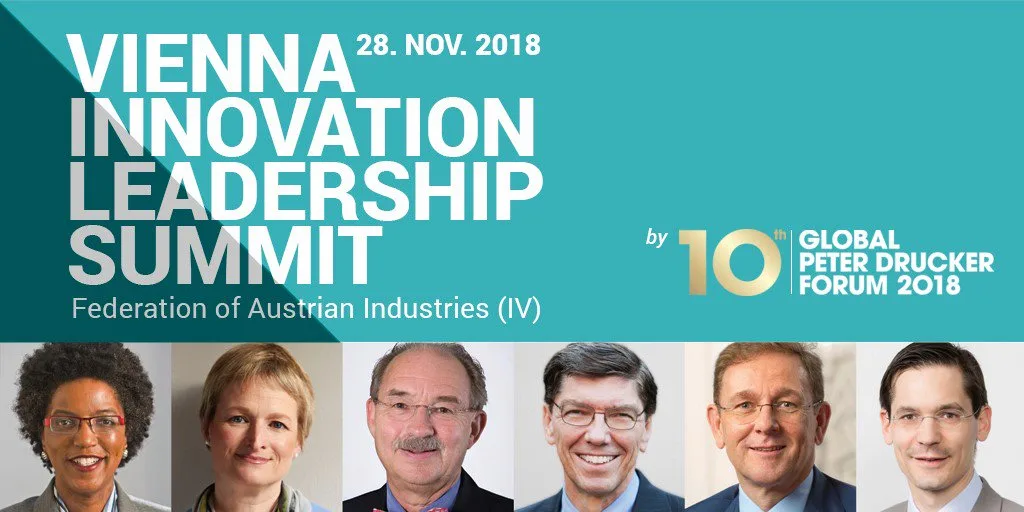
    Global Peter Drucker Forum: Innovation Leadership Summit

    Picture
    The third stopover of my trip across Western Europe sees me in the beautiful city of Vienna, for the Global Peter Drucker Forum on 28–29 November. This year, the organisers expanded the programme to include a half-day 'innovation leadership summit' (summarised here) and an afternoon of round table and workshop sessions (more on that later).
    About 170 people gathered at the House of Industry, the headquarters of the Federation of Austrian Industries. The beautiful building was inaugurated by Franz Josef in 1911. The format  of the summit was straightforward: three panel-based sessions—discussions that explored innovation from three perspectives. A lot of thought-provoking material was shared. Here's a few of the insights that stood out (for me, anyway):
    A new innovation landscape
    Julie Teigland, Regional Managing Partner of EY Germany, Switzerland and Austria, chaired the first session. Panel members included Curtis Carlson, Founder and CEO of The Practice of Innovation and former CEO of SRI (who developed SIRI); Rita McGrath, Professional at Columbia Business School; and Georg Kopetz, Co-founder of Executive Board TTTech.
    Insights: McGrath kicked off the discussion by asserted that strategy and innovation "go together". We can't talk. about one without also discussing the other. 'Digital' is a game-changer because it undermines many of the obstacles (barriers to entry) of market-based contracting. Barriers to entry and the ability to scale are undermined. With it, a fundamental shift, from firms to markets, is underway.
    Carlson picked up the discussion by asking whether entrepreneurship is the 'right' thing to be focused on. He noted that, since 1987, fewer than 20 per cent of startups have created any value at all. The problem is that entrepreneurs are pursuing two vital activities in the wrong order. The creation of value needs to precede entrepreneurship. When entrepreneurs focus first on value, then magic can, and often does, happen.
    Kopetz entered the discussion by asserting the 'born digital' means 'born global'. There is no option. If you are operating in the electronic world, sovereign borders are meaningless. However, scaling is tough; and collaboration is necessary. Interestingly, nearly all major innovations and step changes occur outside major companies, despite such companies being better resourced the most start-ups.
    Making innovation work
    Denise Kenyon-Rouvinez, Director of the IMD Global Family Business Center, chaired the second session. Panel members included Betsey Zeigler, CEO of 1871; Alex Osterwalder, Entrepreneur and Business Model Innovator; Yoshi Takashige, VP Marketing Strategy and Vision at Fujitsu; and Hal Gregersen, Executive Director of the MIT Leadership Center and MIT Sloan School of Management.
    Insights: ​Having set the scene in the first session, the purpose of this session was to 'talk dirty'. Innovation is most likely to occur when people crash into each other. When the do, they tell stories, share ideas and commit to dreams. The natural; outflow is an intelligent human-centric society; one that places people at the centre, not processes or things.
    Gregersen added that the 'digital economy' emerged, in effect, from the convergence of globalisation, innovation and transformation. Being new, all of these elements operate on the edge of uncertainty. Success (in terms of establishing capability) is dependent on leaders being happy to be wrong, create uncomfortable spaces and remain quiet as they listen carefully for weak signals. Yet somewhat paradoxically, isolation (quiet) is the enemy of innovation; and discovery depends on contact.
    CEO perspectives
    Linda Hill, Professor of Business Administration at Harvard Business School chaired the third session just before lunch. Panel members included Vineet Nayar, CEO of Sampark Foundation; Peter Oswald, CEO of Mondi Group; Gilbert Rühl, CEO of Klöckner & Co SE; and Helmut Reisinger, CEO of Orange Business Services.
    Insights:​ The purpose of this session was to listen to established chief executives as they offered coal-face insights about innovation, leadership and 'getting things done' in an increasing volatile world. A natural curiosity, combined with a well-developed propensity to both ask questions and listen carefully to answers, is crucial if the protagonistics are to be effective leaders.
    Standing back, this Summit created space for interactions between delegates and with the speaker panel. As such it provided a wonderful 'on ramp' to the main event, the Global Peter Drucker Forum, but more on that soon.
  • Published on

    Towards a better understanding of corporate governance

    Picture
    Research is a funny thing. On one hand, experience can be greatly helpful: knowing what one is looking for or expecting to see is a boon. On the other, experience can be a hinderance: knowledge often resulting in bias and  preconception, and the very real possibility of missing vital clues. This is one of the great dilemmas for board and governance research.
    Some forty years have now passed since researchers started investigating boards in earnest. That an answer to the question of the role of the board and how they influence firm performance (i.e., what corporate governance is and how it is practiced) remains elusive is an indictment on the research community. Directors and boards need clear and well-founded guidance so they can become effective in role.
    Medical research is conducted by medics; cultural research is conducted by anthropologists; and, engineering research is conducted by engineers, so why is board research typically conducted by academics with little if any business experience? How might a researcher who has never been inside a boardroom hope to recognise the normative practices of board meetings? Or that a subtle interaction between two directors might actually be material to a pending decision?
    That most board and governance researchers have never been in a boardroom or served as a director is alarming. Yes, gaining access to observe boards directly is difficult to achieve. But to restrict board and governance research to counting isolated attributes of boards from outside the boardroom is folly. To be useful, recommendations need to account for the socially-dynamic nature of boards and the behaviours of directors (both of which can only be reliably discerned through direct observation).
    If the question of explaining how boards influence firm performance is to be answered, three things are needed: 
    • Researchers need to get inside boardrooms, to observe boards in action. (What directors actually do can be quite different from what they say they do when interviewed.)
    • Research needs to be conducted through the lens of experience.
    • Recommendations need to be holistic, accounting for both the activities of boards (what they do) and behaviours of directors (individually and collectively). That the structure and composition of boards is, relatively speaking, far less important.