• Published on

    Towards great: learning from recent #corpgov failures

    Picture
    The chattering class has been very active of late, responding vociferously as case after case of corporate failure and misstep has come to light.  Carillion plc and the venerable Institute of Directors (both UK), AMP (Australia) and Fletcher Building (New Zealand) are the latest examples that have resulted in consternation and angst.
    That seemingly strong and enduring organisations continue fail (or have significant missteps) on a reasonably regular basis is a cause for much concern; the societal and economic consequences are not insignificant. Many commentators (primarily, but by no means exclusively, the media) have responded by berating company leaders (the board and management specifically), placing 'blame' squarely at their feet. This is a reasonable: ultimate responsibility for firm performance lies with the board after all. 
    Calls for tighter regulation and stiffer codes abound. Yet the geographical spread of these failures implies that local statutes probably aren't a significant contributory factor. The responses of the boards have been telling: some have circled the wagons (a demonstration of hubris?), others have cast out the chairman or chief executive (diverting blame elsewhere?), and some individuals have simply walked away.
    At this point, it would be easy to join the chattering class; to stand on the margins and berate all and sundry. But let's not go there. Instead, let's try to identify repeated patterns of activity may have contributed to the situations, in search of learnings. Several things that stand out:
    The role of the auditor:​ Most if not all of the firms mentioned above were attested by their respective auditors to have been operating satisfactorily. Yet they were not, clearly. Whether the auditors were in cahoots with management or the board, failing to discharge their duty to provide an accurate assessment or, even, inept remains to be seen. Regardless, something is amiss. To date, few commentators have called out the audit profession as being an accessory (Nigel Kendall is a notable exception). 
    Business knowledge: Remarkably few of the directors of the companies identified here seem to understand the business of the business they were governing. Many directors are recruited for their technical skills (notably, legal and accounting expertise), but few if any have any significant experience in the sector that the business operates in—research by McKinsey shows that one director in six possess such knowledge. How any board can make informed decisions when most of its directors do not understand the wider operating context well is perplexing—it would struggle to detect important though weak signals, much less understand the implications of them.
    Board involvement in strategy: ​ The boards of all of the firms identified here relied heavily on management to prepare strategy. Directors backed themselves to ask questions in response to proposals when they were presented. While most directors are capable and well-intentioned, such a heavy reliance on management is unwise. If the board is not involved in the development of strategy in some way, as many researchers and commentators recommend, the likelihood of the board understanding what it is being asked to approve and subsequently providing adequate steerage and guidance is low.
    If boards are to learn from the failure cases noted here (amongst others), the first and, frankly, most pressing priority is to mitigate apparent weaknesses and focus on what matters. My research suggests that high levels of firm performance are contingent on several factors including:
    • Ownership:​ The board is the apex decision-making authority in every company, meaning the board is responsible making the very biggest decisions. Consequently, if the board expects to have any influence over performance at all it needs to take responsibility—directly—for the big calls.
    • Purpose: If performance is to be achieved and sustained over time, all contributors need to understand their role and why it is important. Sadly, many directors bypass the 'why': they do not understand (and, therefore, cannot describe) why the company exists (activity trumps reason, it seems). Even if they can, they often do not hold a single view. Agreement on why the company exists—its purpose—is crucial; it provides the touchstone against which all other decisions can be made and performance assessed.
    • Strategy: Purpose alone is insufficient. Strategy is the course of action required to achieve the agreed purpose. While no one model (of strategy development) fits all situations, the board should roll its sleeves up and get involved in the formulation of strategy, together with management.
    • Effective board practice: This is the biggie. Check this link, it paints the full picture.
    Some commentators have suggested that the success of the board is entirely a matter of luck. I disagree. While outcomes are not guaranteed, my doctoral research and experience shows that boards can exert influence beyond the boardroom, including on firm performance, but only if they focus on 'the right things'. Unless and until boards start taking their responsibility for the performance for the company seriously the hope of much changing remains, sadly, dim.

  • Published on

    Living in interesting times

    Picture
    I arrived in London yesterday, ahead of what promises to be an interesting week. Formal commitments include delivery of the CBiS seminar in Coventry; planning for a future board research initiative; and a miscellany of meetings in which corporate governance, effective board practice and this recent article will be discussed. Two recent events, Carillion's fall from grace, and the now-public machinations at the Institute of Directors (which have resulted in the resignations of the chairman, Lady Barbara Judge, and deputy, Ken Olisa), are likely to invigorate discussions. Already, I've been asked to comment publicly on the Institute's troubles.
    The problems at the Institute of Directors in particular are troubling. They strike at the heart of what many say is wrong with boards and corporate governance; the Institute becoming a laughing stock in some quarters. The Institute's effectiveness as a professional body is contingent on it being the epitome of good board practice. The IoD chief executive, Stephen Martin, said on Friday that the resignations are a victory for good governance. They are not. Rather, they are an indictment of poor governance.
    Sadly, the Carillion and Institute of Directors cases are not unique. They are but two of many examples of poor practice that reinforce perceptions that boards are not effective. The ancient Chinese saying (more correctly, curse) seems especially applicable just now. 
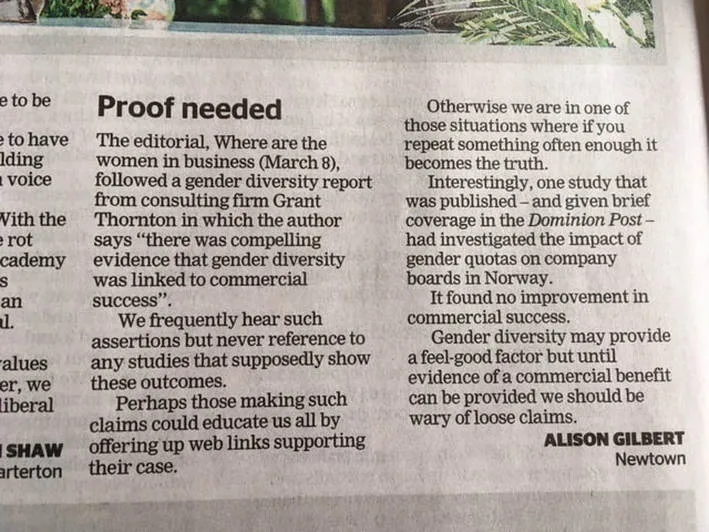
    If trust and confidence is to be restored, the power games, hubris and ineptitude apparent in some boardrooms need to be rectified. Flawed understandings of what corporate governance is and how it should be practiced also need to be corrected, especially the misguided belief that any particular board structure or composition is a reliable predictor of firm performance (the following letter highlights the conventional wisdom problem).
    Picture

    Source: Letters to the Editor, Dominion Post, 10 March 2018

    The scene is set for some fascinating discussions this week. I'll let you know how I get on.
  • Published on

    Brevity and clarity are necessary, but are they sufficient?

    Picture
    GE, a company with a strong history of success including a reputation of being the world's best-run firm, has hit turbulent times. Profit forecasts have dropped by half in the past two years, with the inevitable knock-on effect on the share price. It seems that the size and complexity of the business, and probably some poor decisions in the past, is proving to be a challenge for the board and its ability to fulfil its duties.
    Consider the following indicators, reported in an article published in The Economist:
    • There is no consistent measure of performance
    • Some divisions use flattering definitions of key words, notably 'profit'
    • Performance is not assessed on a geographical basis
    • Little attention is given to total capital employed
    • Sustainability of debt levels are hard to determine
    • Strength of GE's financial arm is unclear
    • Risks to GE shareholders are difficult to calibrate
    • Accuracy of balance sheet is unknown
    How the GE board can make meaningful decisions given these indicators, much less lead the firm intentionally into the future, is hard to imagine. Sadly, this is not a unique case. Wells FargoWynyard Group and, most recently, Carillion are examples of companies that have suffered through poor reporting, weak engagement and the seeming inability of the board to make courageous decisions.
    Fortunately, boards finding themselves in a similar situation are not without options. If they are prepared to retake control of the firm they govern (which will probably require some decisive actions; brevity and clarity of reporting being necessary but insufficient) and take an active interest in its strategic future, then the likelihood of actually making a difference is greatly enhanced.
  • Published on

    Carillion: A messy but not unexpected fall from grace

    Picture
    Another once proud company has just suffered the indignation of failure. Carillion plc, the UK's second-largest facilities management and construction services conglomerate, collapsed on 16 January 2018, after bankers withdrew their support. The fate of hundreds of contracts with public sector agencies, and thousands of jobs were left in the lurch (although some emergency measures have since been put in place).
    Though tragic, Carillion's demise should not have been a surprise to anyone for it did not occur as a result of a single external catastrophic event. Consider these indicators:
    • Chairman Philip Green had previously been censured for breach of trust and maladministration.
    • The company's 2016 annual report showed debts (current plus non-current liabilities) of £2.8B; well above then current assets (£1.7B)
    • The company issued multiple profit warnings in 2017.
    • Executive remuneration clawback provisions were not exercised by the board; rather, the board sought to change the rules.
    • Demonstrations of executive hubris were apparent throughout 2016 and 2017.
    • Questions about the state of the business were asked in the House of Commons in July 2017.
    These indicators, which are not dissimilar to those of other failures (here and here), raise many questions viz. board performance, including questions of accountability; the board's supervision of management (or lack thereof); malfeasance and ineptitude in the boardroom; the efficacy of 'best practice' recommendations; and, the role of auditors. Why the Carillion board failed to act on the indicators listed here (and others not yet public, no doubt) is a matter for due process to uncover. The investigations should not be limited to the boardroom or even executive management. Other questions worthy of consideration include:
    • Did the directors act continuously and completely in accordance with the seven duties specified in the UK Companies Act?
    • What role did 'best practice' corporate governance codes and guidance play, if any?
    • Why did Carillion's customers, including the UK Government, award contracts to a company that had issued multiple profit warnings? Clearly, contracts were awarded either without adequate due diligence, or the findings from due diligence were ignored.
    Hopefully, the investigations now commencing will result in one or more people actually being held to account. Practical guidance to help boards focus on what actually matters (firm performance) is also needed, if boards are to step beyond conventional wisdom (which is clearly not working), and the damage that inevitably occurs when boards are diverted by spurious (and typically discordant) recommendations that appeal to symptoms or populist ideals is to be limited. 
  • Published on

    Blackrock speaks: A new dawn rising?

    Picture
    Larry Fink, co-founder and CEO of influential investment firm Blackrock may have just moved the goalposts. 
    Writing in his annual letter to CEOs, Fink argued that companies think beyond shareholder maximisation, a maxim that has dominated investor thinking since the early 1970s. Companies need to determine their raison d'être, their reason for being, towards which all effort should be aligned. Fink could not have been more clear:
    Without a sense of purpose, no company, either public or private, can achieve its full potential. Ultimately, it will provide subpar returns to the investors who depand on it to finance their retirement, home purchase, or higher education.
    Fink directly associates strategy, board and purpose—and in so doing Blackrock's expectations are spelt out. Simply, boards need to take their responsibility to ensure the long-term performance of the companies they governs much more seriously. Specifically, the board should both determine and agree several things, namely, the reason for the company's existence (its purpose); how the purpose will be achieved (strategy); and, how the progress towards the agreed purpose and strategy will be monitored, verified and reported.
    Together, this is corporate governance.
    To have such an influential firm speak so boldly is wonderful. Mind you, I am rather biased: my research findings and experience working directly with boards over many years now is consistent with Fink's assertions. 
    I commend the letter to all boards. Two rather obvious questions boards may wish to discuss having read it:
    • How might boards to put these above-mentioned assertions into practice? The mechanism-based model of corporate governance that I emerged from my work with high-growth company boards is one option. 
    • Will Fink's missive portend a new dawn for board practice and effective corporate governance? While it's a little too early to know, I certainly hope so. Every bit of pressure brought to bear helps.
  • Published on

    Talk, yes. Progress? I'm less sure.

    Picture
    The annual deluge of articles summarising on the year gone and predicting (promoting?) future priorities is in full swing. Examples include diversity surveys, lists of board priorities and cybersecurity predictions, amongst many others. While these articles make interesting reading, most of the 'predictor' ones should be taken with a grain of salt; the summaries of past practice and current thinking are more helpful. 
    The recently published PwC Annual Corporate Directors Survey (2017 edition) is an example of the former. It offers helpful insights about what US-based directors of large companies currently think about various board and corporate governance matters. The survey results suggest that levels of awareness amongst directors—in relation to gender diversity on boards, working relationships (both between directors and with shareholders), accountability and alignment in particular—are increasing. That the trend line is moving upwards and to the right is good news. However, demonstrable progress, in the form of better business outcomes remains resolutely elusive. This begs a rather awkward question: Why?
    One possibility is that boards are spending precious time on the 'wrong' things. Little if any focus on company performance and strategy is apparent in PwC analysis; the inherent implication being that those surveyed assign responsibility for strategy to management. What's worse, a significant percentage of directors accept what is put in front of them. Critical assessment and vigorous debate is rare.
    The PwC results cast a dark pall over the performance of US-based directors and boards. They suggest that many have lost sight of their statutory obligation, which is that responsibility for company performance lies with them. This assessment is consistent with first-hand observations of boards in action, including my own, which reveal that the dominant focus of many boards is compliance (monitoring historical performance and checking regulatory ​requirements are satisfied). The protection of professional and personal reputation is a very powerful motivation for many directors, more so than ensuring the performance of the company it seems.
    If boards are to become more effective in fulfilling their value-creation mandate, directors need to hold tight to their core responsibility and concentrate on what actually matters—which is to govern in accordance with prescribed duties, and with the long-term purpose and performance of the company to the fore. Necessarily, effective steerage and guidance requires the board to be discerning and committed to the task, using reliable governance practices in pursuit of better outcomes, lest they be diverted by spurious (and often discordant) recommendations that appeal to symptoms or populist ideals. ​How might this be achieved?
    Returning to first principles, one option is to re-conceptualise corporate governance; as a multi-faceted mechanism that is activated by competent, functional boards. The mechanism itself is straightforward: an integrative assembly comprised of strategic management tasks (the board's responsibility to influence the performance of the business places it at the epicentre of strategic decision-making and accountability), relationships (with the executive, shareholders and legitimate stakeholders) and five behavioural characteristics of directors (details). ​The harmonious exercise of the five behavioural characteristics in particular provides a platform for motivated directors to interact well, and for the board to make forward looking, informed, strategically-relevant decisions in a timely manner. 
    A mechanism-based understanding of corporate governance provides an alternative pathway to achieve more effective outcomes from those promoted by conventional wisdom. Specifically, it provides a framework to focus the board's attention on what actually matters; outlining the tasks, interactions and behavioural characteristics that are conducive to effective contributions. Significantly, those aspects of corporate governance orthodoxy that have demonstrably failed to have a beneficial impact are challenged. For example,  board structure and composition recommendations are set to one side, as well as any notional separation between the board and management; an uncomfortable consequence for some.
     If you would like to know more, including how to deploy such a proposal in practice, please get in touch.