• Published on

    The "Learning Board": a good model

    Image description
    Over the last few months, I have re-read quite a few books and articles about models of governance, to see how my doctoral research might build on the suggestions of earlier contributors. Many years ago my father taught me that building on the work of others is smart, but only when the prior work is solid—a stable foundation being crucial to anything that follows.

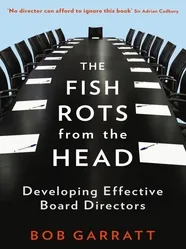
    The "Learning Board", developed and suggested by Bob Garratt nearly twenty years ago, is one of the models that has captured my attention. Garratt published his suggestions in a profoundly titled book The Fish Rots from the Head (3rd edition). Garratt highlights four key tasks of directors within the context of a board's lifecycle:
    • policy formulation and oversight
    • strategic thinking
    • supervising management
    • ensuring accountability.

    He suggests that boards need to balance four intellectual viewpoints simultaneously in order to achieve the four key tasks. When they do, overall effectiveness can be enhanced.
    • An external perspective
    • An internal perspective
    • A short-term perspective
    • A long-term perspective.

    I found this to be very helpful, because it provides a useful context for my work (an investigation of how boards can influence company performance, and the influence of strategic decision-making). Regardless of my efforts though, I commend Garratt's book to aspiring and established directors. It's easy to read, and logical in its approach to the topic.
  • Published on

    CEO quits: But what of the board?

    News emerged today that Peter Campbell, CEO of Brackenridge, an intellectual disability facility, has resigned after five months of investigations and media scrutiny. Tragically, three residents died at the facility last year. There have been a series of complaints relating to safety as well.

    Clearly, there have been operational problems at Brackenridge—the review concluded that management had been distant and unresponsive. Notwithstanding this, I suspect there has been a failure of governance as well. Some important questions that need to be asked are:
    • What has the board been doing in the period leading to the review and since?
    • Did the board know about the "series of complaints" that precipitated the review? If so, why did it not investigate and act? And if not, why not?
    • Why has the chair chosen to defend the CEO, when clearly something was amiss?

    Superficially, the board appears to have been quite passive, to the extent it may have failed to discharge its legal and moral duties effectively. Notwithstanding the remedial plan now in place, the performance of the board needs to be reviewed. Weaknesses need to be identified and changes made, to improve the process of governance and quality of oversight at Brackenridge. The residents and their families deserve as much.
  • Published on

    Retail giants stand-off: what is going on?

    The pages of history are littered with stories of business mergers and acquisitions—some of which successfully achieve the intended aims after consummation, most of which do not. Stories of failed attempts are far less common, especially when the suitor's advances are confidential. However, one failed attempt, of which news broke in the Australian business press over the weekend, merits further comment, particularly because it involves a corporate board that has been accused of a series of bungles of late.

    The headline story concerns a proposal made by department store titan Myer to merge with its competitor David Jones. While the companies are currently trading profitably, pressure is starting to mount on both businesses as new competitors including on-line traders emerge. In October 2013, the Myer board presented a confidential merger proposal, claiming that operational savings of $85M per year would ensue. It was formally rejected by the David Jones board in November. The existence of the proposal, and David Jones' rejection of it, remained confidential—until recently.

    Several questions must be asked as a result of this situation. Did the David Jones board act in the best interests of the company by rejecting the proposal, especially given claims that the situation was a "bloody fiasco" and that the directors were "just trying to protect their position"? Further, why did two David Jones directors buy shares the day after the proposal was received? (The ASIC has determined not to investigate the share transaction, despite it appearing to be, superficially at least, an instance of insider trading.)

    The shareholders of both companies deserve better than this. Both companies have long and proud histories. They are publicly-listed, so the respective boards have a duty of care to keep shareholders (and the market) informed of material developments. Is the David Jones board on borrowed time? Perhaps. The response of shareholders, and the ASIC and ACCC, will be very interesting to observe.
  • Published on

    Sadly, some things are just the same...26 years on

    We live in a fast-paced world, where the only constant seems to be change itself. Messages of the latest and greatest scheme or product or idea bombard our senses daily, imploring us forward, towards "progress". Yet in some quarters change actually occurs very slowly—at glacial speeds even—despite the best intentions of enthusiastic advocates. The corporate boardroom is one such quarter.

    I've been reading Making it Happen, Sir John Harvey-Jones' reflections on leadership. Harvey-Jones, a successful British businessman and industrialist, was perhaps best known for leadership of British firm ICI, culminating in his chairmanship from 1982 to 1987. His insights are timeless, because they continue to be relevant today, 26 years after they were first written. To illustrate the point, here is a selection of salient comments that Harvey-Jones made about boards in 1988:
    • Every member of a board shares a co-equal responsibility for the future of the company. Board members are chosen from amongst the most successful executives ... understandable tendency when you first join a board ... for everyone to assume that you will 'pick it up as you go along'.
    • Boards do not easily set themselves the sort of criteria of success that they would unhesitatingly apply to every other part of the business. Yet unless a board continuously criticises the way it is working ... it is extraordinarily difficult for it to improve its performance.
    • Many boards are quite unclear as to whether they are merely a coordinating committee, or whether their primary responsibility is to the group as a whole.
    • It is important not to go in to a meeting without some clarity in your own mind as to what you are expecting to achieve. If you go because the meeting has been called, with little personal aim, one should ask oneself why one is going at all.
    • Sadly, it is perfectly possible for boards of directors to meet regularly and never discuss any creative business at all. (Harvey-Jones describes this as a "severe abnegation" of both personal and collective responsibility.)

    Do any of these points sound familiar? They should do, because they still characterise the behaviours and attributes of many boards in 2014. Why have boards not embraced the same enthusiasm for change and improvement as has been demonstrated elsewhere in the business community? It's high-time boards took stock.
  • Published on

    On leadership: there is no silver bullet

    The production of silver bullets—panaceas—is a growth industry. New books, all claiming to contain "the" answer, appear in the bookstores almost daily. Sadly, many are far more self-indulgent than helpful to the reader. Yet we lap them up, as we search for ways to be more effective in our professional and personal lives.

    I've become a bit jaundiced by the self-help gravy-train of late, however one of the books from my summer reading list has restored my faith somewhat: History Lessons: what business and management can learn from the great leaders of history. Jonathan Gifford, the author, asserts that there is no one model leadership model or kind of leader that can hope to be effective in all situations. Leadership is a complex phenomenon, and different attributes need to come to the fore in different situations. What a breath of fresh air.

    Gifford identifies eight skills and abilities that represent many of the essential things that any leader should be able to do and—ideally—be good at. He uses great leaders from history (not all of whom will be well known in the Western world) to illustrate his points.
    • Changing the mood
    • Boldness of vision
    • Doing the planning
    • Leading from the front
    • Bringing people with you
    • Making thing happen
    • Taking the offensive
    • Creating opportunities

    The book is easy to read. I commend it as a great investment, to aspiring and established leaders. But be warmed: it will make you think about your current leadership situation.
  • Published on

    How is a researcher different from a consultant?

    Last week, I explored the difference between an advisor and a consultant. The question stimulated a strong response (thank you!), thus this encore. The difference between a researcher and a consultant might seem to be more clear cut. Most of us think of researchers as those boffins that inhabit our learning institutions, whereas consultants are typically suited and found in business environments. Does that make them completely different beasts? Consider this:
    • A researcher defines problems and tries to solve them. So does a consultant.
    • A researcher is a knowledge worker. A consultant is as well.
    • Researchers tend to work alone. Many consultants do as well.

    At this level, the roles appear to be very similar, so are the two terms simply two different names for a very similar activity? Possibly, but I don't think so. A key difference between the roles is emphasis. A consultant is most interested in practice, and good consultants use theory to contribute to their work. In contrast, a researcher is most interested in theory (be it testing theories or developing new ones), and good researchers use data from practice to inform their work (testing theories or developing new theory).

    The roles are different, but they are closely coupled. Given this, why do so many consultants look down their noses at academic researchers (and vice versa)?