• Published on

    On corporate governance: circa 2012 and 2014. What's changed?

    I got a little bit fed-up with writing today, so I decided to read back through Musings, to see how the corporate governance discussion has changed over the last couple of years. Sadly, many of the topics discussed two years ago are still being discussed. Sure, the prevalence of articles about boardroom performance seems to be waxing, and the number of quota-based gender proposals has waned somewhat. That a very similar set of topics is being discussed is a shame. It suggests we are making slow progress. The following muse, originally written in October 2012, illustrates the point fairly well.
    Have you noticed the rising tide of news stories about corporate governance in recent months? While some have highlighted the fraudulent behaviours of some boards and directors, most of the articles have focussed on efforts to improve the quality of governance around the world. 

    Much of the current discussion is focussed on regulation and diversity. Some regulators, including those in Singapore, believe that good regulatory frameworks are key to investor confidence. Many others, including Hong Kong's Exchange HKEx and noted academic Dr Richard Leblanc, are promoting diversity as a means of improving the quality of governance. I applaud these moves, but question whether regulation and diversity are the variables that will reliably deliver the main goal of good governance: better company performance. Regulation, for example, is a compliance tool not a growth tool. While they provide important safeguards for shareholders and stakeholders, they don't help companies to grow.

    My conclusion, having reading hundreds of research reports and peer-reviewed articles, is that behavioural factors, social context and an active involvement in strategic decision-making are far more important than regulatory, structural or composition factors. As such, this is where our efforts to improve governance performance should lie. Ultimately though, the bottom line remains the same. Shareholders—whether professional investors or small business owners—need to know that the board is fulfilling its mandate to maximise company performance. If regulation or diversity helps achieve that, then well and good. If not, then let's move our attention to other factors—quickly—for the good of our economy and society.
  • Published on

    Boards: talking with shareholders is not optional

    I've been on vacation this week, in Perth, Western Australia, with my wife. One of the things that we enjoy while away is to read newspapers that we wouldn't normally see at home, especially the local newspaper. This routine gives us a different perspective on what's going on in the world at large, which serves to broaden our horizons. I try to get my hands on a print copy of the The Australian when in Australia, and often read online versions of the New York Times and The Times as well. 

    The commentary pieces and investigative articles published in major newspapers are often quite thought-provoking—particularly when one is relaxing over a coffee and a muesli breakfast. For example, this article, published in the New York Times today, caught my eye. It highlights the difficulties that investors are having in talking with the boards of the companies they own (or, more correctly, part-own). I was stunned. Why would any director who is serious about their contribution not talk to the people to whom they are responsible and accountable? It smacks of hubris. More importantly, what can be done to remedy this problem?
  • Published on

    Adapt or die: a recipe for change

    One of the big challenges for boards, managers and business leaders in the modern business world concerns change. Many leaders seem to be able to formulate strategy reasonably well. However, far fewer are effective when it comes to making organisational change happen. I was discussing this topic with a colleague this week—the context being the board's role in overseeing change—when they referred me to this short article published on the London Business School – Business Strategy Review website. The article took me about five minutes to read. However, as I pondered the ideas that author Therese Kinal mentions, the significance of her recipe started to dawn on me so I thought I'd share it with you. Kinal suggests that successful organisational change requires six ingredients:
    • A real, pressing and complex business problem
    • A diverse team with the right mix of skills and influence
    • Learning through action
    • Going through a battle
    • Synergistic co-operation
    • The coach

    Kinal offers some wonderful and highly pragmatic insights, based on a model she calls Unleashing. I won't repeat the detail of the article here, other than to say the recipe is people-centric (surprise, surprise), that none of the ingredients are optional and there are no shortcuts. If you are a company director, or an executive manager, I recommend you click on the link and read the article. I doubt you'll be disappointed. 
  • Published on

    Guest contributors on Musings. What do you think?

    I am thinking about the possibility of opening Musings up to guest contributions. At this stage, it is just an idea, but it is one that I am keen to explore. For the last two years, every post to Musings has been mine. I am happy to continue to be the sole contributor, however when a couple of people recently asked me whether I had ever considered inviting others to provide contributions, it set me thinking. 

    What does Musings offer? It's an outlet to share ideas—about corporate governance, strategy and our place in the world. From small beginnings, the readership has grown, to the point where over 4000 unique visitors drop in each month. Something about the blog must interest people.

    Anyway, to the question. Would you like to read contributions from other folk from time to time, to provide some variety? Would this be appreciated? The general theme of Musings would stay the same.

    Please reply here if you have an opinion, or contact me directly if you'd like to become a guest contributor. 
  • Published on

    The "Learning Board": a good model

    Image description
    Over the last few months, I have re-read quite a few books and articles about models of governance, to see how my doctoral research might build on the suggestions of earlier contributors. Many years ago my father taught me that building on the work of others is smart, but only when the prior work is solid—a stable foundation being crucial to anything that follows.

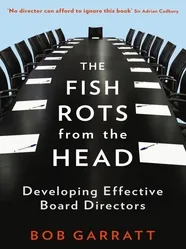
    The "Learning Board", developed and suggested by Bob Garratt nearly twenty years ago, is one of the models that has captured my attention. Garratt published his suggestions in a profoundly titled book The Fish Rots from the Head (3rd edition). Garratt highlights four key tasks of directors within the context of a board's lifecycle:
    • policy formulation and oversight
    • strategic thinking
    • supervising management
    • ensuring accountability.

    He suggests that boards need to balance four intellectual viewpoints simultaneously in order to achieve the four key tasks. When they do, overall effectiveness can be enhanced.
    • An external perspective
    • An internal perspective
    • A short-term perspective
    • A long-term perspective.

    I found this to be very helpful, because it provides a useful context for my work (an investigation of how boards can influence company performance, and the influence of strategic decision-making). Regardless of my efforts though, I commend Garratt's book to aspiring and established directors. It's easy to read, and logical in its approach to the topic.
  • Published on

    Straight talking trumps politically correct platitudes

    I read two straight talking articles this week that provided welcome relief from the rather superficial and politically correct reporting that seems to dominate newspapers like the Dominion Post these days:

    Thank you for Messrs Morgan, Guthrie and du Fresne for your forthright articles which, I suspect, reflect the views of the majority of New Zealanders. The time for the silent majority to push back on those self-indulgent folk who make an art-form of political correctness and living off the state is upon us.