• Published on

    Sometimes you have little choice but to activate 'Plan B'

    The current fuel supply problems in France, and planned strikes involving the Parisian Metro and bus network and air traffic control is likely to have a major impact on the French economy and, no doubt, its reputation as a reliable destination for commerce and pleasure. 
    Normally, situations like this are simply stories on the news feeds—news from afar. However, this one is a little more personal because I am due to be in Paris 1–3 June to speak at the EURAM conference. The planned strikes will cause chaos, rendering movement around the city nigh on impossible and placing my return to London to meet pre-booked long-haul flights at serious risk. After considering several options and weighing up the risks, the best (but far from ideal) decision seems to be activate Plan B, to cancel the Paris portion of the trip. Sadly, this means I will not attend EURAM this year. 
    All is not lost though. The London portion of the trip has been very worthwhile. To have met several influential business leaders and participated in some important discussions has been a privilege. The prospect of several advisory and speaking engagements now looms large. Consequently, I will return to London in mid September and again in late October. Please get in touch if you want more details of the visits, have a request or you wish to schedule a meeting.
  • Published on

    Would you like to learn more about #corpgov and board effectiveness?

    Are you based in or near London or Paris? Do you want to learn more about board effectiveness, corporate governance and how boards can exert influence from and beyond the boardroom?​ ​If so, please read on.
    In a few weeks I will be visiting London (24–31 May) and Paris (1–4 June) to speak with directors and trust board members about board practices, board effectiveness and emerging trends in corporate governance; share the results of my latest research; attend meetings; and, to present a paper at the EURAM conference.
    If you have a question (perhaps along the lines of these ones below) or a request and would like to take advantage of my proximity, please get in touch. I'd be delighted to hear from you and to schedule a meeting. 
    • Do you want to increase the effectiveness of your board?
    • Would you like to know about my latest research on boards and firm performance?
    • Do you have a question about boards, board practice, corporate governance or a related topic?
    • Do you want to explore how to apply some of the suggestions I've shared on Musings?
    • Are you looking for a speaker to address an event or conference sometime in the next 12 months?
    If you've answered 'yes' to any of these questions...you know what to do. I am at your service.
  • Published on

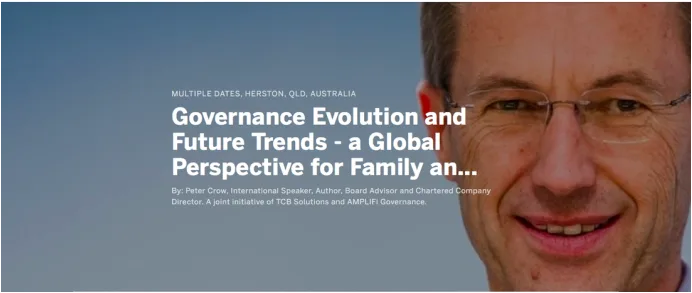
    Keynote speaker: Governance evolution and future trends

    Earlier this year, Lloyd Russell of TCB Solutions and Deb Coren of AMPLIFI Governance contacted me to discuss an event they were planning in their home town of Brisbane, Australia. They wanted me to deliver some talks and share some insights on the evolution of governance—with a specific focus on family-owned businesses. After learning more about their plans I was thrilled to accept the invitation. With that, planning got underway.
    Two events have now been scheduled on Thu 19 May, one in the morning and the other in the evening. 
    ​If you are a family or private business owner; or an independent director, advisor or partner, then this event may be of interest. Click on the image for more information and to register (a new browser page will open).
  • Published on

    Board size and composition: the Goldilocks effect

    Board diversity and board size are common topics of conversation in governance circles these days. Hardly a week goes by without one or both topics being mentioned. Most commonly people ask about board diversity and the relationship with firm performance, and the 'perfect' board size. Typically, my responses have been "Yes, diversity is good" and "No, there is no such thing as a perfect board size". Beyond that, context kicks in because every board, governance situation and even every decision is, to some extent at least, unique.  
    I have happily shared these responses and offered other supporting commentaries to all who ask—until now. What's changed? This article has set me thinking. Here are some insights that bear further consideration:
    • On team (read, board) size: Many boards of directors have five to fifteen members (the largest board I have advised had eighteen members—what group dynamics disaster). Contrast that with the research cited in the article and elsewhere, which suggests that six is pretty close to optimal. Beyond six, cliques emerge and the likelihood of free riding increases. Have you seen any of these characteristics? It might be time to review the size of your board.
    • On diversity: Diversity has been heavily promoted amongst the governance community in recent years. While diversity can be great for ideation, it can also be bad for cohesion. That's because the board needs to operate as a team. The research suggests that some similarity is good (i.e., shared understandings not same physical attributes) because it enhances effectiveness in performing complex and unpredictable tasks (like board decisions!). The point here is that sameness is good in some ways (operating basis and purpose) and diversity is better in others (ideation and debate). Striking the balance takes maturity.
    So, food for thought. The article was published by the Wharton School at the University of Pennsylvania—not by some backyard consultant or agency trying to sell services. This means we can rely on the commentary. While it may or may not be 'right', it certainly has substance. I would love to hear what you think about these matters after you have read the article and pondered the ideas and suggestions.
  • Published on

    How can NEDs / board members stay strategic?

    Much has been written in recent years about the governance of organisations, boards and directors. Many different views have been expressed. With it, different understandings of the function of boards have emerged. In some quarters, 'governance' has become a panacea for all manner of organisational ills. Others speak and behave as if the board is a beating stick to 'keep the executive honest'. Relatively few have held true to the original concept (kybernetes: to steer, to guide to pilot). Consequently, it is little wonder that some new board members can be unclear about their role. 
    The task of governance includes decision-making that affects the long-term future of the organisation. In other words, strategy and strategic decision-making. While the plethora of understandings abound, the question of how NEDs and board members ensure they stay strategic remains.
    ​I had the honour and privilege of hosting an on-line forum recently to discuss this question. A large community of UK-based board members gather every week to discuss governance matters of interest.  A summary of the discussion that I was involved with has been posted hereon Storify. Enjoy!
    If you have any questions, or want to explore matters further, please get in touch.
  • Published on

    Making smart decisions in the boardroom, on less-than-complete information

    One of the enduring challenges that directors face every time they meet together as a board concerns decision-making. How do directors make smart decisions when 1). they often lack crucial information, and 2). the environment is fundamentally both complex and dynamic? The answer lies in the group of directors' (the board's) ability to make decisions, as one.
    Why so? Legally, the board is a collective of directors. Individual directors make contributions to discussions and debates, but not decisions. It is the board that makes decisions. This transition—from the singular (individual directors, contributions, inputs) to the collective (the board as one whole, decisions, outputs)—occurs when directors meet (i.e., in board meetings, when the board is in session). If the transition is to occur well, all of the directors must be actively engaged their work—working together towards the decision, as one. 
    Group decisions are much harder to make than individual decisions. Reaching agreement can be a minefield, especially if information is missing, trust is low or if directors are more interested (sometimes covertly) in pursuing multiple agendas or representing constituencies rather than acting the best interests of the company (as the law requires).
    How can boards get past this challenge, to make effective decisions on a reasonably consistent basis?
    Recently, CGMA (Chartered Global Management Accountant, a joint-venture between AICPA and CIMA) tackled this question head on. Their report has just been released. You can read a copy of the executive summary here, or the full report here.  ​The authors make eight key recommendations for effective group decision-making:
    • Build greater trust
    • Value the non-financial data
    • Extract relevant data
    • Promote collaboration
    • Incentivise the medium- and long-term, too
    • Engage external stakeholders
    • Review the outcomes
    • Be patient
    I commend this report to you, especially if effective decision-making has been a challenge for your board over the past year or so. Share it with your board colleagues and ask the chairman to schedule a discussion at an upcoming board meeting. If nothing else, you'll bring the expectation of effective decision-making out into the open. Or, the board may find that some behaviours or expectations need to be adjusted, and that a formal board review is appropriate. The discussion may also expose some larger but hitherto hidden issues including that the board may not be clear on the purpose or the strategy of the organisation. If this is discovered, some external advice and assistance may be in order. 
    Regardless of the discussion and the outcome,  I suspect it will time well spent.