• Published on

    Making smart decisions in the boardroom, on less-than-complete information

    One of the enduring challenges that directors face every time they meet together as a board concerns decision-making. How do directors make smart decisions when 1). they often lack crucial information, and 2). the environment is fundamentally both complex and dynamic? The answer lies in the group of directors' (the board's) ability to make decisions, as one.
    Why so? Legally, the board is a collective of directors. Individual directors make contributions to discussions and debates, but not decisions. It is the board that makes decisions. This transition—from the singular (individual directors, contributions, inputs) to the collective (the board as one whole, decisions, outputs)—occurs when directors meet (i.e., in board meetings, when the board is in session). If the transition is to occur well, all of the directors must be actively engaged their work—working together towards the decision, as one. 
    Group decisions are much harder to make than individual decisions. Reaching agreement can be a minefield, especially if information is missing, trust is low or if directors are more interested (sometimes covertly) in pursuing multiple agendas or representing constituencies rather than acting the best interests of the company (as the law requires).
    How can boards get past this challenge, to make effective decisions on a reasonably consistent basis?
    Recently, CGMA (Chartered Global Management Accountant, a joint-venture between AICPA and CIMA) tackled this question head on. Their report has just been released. You can read a copy of the executive summary here, or the full report here.  ​The authors make eight key recommendations for effective group decision-making:
    • Build greater trust
    • Value the non-financial data
    • Extract relevant data
    • Promote collaboration
    • Incentivise the medium- and long-term, too
    • Engage external stakeholders
    • Review the outcomes
    • Be patient
    I commend this report to you, especially if effective decision-making has been a challenge for your board over the past year or so. Share it with your board colleagues and ask the chairman to schedule a discussion at an upcoming board meeting. If nothing else, you'll bring the expectation of effective decision-making out into the open. Or, the board may find that some behaviours or expectations need to be adjusted, and that a formal board review is appropriate. The discussion may also expose some larger but hitherto hidden issues including that the board may not be clear on the purpose or the strategy of the organisation. If this is discovered, some external advice and assistance may be in order. 
    Regardless of the discussion and the outcome,  I suspect it will time well spent.

  • Published on

    That was a close call...

    A word of warning for business leaders and academics invited to speak at conferences run by an organisation called WASET (World Academy of Science, Engineering and Technology): Give the organisation a wide berth. WASET appears to be a genuine organisation that runs conferences but, if the many comments on the Internet are any guide, the conferences are a front for a scam of some sort.
    I nearly got caught out. In early January, I responded to an invitation to submit an abstract for consideration at the 15th International Conference on Corporate Governance in Singapore. (I had been looking for a suitable conference to share an important aspect of my research on corporate governance and strategic management. The conference seemed OK, so submitted a half-page abstract.) A few days later, notice of abstract acceptance arrived, together with a request to submit the full paper for review. All good so far. But then...
    ​Two emails arrived today. One was an invitation to attend the conference. The other was notice that my paper has been accepted onto the programme—despite no paper having been submitted, much less reviewed! This didn't sound right. A quick search revealed many pages of blog posts and comments from people asking if WASET conferences are a scam, whether the conferences are fake, and other similar questions.
    The decision to back out came easily.  Luckily, no intellectual property or money changed hands.
  • Published on

    Is it time to think about a Young People Board?

    Board rejuvenation is often considered and discussed, but statistics on boards member ages show little progress. The general public thinks a board of directors is a set of relatively old people. Common sense and corporate governance approaches lead one to think that the introduction of new ideas from younger generations would surely be a company asset.
    Age diversity within a board is unquestionably desirable, but will one or two younger directors be enough? Probably not. In fact, except in exceptional cases (mainly in new technology fields), board members will probably be least 35 years old—hardly 'young' any more—by the time they have acquired the experience needed to be a skilled board director. Also, younger leaders often have full-time jobs, so will there be sufficient candidates available anyway? Recruitment of younger directors may be difficult and generally will not be enough to ensure that potential contribution from truly young people will be brought to the boards. How then to proceed ?
    One approach to solving this problem might to be create a Young People Board, under the leadership of the official board—a 'shadow cabinet' of sorts. With slightly different goals, some municipalities use this approach. A Young People Board could be composed of 18 to 25 year old volunteers—a similar number of members as the official board. Recruitment could be for three-year terms (with renewal of one third every year). The aim would be to achieve multi-faceted diversity.
    Periodically (say three times per year), the company board would invite the Young People Board to consider a topic discussed by the official board. The Young People Board would meet to debate the topic and develop proposals. Many ideas would emerge as young people naturally consider new technologies; social networks; data protection; ecology; ethics; and, international perspectives. Each year, a half-day meeting would be scheduled with the official board, to receive presentations and debate the topics studies by the Young People Board .
    The Young People Board formula would be light, without any significant expenses or time commitment from the official board members. However, the process would enable official board members to be positively confronted with new ideas coming from truly young people. They may even retain some ideas for implementation!
    Members of the Young People Board and, indirectly, their friends and relatives, would derive benefits including learning about the company activities, its executives and, importantly, the 'corporate governance' world. Through the process, the company may identify young talents for later hiring. The company could use this approach to improve its image, especially among young people.
    Many speeches and writings advocate innovation. As one dwells on this, the realisation that innovation applies not only within technology areas, but also in organizational processes and the social domain. The Young People Board is a concrete example of this type of innovation. Is this something your board can support? If so, please contact Guy Lé Pechon at Gouvernance & Structures.
  • Published on

    Does the term 'corporate governance' need a spring clean?

    Have you noticed how 'corporate governance' has pervaded the modern lexicon? The term is used in all manner of contexts nowadays. Some are appropriate and some less so. I wrote about this last year, off the back on a comment made by Rob Campbell. Here's a couple of fresh examples that I've heard used in the last sixty days:
    • ​That "more women are needed in governance". The speaker probably meant more women are needed on boards, to govern. The subtlety? Women are people and boards are structures, whereas corporate governance is a mechanism through which and by which boards act. I doubt more women are needed within the mechanism! Rather, more women are needed on the board, to activate the mechanism more effectively, in pursuit of desired performance objectives.
    • "We'll get governance to look at that", and the variant "That will need governance approval". The two different executives (same forum, I was the facilitator) meant that the matters on the table needed to go to the board for consideration. 
    Both of these examples might sound a little contrived, but they are not. All three phrases were spoken, spontaneously and in my hearing, by capable and well-intentioned people. The people in the room knew what was meant, I think. However, these three vignettes set me thinking. Is our usage of the term 'corporate governance' starting to change—away from the original intention (describe the functioning of the polity, i.e., the board of directors) to something different, or have we become somewhat lazy in our usage? I'd be interested in your views on this one!
  • Published on

    Ten #corpgov musings that generated the most discussion in 2015

    Picture
    The topic of corporate governance—that is, the functioning of the board—has generated much interest in the business community and beyond in 2015. From failures and successes, to emerging ideas and beyond, corporate governance has been front of mind for many throughout the year. Looking back, over 150 articles on corporate governance were added to Musings during the year. Here's a list of ten musings that generated the most discussion in 2015, in no particular order.
    The top ten #strategy list will be posted on Dec 26.
    If you want to discuss any of these postings (or ask a question about a related topic or request assistance), please get in touch
  • Published on

    Effective boardroom practices: Dispatches from Singapore

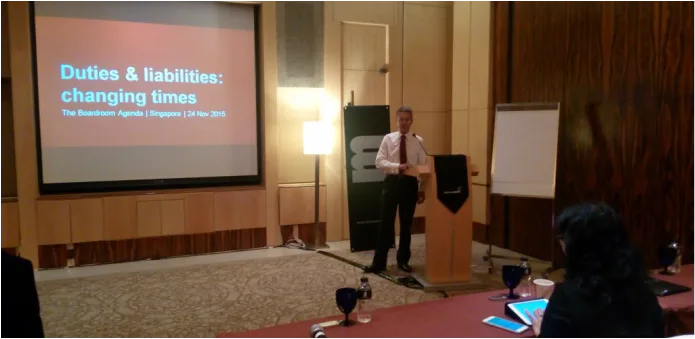
    ​Nearly fifty chairmen, directors and company secretaries from around South-east Asia, the Middle East and Northern Africa gathered at the Ritz–Carlton Millenia Hotel in Singapore this week for The Boardroom Agenda conference. Delegates received presentations, shared stories and debated issues over two days (23–24 November), under the Chatham House rule. I had the honour of contributing to the discussion on the second day. Here are some of the takeouts:
    • Neal Cross, Managing Director and Chief Innovation Officer at DBS Bank provided a stirring keynote presentation to kick off the day. Disarmingly frank in delivery, his topic Fostering innovation in the boardroom was both challenging and well-received. Cross asserted that banks simply must innovate, and radically so, lest their market collapses around them as fintechs and large technology companies (read: Google, Amazon, Apple, others) eat the bank's lunch. He then outlined the DBS approach to innovation, which includes a three-day 'hackathon', whereby teams of staff are set up to create new product ideas. The resultant ideas are pitched to the board, and funding is provided to commercialise the best ones—entrepreneurship in action.
    • Raoul Chiesa, Board Member on the Italian Association of Critical Infrastructures delivered a wake-up call to delegates. Speaking straight off a flight from Europe, Chiesa, an expert of information security matters, summarised the history of hacking and the crucial need for boards to take information security seriously—all with some powerful (and quite alarming) case studies and real-world examples. Delegates were amazed at the scale of the problem and the material risk to commerce that 'the bad guys' present. The cyberthreat is widespread and poorly understood, especially in boardrooms. The message was clear: boards need to get up to speed, by receiving presentations and updates from experts; asking probing questions; taking a strategic view of risk; and, empowering the CEO to act.
    • The pre-lunch session took the form of a panel discussion and dialogue with delegates. I joined Ralph Ward at the front of the room. A wide range of topics were explored including the merit of codes of conduct; diversity in the boardroom;  the conundrum of balancing conformance and performance; confidentiality; conflict management; the conduct of effective board evaluations; and, the difference between so-called independent directors and independence of thinking. Delegates seemed to appreciate the candid responses from panelists, including recognition that no one-answer-fits-all; best practice often isn't; and that the work of the board can be messy.
    • After lunch, delegates attended one of two streams. I chaired the Board Insiders one. Dr Lim Lan Yuan, a Singapore-based business and law scholar and company director spoke first. He managed to squeeze forty years of experience into a thirty-minute talk. It was a sight to behold. Delegates were enthralled with his summary of how boards should work; how they actually work (or don't); the importance of a clear division of responsibility between board work and management activity; the importance of the board undertanding the business of the business, strategy and market trends; boardroom dynamics; and, anecdotes of associates that messed up (badly) and went to jail. That Dr Lim was able to move seamlessly between theoretical concepts, practical recommendations and real-life stories as he spoke helped the delegates gain considerable value from the talk. The only person who struggled with his commentary was me: Dr Lim covered off several of the points that I was going to discuss in the following slot. Consequently, a few on-the-fly adjustments were needed to extend the discussion to related areas of interest (see pic below). That the delegates heard similar stories and recommendations from two different speakers with different cultural and business backgrounds was hopefully encouraging—and supportive of the notion that 'good practice' is good practice almost anywhere.
    • The final session of the day was a 'deep dive', whereby delegates gathered around one of two tables to consider a table-question and to share experiences. One table was asked to identify factors that contribute to both good and bad dynamics in a boardroom, and the other was asked to discuss how a board should function in the event of a major crisis. The groups had 30 minutes or so to wrestle with the assigned question and then report back. The insights shared were great, and the good-natured banter demonstrated that the delegates had built a good rapport with each other. Thank you to Dr Lim and Curtis Chin who moderated the table discussions. You made my job of session chair very straightforward.
    • The conference was organised by marcusevans. Their people did a great job, both in the weeks leading up to the conference and at the venue itself. If you get the chance to work with them, take it.
    Picture
    ​I've come away from the conference with the impression that the quality of corporate governance and board practice in Asian and Middle Eastern economies is rapidly improving. Overall, the hunger to improve board effectiveness was plain to see, as was the desire to learn from those with experience gained elsewhere (if the many conversations, requests to return and business cards in my satchel are any indication). However, care must be taken to ensure that models and frameworks in use in the Anglosphere are not blindly implemented in this region. Such colonialism is unwarranted and patronising, and it may be culturally demeaning as well.