
• Published on

    Do you have a wicked #corpgov question?

    Image description
    Much has been written about corporate governance, board practice and business performance in recent years. Many claims have been made along the way as shareholders, directors, researchers, consultants and members of the business community have tried to understand what boards do and how they influence business performance.
    Despite the best efforts of many—and many claims that various observable attributes of boards are causal to performance—credible answers have been few and far between. That we cannot explain how boards influence the achievement of business performance outcomes remains a rather large blindspot, especially as boards hold the responsibility for business performance. Hopefully, help is not far away.
    In the meantime, we have much to learn from each other. If you are wrestling with some aspect of corporate governance, board practice or value creation that is proving to be a thorn in your side or the side of your board, I would like to help you wrestle with it and, perhaps, even resolve it.
    Please ask your wicked question (either by posting a reply or sending an email), and I will do some research and provide a reply as quickly as possible.
  • Published on

    Research update + heartfelt thanks

    Over the last month or so, I've begun to receive questions—several per week—about my doctoral research. Most have been variations on these themes:
    • Has the thesis been examined yet / have you get your PhD yet?
    • Can I have a copy (or a summary) please?
    That people beyond close friends and associates might be interested in the status of the research and in reading the outputs has been gratifying. Sadly, process delays have impeded the provision of affirmative responses for the time being. The background and current situation is as follows:
    On the examination: I had hoped to have some news by now, as eleven weeks has passed since the dissertation was submitted for examination (oral examinations normally occur about 8–12 weeks after submission). However, there was a problem with the examiner panel and some seven weeks elapsed before it was resolved. I've now been told to expect to expect the oral examination during the week of 19 October—another nine weeks away! Thankfully, my head supervisor is trying to accelerate the process, and I've got other things to be going on with.
    On the request for a copy of the full dissertation: A copy of the dissertation (The influence of boards on business performance: Evidence from inside the boardroom) will be posted here after the examination and emendation process is complete. A copy will also be available via academic search engines in due course. In addition, I plan to consolidate the main research findings into a slim (but readable, with practical implications) volume. If you would like to be added to a mailing list to receive a copy when it is available, please let me know.
    Notwithstanding the rather annoying delay, feedback from several people who know about the research findings suggests it will be worth the wait, both as a useful guide for boards and as a basis for future research. However, such claims are preemptive and presumptive in my view: the dissertation needs to emerge from the examination process first! 
    My heartfelt thanks for your interest in the research, and your patience while the examination process runs its course. My hope is that your interest and patience will be satisfied soon!
  • Published on

    On the sources (and a possible remedy) of so-called "governance failure"

    The much-storied scandals at FIFA, HSBC and Toshiba have highlighted a plethora of weaknesses in the way large companies are led and run. Fingers have been pointed and blame apportioned. Management has copped a fair bit of flak, but the board has not been immune either. While the media has had a field day, finger pointing and broad statements provide little comfort to those in pursuit of long-term performance. Remedies are required.
    Reputability has studied a number of failures recently(*), in pursuit of remedies. The analysis identified nine prominent categories of weakness, the first six of which were influential in the majority of failures:
    • Board skill and NED control
    • Board risk blindness
    • Defective information to or from board
    • Leadership on ethos and culture
    • Risk from incentives
    • Risk from complexity
    • Risk glass ceiling
    • Charismatic leader
    • Poor crisis management
    When these factors are considered holistically, the stark implication is that failure appears to be associated with board weakness in at least three areas (engagement, strategy and risk). If boards are to make effective contributions, these weaknesses need to be resolved. And therein lies a challenge: a return to first principles, and a different conception of corporate governance is likely to be necessary. Will boards embrace such a change in pursuit of better business performance? Let's hope so.
    (*) The full Reputability Report, entitled Deconstructing failure—Insights for boards, is available here.
  • Published on

    Success attributed to board: Lessons for all

    How valuable is a board of directors to the performance of the business it governs? Does it influence business performance; or does it act as a policeman, "simply" monitoring the chief executive; and, do we even know? Many have attempted to answer this question. More often than not, the responses have been based on statistical analyses of secondary data (surveys, questionnaires, public data). Descriptions of what actually occurs in the boardroom typically remain hidden. Insights from direct observations of boards in action or from first-hand interviews are rare, so it pays to take note when they become available—as occurred when Nigel Bamford, chief executive of fireplace manufacturer Escea went on record this week. His comments, reported here, provide some interesting insights for boards to consider:
    The Bamford interview provides a much-needed glimpse into the boardroom of a successful company. However, and thankfully, the Escea experience is not unique. The insights are consistent with emerging research about what boards need to do if they are to exert influence on business performance. Consequently, important questions for your own board to consider include:
    • The Escea board meets monthly, for two hours per meeting. Despite this small amount of time spent together, the board manages to monitor past performance and look ahead. This suggests that the chairman has a disciplined approach to meeting protocol, and that the board has at least one eye on the future success of the business.
    • The board is comprised of directors with "a whole range of different perspectives and different disciplines". Decision quality appears to have benefited as a consequence.
    • That the board is comprised of three company founders and two external directors suggests that technical independence (as promoted in many corporate governance codes) is not necessary for board effectiveness including effective decision-making.
    • The emphasis in Bamford's comments is on debate and diversity of thought. Gender and other forms of observable diversity were not mentioned.
    • The Chief Executive expects the board to 'add value' by challenging proposals and driving the decision-making process.
    • A one-size-fits-all approach to board practice and corporate governance is not appropriate.
    • While the Escea board looks ahead, strategy was not explicitly mentioned. Whether the board works with management on the development of strategy, or critiques strategic options and proposals presented by management is unclear.
    Bamford's final comment is perhaps the most telling. "In time, a board is useful for all businesses of reasonable scale and ambition." Two important lessons emerge from it:
    • Formalised boards and board practices are helpful once ambitious (growth oriented) businesses have achieved reasonable scale, and if attention is focussed on the future.
    • Formalised board structures and practices are not always necessary (beyond statutory requirements), especially very small businesses where the same person or group of people both own the company shares and manage the business. Meet your statutory requirements but don't burden the business with unnecessary corporate governance and board practices. They are not required.
    • How might the insights discussed here help your board lift its performance in pursuit of business success and value creation?
    • Might a discussion at your next board meeting, to consider the appropriateness of your current board practices be useful? 
  • Published on

    Speaking & advisory tour to UK & Eire—programme is filling fast

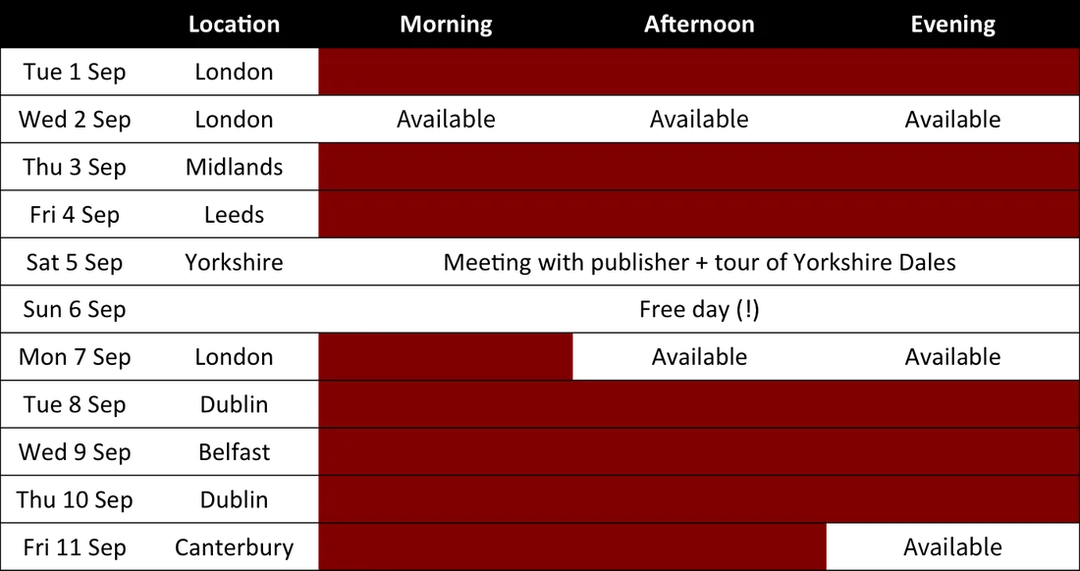
    Wow, that was quick! Six days ago, plans for my Spring speaking and advisory tour to the UK and Ireland were 'starting to come together'. Now the eleven-day tour—to discuss corporate governance, value creation and board practice topics—is nearly full subscribed. Thank you! Three masterclasses, four 'general' speaking engagements, a masters-level lecture and several private meetings are confirmed on the programme. (Details of the 'public' events will be published by the event sponsors in due course.) In addition, two parties have requested planning meetings to discuss future advisory or speaking engagements, to occur in early 2016. If you think you might want to book me but want to talk about it first, that's entirely fine. Just let me know.
    As of today, just one full day (2 Sep) and one part-day (7 Sep) remain available to be booked. I'll be in London on both days as you can see. If you are based in London (or the home counties) and you want to book a meeting or speaking engagement, please get in touch soon--before it's too late!

    Picture
  • Published on

    Boardroom diversity: Is the rhetoric finally starting to mature?

    These topics, both arguably proxies for the on-going fight for a more equal society, have been the subjects of much research and discussion over the last decade or more. Claims and counter-claims have been asserted—sometimes quite stridently—in both the popular press and in the academic literature. While many commentators have asserted that the presence of women in boardrooms, or diversity amongst directors is causal to increased company performance (and others have jumped on the bandwagon), a small number of bold souls have questioned the analysis, recognising that any linkage is complex and likely to be contextual.
    Researchers, consultants and commentators need to build on Turner's comments. If we are to understand how boards work, and how influence is exerted, boards need to be observed in action. Sophisticated analyses, capable of exposing factors that may not be directly observable or consistently applicable, are also required. The resolution of the problem (of explaining how boards influence business performance) is more likely to be found in the subtleties of director qualities and behaviours, and the complexities of how they work together, than in any regular correlation between an observable attribute and subsequent business performance.
    Thank you Caroline Turner for recognising this, and for advancing the conversation.
    Now, Caroline Turner, a leading commentator appears to have called time on the rather simplistic assertions that have dominated the discourse (click here to read her recent article). Her response to the question of whether gender diversity is good, bad or indifferent is "It depends on which study you read". I agree. Importantly, Turner's conclusion (that "solid research by highly respected organizations, disputed by some, shows a correlation between gender diversity and results") and appeal (for more research) signals a much needed maturing of the rhetoric.
    What is it with the women on boards and diversity discourse?