• Published on

    When things go wrong...what can be done?

    Boards, and an oft-mentioned but mysterious concept—governance—are topical. Daily, it seems, these terms feature in our newspapers and on social media, usually because something has gone wrong. And when it does, ​the chattering class is not slow to react. Typically, the targets of their comments are the board and management of the organisation.  That seemingly strong organisations suffer significant missteps—or even, fail outright—on a fairly regular basis is worrisome; the societal and economic consequences are not insignificant. What can be done?
    Recently, the inimitable Mark Banicevich invited me to discuss boardroom success and failure, and to offer guidance that boards wanting to lift their game may wish to consider. 
    Hopefully, our discussion is helpful and enlightening. Regardless, I welcome questions and comments, either here or send me an email.
    This is my second conversation with Mark (the third will be published in May). If you missed the first, you can access it here: Governance around the world.
  • Published on

    A journey, in thought and deed

    Picture
    When I was a boy, milk was free (I was raised on a dairy farm), but you could buy it in a glass bottle with a silver foil top (pasteurised but not homogenised) for four cents a pint at the general store. Television (once we got one, in 1969, to see the Apollo 11 moonshot) was a grainy, black-and-white experience, with a single channel available. You got to watch whatever the broadcaster chose to deliver across the airwaves.
    Now, milk costs several dollars a litre, but it comes in many different styles (blue, light blue, skim, lo-fat, full-cream, calcium fortified, lo-lactose and UHT—as well as products called milk that contain no milk at all, such as oat milk and almond milk, in a wide variety of packaging options). Television has changed too: from a take it or leave linear broadcast experience via rabbit-ear antennae, to a plethora of video-on-demand (streaming) options via the internet. 
    These are but two of thousands of examples that illustrate the onwards match of technology. Oh how life has changed, even in my lifetime.
    The onward march has also affected the way we communicate, not only personally with family and friends, but also with clients, suppliers and the general public as well. The notion of using a fountain pen to handwrite a letter, or making a toll call, seems quaint now—but some of us still value these moments. The emergence of social media has extended our reach in ways not thought possible twenty years ago. Sharing business cards, once commonplace, is now rare. If people want to contact me or learn about me, they tend check my LinkedIn profile (notice the assumption, that I have one), even before mentioning Google or asking about a website or blog. 
    And that brings me to the point of this muse, which is to share one aspect of a conversation with an esteemed company director, in the hope it might encourage others committed to serving the director community. Yesterday, I was asked about the role of social media in my business life, what channels I use and how long had I been using these. The first two questions were readily answered; the third took a little longer—because I needed to find the menu option!
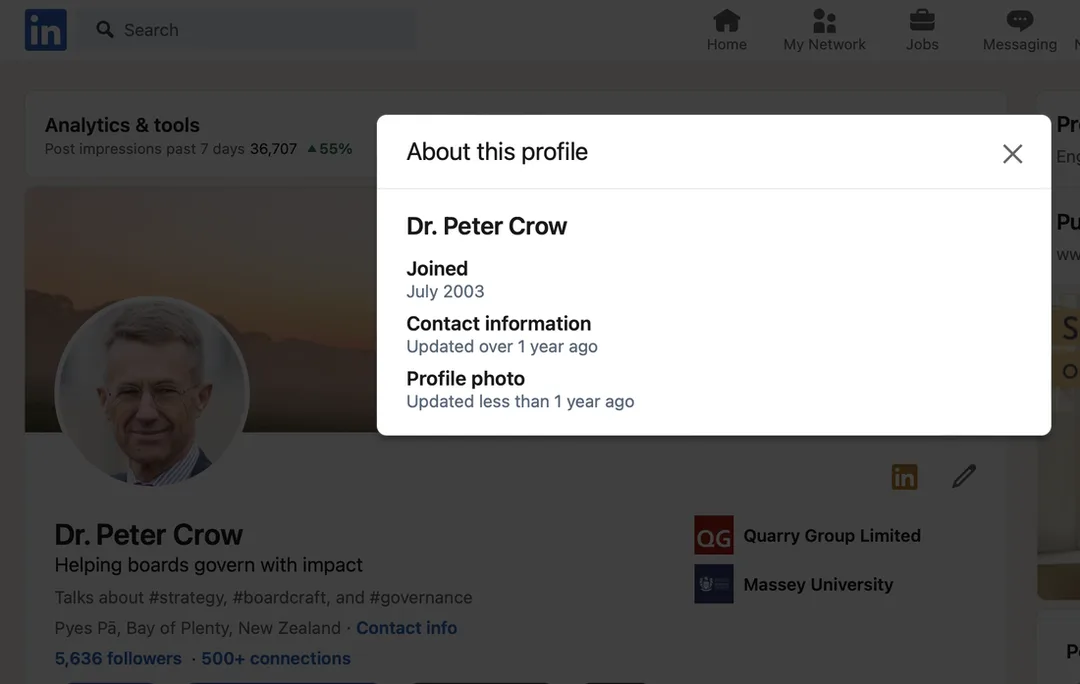
    • Social media: LinkedIn is the only social platform I use. It complements my website and blog, as a forum to comment on topical issues, share articles written by other people and, candidly, reach boards and directors who make use of Linkedin as a trusted source of information. Previously, I used Twitter, but that did not last long for the platform was, I thought, little more than a soapbox for people to shout at each other. When I checked my LinkedIn profile, I was surprised to see I had first used the platform in July 2003, over twenty years ago and just three months after the platform was officially launched by Reid Hoffman!
    • Website: petercrow.com was first launched in November 2001, the month after I left paid employment and founded QuarryGroup, the global board advisory practice. Musings, the blog, came later, in March 2012. The websites were (and remain) online brochures, whereas the blog was created as a place to share my thoughts and test ideas while working on my doctorate. Since 2016, Musings has become a forum for a wider range of board and governance topics. Today, approaching 750 entries later, Musings is read widely, by a global audience.
    Thank you for permitting me to share my experience. I hope anyone considering using social media or a blog as a channel might be encouraged—not only to do so, but to stick at it over the longer term. My journey to date has been fulfilling; I have met thousands of people from many walks of life and, I hope, they have valued the interaction as much as I have.
  • Published on

    Boards and ... mathematics?

    Picture
    Diversity of thought has been widely promoted in recent times, as a mechanism to supposedly increase decision quality in boardrooms. Superficially, the idea of thinking differently is a positive evolutionary development from earlier efforts (think: women on boards) to break what is often described as the Old Boys' Club. That the discourse and intent has begun to move beyond appointing directors on the basis of physical attributes is helpful. And yet, the idea of 'diversity of thought' has long troubled me. 
    How does anyone know what I am thinking, or anyone else in the boardroom for that matter? And what is diversity in this context anyway—me having different thoughts, or several of us thinking differently? Crucially, what of any link to the board's work and purpose, which is to provide steerage and guidance to achieve a strategic goal? 
    Researchers have published correlations based on specific datasets, but the general case (a reliable linkage between demographic diversity and organisational performance) remains elusive. The somewhat amorphous 'diversity of thought' is similarly afflicted. Recently, cognitive diversity (that is, different ways of processing information and approaching problems) has been suggested as a more reliable mechanism to achieve higher quality decisions and, by implication, outcomes. This sounds positive, but reliable explanations are yet to emerge. 
    Why is this so hard? Could the paucity of reliable explanations (of the relationship between board work and company performance) be due to researchers, directors' institutions and others trying to explain board work and develop 'best practice' models looking in the wrong place or using inappropriate tools? What if hypothetico-deductive techniques (in search of a deterministic best practice approach to some aspect of board work) are laid to one side and methods more common in social science used (critical realism or contingency theory, for example)? Should researchers embrace the idea that boards are social organisms, and that governance is a mechanism activated by the board?
    For the record, I employed critical realism, long-term observational techniques and contingency theory when researching boards a decade ago, as part of my doctoral research. The study was ground-breaking for it revealed new insights about board work including an explanatory framework. If you want to learn more about this study, check my thesis (academic-speak) or this article (plain-speak).
    In the past few weeks, I have picked up the question again (thanks to a wandering mind on long haul flights!), and have begun to wonder if fractals and chaos theory might offer a viable pathway to developing a theory of board work. Whether this might be a fruitful search or a blind alley remains unclear. Regardless, my mission is to help boards govern with impact, so the least I can do is dig further. And dig I shall.
    One request: If you know about fractals, or know of anyone who possess such expertise—especially in relation to social phenomena—could we schedule a call please? I'm starting from a pretty low base!
  • Published on

    Better board work: what does 'good' look like?

    Picture
    And there you have it: before many of us realised, the solar equinox has passed once more—that moment when the sun passes the celestial equator and winter (or, for those in the global south, summer) beckons.
    The equinox also signals the recommencement of on-the-ground contributions in the Northern Hemisphere. To wit, I shall be in the United Kingdom and Switzerland soon—from 2nd through 13th October, in fact. My programme sees me in London, Leeds, Cambridge, Zurich and St. Gallen, for a variety of contributions:
    • ​meetings with boards, directors and colleagues;
    • a private luncheon with a doyen of corporate governance;
    • two conferences (EIASM 20th anniversary workshop on corporate governance, in St. Gallen; and, the IBEM thought leadership conference, in London);
    • delivery of two keynotes and a guest lecture; and,
    • some quiet time writing.
    I am looking forward to hearing the heartbeat of company directors, advisors and others, to understand recent developments and emerging trends, and to discern changes since I visited earlier this year.
    I have intentionally held space available for a few informal meetings. So, if you want to meet up while I am in your neighbourhood—be it to discuss the work and impact of boards, corporate governance, or some other topic of interest—do get in touch. I would be delighted to hear from you.
  • Published on

    Ten days in the UK & Europe: A snapshot

    Picture
    I have just arrived back in New Zealand, from ten days in the UK and Europe. My meetings with directors, advisors, academics, students and directors’ institutions had two primary objectives: to listen and to share. The listening aspect was to gain firsthand knowledge of issues and opportunities; the sharing aspect to provide updates on the craft of board work and my experiences as a practicing director.
     Learnings (a few immediate observations, in no particular order):
    • Directors say they are finding it hard to distinguish between signal  and noise—that which is material to monitoring and verifying performance and progress, and that which is, essentially, argumentation from stakeholders asserting preferences with only tenuous associations with sustainable performance.
    • ESG remains 'hot', although everyone I asked said the marketplace was fracturing. Acolytes are becoming more assertive, especially in their expectations that companies prioritise net zero, climatic change response, and equity above all else. Others are less convinced, as they are yet to see any increase in company performance or alpha. The gap between the groups is growing too—adherents have started using the 'anti-ESG' moniker, in an effort to claim the high ground. Detractors have not been silent either, saying the discourse needs to move away from what they describe as ideological fervour to pragmatism and common sense. 
    • Increasingly, directors are questioning whether quarterly board meetings (common in Europe) is actually a good idea. The directors I spoke with said they find it really difficult to keep up with compliance matters, much less contribute well to strategic items. The power balance leans reasonably strongly in favour of the CEO too.
    • Calls for optionality to be removed are becoming more commonplace. (Optionality meaning all directors of companies of substance should be required to be professionally qualified, in the same way as doctors and lawyers need to achieve and maintain a relevant professional accreditation.)
    • Geopolitical turbulence is front of mind (greater in Eastern Europe than Western Europe). The situation is exacerbated by economic headwinds and energy security concerns (think: gas and electricity supplies) despite Europe emerging from a mild winter. The UK and France (in particular) are also struggling with high inflation, strikes and, in France, a proposal to raise the age of retirement. Given the uncertainties, many leadership teams have shortened their strategic horizons and some have become quite defensive.
    • The Credit Suisse bailout by UBS unfolded before my eyes—I was in Zürich the day after the failure. Like many other failures, this one came as little surprise to insiders; the company has endured scandals and criticism for some years. (My early assessment: the board appears to have been asleep at the wheel.)
    • Directors continue to struggle with what corporate governance is and how it should be practiced. Sadly, the confusion observed during this trip is as widespread as in the past. Directors' institutions have a critical role to play, to clearly and straightforwardly assert what corporate governance is and, critically, what it is not. 
    Amongst it all, there were some gems:
    • Several directors spoke passionately about their work, and how efforts to engage more actively, with an underlying sense of purpose, is starting to make a difference.
    • Researchers are moving focus, from quantitative studies using public data, to trying to get inside boardrooms to observe boards in action (ie: the practice of governance).
    • Advisors to General Counsels, CEOs and SME founders have recognised a different conversation is needed to appeal to boards and directors. I was pleased to offer a few insights and suggestions.
    • I had the delight of delivering a guest lecture to forty or more researchers and students at Leeds Beckett University. The Q&A was fascinating—a candid exchange with people passionate about helping boards govern well.
    Several followup visits are now being planned, to advise, assess, educate and speak on topical board and organisational performance matters. If you want to discuss a matter of interest, or check my availability to assist, contact me for a confidential, obligation-free discussion.
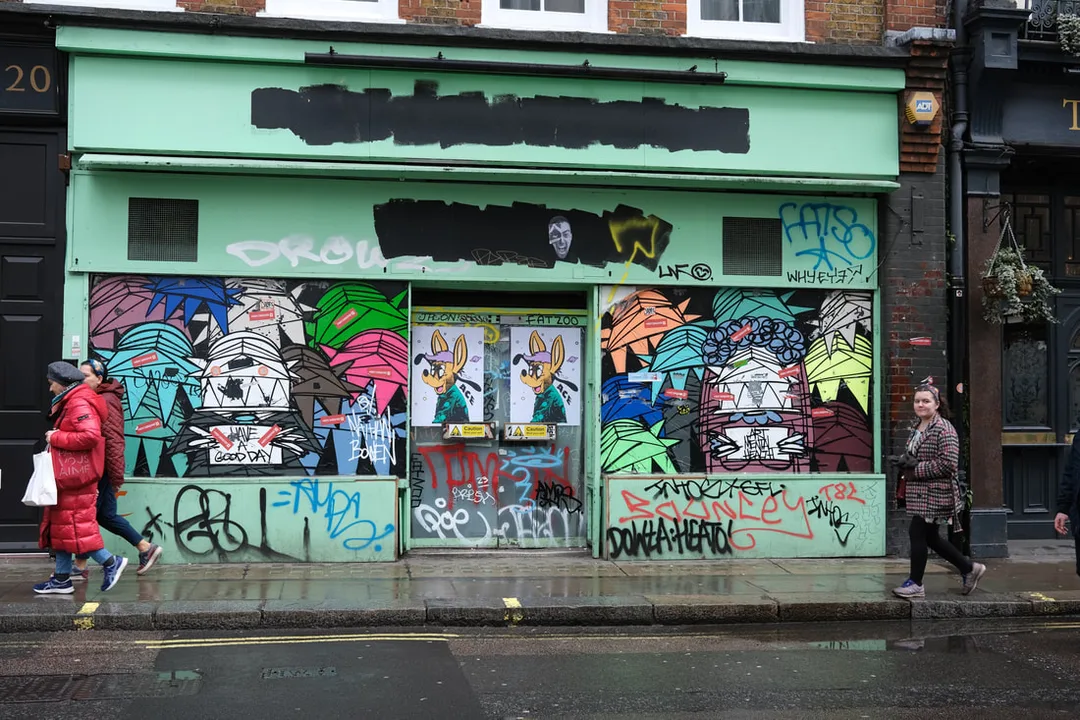
    The headline picture, showing a derelict property in Soho, London, is analogous to the state of governance in many places in Europe: structurally sound but outwardly messy.  
  • Published on

    Musings: A decade on

    Picture
    This entry is a little more personal than most posted here. But, if you'll allow the indulgence...
    Yesterday started out like many others before it: a mix of client and administration work, video calls across timezones, director commitments and writing (The craft of board work is coming along nicely). I 'logged off' a little later than usual—around midnight—having just completed a two-hour video call with members of the Global Peter Drucker Society (advance planning for the 2022 edition of the Global Peter Drucker Forum to be held in Vienna late this year). 
    Tired but satisfied after a long day, I prepared for bed. And as I did, my mind wandered. March 24th was significant for some reason. Then I remembered; it was Musings' birthday! Yes, ten years ago, on 24 March 2012, I stepped, with some trepidation, into the blogosphere. That first step? A three-line post
    My motivation was straightforward, to share thoughts and test ideas on corporate governance, strategy and board effectiveness. At the time, I had just started on my doctoral journey (a milestone achieved in 2016). A platform to engage with academics and global leaders—and to let off steam from time to time—was going to be helpful, I thought. And so it was, and continues to be. 
    Today, some 712 posts later, Musings has entered middle-age. From tentative first steps, to now a library of comments on professional (corporate governance, strategy, and the craft of board work), philosophical and personal topics. Whether the thinking underpinning the articles has improved over time or not is for readers to determine. Hopefully, a progression is evident. And, while the frequency with which posts have appeared has declined a little in recent years, my desire remains as it was in 2012: that each post proved valuable to at least one person. If that was achieved, the effort was worthwhile.
    Looking back over the decade, I have been most fortunate to have met and learned from many great thinkers, leaders and doyens of corporate governance and strategy. I have also had the privilege of serving aspiring and established directors, and boards, across five continents. Musings has been an enabler.
    The support and encouragement shown as I have pursued my passion—to help boards realise the potential of the organisations they govern—has made a great difference to me. Hopefully, it has been beneficial to others as well. Thank you.
    And, in case you are wondering, Musings, will continue to be published, for as long as readers show interest.