• Published on

    BAM2014: Opening sessions

    BAM2014 got underway this morning, with a light breakfast of croissants, pastries and coffee to welcome first-time attendees (a great way to help break the ice, thank you organisers!). A series of professional development workshops followed. Seventeen topics were offered, across two workshop sessions, before lunch including:
    • The state of corporate responsibility and sustainability research
    • Developing senior leadership and management capability
    • Cognitive mapping: making sense of qualitative research data
    • Low-tech teaching
    • Researching and engaging with SMEs
    • Generating impactful research: Views from the field

    The workshop sessions were intentionally interactive, with the facilitators actively eliciting comments from, and the  experience of, the delegates in attendance. I attended the cognitive mapping session (quizzically, not really understanding much about the topic) and the generating impactful research (hoping to pick up some tips for my own research) sessions. The cognitive mapping session was really helpful. It exposed me to a method of moving meaningfully from the vast quantity of data that is typically gathered in observations and interviews toward some meaningful conclusions. However, a little knowledge can be a dangerous thing, because I now realise that I may have missed a trick in my research analysis—something that I'll need to give some careful though to in the coming days. The impactful research session was aimed at researchers seeking external (funding) assistance to support their research. This session was of less interest to me as I plan to return to professional practice and advisory work.

    After the lunch break, several business and academic speakers will open the conference. They will address the conference theme: The role of the business school in supporting economic and social development. In my rather limited experience, one of the shortfalls of many business colleges relates to relevance. That business research conclusions often have limited practical application is an indictment on business schools and on the research process. This should be an interesting discussion.  
  • Published on

    BAM2014: starts today

    The 28th Annual British Academy of Management Conference starts in Belfast today. With over 700 delegates registered, 640 papers to be presented (at times over 20 parallel tracks!), the next three days promise to be very busy. My intention is to attend as many of the corporate governance papers as I can get to, strategy papers and a selection of others. I'll post reflections that various points over the next three days, and encourage those interested to follow the hashtag #BAM2014.
  • Published on

    BAM2014: My paper now available

    The organisers of the BAM2014 conference have published all of the conference papers online. If you wish to read a copy of my paper, On the use of critical realism to advance governance research beyond correlations, please click here. The purpose of the paper is twofold: to debate some of the core assumptions and approaches that have been favoured by many corporate governance researchers to date; and to offer an alternative approach to research—one that has the potential to help researchers solve the challenging problem of explaining how boards can influence the achievement of company performance outcomes.

    The ideas in the paper form an important foundation stone of my doctoral research, so please feel free to post a reply, or to send an email, if you wish to make any comments about it. I'd welcome the feedback!
  • Published on

    BAM2014: Final programme published

    The 28th Annual British Academy of Management Conference is now less than a week away. The conference is being held in Belfast, Northern Ireland, on 9–11 September, and the final version of the BAM2014 programme is now available on the conference website. I'm down to deliver my paper on Thursday morning.

    This year, over 640 full and developmental papers will be delivered over three full days. Helpfully, the wide range of topics have been grouped into 24 tracks. In addition to the papers, keynote speakers will address the delegates each morning; and there are symposia; special interest group meetings; professional development workshops; and, a gala dinner (at the Belfast Titanic Museum, no less) to attend. Delegates will be busy!

    If you are interested in a particular track or specific paper, but cannot attend, please let me know. I will do my best to attend the presentation for you and report back. Also, if you are planning to attend the conference and would like to meet up over a coffee or snack, please contact me via Twitter or email.

    PS: As has become my practice during conferences, I will provide summaries and reflections throughout BAM2014, so please check back regularly if you are interested.
  • Published on

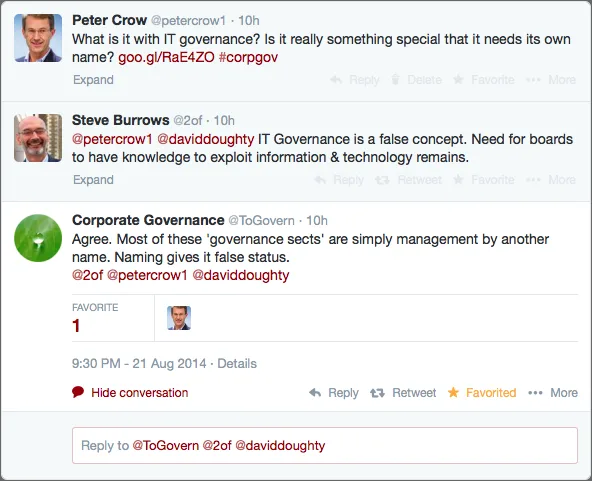
    I learnt a new phrase today: 'governance sects'

    The English language is constantly evolving, as we find new ways of describing things and expressing ourselves. Sometimes, words and phrases are helpful abbreviations of a new social phenomena ('selfie'). Other words and phrases convey a reasonably strong value judgement, like the one I learnt today:
    Picture
    The use of 'sect' to describe those that promote new ideas about boards and corporate governance, or suggest derivations or deviations from existing ideas, raises the stakes. According to my dictionary a sect is "a group of people with somewhat different religious beliefs (typically regarded as heretical) from those of a larger group to which they belong".

    Why some people find it necessary to promote aspects of the bigger picture as being the picture is beyond me. If the purpose of a board is to optimise company performance in accordance with the shareholder's wishes, and corporate governance is the mechanism through which the board seeks to achieve this, is this not where our effort should lie?
  • Published on

    We all get stale. How do you freshen up?

    One of the big challenges of tackling a major project relates to vitality. When we set out to tackle something new, be it a hobby, a job, a long walk, a marriage or something other 'project'; we generally start with much hope and anticipation. However, over time, we can get a little stale, as the rigours and routines of the daily grind take precedence in our mind over the goal that we set out to achieve. Sound familiar?

    Regular readers will know that I've been working on a major research project in early 2012. The good news is that the end is now in sight. However, there is still much to do and the risk of getting stale is never far away. One of the techniques that I have used to keep fresh is to change the focus temporarily—by helping others solve gnarly real-world problems. Today for example, I had the privilege of working with a group of directors and a manager—helping them wrestle with their business, to try to get some clarity around core purpose and strategic priorities. The Chair's closing comment, "the morning was incredibly worthwhile", suggested that progress had been made. Next week, I have an independent review of another board to do. That board has some interesting challenges around focus; role; and, interaction with the Chief Executive.

    Small 'side' projects keep me mentally fresh. They get me out of the office and away from the routine of the research. Sitting with real people, and helping them wrestle with real problems, is so invigorating. Crucially, when I return to the research, I feel sharper and seem to work more effectively. How do you freshen up?