• Published on

    On complexity, prioritisation, decision-making

    Picture
    The onset of the latest war in the Middle East has captured the hearts and minds of political and business leaders, and the general population, around the world. The mainstream media is awash with coverage of military interventions and responses, and, now, the choking of the Strait of Hormuz. ​And this is reasonable, for the impacts on global commerce are being felt widely.
    That the situation is complex is axiomatic. But it is not a new phenomenon: the Middle East has been a hot-bed of disputes since biblical times. Muslims, Jews, Ottomans, Babylonians, Zoroastrians, and other groups including colonial powers have fought over land, water, and, latterly, oil, for a long time. If history is a reliable indicator, lasting peace will be difficult to achieve. 
    The situation is instructive for another reason too: the near-total focus on the subject. ​From mainstream media to business meetings, and in conversations around dinner tables and in local pubs and bars, the topic du jour is the Middle East War (an intentional descriptor, for the scope has long-since reached beyond Iran and Israel). Little else matters at the moment—or so it seems. And yet other battles continue around the world, in Ukraine, Afghanistan, Pakistan, and elsewhere; the climate continues to change; China’s influence continues to rise; and the impacts of Brexit and Covid continue to be felt, despite fading memories. 
    That events beyond the Middle East War are not being widely discussed does not mean they have gone away or are no longer relevant. 
    The parallels for boards and business leaders are stark: That which is front-of-mind dominates the mindshare. However, just because risks are not discussed does not mean they are not present. Boards that ignore complexity and dynamism do so at their peril. To wit, how often does your board allocate time to consider carefully still-weak signals, strategic risks, various scenarios and interdependencies? In times of great change or disruption, “At every board meeting” is a good answer. 
    If boards are to have any hope of governing with impact amidst complexity, directors need to be on their game. That means preparing well (understanding extant risks, emerging developments, and interdependencies); being actively engaged and decisive in meetings (includes prioritising where and how limited resources are applied); and holding fast to the tenet of collective responsibility after a decision is made. 
    Directors who keep alert and maintain a strategic mindset are more likely to detect still-weak signals, make smart decisions and, ultimately, realise the potential to the company they govern.
    And what is not to like about that?

  • Published on

    Space to wait: will it help you be a better contributor?

    Picture
    I was fascinated last evening, at a variety of behaviours on display following news that UA787, a flight from Houston to Chicago-O’Hare was delayed due to a technical problem. The captain provided updates, initially announcing the delay and reason. A little later, he came on the PA again, to apologise. Then he added, “that the engineers were working on it, and were confident of resolving the issue soon.”
    Some, likely the elderly gentleman I was seated beside, were a little anxious.  He was being met by a family member and did not want to put the family member out at all. His response was to ask the flight attendant for an ETA, so he could make a telephone call to the party meeting him. Others, such as the business woman seated across the aisle, became agitated, as if the delay was the flight attendants’ fault; the impression being that she was busy and important and, therefore, the problem needed to be fixed “now”. Her response was direct: as soon as she had the opportunity, she collected her things and hurried off the flight. Others got off too, without fanfare. Yet others, sat quietly and waited, knowing there was little they could do.
    The situation provided an impromptu study of human behaviour and, in particular, how some people seem to have lost (or rejected) the art of waiting.
    I wanted to get to Chicago as much as any other passenger, especially having already flown in the care of Air New Zealand from home to Houston. And, a younger me may well have become frustrated at the situation, as the woman who left abruptly. But, I have learned to leave those things we cannot control to others.
    As I reflect on the experience, my mind is drawn to board work. The role of director is one of service. Have I allocated sufficient time to not only read papers, but consider them and read further? How patient am I when arrangements do not flow as planned, especially logistical arrangements? Is my schedule crammed, or does it provide space, not only as contingency but also for critical thinking?
    The very best directors arrive at meetings prepared, calm, and ready to go, having allocated space before the meeting, to read, think, and prepare questions. The rest, who tend to look harried and unprepared, need to reflect on their situation. Why are they not ready to contribute well? Are they poorly organised? Are they overboarded? Ultimately, are they fit to serve as directors, given the duties they owe?
    PS: UA787 departed 57 minutes late, and arrived approximately 24 minutes behind schedule. The Captain apologised once more. Flight attendants were polite. Passengers were looked after. The world didn’t end.
  • Published on

    Is ESG a harbinger of something big, or just a TLA?

    The June solstice is almost upon us. Davos, the World Economic Forum's annual meeting of elite political, academic and business leaders (some would say, talkfest), is over for another year. Private jets have returned to base, and the thoughts of leaders (in the northern hemisphere, at least) are turning to summer holidays and, with it, relaxation, reading lists and an opportunity to cogitate. Meanwhile, leaders south of the equator press on, for the June solstice marks the onset of winter.
    Metaphorically, the June and December solstices are signposts: ​marker pegs that signal pending change.
    Over the past couple of years, I have been watching intently one signpost in particular, wondering whether it might portend a change in relation to board work, or whether it might be a mirage that can be ignored. ESG, a three-letter acronym for environmental, social and governance, was coined in 2005 by a group associated with the United Nations. The stated goal was to put pressure on companies to think beyond financial indicators as the primary indicator of business performance, and to report accordingly. 
    A veritable industry of so-called experts (many self-styled) has emerged in recent years, all claiming to help businesses respond well to ESG demands and expectations. Many business leaders, activists, politicians and directors’ institutions have latched on too, themselves motivated by various self-interests. That interest in operating sustainably and improving reporting is high is no bad thing. 
    However, to date, evidence to support the proposition that the embrace of ESG leads to better performance is yet to emerge. Indeed, cracks are starting to appear. Several critical thinkers have called out ESG as offering less than what has been claimed. Some have gone as far as asserting that ESG is a ‘solution’ looking for a problem (read: wasted effort). Whether it is or not remains to be seen. However, there is cause for concern: discussion has reached the point that advocates have deemed it necessary to make counter arguments, to defend ESG. That several different definitions of the term are circulating doesn't help. Boards also need to be very alert and ask probing questions, to ensure they continue to discharge their duties. In particular, boards need to assess whether ESG proposals are conducive to improved business performance, and if ESG is a harbinger of substantive change in the way businesses need to operate or yet one more TLA, a fad that will ultimately be consigned to the history books and, in time, forgotten. 
    That questions are being asked—openly—should be a catalyst for political, civic and business leaders to check that the aspiration (claim), intention (strategy), actions taken and resultant outcomes are aligned. On the evidence to hand, ESG is unlikely to be a panacea. Thus, a level of scepticism in relation to the purported benefits of ESG is warranted. ​​​
  • Published on

    The self-corrective power of the market

    Picture
    The invisible hand, Adam Smith opined, is a metaphor for self-corrective power in systems. If one party within a system, or one part of a system, becomes too strong or dominant then, sooner or later, an alternative will emerge, to restore equilibrium. Regardless of whether it is applied personally (think: bodily effects of obesity), in politics (extreme ideologies), or at population (demographic and social inequities) or even planetary level (geological stresses), the maxim holds, it seems. 
    In business, the self-corrective power is the market. If price is perceived to be too high, or too low; workplace culture or employment conditions are unhealthy; product or service quality does not meet expectations; or, return on funds invested is too low, prospective customers (staff, suppliers, shareholders) respond—they seek alternatives. This inherent power, held by those who interact within the system, has underpinned sustainable commerce for centuries, even millennia.
    And yet some governments and para-governmental agencies find it necessary to intervene, through the creation of rules. But such interventions are usually costly, and they rarely achieve enduring equilibrium. Inevitably, those with decision-making power within companies find ways around what they perceive to be unreasonable barriers to sustainable prosperity. ​Please don't misconstrue this observation as a wholesale rejection of rules. It is not. Rather, it is a plea for regulators and boards to take stock. What is the minimum regulatory or policy framework to facilitate commerce and ensure fairness; the point beyond which effort will naturally be diverted, resulting in inefficiencies?
    Consider stakeholder capitalism as a case in point. Advocates argue a more stringent regulatory framework is required to ensure the value created by companies is 'shared equitably'. This seems fair. But what if an external stakeholder group influences company strategy in a direction different from that which the board and management have agreed is appropriate? Where does accountability lie is such a situation? Should external stakeholder groups be held to account if they ‘force’ certain practices and policies onto a company that impair the performance of the business and lead to in value erosion? The more time spent satisficing the expectations of external stakeholders, including complying with regulatory requirements, the less time remains to pursue agreed goals and sustainable performance.
    If company leaders—boards in particular—focus resolutely on the pursuit of agreed strategy, and on the achievement and reporting of results across the three critical dimensions, namely, social (staff, client, supplier satisfaction, which includes fair pay, good relations, etc.); environmental (impact, minimising footprint) and economic (financial return to shareholders), prosperity should follow. But if leaders trade recklessly; abuse staff or suppliers, price goods and services above what is reasonable, or disregard the environment, the company they govern deserves to struggle or, in severe situations, fail. Regardless, the invisible hand will have made its presence felt. What more should anyone expect?
  • Published on

    Curiosity, COVID19 and the cat

    Picture
    The global crisis brought about by COVID19 has precipitated a range of reactions and emotional responses. These have included fear (of catching the virus, becoming very sick or even losing life); frustration (that civil liberties have been withdrawn); anger (the prospect of high levels of state control after the immediate crisis has passed); praise (the selfless actions of first responders and healthcare professionals); disappointment (of not being able to spend time with loved ones); beatification (of some political leaders); confusion (about the conflicting official guidance); and more besides. Inherent biases are also on display, as people turn to social media to express themselves (or react to what others have written). Some have supported the government's actions and public health responses; others have been highly critical, even vitriolic.
    It's perfectly natural for people to react to what they read and hear about the situation and the uncertainty foisted upon them—and to be curious about the motivations of leaders and what the future might hold. 
    In times of great crisis (when chaos tends to reign), the most important priority for a leader (board of directors, executive team, community leaders or the government) is to re-establish a sense of stability and order, noting the fine line between providing leadership and imposing one's will.
    Effective leaders tend to roll their sleeves up, identify options, openly encourage alternative perspectives, make decisions based on best-available data and assumptions thought valid at the time of the decision, and explain why decisions have been taken. But as the situation develops—and it will, both naturally and in response to various interventions—progress and data need to be reviewed. Effective leaders display an openness to reverse or amend earlier decisions promptly if new data do not conform to a priori assumptions. Transparency and accountability are both crucial to maintain the confidence and support of stakeholders.
    But effective leaders also look beyond the immediate crisis. They ask questions to discover what the future might hold, and whether the crisis presents an opportunity to do things differently. But they don't pursue change for change sake. Over the past two or three weeks, a bevy of visions of what a post-COVID19 world could or should look like have been published by think-tank groups; futurists; independent consultants; journalists; social media commentators; self-styled experts; company leaders and other pundits. Amongst those shared to date, 'digital transformation'; 'locking in new ways of working'; 'a post-office world'; 'the end of globalisation'; 'balanced capitalism'; 'a more inclusive society' and other similar phrases have featured prominently. Some of the proposals I have seen are coherent and merit further investigation; others are little more than bias-laden and thinly-veiled attempts to influence public opinion in favour the author's favoured ideology. Hopefully, political leaders have been considering options to rebuild the economy and social fabric too, but these are yet to be revealed.
    With so many options (and many more to come, no doubt), business, political and community leaders face a daunting challenge: of threshing the wheat from the chaff, and making strategically-important decisions in the best interests of others, not self. To decide where and how to move next, in the midst of great ambiguity and uncertainty, is not for the faint-hearted. Wisdom and maturity are invaluable capabilities in this context.
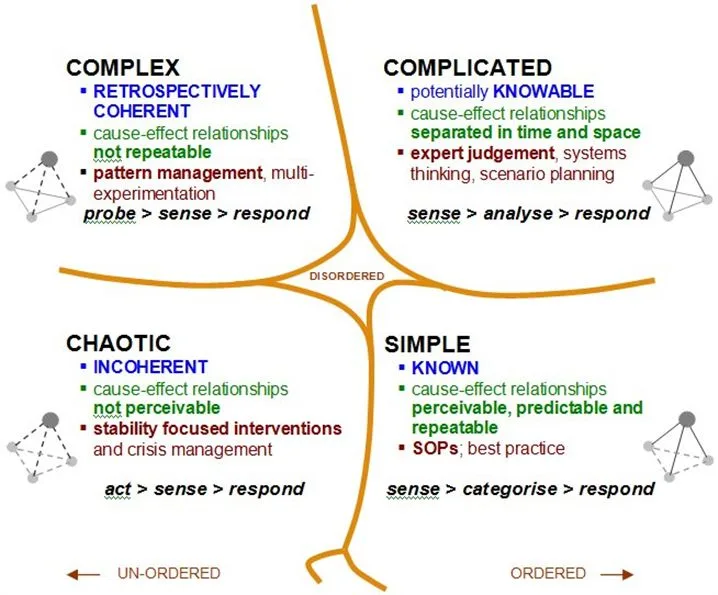
    Many tools and frameworks are now available to help leaders make sense of a multiplicity of options, and to respond well given the prevailing context. The Cynefin Framework is worthy of consideration. (Hat-tip to a Netherlands-based colleague who reminded me of it recently.)
    Picture
    Regardless of which approach or framework you use, high-level sense-making and systems thinking expertise is vital. Heterodox ​perspectives are to be encouraged too. Without these, leaders run the risk of becoming introspective, leaning in on natural biases or, worse, preferred ideologies. Also, great care must be exercised to ensure intended visions are made plain, strategies are coherent and decisions are evidence-based. If such care is not taken, those concerned by what they deem to be inappropriate experimentation or investigation might bite back. ​Curiosity killed the cat, after all.
    The COVID19-induced crisis presents leaders (politicians, boards of directors, community leaders) with a golden opportunity to take stock and, having thought carefully, make decisions in the best interests of the constituency, company, community they serve. Effective decision-making in chaotic situations is far from straightforward, but our future prosperity depends on it.
  • Published on

    How does your board rate on the 'trust' scale?

    Picture
    Trust is one of those social building blocks that is crucial for getting things done with others. Board work by no means exempt. When directors a faced with making strategically-important decisions, they must rely on information from and interaction with their board colleagues, the chief executive and any other advisors who may have been invited to contribute. Then, after consideration and having made a decision, the board needs to follow through, by ensuring the decision is implemented well. But, and sadly, the  levels of trust both between directors and with external stakeholder groups is often lower than what is needed for effective decision-making. The following comments, originally published in 2016 by EpsenFuller (subsequently acquired by ZRG Partners), make the point deftly:
    Board directors today face a variety of challenges. Whether it is a case of corruption or the increasing threat of cybercriminals, their performance in dealing with these issues is the subject of considerable attention, explained The Huffington Post (Jan. 25, Loeb). Investors, consumers and NGOs alike are looking to boards for accountability in terms of company performance. Yet, a recent study found that public trust in boards of directors is lower than that of CEOs. A mere 44 per cent of survey participants claimed to have trust in a company's board—five per cent less than trust in CEOs. Influential constituencies are demanding that boards perform at exceptional levels while maintaining distinct independence from company executives.
    That some directors do themselves no favours (through poor behaviour, malfeasance, hubris and  failing to complete actions, for example) is self-evident. But all is not lost. High levels of performance are possible—if all of the directors commit to working together (both as a board and with management) and reach agreement on the company's core purpose; the strategy to be pursued to achieve the agreed purpose; how performance will be measured; and the values that will underpin behaviour standards, decisions, and everything the company does and stands for.
    Perhaps if more boards embraced this mindset (working together), with the company's best interests to the fore, the trust problem that generates so much tension (not to mention column inches) would gradually become a thing of the past. Is this expectation worth striving for, or do you think it is too ambitious?