• Published on

    Are you onboard or overboard?

    This muse is the second in an occasional series being written over the holiday period entitled Tough questions about boards. The first muse considered the question of board size. This one looks at board commitment, by asking the question:
    • How many directorships is it 'reasonable' for a competent director to hold at any one time?
    The number of concurrent board appointments is a touchy topic for some directors, especially those who think in terms of turning and contributing 'on-the-fly'. How any director can expect to make meaningful a contribution without reading reports and thinking critically about the matters at hand well in advance of the actual board meeting is beyond me. I've written about this before. Then, I suggested that four concurrent directorships (of mid-cap publicly-listed or privately-held companies) was a reasonable upper limit for any director that hoped to make a meaningful contribution to board discussions, decision-making and, ultimately, company performance.
    The feedback at the time suggested the commentary struck a nerve, and that change was coming. Now, two years on, I'm not so sure. A conversation with a colleague earlier this week leads me to believe not much has changed. The colleague recounted a conversation he had with a director who off-handedly said that ten boards was her working maximum. "Beyond that, things get a bit hectic", she apparently said. Imagine that: ten boards! She must have a big brain to hold the details of ten companies, and know something about time management that most of us don't. However, that director is not alone, if the stories in this article are any indication
    Why do boards and shareholders continue to ask busy people, including so-called celebrity directors, to join their boards when there are literally hundreds of highly competent director candidates (with sufficient space in their diary to learn the business well and make a meaningful contribution) available to choose from? Have they/we lost sight of why boards exist and of their role in value creation? On the evidence above, perhaps we have.

  • Published on

    Strategy without purpose is, actually, just a collection of activities

    Image description
    Do you know why your company exists, it's raison d'etre? Can you provide a clear and succinct response to the question, or does the question leave you somewhat flummoxed? When I ask the question of others (it's usually the first thing I ask when leading a strategy development workshop), the most common response is a description of what the company does. But this does not answer the question! 
    Most people (especially your staff, customers and suppliers) don't care what your company does, they want to know why. You need to be able to tell the story. This article, published by Harvard Business Review sums it up nicely. Here are some questions for your board to consider:
    • Does your company have a single, clearly-stated purpose?
    • Is the purpose consistent with the wishes of shareholders?
    • Is your company's strategy demonstrably linked to achieving the agreed purpose?
    • Has the purpose been communicated throughout the company?
    • Do people (the board, management, staff) buy in to it?
     Directors need to get their collective heads around these questions. It's a matter of leadership, and of accountability. Let me know if you need any assistance with this, I'd be delighted to help.
  • Published on

    Effective boardroom practices: Dispatches from Singapore

    ​Nearly fifty chairmen, directors and company secretaries from around South-east Asia, the Middle East and Northern Africa gathered at the Ritz–Carlton Millenia Hotel in Singapore this week for The Boardroom Agenda conference. Delegates received presentations, shared stories and debated issues over two days (23–24 November), under the Chatham House rule. I had the honour of contributing to the discussion on the second day. Here are some of the takeouts:
    • Neal Cross, Managing Director and Chief Innovation Officer at DBS Bank provided a stirring keynote presentation to kick off the day. Disarmingly frank in delivery, his topic Fostering innovation in the boardroom was both challenging and well-received. Cross asserted that banks simply must innovate, and radically so, lest their market collapses around them as fintechs and large technology companies (read: Google, Amazon, Apple, others) eat the bank's lunch. He then outlined the DBS approach to innovation, which includes a three-day 'hackathon', whereby teams of staff are set up to create new product ideas. The resultant ideas are pitched to the board, and funding is provided to commercialise the best ones—entrepreneurship in action.
    • Raoul Chiesa, Board Member on the Italian Association of Critical Infrastructures delivered a wake-up call to delegates. Speaking straight off a flight from Europe, Chiesa, an expert of information security matters, summarised the history of hacking and the crucial need for boards to take information security seriously—all with some powerful (and quite alarming) case studies and real-world examples. Delegates were amazed at the scale of the problem and the material risk to commerce that 'the bad guys' present. The cyberthreat is widespread and poorly understood, especially in boardrooms. The message was clear: boards need to get up to speed, by receiving presentations and updates from experts; asking probing questions; taking a strategic view of risk; and, empowering the CEO to act.
    • The pre-lunch session took the form of a panel discussion and dialogue with delegates. I joined Ralph Ward at the front of the room. A wide range of topics were explored including the merit of codes of conduct; diversity in the boardroom;  the conundrum of balancing conformance and performance; confidentiality; conflict management; the conduct of effective board evaluations; and, the difference between so-called independent directors and independence of thinking. Delegates seemed to appreciate the candid responses from panelists, including recognition that no one-answer-fits-all; best practice often isn't; and that the work of the board can be messy.
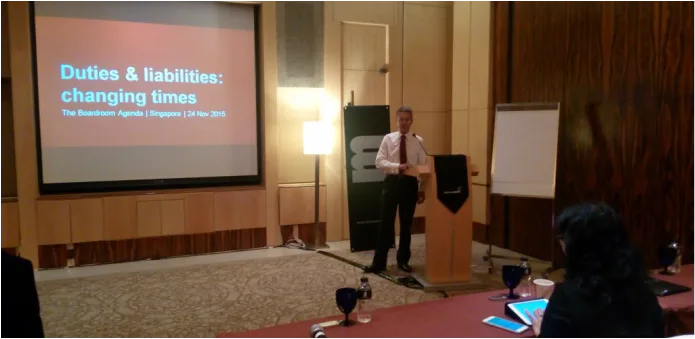
    • After lunch, delegates attended one of two streams. I chaired the Board Insiders one. Dr Lim Lan Yuan, a Singapore-based business and law scholar and company director spoke first. He managed to squeeze forty years of experience into a thirty-minute talk. It was a sight to behold. Delegates were enthralled with his summary of how boards should work; how they actually work (or don't); the importance of a clear division of responsibility between board work and management activity; the importance of the board undertanding the business of the business, strategy and market trends; boardroom dynamics; and, anecdotes of associates that messed up (badly) and went to jail. That Dr Lim was able to move seamlessly between theoretical concepts, practical recommendations and real-life stories as he spoke helped the delegates gain considerable value from the talk. The only person who struggled with his commentary was me: Dr Lim covered off several of the points that I was going to discuss in the following slot. Consequently, a few on-the-fly adjustments were needed to extend the discussion to related areas of interest (see pic below). That the delegates heard similar stories and recommendations from two different speakers with different cultural and business backgrounds was hopefully encouraging—and supportive of the notion that 'good practice' is good practice almost anywhere.
    • The final session of the day was a 'deep dive', whereby delegates gathered around one of two tables to consider a table-question and to share experiences. One table was asked to identify factors that contribute to both good and bad dynamics in a boardroom, and the other was asked to discuss how a board should function in the event of a major crisis. The groups had 30 minutes or so to wrestle with the assigned question and then report back. The insights shared were great, and the good-natured banter demonstrated that the delegates had built a good rapport with each other. Thank you to Dr Lim and Curtis Chin who moderated the table discussions. You made my job of session chair very straightforward.
    • The conference was organised by marcusevans. Their people did a great job, both in the weeks leading up to the conference and at the venue itself. If you get the chance to work with them, take it.
    Picture
    ​I've come away from the conference with the impression that the quality of corporate governance and board practice in Asian and Middle Eastern economies is rapidly improving. Overall, the hunger to improve board effectiveness was plain to see, as was the desire to learn from those with experience gained elsewhere (if the many conversations, requests to return and business cards in my satchel are any indication). However, care must be taken to ensure that models and frameworks in use in the Anglosphere are not blindly implemented in this region. Such colonialism is unwarranted and patronising, and it may be culturally demeaning as well.
  • Published on

    ECMLG'15: On cyber defence and leadership

    ​The second day of the 11th European Conference on Management, Leadership and Governance opened with an outstanding keynote delivered by Lt. Col. Paulo Nunes of the Portugese Military Academy. Nunes is the Programme Leader of a NATO-sponsored multinational cyber defence education and training (MN CD E+T) project (click for more details).
    The digital and physical worlds are, increasingly, being integrated—to the extent that some would suggest the existence of a blurred reality. 'Cyber' is a red-hot topic in both the business and military worlds, to the extent that it has become the frontline of various attempts to achieve both legal and illegal political, military and economic objectives. Nunes reported that the biggest weakness in the system is people, the human firewall.
    The MN CD E+T project has been commissioned to design and implement an integrated approach to increasing awareness and providing training at the nation, NATO, EU and business levels to prepare, detect and respond the various weaknesses and threats. This includes work to determine expected behaviours and desired operational outcomes, and then to develop and deliver appropriate learning systems. Seventeen nations are currently involved in the programme, with more enrolments expected in the coming months.
    If implemented well, the programme offers considerable benefits to businesses of all sizes and types. Boards and directors would be well advised to receive briefings and allocate time to think critically through the issues and implications.
  • Published on

    ECMLG'15: Human-oriented performance management

    The translation of strategy and goals into actionable targets and outcomes is a challenge for many organisations. Rob ter Hedde and Benny de Wall (Utrecht, Netherlands) have been investigating this challenge. While many think in terms of 'hard priorities' of operational efficiency and organisational design, ter Hedde and de Waal focused on human factors. They presented a model consisting of four dimensions—strategy translation; dialogue and action orientation; continuous improvement and organisational learning; and, information and visualisation—and suggested that the link between strategy and effective implementation was contingent on this four dimensional model being set in motion.
    Their results showed that anchoring the organisation's objectives and strategy in the minds, hearts and hands of the people (staff and other stakeholders) is crucial for performance improvements. While not explicitly stated, this research reinforces the importance of clearly annunciating core purpose—the 'why'. People are more likely to get behind causes that things. The civil rights leader, Martin Luther King, provided a very famous demonstration of this with his Dream speech. Just imagine the [non]impact if MLK had uttered "I have a plan...".
  • Published on

    New VW CEO wants a new strategy. Why?

    An interesting development hit the press today: Matthias Mueller, the incoming chief executive of Volkswagen AG, reportedly wants to embrace a new strategy for the beleaguered group. That an incoming chief executive wants to put his mark on the business is not particularly newsworthy, it is commonplace.
    The interesting piece is the board's response. Will it entertain a new strategy, or will it assert its authority as the top-most decision-making authority? The challenge for the VW board is to decide whether the existing strategy is satisfactory and well-implemented (notwithstanding the scandal relating to the US market emission standards), or whether the company's strategy is flawed.
    Given the strong financial performance over recent years, the more likely of the two options is that the strategy is OK. If this is correct, the board's decision becomes a straightforward assessment of power. Who is in control, the board or the chief executive?