• Published on

    Keynote speaker: Governance evolution and future trends

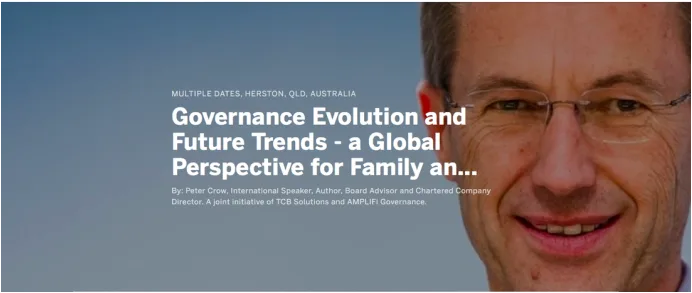
    Earlier this year, Lloyd Russell of TCB Solutions and Deb Coren of AMPLIFI Governance contacted me to discuss an event they were planning in their home town of Brisbane, Australia. They wanted me to deliver some talks and share some insights on the evolution of governance—with a specific focus on family-owned businesses. After learning more about their plans I was thrilled to accept the invitation. With that, planning got underway.
    Two events have now been scheduled on Thu 19 May, one in the morning and the other in the evening. 
    ​If you are a family or private business owner; or an independent director, advisor or partner, then this event may be of interest. Click on the image for more information and to register (a new browser page will open).

  • Published on

    What does the Age of 'self(ie)' mean for business?

    One Saturday morning, about fifteen years ago, my elderly father-in-law and I sat in the morning sun, sharing a few stories over a cup of tea. He was asking about my then burgeoning advisory business and family life. I was interested in hearing him reflect on his experiences in business, particularly his career-long journey with the same employer—from a junior staff member to, eventually, chief executive.
    As he spoke, Bill reminded me that he only ever had one employer, and that although he had been blessed to contribute at many levels he had only ever completed one job interview, that being when he first got a job. He went on to talk about the power of team over individual, and of loyalty to both your employer and your own principles. Much has changed since he retired in 1984, not the least of which has been the erosion of the values that served as Bill's North Star throughout his career.
    Today, most things are negotiable. For many, the motivation has changed, from providing service (to the employer) to self-service. Never has this been more apparent in the everyday behaviours of staff, particularly the younger generation. If we don't get want we want, or if we get a better offer elsewhere, we act. That staff and customers are more interested in self(ie) has huge implications for productivity and value creation in the longer-term. While team productivity is a matter for the chief executive, value creation is the responsibility of the board on behalf of the shareholder. How is your board wrestling with this? Does your board regularly allocate time to understand the changing environment, consider strategic options and make strategic decisions? Companies that expect to thrive in the future need to address the emergent challenge of 'self(ie)'. 
    The best place to start the discussion is in the boardroom.
  • Published on

    Making smart decisions in the boardroom, on less-than-complete information

    One of the enduring challenges that directors face every time they meet together as a board concerns decision-making. How do directors make smart decisions when 1). they often lack crucial information, and 2). the environment is fundamentally both complex and dynamic? The answer lies in the group of directors' (the board's) ability to make decisions, as one.
    Why so? Legally, the board is a collective of directors. Individual directors make contributions to discussions and debates, but not decisions. It is the board that makes decisions. This transition—from the singular (individual directors, contributions, inputs) to the collective (the board as one whole, decisions, outputs)—occurs when directors meet (i.e., in board meetings, when the board is in session). If the transition is to occur well, all of the directors must be actively engaged their work—working together towards the decision, as one. 
    Group decisions are much harder to make than individual decisions. Reaching agreement can be a minefield, especially if information is missing, trust is low or if directors are more interested (sometimes covertly) in pursuing multiple agendas or representing constituencies rather than acting the best interests of the company (as the law requires).
    How can boards get past this challenge, to make effective decisions on a reasonably consistent basis?
    Recently, CGMA (Chartered Global Management Accountant, a joint-venture between AICPA and CIMA) tackled this question head on. Their report has just been released. You can read a copy of the executive summary here, or the full report here.  ​The authors make eight key recommendations for effective group decision-making:
    • Build greater trust
    • Value the non-financial data
    • Extract relevant data
    • Promote collaboration
    • Incentivise the medium- and long-term, too
    • Engage external stakeholders
    • Review the outcomes
    • Be patient
    I commend this report to you, especially if effective decision-making has been a challenge for your board over the past year or so. Share it with your board colleagues and ask the chairman to schedule a discussion at an upcoming board meeting. If nothing else, you'll bring the expectation of effective decision-making out into the open. Or, the board may find that some behaviours or expectations need to be adjusted, and that a formal board review is appropriate. The discussion may also expose some larger but hitherto hidden issues including that the board may not be clear on the purpose or the strategy of the organisation. If this is discovered, some external advice and assistance may be in order. 
    Regardless of the discussion and the outcome,  I suspect it will time well spent.
  • Published on

    Who's actually in control at Yahoo?

    Picture
    The much storied Yahoo Inc. continues to consume column inches (or, pixels if you consume your news online). From bold beginnings, Yahoo has endured a mixed career as an Internet search engine business. Current chief Marissa Mayer has had her fair share of headlines as well, including some stinging criticisms over some of her management decisions. Now, with a proxy fight looming, Yahoo has issued this release, which has been reported by Ronald Brausch on Dealpolitik (and no doubt others)
    The release and associated commentaries make interesting reading, especially for students of corporate governance, strategic management and firm performance: For example, the release implies that ownership of the new strategic plan lies with the CEO. Consider these two statements:
    • Maynard Webb (Yahoo chairman) is quoted as saying, "The Board is committed to the turnaround efforts of the management team and supportive of the plan announced today."
    • ​Brausch writes "I think the board continues to support Ms. Mayer’s plan to turnaround Yahoo...".
    ​These statements raise a really interesting question. They imply that control lies with management. Does ultimate responsibility for firm performance not lie with the board of directors? Why has the board chosen to stand a little aloof from this? Are these statements simply examples of sloppy copywriting within Yahoo and on Brausch's part, or does control over the company strategy actually lie with the CEO?
    While I have no doubt that some investors are keen to gain partial or complete control of the company (as Brausch reports), the commentary suggests that a more pressing challenge needs to be addressed if Yahoo is to become great again. The question of whether the board or the CEO is calling the shots and, therefore, is actually in control needs to be resolved, and quickly.
  • Published on

    Can strategy and execution be usefully distinguished?

    Image description
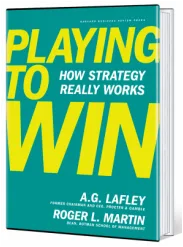
    Roger L Martin, a respected professor at Rotman School of Management and co-author of Playing to Win, has put the cat amongst the pigeons, with this commentary, itself a response to this widely circulated article. The authors of the original article reported findings from a study, which showed that only eight per cent of leaders are good at both strategy and execution. Martin contends that most leaders who are very effective at either strategy formulation are also very effective at execution. Quite a different view. Two different perspectives. Who is correct?
    As with any report involving statistics, context is crucial. If you consider all leaders (as Leinwand, Mainardi and Kleiner did), only eight per cent are "very effective" at both formulating strategy and executing strategy. However, if you only consider only those that are "very effective at strategy", fully two-thirds are also good at execution (Martin's point). Thus, both authors are 'correct'. But which commentary is more helpful to leaders and those intent on achieving business success?
    The shocking statistic is that just sixteen per cent of leaders are "very effective" at strategy formulation or execution or both. Turbulent times demand outstanding leadership, both to determine strategy and to ensure it is executed with excellence. Poor, neutral and even "effective" contributions have little chance of moving companies toward their goals if they are competing against "very effective" leaders. Consequently, 84 per cent of leaders will be found wanting (notice the Pareto Principle?). Rather than debate statistics, it may be more useful to move the discussion to discovering how to move more leaders into the "very effective" sector.
    Another perhaps more important question—for boards of directors in particular—centres on Martin's assertion that strategy and execution are the same thing. Can the two tasks can be distinguished? 
    Strategy formulation and execution are two of the four pillars of strategic management (development, approval, implementation and monitoring). My research suggests that business success is dependent on two things: having a clear sense of purpose and an effective strategy, and great execution. The former is an important task that boards and managers should work on together and the latter is the domain of management (only) once strategic decisions are made by the board. However, some flexibility is required because things change. Decisions and adjustments are required from time to time. If companies are to react and respond quickly, strong leadership is crucial to avoid mayhem. So where does that leave Martin's assertion, that formulation and execution cannot be usefully distinguished? What is your experience?
  • Published on

    Ten #strategy musings that generated much discussion in 2015

    Alongside corporate governance and board practice, the topic that occupied most of my time in 2015—as an advisor, facilitator, researcher and writer—was strategy. The numerous enquiries and  discussions suggest that boards are starting to acknowledge that an involvement in strategic management in some form is appropriate. And not before time: boards are responsible for company performance, after all. 
    Of the hundreds of articles published on Musings this year, strategy and strategic management received almost as much attention as corporate governance. These ten articles in particular stimulated plenty of discussion—and some folk sharing some strongly-held views as well!
    If you want to discuss any of these postings (or ask a question about a related topic, or request some assistance), please get in touch. I'll do my best to respond within 24 hours.