• Published on

    Understand your business better: SWOT 2.0

    Image description
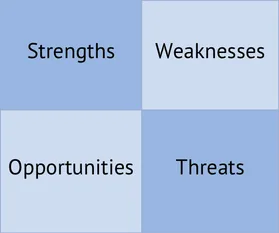
    Do you use the SWOT tool in your organisation as a precursor to the strategy development process? SWOT (Strengths, Weaknesses, Opportunities and Threats) is a useful tool, but it has fallen out of favour in recent years, as organisations have struggled to deal with the 'laundry lists' generated during SWOT sessions. Also, other tools have become popular. 

    Many people have told me that SWOT is old (it is) and irrelevant (let's discuss this), and that newer tools do a better job. I agree, to a point. The trouble with most SWOT analyses is that they only go half-way. Identifying those internal and external things that are helpful or harmful to your organisation's success is useful if and only if something is done about them. The lists generated from SWOT sessions can be long, and complementary items often appear on each side of the ledger. Creating and resourcing effective action plans from such lists is simply too hard in most cases.

    One modification that I have used for a couple of years now is to add a 'so what?' question to the analysis after the lists are assembled. For each strength, weakness, opportunity and threat, think about the impact or consequence of that item on the organisation—by asking 'So what?'. If the impact or consequence is high or significant, create an action to maximise (strength or opportunity) or minimise/mitigate (weakness or threat) it. If the impact or consequence is low or insignificant, simply put it to one side for now. This simple addition (let's call it SWOT 2.0) helps teams prioritise those things things that actually matter. It has transformed the usefulness of the tool (and the quality of the strategy) in every case that I am aware of.

    One last word though: don't be lulled into thinking that SWOT, SWOT 2.0, PESTEL or any other tool is a panacea. They are just tools. They need to be used correctly, for the purpose for which they were designed. Often, it is wise to use a couple of tools, to ensure you get a well-rounded picture to base your strategy development work on. 
  • Published on

    Purpose before strategy

    One of the big temptations in the strategy development process is to jump into 'answer' mode too early. Jumping quickly to conclusions is a real and understandable temptation. We live in a high-paced world and we want answers. We want plans to achieve our goals—the sooner the better. 

    Many companies start the strategic planning process by jumping to the determination of goal (what do we want to achieve?) before leaping head-long into the question of how the goal will be achieved (what is our strategy? or what is our plan?). Sometimes, this process is informed by an environmental scan. Generally, the strategies that emerge from such processes are ill-conceived and readily defeated. I've lost count of the number so-called strategic plans that follow this pattern.

    The crucial element that is often missing from the strategy development process is purpose: an answer to the 'why' question. Spending time with shareholders (or, their representatives at least), with customers and possibly with a wider group of stakeholders, to work out why the organisation exists is time well spent. A drug company needs to know it exists to defeat cancer (for example) long before any strategies to develop medications or build grand marketing plans are considered. People get onboard with causes not things. Imagine how different things might have been if Martin Luther King had uttered "I have a plan" in 1963.

    'Why' needs to come before 'what', in business and in research. Owners, boards and trustees of not-for-profit agencies need to own the 'why' question and doggedly pursue a response. To ignore this maxim is to simply do stuff without due reason or cause—and that's hardly conducive to the building of a sustainable business or to conducting effective research. 
  • Published on

    Xero: a considered approach to boardroom succession

    Xero is a young company with a clear mission: to become a global leader in on-line (read: cloud-based) accounting systems. While the company has some pretty serious competition, its stellar rise on the stock-market and ebullient CEO has seen it enter the consciousness of the general public in New Zealand, Australia and, increasingly, other countries as well.

    Part of the company's success appears to be due to its mature and considered approach to governance, and succession in the boardroom in particular. Phil Norman was appointed to the chair prior to the company being listed. Phil is a startup specialist, he got the company underway. Subsequently, Phil was replaced by Sam Knowles who established Kiwibank and grew it to become a viable player in the New Zealand market. Sam, who chaired the Xero board through the company's initial expansion beyond New Zealand, oversaw the repositioning of the company, from a great little company from Wellington New Zealand (where?) to a growing global company. Recently, Sam left the board to be replaced by Chris Liddell. Chris has had a long and successful leadership career in large companies including General Motors, Microsoft and International Paper. He lives in New York and is well connected with the movers and shakers there. Two independent directors have just been appointed—San Francisco-based Bill Veghte and Australian-based Lee Hatton. Hatton is Xero's first female director. Both will bring a fresh perspective no doubt. 

    With the benefit of hindsight, it is easy to see that these appointments have been considered and intentional. Xero has sought specific individuals with specific capabilities to provide leadership in the boardroom. As new capabilities and connections have been required, changes have been made. Xero is trying to become a world-class company. If it succeeds (and even if it falls short), I suspect a future generation of MBA researchers will identify governance quality and succession in the boardroom will have been important building blocks. Regardless of how it plays out, startups and more mature companies would be well advised to take a look at Xero. The company's approach to leadership, governance and succession is refreshing.

    Disclosure: While I am known to some current and former members of the Xero board, I do not own shares and do not have any commercial relationship with the company.
  • Published on

    On ego, knowledge and effective governance

    Do people that promote themselves heavily—by describing themselves in glowing terms; providing long introductions; and, embellishing their accomplishments—annoy you? People that behave like this are relatively easy to spot. They are often quite loud, and their large egos generally signal their presence.

    Interestingly, a recently published article has suggested an inverse relationship between ego and knowledge—which suggests that those with large egos have little to contribute. This is somewhat alarming, as many corporate disasters over the last forty years can be traced back to failures of governance, fuelled by hubris and overactive egos. Just how knowledgeable were the directors in these cases? The message in the article is relevant for everyone in the business community, particularly those directors that see themselves as being above the law and beyond any form of accountability. How long will it take, and how many more lives will be lost, before someone takes a stand?
  • Published on

    Achieve more by doing less

    Every entrepreneur and active business owner that I know dreams of building a business capable of achieving sustained profitable growth over time. However, maintaining continuous profitable growth is hard, and there seems to be a wide gulf between the dream and the reality. Just ten per cent of companies manage to do it over a continuous ten year period. I haven't found any research that explains why companies experience such difficulty achieving sustained growth, although one research report I read recently suggested those companies that do achieve it appear to have three characteristics in common:
    • They reduce the scope of their business
    • They look for profitable opportunities within their existing core business boundaries
    • They set high performance targets

    Interestingly, these three characteristics are increasingly being associated with effective governance: the determination of strategy and the setting of performance targets. While not mentioned in the report, the boards presumably implemented a structured monitoring regime as well. 

    These characteristics challenge conventional wisdom that you have to do more (diversify the product mix and/or enter new markets) to get more. They also enhance the credibility of the proposition that the board’s active involvement in strategy development and performance monitoring is crucial to a company achieving and sustaining profitable growth over time.
  • Published on

    ICMLG'14: closing remarks

    Well, ICMLG is over for another year. The ACP organisation, and hosts Babson College (Phil Dover and Sam Hariharan, in particular), organised a great conference. Delegates assembled from over 20 countries from the five major continents. The theme of entrepreneurship provided a linking thread between the keynote speakers (Isenberg and Schlesinger), the paper streams and many conversations over coffee and food.

    I particularly enjoyed the provocative sessions of Isenberg and Schlesinger, and appreciated the opportunity to test some of the ideas that are emerging from my research, especially with researchers from outside the Anglosphere. That feedback will result in some adjustments to the way that my thesis is written up. To everyone who offered feedback: thank you!

    I commend this conference to all management, leadership and governance researchers, and practitioners with an interest in these and related fields. Next year, the conference venue is in the southern hemisphere, in Auckland New Zealand. The co-hosts will be AUT and Massey University. Certainly, I am looking forward returning the hospitality afforded to me in the international conferences that I've been fortunate enough to attend in the last couple of years.